
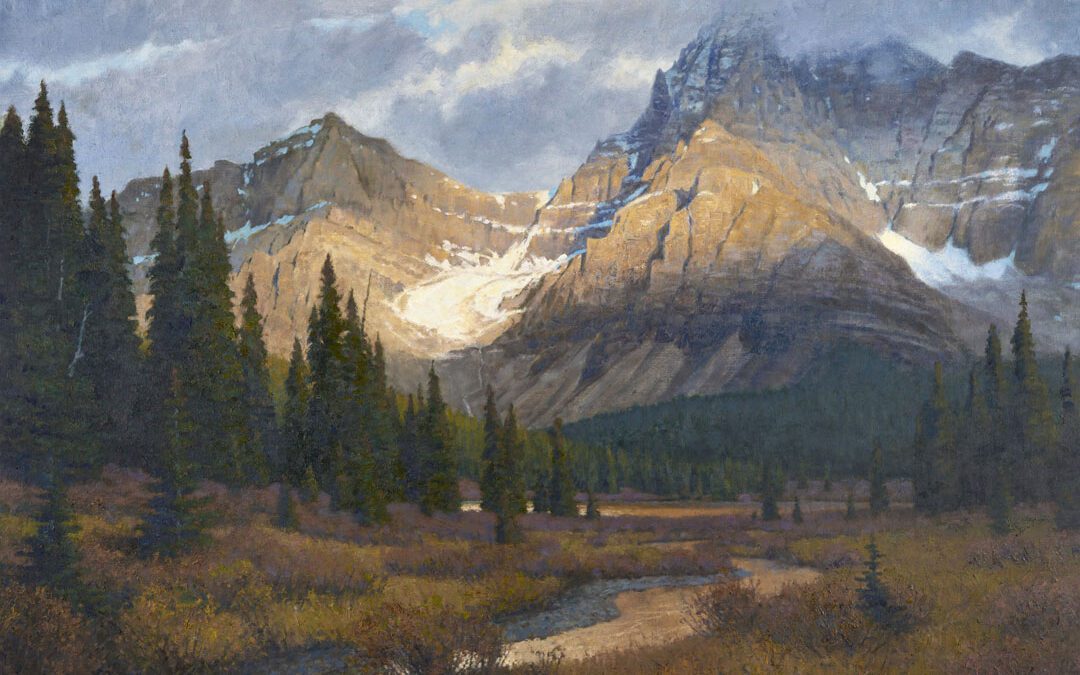
On a summer afternoon long ago in Bozeman, Montana, a grouping of paintings stopped me in my tracks. These were not major works by painter Ralph Oberg, but depictions of high elevation lakes in Glacier National Park of Montana. Their water, set in bowls carved out by juggernauts of ice, sparkled like soothing aquamarine emeralds, turquoise and jewels forged of lapis lazuli, cradled in the muscly arms of surrounding granite peaks.
Next to them in the window of an art gallery were larger dramatic studio paintings featuring wild sheep and goats defying gravity on craggy cliff faces. Those gripping works sparked the same kind of inner excitement one feels when scouting for those animals in late August, glassing the sidewalls of peaks and wondering how one might venture closer.
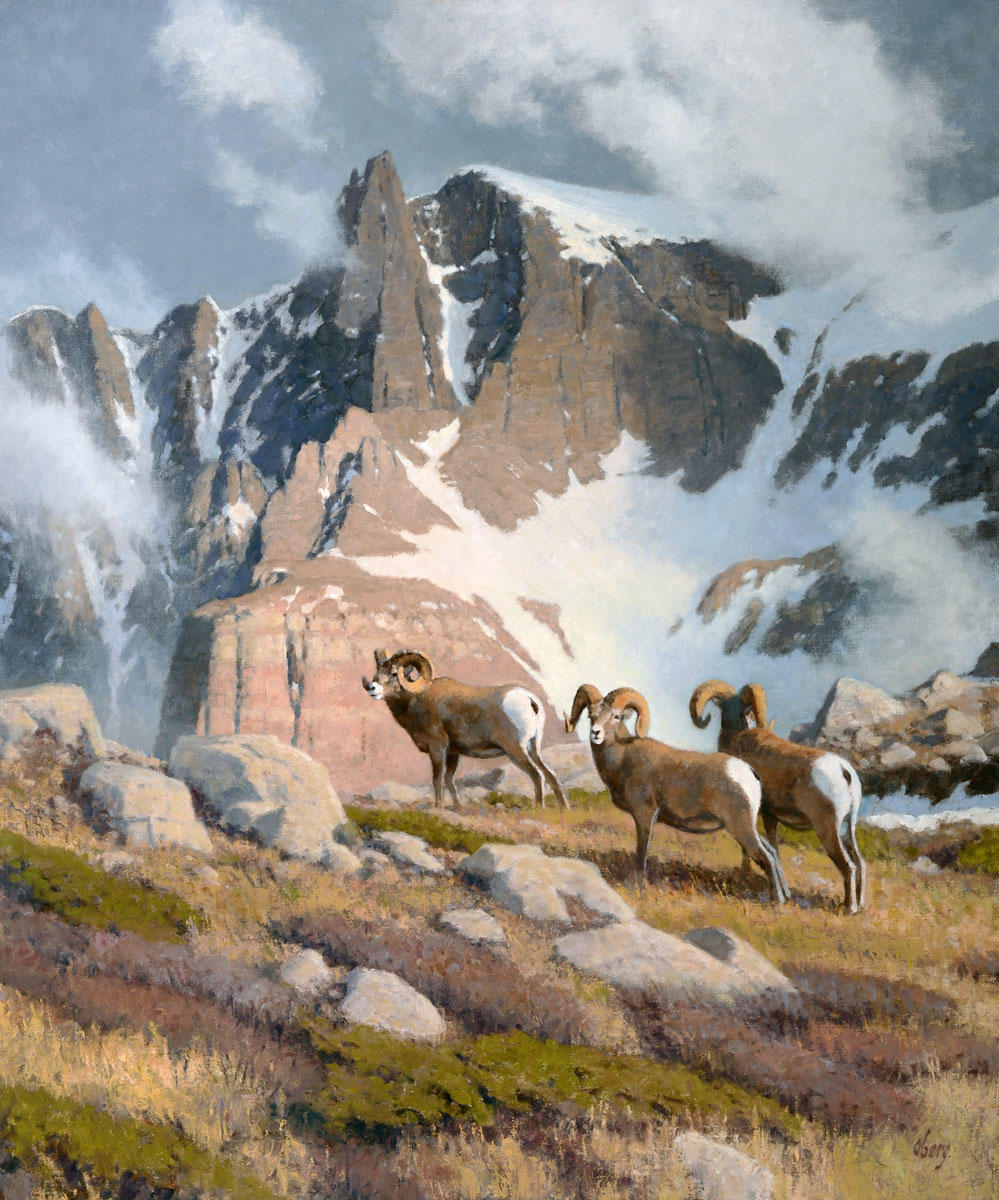
Colorado, 2021, oil on linen, 48 x 40 inches.
Landing a coveted sheep, goat or moose tag only happens with the luck of the draw, though for many, having an Oberg on the wall is considered just as fortunate and rare. Consider the impact of his tour de force, Colorado, a tribute to bighorn sheep that sold in 2022 at the prestigious Prix de West Invitational. It is the premiere annual Western art show in the country and held at the National Cowboy and Western Heritage Center and Museum in Oklahoma City.
Few have a better grasp of Oberg’s niche than art historian Susan Simpson Gallagher, who runs the Simpson Gallagher Gallery in Cody, Wyoming. Earlier in her career, she was the first curator at the National Museum of Wildlife Art in Jackson Hole and which boasts the largest collection of Carl Rungius paintings on display in the U.S. “At his best Ralph follows in the tradition of Rungius and all of the great animaliers in painting and sculpture in an unparalleled sort of way. There’s sensitivity and bond with nature in Ralph’s work that shines through. I have had a couple of paintings of bison and elk that are, for me, some of the finest wildlife paintings I’ve ever seen. You sense the enthusiasm and excitement he has in the beauty of his work.”
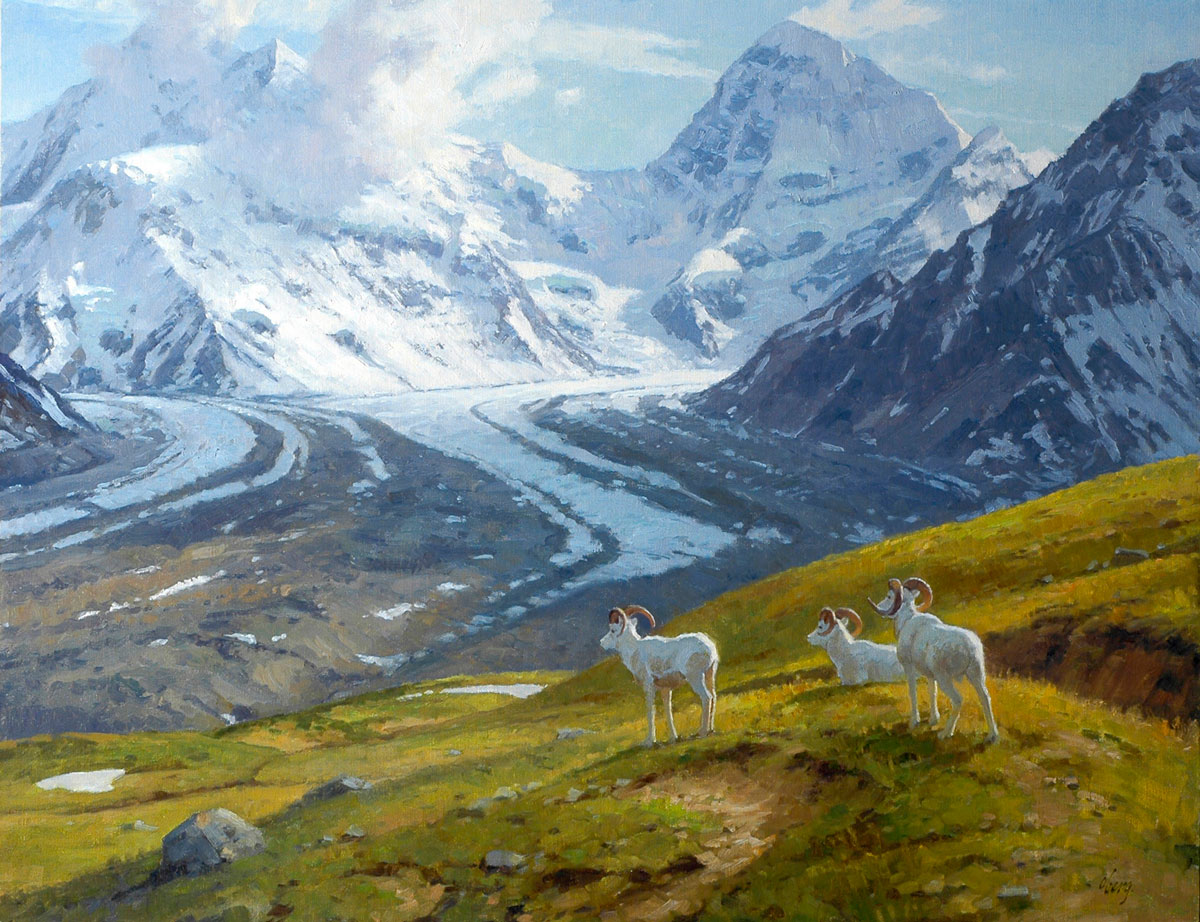
The Wild Heart of Alaska, 2011, oil on linen, 28 x 36 inches.
For 60 years, Oberg has hiked or climbed into remote corners of his native Colorado Rockies, ranges in Alaska and Canada, the Swiss Alps and even the Himalayas. For many of those years, has been hauling sketchpads, drawing instruments, cameras with lots of lenses and, when possible, a portable easel, canvases and paints, in his backpack. These are the tools he uses to capture the essence of some peaks that have no names.
The late collector John Geraghty, a driving force behind the eminent Masters of the American West exhibition held every year at the Autry Museum of Western Art in Los Angeles, told me that calling Oberg a “wildlife artist” was grossly misleading. “His animals inhabit spectacular landscape paintings,” Geraghty told me. “Ralph lends greater impact to the animal by making an equally inspiring commentary about where it lives.”
Geraghty, who said Oberg’s paintings transport him into places he knew he would never visit, went on. “It’s not just his application of color, but his control of value changes that tells you how masterful he is,” he noted, adding that for every finished Oberg easel painting or finished study there are several plein air studies and sketches informing its execution.
Just as Oberg’s body of work inhabits its own realm in wildlife and sporting art, so, too, has he forged a path forward away from the beaten path of other artists. Today, at age 73, he is in the prime of his career.
A testament to the standing he has among peers and collectors, Oberg in autumn 2023 is part of a special group exhibition being held at the Woolaroc Museum’s Retrospective Exhibit and Sale in Oklahoma. Along with him, the impressive roster of award-winning contemporaries includes William Alther, Thomas Blackshear II, Tom Browning, Scott Burdick, Glenn Dean, Jane DeDecker, Dan Ostermiller, Roseta Santiago, Mian Situ and Daniel Sprick.
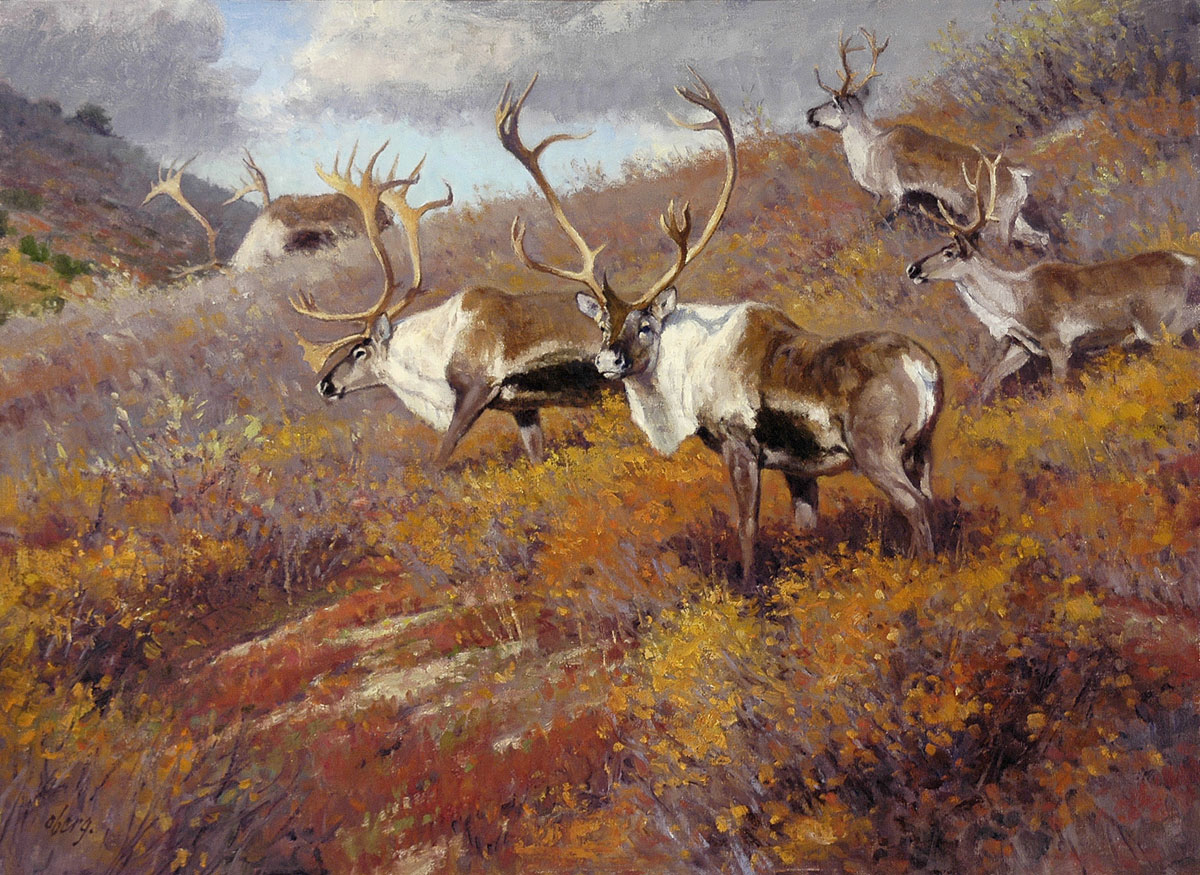
Alaskan Tapestry, 2007, oil on linen, 22 x 30 inches.
For those who can manage an excursion to Osage County, to visit the ranch turned museum and game preserve established by legendary oil wildcatter Frank Phillips, it would be a pilgrimage well worth the effort. At the Woolaroc, Oberg plans to unveil new works that will be joined by some of the “greatest hits” of his career, on loan for the show. Alaska Tapestry from 2007 and the 2011 work The Wild Heart of Alaska demonstrate Oberg’s love for not only lofty altitudes but high latitudes. In some ways they are homages to his gratitude to the 49th state for whetting an almost rabid hunger to exploring wild country.
It’s no secret that today’s art market is in transition, and it has been enormously challenging for painters and sculptors who, in the pre-internet age, could count on galleries to put their works before the public. But the advent of social media, economic conditions that have forced many galleries to shutter their physical spaces and auctions changing the collecting landscape, reputation counts more now than ever. Oberg has landed in a sweet spot—his visions speaking to older collectors who favor more traditional wildlife art and younger hunters who prefer a more modern stylistic flair.
“I like to quote my painter friend Wayne Wolfe,” Oberg relates. “Wayne said, ‘Although I primarily paint to please myself, I somehow would like to not acquire an unusually large collection of my work.’” Oberg needn’t worry about that. These days, he has a steady list of clients enlisting him to complete commission work based on their favorite species and he has broadened his range of Western motifs.
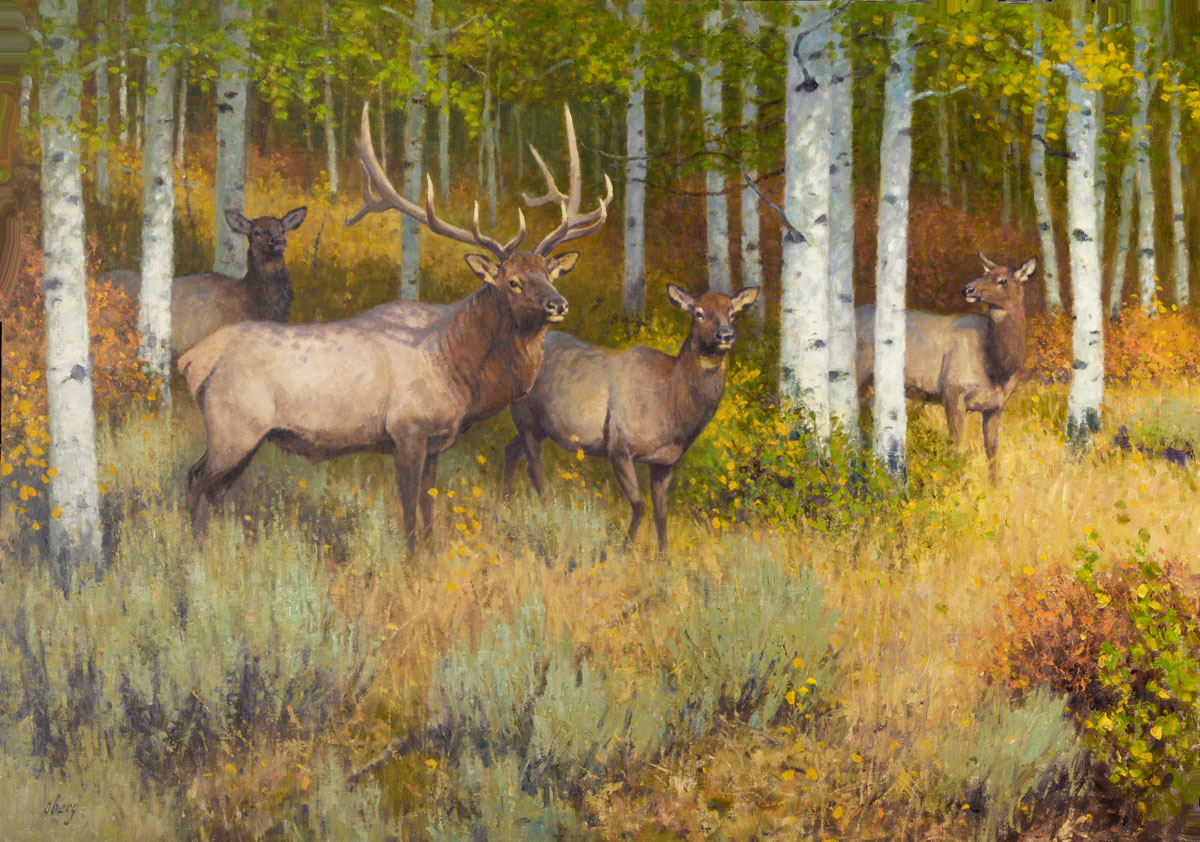
Out Into the Open, oil on canvas, 36 x 48 inches.
At the 2023 Prix de West Invitational, he debuted a piece titled Packin’ In portraying a train of horses headed toward a remote hunting camp. A year earlier in 2020, he received the prestigious Wilson Hurley Memorial Award for a moving painting of mountains, A Remnant of Wildness at the Prix de West, a noteworthy achievement because it’s an annual convergence of many of the top living landscape painters in the country. And a year before that, at the Briscoe Art Museum in San Antonio, Oberg’s piece Prairie Sunset won the Purchase Award and is now part of the museum’s permanent collection.
Maryvonne Leshe, the longtime presence behind Trailside Galleries in Jackson Hole, Montana, and Scottsdale, Arizona, once told me, echoing what Geraghty said, that the market is “abrim” with artists who are “either great at landscape or wildlife,” but seldom is there a convergence of supreme skill at both. She understands why Oberg, though stylistically different, has earned a generational comparison to Carl Rungius (1869-1959) whose painting explorations of the Wind River Mountains in Wyoming and later the Canadian Rockies have fueled a similar wanderlust in Oberg.
“How do you articulate the gift that some artists like Ralph are born with? Few are able to reach the next level and break through, even when they vigorously apply themselves,” Leshe says. “It’s the thing that isn’t explainable.”
Oberg’s close painter friends Matt Smith, known foremost for his desert scenes, and John Potter, a wildlife artist featured in this magazine in 2022, point out that his talent is about far more than basic instinct. “Ralph has paid his dues. He has constantly pushed himself out of his comfort zone, learned and solicited critiques from some of the greats who came before him and then he has applied their wisdom,” Potter says.
Often, Oberg paints on location with his wife, the noted botanical artist Shirley Novak, whom he lavishes praise upon as being his best sounding board and gentle dispatcher of insight when he’s struggling with a painting.
Oberg readily admits that a key turning point occurred decades ago when he and Smith were among a rising new guard of Western painters who adopted plein air painting (painting from life outside under natural light and conditions) which radically re-oriented the way they saw things. “To be comfortable and honest about what you are putting before the people who encounter your work, you have to understand your setting,” Leshe told me.
Smith and Oberg often rendezvoused at painting workshops to study side by side with renowned landscape painters Wolfe, Bob Kuhn, Clyde Aspevig, Skip Whitcomb, James Reynolds, Len Chmiel and the late Hollis Williford. In recent years, Oberg has tried to pay forward their generosity by helping young emerging artists.
“My relationship with Len grew into a friendship that included many years of quail hunting every January in Arizona with our vintage English style side-by-side shotguns and his dogs,” Oberg says. “I started bird hunting in my mid-teens by working on a Nebraska farm all summer and returning for Thanksgiving and Christmas vacations to hunt pheasants.”
Born in the Gulf Coast town of Biloxi, Mississippi in 1950, Oberg is actually the son of outdoorsy New England parents. Because of his father’s career in the military, the Oberg clan found its way to Colorado when he was four years old. At a family cabin retreat in the mountains, he was encouraged to amble, and he found his way up several of Colorado’s 14ers.
“My motive from the time I was very young, first as a teenager before I took up painting, was exploring pure wilderness, those rare places untouched by our imprint,” he says. When his career began, he never put human figures in his paintings—no roads, no signposts, just the mountains and animals. That has changed but collectors tell him all the time his mountain scenes give them a vicarious escape. “I’ve come to realize most people haven’t had the opportunity of experiencing the solitude of wilderness as I have. It’s something I like to try to communicate—to remind viewers there’s a different world out there that in your imagination you can join me in knowing.”
Taking a break from college at Colorado State University after only two years, Oberg, an admitted free spirit, set out in his Volkswagen with a backpack filled with art supplies and field guides on a search for his own Holy Grail. Painting and sketching his way from one trailhead to the next, his art then reflected a literal reaction to wildlife. He became proficient in what he readily terms “the Wild Wings School” often associated with the print market and subjects like waterfowl, upland game birds and some big game animals. “I did dry-brush watercolors and painted all the hairs and feathers. I learned much about anatomy by this close observation,” he says, admitting that the graphic nature of limited edition prints, and often hyper-photo-realism portrayals of wildlife, was not representative of his own aesthetic.
Oberg isn’t afraid to take risks. Back in 1973, he quit the only “normal” job he ever had at a design studio in Denver and headed north to Alaska at the invitation of his brother, Russ. A crew of seven aspired, in a month-long expedition, to chart a new climbing route up Mt. Deborah 100 miles east of Denali National Park. Ralph was there in a supporting role. They encountered Dall sheep, caribou and grizzlies. Oberg’s return to an asphalt road required a 50-mile hike. “We were kids in our 20s, basically, and didn’t have enough money to enlist a bush pilot to fly us out, so we walked out,” he says. “It was then and remains in my memory one of the most dramatic experiences in my life.”
Somehow, he gained the naïve impression that he could make wilderness exploration a platform for earning a living as a painter. Half a century later, it’s obvious his hunch was spot on.
During the last few decades, Oberg often has found himself bound for the old haunts of Rungius in Wyoming and Canada. He says it is continuously daunting to venture before summits daring to faithfully portray the moods they evoke in a painting; but the exercise, in total humility he added, assumes even more intimidation when it involves going to the same vistas where Rungius—and where others, such as the late and supremely talented Bob Kuhn—stood, too.
“I see so many wildlife artists out there, especially the younger ones, who try to take short cuts or they are doing it mostly for the money. They might have talent but they don’t seem to have a lot of heart,” Potter explains. “Ralph has an unwavering love for real wildness. It flows through him.”
Potter, however, can’t resist taking a poke at his friend. “I’ve been in the Wind Rivers on the trail of Rungius and it’s true that Ralph is tough, but camping with him is more like glamping. He makes the absolutely best chocolate maple syrup coffee in the world.”
Oberg could probably write a hiking guide to the mountains of North America. The Alps, he says, are different from the mountains in western regions of this continent. At the 2014 California Art Club, Oberg’s painting Ice Fall was awarded The Gold Medal. Ice Fall was based on a day hike up from the Swiss town of Grindelwald to the toe of the Fiescherhorn Glacier where Oberg did a 12×10 plein air study that he immediately knew would expand to huge dimension in the studio. “It is a statement about the rapid melting of glaciers worldwide, which I have clearly seen in over 50 years of travel in glacier country,” Oberg says, noting that changes in the high country have huge potential implications for species that feed on specific native plants fed by snowpack.
Given his druthers, Oberg says he prefers home ground. “The Alps are visually spectacular but aren’t really wild unless you’re a climber up on the cliffs,” he says. “It’s a tame environment by comparison to what we have, and access is easy to get up to many peaks. But what’s really missing is a diversity of species that still exist because of the conservation ethic we cherish. Animals give spirit and life essence to a wild landscape. As readers of this magazine know in their hearts, a wild landscape needs no explanation. It stands on its own.”
Oberg’s is the kind of world all of us in the fall dream of reaching, where we experience the most elusive, rugged wildlife on their terms. “Ralph knows the mountains and understands why the animals he paints are an extension of them,” notes his friend Matt Smith. His work speaks to an adventurer’s restless spirit, particularly hunters who have ventured into the back of the beyond.