
It was an embarrassing moment to say the least. I, an experienced wildlife biologist, lifelong hunter, had pointed toward three animals on a broad New Mexico plain north of Roswell and proclaimed them to be pronghorn antelope.
“I don’t think so,” said my wife. “I think they’re woolly sheep!”
“Hmph!” I replied, irked at being questioned. She simply smiled.
Then, as we got closer, I realized I had been wrong, they indeed were sheep, domestic sheep. It was bad enough that I had misidentified sheep as pronghorns, but what made things even worse was my wife was right. Snickering and then guffawing from our two daughters in the back seat did not help my badly bruised ego.
“Daddy, I think you need to go have your eyes checked,” said my older daughter.
“Yeah Daddy, or get a book that will help you identify animals,” added the younger. With the younger, several years later I would get a little revenge when her first born, our grandson’s first words were, “Pronghorn Antelope” as opposed to “Mama!”
Many years earlier as a mere youngster myself, I had seen photos of and read articles about pronghorn antelope. From those stories and photos of our continent’s truly unique antelope species, I knew I would someday hunt one.
My first opportunity came early in my career as a wildlife biologist when our Wildlife Disease Project (a joint venture between the Texas Parks and Wildlife Department and Texas A&M University’s Department of Veterinary Pathology) got involved in research to determine what was killing pronghorns on the Rock B Ranch in Permian Basin area west of San Angelo. It was there I collected my first pronghorn, albeit a young doe that was debilitated by disease. A day later, I shot an ancient buck at extremely long range after missing him several times. Both were taken with a Winchester Model 88 lever-action .243 Win. This had happened long before I misidentified domestic sheep as pronghorns.
I did learn a lesson, painful as it was, to use my eyes to their fullest advantage when looking for pronghorn antelope.
I have long had a “love affair” with pronghorns! One of my pet peeves regarding the species is when they’re referred to as “speed goats”! They are not goats! They belong to a family unto themselves: Antilocapridae with a scientific name or Antilocapra americana. Today’s pronghorn is the only living member of its family. All others of their broad family went extinct thousands of years ago. Interestingly their closest relatives according to science are Africa’s giraffes and okapis.
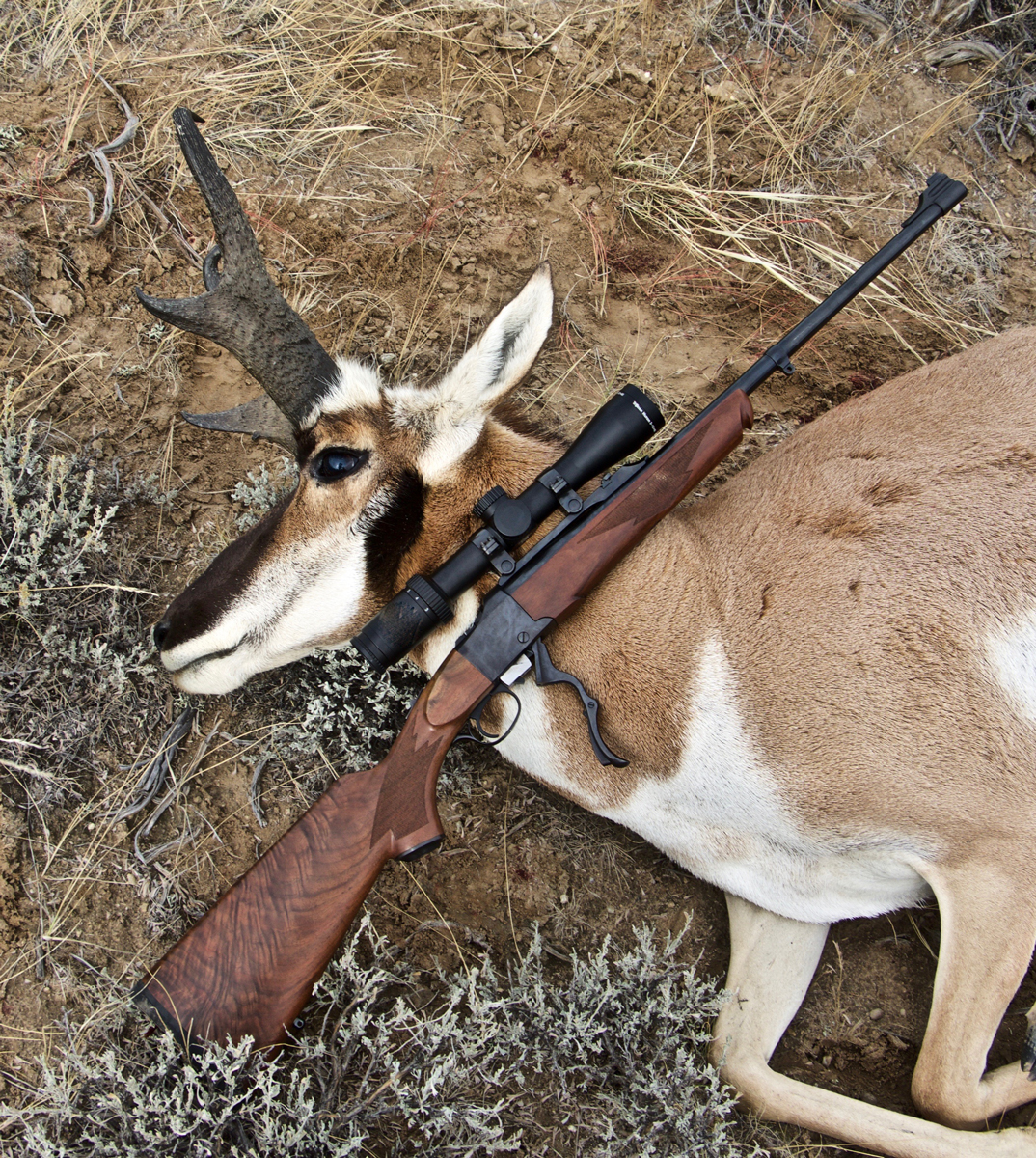
Pronghorns are unique not only because they have branched true horns, but the outer sheath is cast each year as a new one begins to grow. No other antelope species does that. They also do not have “dew claws,” only two distinct hoofs on each of their feet.
Known as the fastest animal in North America, they can run speeds great distances and in excess of 55 miles-per-hour. To assist them, Mother Nature has equipped pronghorns with a “screen” in their breathing system that strains out pieces of debris, grass and weeds. This enables them to breathe freely while running with their mouths open.
The pronghorn is a uniquely American animal that once was on the brink of extinction, but was brought back to tremendous numbers thanks to sportsmens’ dollars and landowners’ interest, a truly great conservation story!
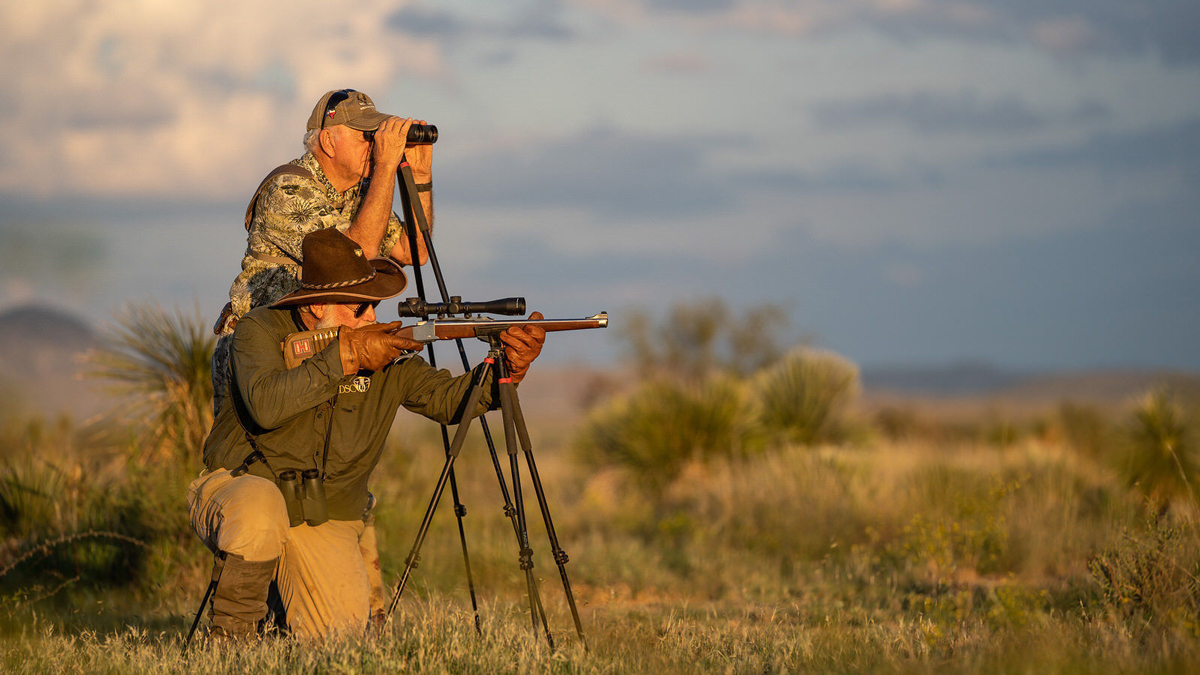
Larry prepares to take a shot with his Ruger No. 1 RSI while guide watches.
After taking my first pronghorn, I hunted them many times in Texas and New Mexico, but also in Colorado and Wyoming. I pursued them with conventional rifles, primarily bolt-action and single-shots; .45 and .50 muzzleloaders; and a variety of handguns, single-shots and revolvers.
All my pronghorn hunts have been spot-and-stalk; challenging and great fun!
As a true plains animal, the pronghorn depends upon its remarkable long-distance vision, which is comparable to an eight-power binocular. On numerous occasions. I have glassed them from great distances only to realize they were watching my every move.
In today’s world, where we have firearms, optics and ammo extremely accurate out to 1,000 or more yards, I suspect quite a few pronghorns are taken at extremely long ranges. If that’s how someone wants to pursue animals, that is his or her decision. To me that’s shooting rather than hunting.
I have taken pronghorns at 500 yards and beyond, but only after I ran out of cover that might get me closer. One of those 500-yard shots was on the famed TO Ranch in northern New Mexico. I was hosting a hunt that involved several writers and industry people. As such, I waited until everyone in camp had taken a pronghorn before I started hunting.
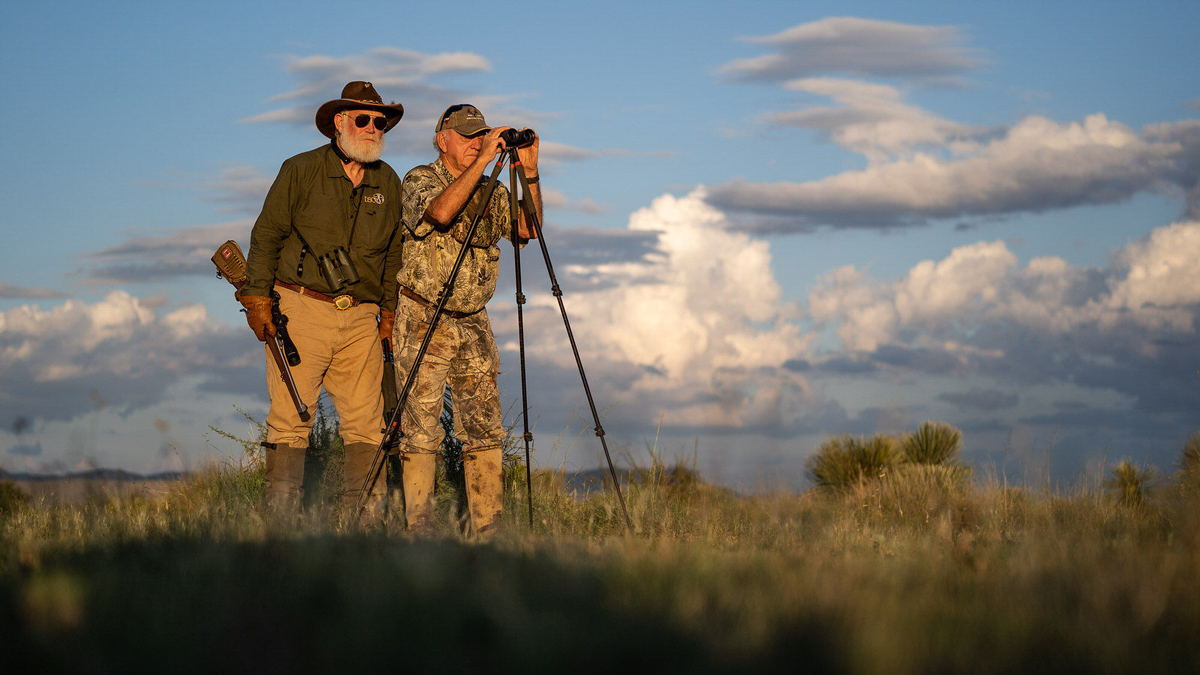
Larry and guide looking for pronghorn.
On the last afternoon, I shot at a nice buck with my single-shot .30-06 T/C Encore handgun, using Hornady’s 165-grain SST loads. Prior to shooting. I did not “range” him, but estimated he was 500 yards away.
With a large rock and my backpack as a rest, I fired my first bullet, which hit just under the belly of the broadside buck. My second went over his back. He did not know I was shooting at him. My third shot hit him perfectly behind his shoulder and he dropped in his tracks.
Two of the writers with me had ranged him at 504 yards. Back then, I knew that particular handgun and where to hold out to 500 yards, which I learned from shooting prairie dogs at 500 yards with that handgun. In doing so, I learned much about hold-over and “reading” the wind.
That long-shot pronghorn was an exception. I much prefer to stalk to as close as possible before taking a shot. Many hunts found me slithering like a snake in tall grass or crawling through shallow ditches or rills to get within 100 yards or less, even though I carried a firearm capable of making 500-yard shots.
One of my more recent pronghorn hunts was at Texas’ Trans Pecos with Greg Simons’ Wildlife Systems (www.wildlifesystems.com) near Marathon. I carried a Ruger No. 1 RSI chambered in .257 Roberts using Hornady’s 117-grain SST ammo. With it, I could easily keep my shots within a three-inch circle at 300 yards while shooting from a hunter’s rest. However, I intended to get as close as possible before pulling the trigger.
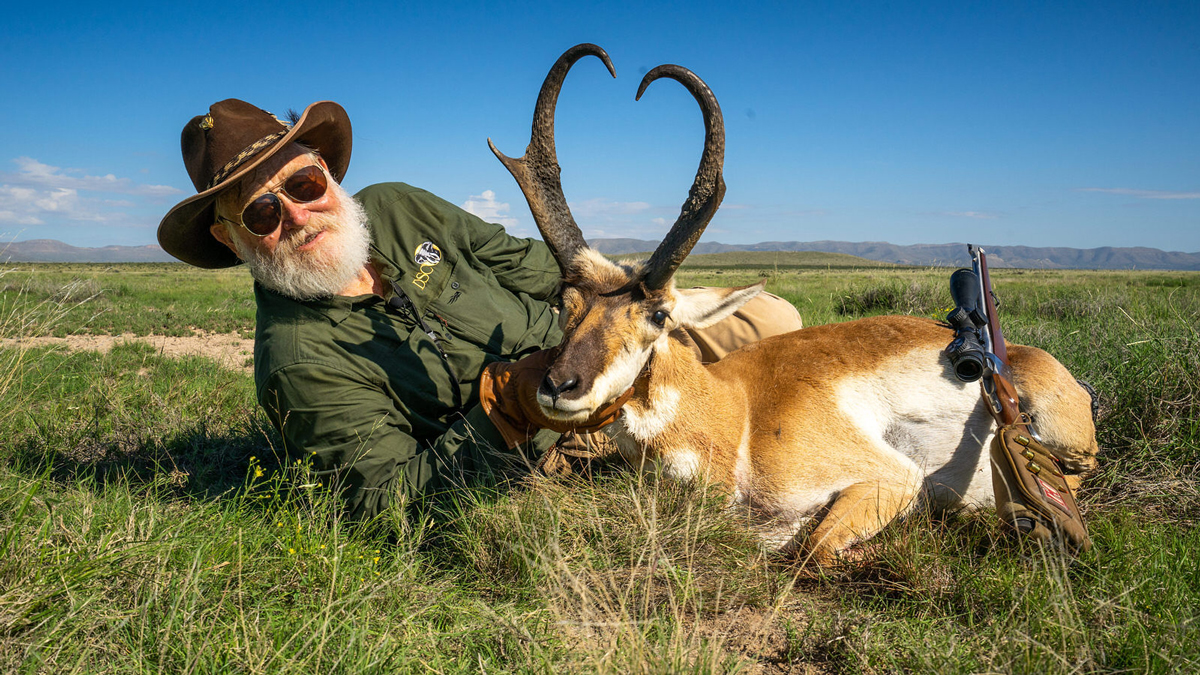
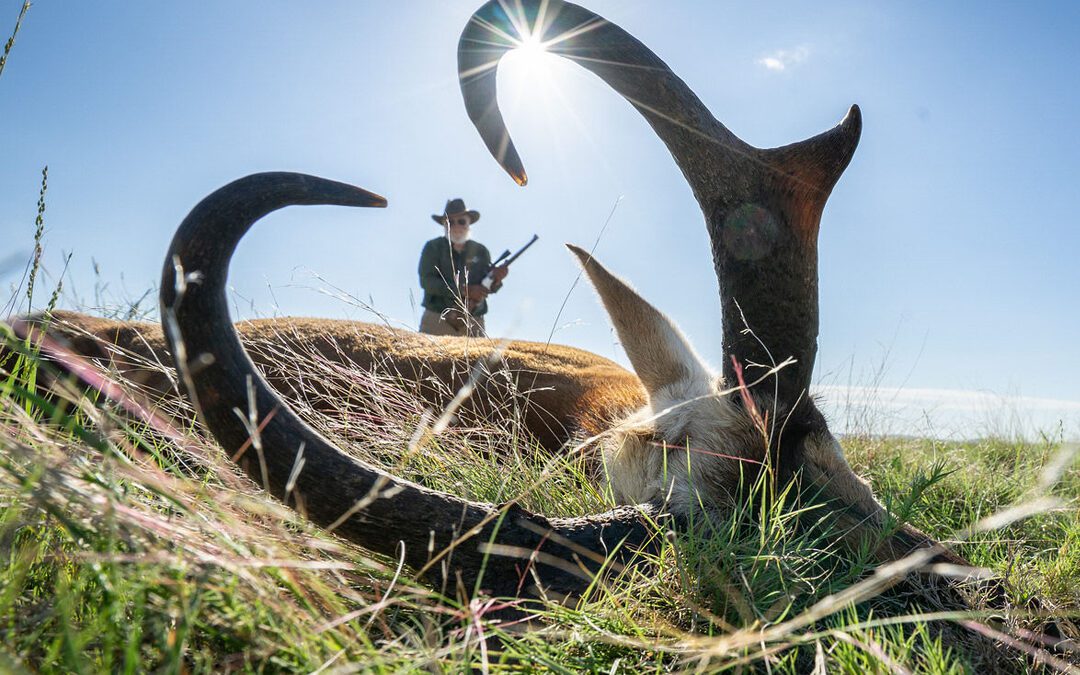
Larry poses his best ever pronghorn taken in Texas with Wildlife Systems.
Sitting on slight rise, we spotted a really good buck. Through my Stealth Vision spotting scope, I could see his horns were massive and deeply hooked, one of the biggest I had seen in years of hunting the animals. His lyre-shaped horns were approaching three times the length of his ears, which typically measure about six inches in length.
It took more patience than I normally possess and a lot of crawling like a snake before my guide and I finally got within 200 yards of the buck. He was interested in several does that were getting mighty nervous. I set up my shooting sticks, got a solid rest, then proceeded to badly jerk the trigger and miss. Thanks to many years of hunting with a Ruger single-shot, I reloaded quicker than most can cycle a bolt, got a solid rest and this time squeezed the trigger. At the shot, the buck took off, running a tight circle as I had seen heart-shot animals do, and then fell before I could shoot again.
A few moments later, we started walking toward my buck. The closer we got to him, the bigger his horns seemed to grow. At his side, I quickly realized he indeed was my best-ever pronghorn.
I had previously taken numerous pronghorns with horn lengths upward of 15 inches. This buck’s horns were later measured at 17 inches. I was thrilled beyond words. I consider that pronghorn one of the best animals I’ve ever taken. Not only did my buck have long horns, his venison proved to be absolutely delicious.
Thinking about my trophy pronghorn has got me yearning to once again go after North America’s most unique and strikingly handsome game animal. I fully understand why some refer to him as the “Prince of the Plains”! Indeed the “eyes” have it!