
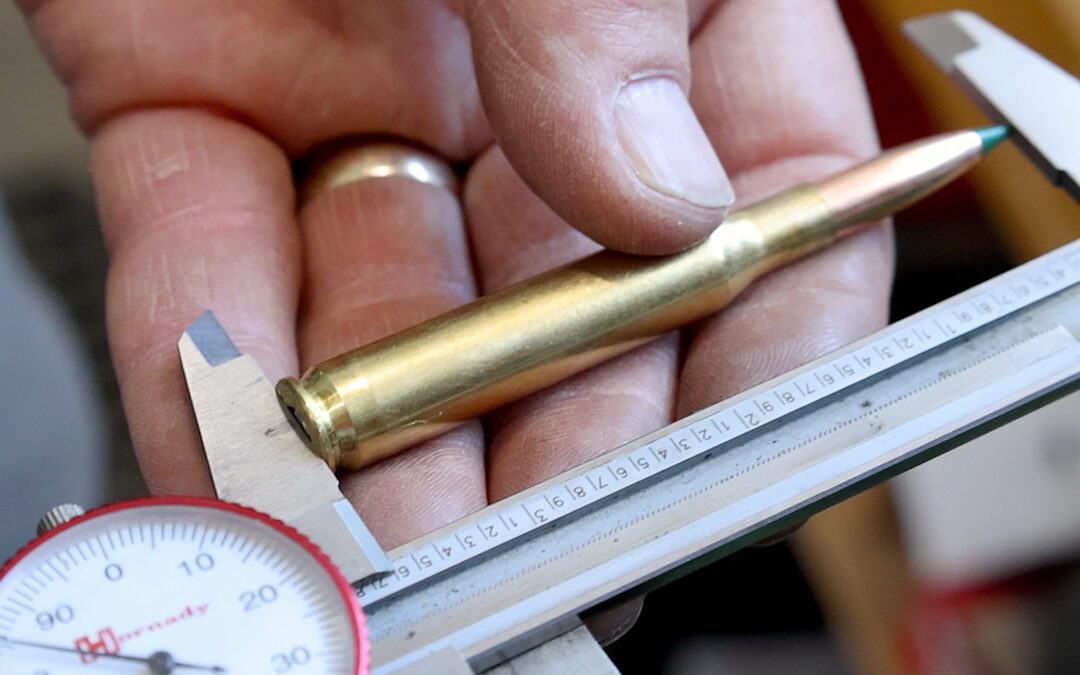
Few things get faster and stronger with age, but the 100-year-old 270 Winchester does.
When this little “coyote cartridge,” as Elmer Keith deridingly called it, officially stepped onto the stage, it was driving a 130-grain spire point 3,140 fps, according to its creator, Winchester. That was enough bullet mass and velocity to churn up 2,847 foot-pounds of kinetic energy. Perhaps too much. After grabbing everyone’s attention with the hyper velocity, Winchester quietly throttled back the horsepower to a perhaps safer 3,060 fps muzzle velocity and 2,700 ft.-lbs. energy.
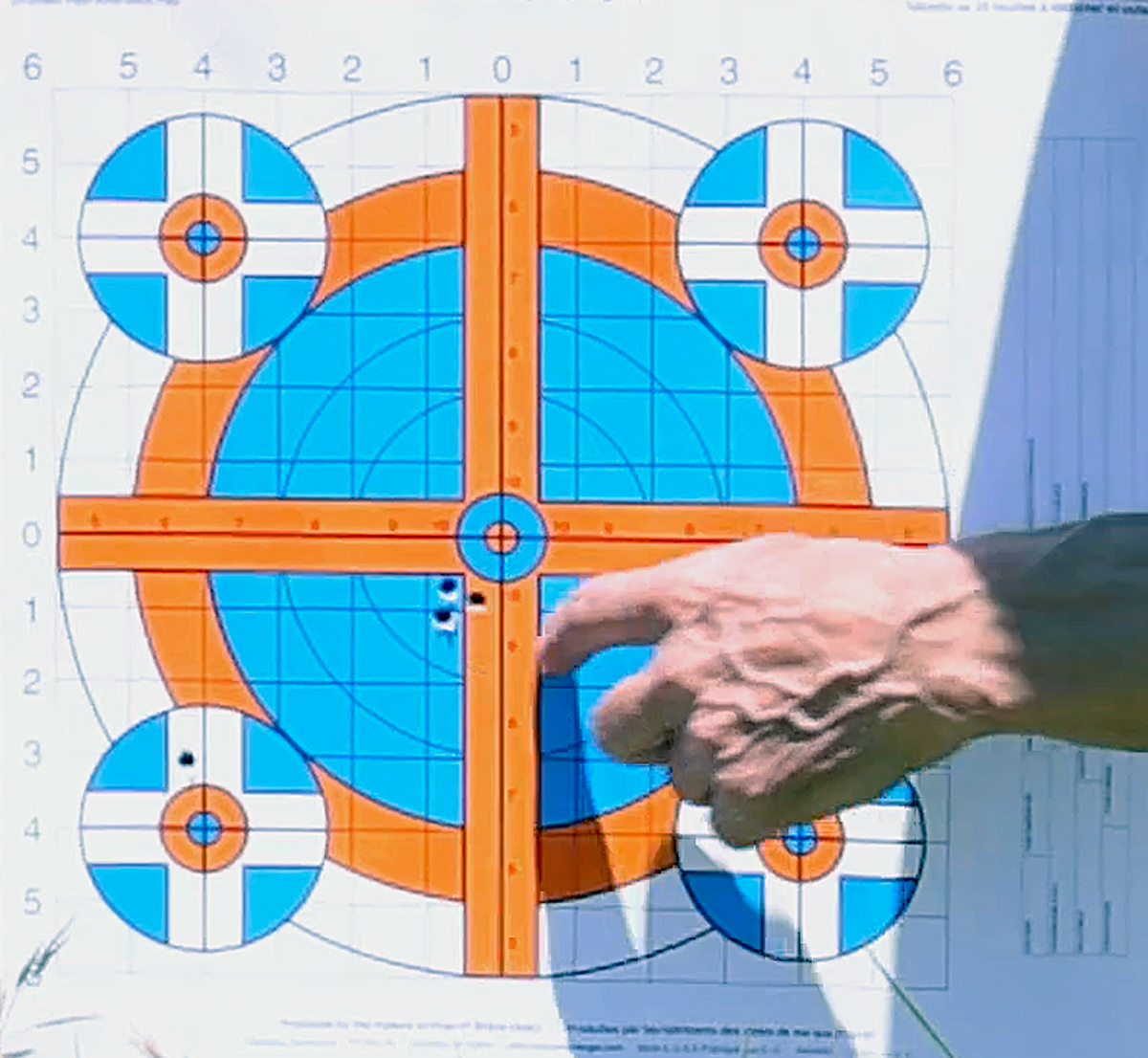
A 3-shot group from a fast-twist 270 Winchester handloaded with 155-grain Barnes LRX bullets.
Today that same necked down 30-06 case can drive a handloaded, 170-grain, .277-inch bullet 3,000 fps, fast enough for 3,398 foot-pounds of muzzle energy. Most 270 Winchester aficionados will throw a challenge flag at those numbers because they know that a 170-grain bullet will likely not stabilize in a 270 and, even if it could, the 270 case doesn’t hold enough powder to safely push 170 grains 3,000 fps.
Yet I’ve done it—and still have all my eyes and fingers.
Before I reveal the magic, let us indulge a quick trip down “270 Lane” for some perspective on this famous, fast, flat-shooting cartridge, consistently one of the top ten best-selling hunting rounds since the end of WWII.
In 1925, the fastest, flattest-shooting “deer” cartridge in the USA was probably the 30-06 driving a 150-grain spire point 2,700, perhaps 2,800 fps. (The British 300 H&H Magnum released that year was hitting 3,000 fps, but no American rifles were chambered for it.) The Savage 250/3000 was skipping along at 3,000 fps, but only with an 87-grain bullet, not a weight most deer hunters thought sufficient. Charles Newton had designed the 250/3000 from a shortened 30-06 case, but he preferred a 100-grain bullet at 2,800 fps. Savage wanted the marketing cachet of 3,000 fps.
With his 25-caliber creation safely in production, Newton pushed forward with his 256 Newton, another 30-06-inspired cartridge he’d designed in 1913. The ballistician/inventor shortened the 30-06 a bit, gave it more taper and a sharper shoulder, and necked it down to grip a .264-inch bullet. Western Cartridge Co. loaded it with a 129-grain spire point at 2,760 fps and sold 256 Newton ammunition from 1913 through 1938. Can we surmise whence Winchester got its inspiration for the 270?
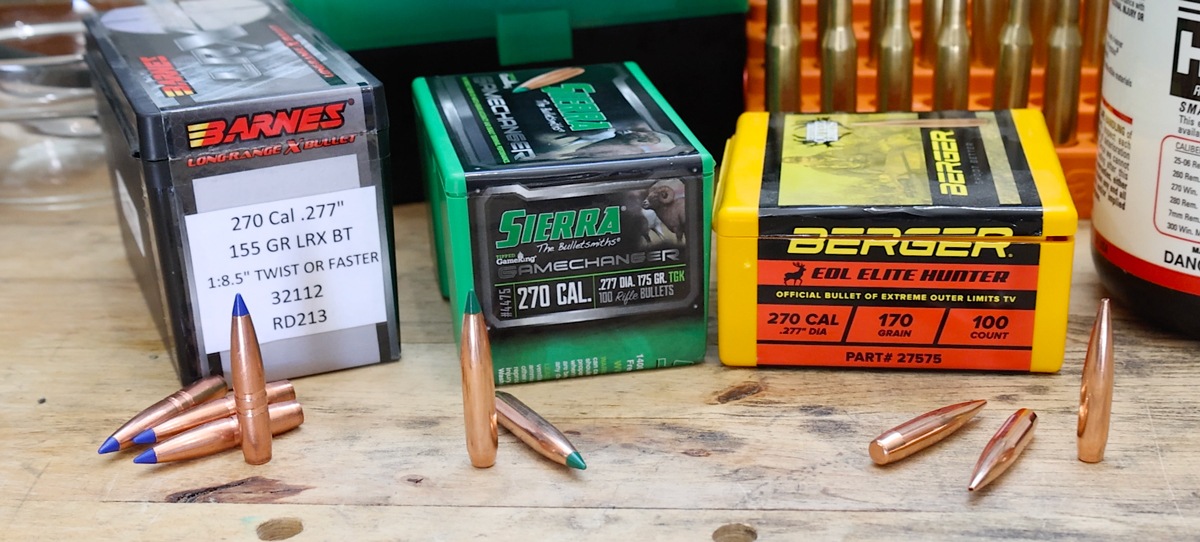
These were the long-for-caliber .277-inch bullets we tried. The Barnes 155-gr. LRX is lighter than the 170-gr. and 175-gr. bullets but equally long, which requires the 1:7.5-inch rifling twist to stabilize. Handloads grouped sub-MOA. We were able to safely drive 170-gr. Berger Elite Hunter bullets as fast as 3,000 fps before primers began to flatten, indicating being over maximum chamber pressure. We backed off to 2,950 fps.
Here comes the surprising part:
In 1919 Winchester began building and selling a high-end, T.C. Johnson-designed Model 51 “Imperial” bolt action rifle chambered in 30-06, 35 Newton and 27 Cal. Some two dozen were built with high-grade walnut stocks in Winchester’s Gunsmith Shop (custom shop) before the board of directors cancelled the program on the mistaken assumption bolt-action sporters were a “frivolous toy.” When the new Remington Model 30 bolt action hit dealer shelves in 1921 and grabbed significant market share, Winchester did an about face. In 1925 it unveiled a slightly improved Model 51 bolt action as the Model 54. One of the chamberings offered was, again, the 27 Cal.—already five or six years old but now newly christened 270 WCF (Winchester Center Fire.)
Despite its scintillating velocity, the “new” 27-caliber round didn’t rocket to fame and glory until an up-and-coming outdoor writer named Jack O’Connor hitched his wagon to it.
After Jack became the guns and hunting editor for Outdoor Life in 1942, his fame grew and so did the 270’s. O’Connor had been shooting it since 1925.
To interest more hunters in its speedy 270, Winchester added a 150-grain bullet in 1933. At an advertised muzzle velocity of 2,675 fps, it hit hard but didn’t sell well. It rather ruined the speed prestige of the brand. Winchester’s next offering five years later restored that prestige. Its 100-grain bullet at a sizzling 3,480 fps turned heads and would have established another speed record had Winchester not introduced its 220 Swift in 1935.
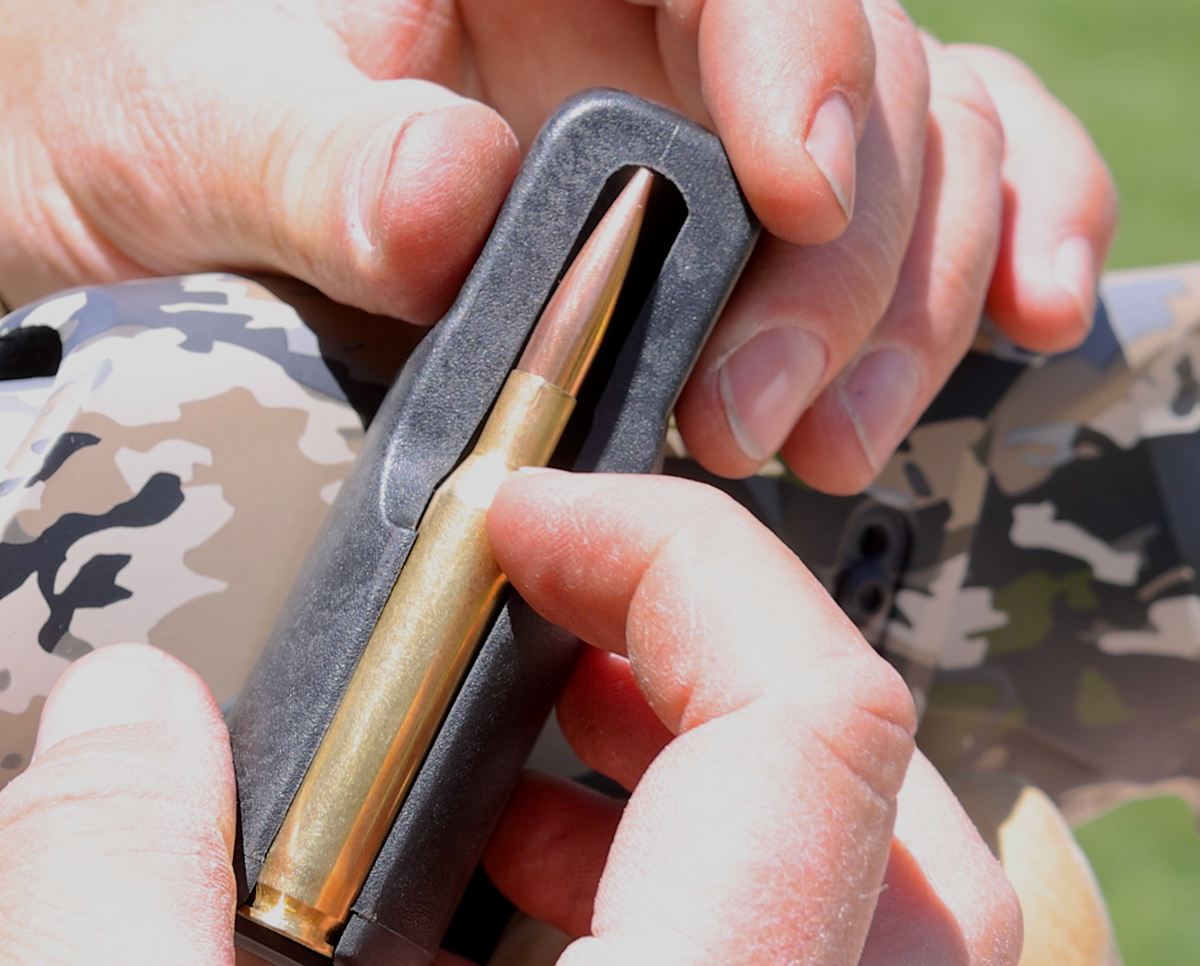
One of the ingredients that made it possible to load and shoot 170- and 175-grain .277-inch bullets accurately in a fast-twist 270 Winchester was a full magnum-length magazine that accommodated long bullets seated to an overall cartridge length of 3.585 inches, well beyond the 270 Winchester’s traditional 3.34 inches overall length.
Over the years, several after-market bullet makers provided 160-, 170- and even 180-grain .277 bullets for the 270 Winchester (and 270 Weatherby Magnum after 1944.) Some of those heavyweights stabilized in standard 1:10-inch twist barrels; some did not. Velocity, predictably, fell well below the scorching speed that made the 270’s reputation.
In the latter half of the 20th century, several 140-grain boattail spire points appeared. Those split the difference between the 130-grain deer bullet and 150-grain elk bullet. Handloaders discovered they could drive them 3,000 fps or slightly faster, nearly matching the trajectory curve of the 130s and energy of the 150s.
Today, a quarter through the 21st century, the old 270 has lost significant market share to a flurry of 6.5mm and 7mm and, yes, even one or two .277s delivering flatter trajectories, less wind deflection and more kinetic energy at all ranges. But that doesn’t mean the old timer must be put to pasture. New powders and, most significantly, new bullets can make the 270 Winchester faster and harder hitting than ever, which brings us to the suspicious claims of this author’s 3,000 fps with a 170-grain bullet? How?
First, I procured a new 270 Winchester-chambered Browning X-Bolt 2 rifle with 1:7.5-inch twist rifling in a 24-inch barrel. SAAMI specifications puts 270 Win. overall cartridge length at a nominal 3.34 inches, but this rifle’s magazine measured 3.6 inches internally, enough room to seat 170-grain Berger Elite Hunter, Sierra 175-grain Tipped Game King and Barnes 155-gr. LRX bullets for 3.585 inches overall cartridge length without encroaching on powder space.
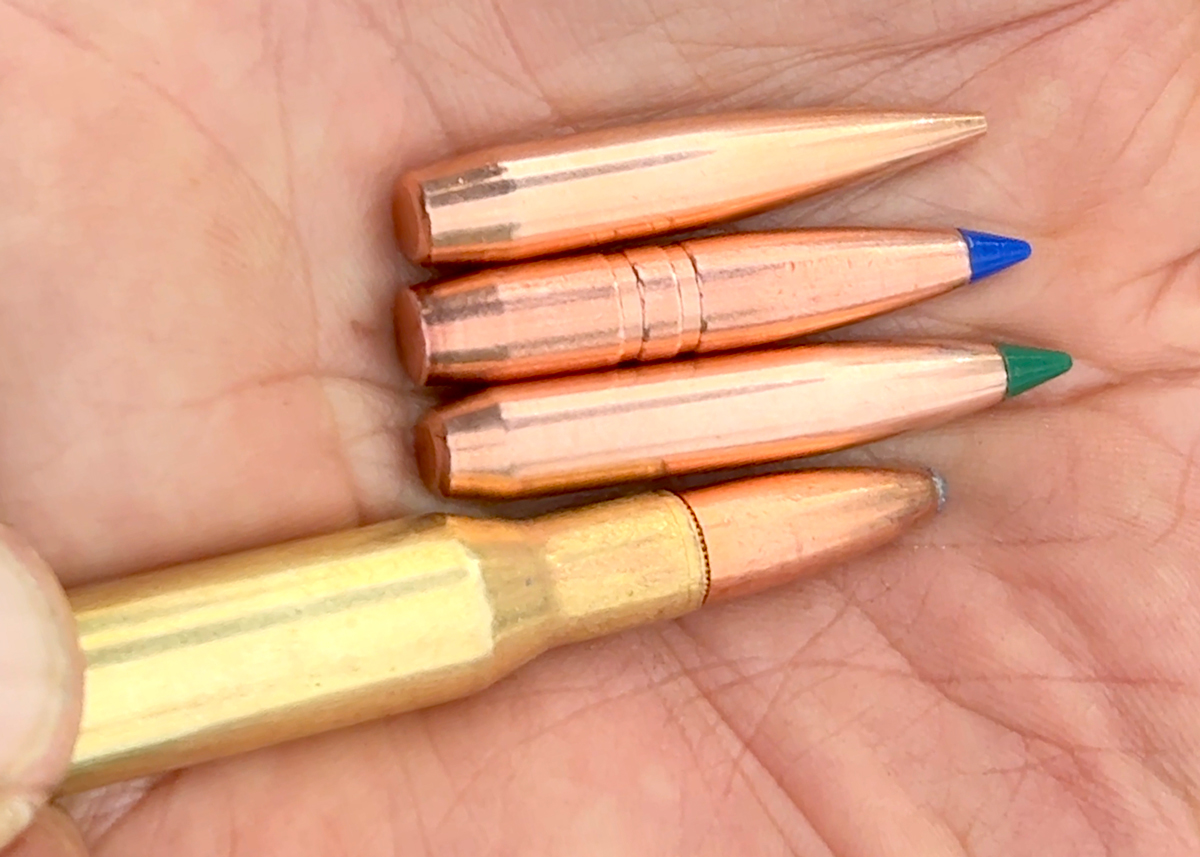
Long bullets (bottom to top): Berger 170-gr. Elite Hunter, Barnes 155-gr. LRX, Sierra 175-gr. Tipped Game King compared to a traditional 270 Winchester loaded with a 130-grain bullet.
While watching for pressure signs, Joseph von Benedikt and I began carefully working up loads with these three long, high B.C. bullets atop Hodgdon H-1000 powder and chronographing muzzle velocities. We reached 3,000 fps with the 170-grain Bergers before primers began flattening. We backed off to a safer 2,950 fps and printed sub-MOA groups. At this launch speed with this bullet’s G1 B.C. of .676, ballistic calculators predict a maximum point-blank range on a 6-inch diameter target of 305 yards. Wind deflection in a 10-mph right angle breeze should be 12 inches at 500 yards. Muzzle energy at 3,286 ft.-lbs. dwindles to just 1,984 at 500 yards and doesn’t fall below the recommended elk minimum of 1,500 until 750 yards. This is not to recommend engaging elk or any other game at such distances, but to show how the centenarian 270 Winchester with 21st century components rises to the performance level of a 7mm Remington Magnum, 7mm PRC, 6.8 Western and nearly a 300 Winchester Magnum. Not bad for a doddering 100-year-old.
Whether more rifle manufacturers will begin offering fast twist 270s or ammo makers begin loading heavy, long, high B.C. bullets in 270 Winchester remains to be seen. But many after-market barrel makers build and sell fast-twist 270 Winchester barrels. Dozens of gunsmiths stand ready to mate them to the action of your choice. Some might require installing longer magazine boxes but, once that’s done, you can load your own long bullets and ride the 270 Winchester deep into its next 100 years. Saddle up.