
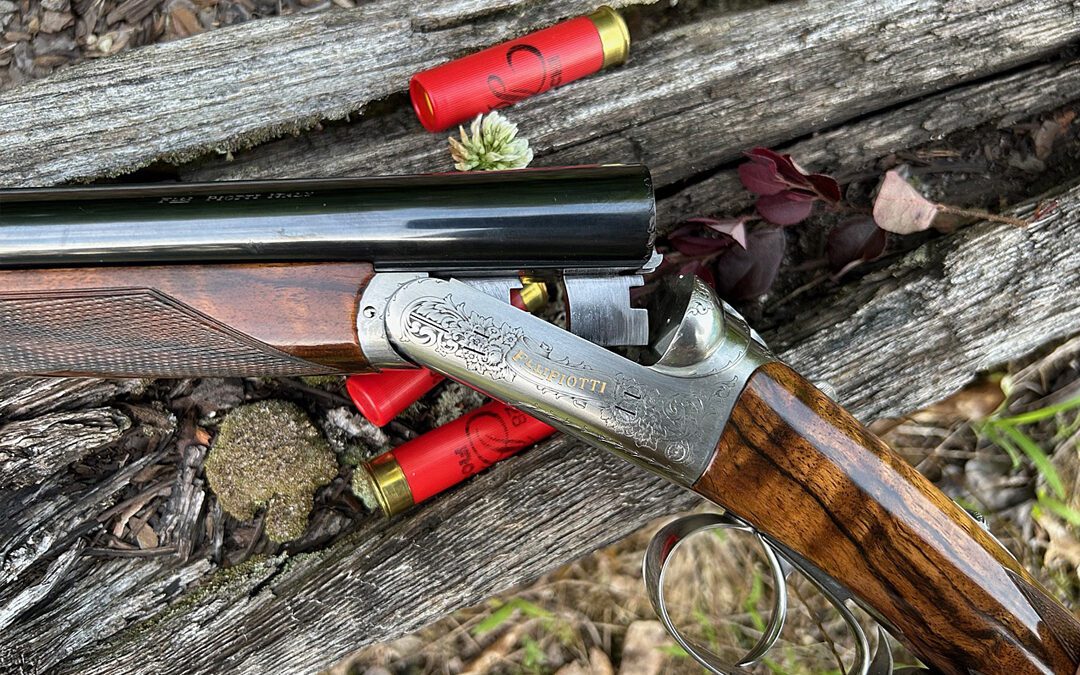
Dan Moore has a long-standing relationship with the Italian gunmaking firm of Fratelli Piotti that goes all the way back to the days of his father, William Larkin Moore. Dan also is a great fan of round-action side-by-side shotguns, especially those from the hands of Dickson, McNaughton and David MacKay Brown. Who wouldn’t be? Those lovely and historical “rounds” have a lot to commend them.
These days, field shotguns are carried a lot more than they’re shot. That’s just a fact of life. The “old days” when wild game was plentiful are long gone in vast areas of this country. I ought to know, because I grew up in mid-southern Georgia at a time when it seemed that game was everywhere. In my little corner of the world, quail were so prolific that 20-covey days were not unusual, and almost every rural farmhouse had a well-protected “house covey” that was immune to harm just because the lady of the house liked to see them scurry around the home-place every dawn and hear them call as they “coveyed-up” in the twilight.
Mourning doves were plentiful as well, and there were enough ducks to demand a day or three of attention when the weather got cold enough to bring them down into our part of the country. It used to be that almost any gun would suit my needs, but those days are largely over now and, as I grow older and the miles grow longer, I’ve begun to appreciate the qualities of a gun that’s light and comfortable to carry with few sharp corners to rub my increasingly tender anatomy. There are very few places where you can locate many wild, free-ranging birds anymore, and it seems that it takes a lot more walking to find them.
That’s the world where a round-action side-by-side really shines. If you want to see for yourself, find an old McNaughton or Dickson, or a newer MacKay Brown round-action. Wrap your hand around its mid-point, right where it balances, and walk around for a while. Drape it across your arm as if you were walking across a mile-wide stubble field or an ankle-deep woodcock bog. Better yet, conjure up a steep up-and-down Appalachian ridgeline like the ones where I most often hunt grouse. Now exercise your imagination a little more and stretch those images into an all-day, many-mile hunt. Under real-life conditions, you really can tell the difference between a conventional square-bottom shotgun of any kind and a round-action side-by-side!
Unfortunately, the truth is that good condition round-actions are frightfully difficult to find these days. That’s because you can’t take a conventional sidelock or boxlock and round it off, because the internal lock-work takes up too much room. The “round” has to be built from scratch as a round-action shotgun. True round-actions have heretofore been built on trigger-plate actions that allow the action to be contoured far more than any other type of action. And that makes them a lot more comfortable to tote around all day.
Dan and I share those sentiments, and we agreed that it was a shame that it was so hard to find a great round-action shotgun. The difference is that I can share my opinions, but Dan has contacts. And by that, I mean serious contacts who can actually do something about the problem. Fratelli Piotti, the justly famous Italian makers of best-quality shotguns, stood out among them. To make a very long story short, a few international calls, years of conversations, a few more of planning and protypes, and Dan was on the phone, telling me about the beautiful and tiny new round-action guns from Piotti that were, at that very moment, on the way from Italy.
A few days later, Dan had a couple of them, a 20-and a 28-gauge, at his shop in Scottsdale, Arizona. They’re the only ones in existence at this time, and now I have the 28-gauge in my own hands, and it’s truly spectacular!
The gun is built on a wholly new action that’s best described as a hybrid of an Anson & Deeley and a trigger-plate action, and you simply can’t describe it without using the word “tiny.” I’ve seen some extremely small frames on older English .410s, but none as small as this little Piotti 28-gauge. It has 30-inch barrels, as it should, because it scales a scant 5 pounds, even. If it weren’t for the long barrels, it wouldn’t have any “follow-through” at all, and we all know what that does for your shooting! A gun with no “follow-through” tends to stop at the slightest lapse in concentration, resulting in a miss.
The long barrels compensate for the feather-light weight. The slender straight-hand buttstock and forend are made from one of the most spectacular (there’s that word again!) pieces of Turkish walnut that I’ve ever seen. Personal taste, of course, comes into play when you make such an assertion, but in nearly 80 years of “wood ogling,” I’ve never seen one that I thought was nicer.
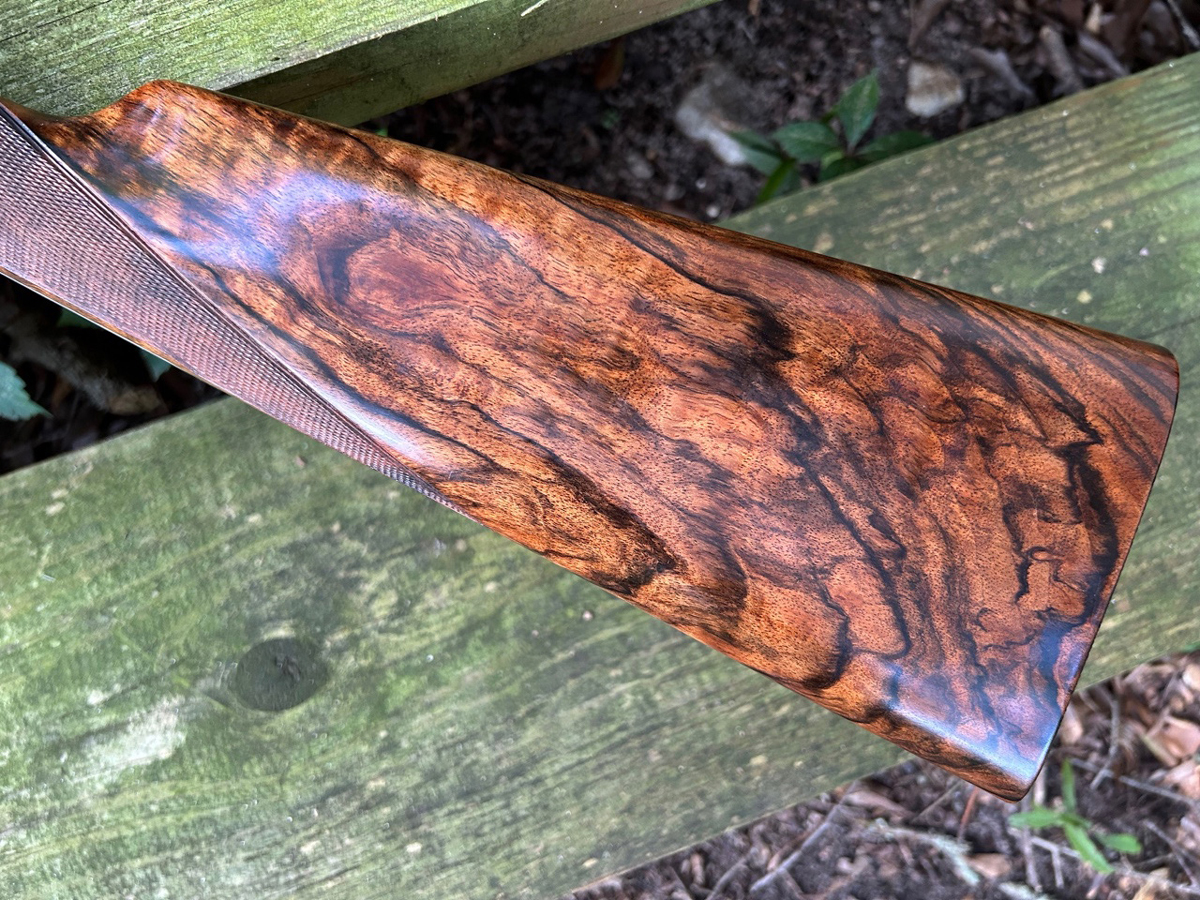
The slender buttstock on the sample gun has fairly conventional measurements. Drop at comb is 1 1/2 inches and it’s 2 1/4 inches at the heel. Length of pull is a full 15 inches, which many folks will like, but is a little long for my very average-size body. All of which is irrelevant, since the “round” is bespoke, and Dan can have the gun built to whatever specs you’d like.
The engraving consists of “vintage” English scroll, which is immaculately executed by Castelli, and is rather spare, giving the little double an elegant, classic look that I really like. It has double triggers and ejectors and a neatly rolled trigger guard for comfort.
All things considered, the little 28-gauge is simply wonderful, and its subtle, clean lines make it a joy to behold. It should make a quail, snipe or woodcock gun that’s as good as you could ask for if you can handle the super-light weight. The 20-gauge, which Dan has in his shop, is built to the same specs, except that it has a single trigger and comes in at 5 pounds, 13 ounces. It might make a little better all-around upland gun, but even that could be the subject of a rip-roaring good campfire debate.
As excited as I am about the 28- and 20-gauge Piotti round-actions, there’s something that excites me even more. Dan tells me that there’s a round-action 16-gauge on the way that will just barely break 6 pounds with the same general specs. Most of you already know that my very-most favorite gauge for general use on upland game is the 16, and the prospect of a trim, voluptuous, 6-pound round-action 16 gauge is damn near more than I can handle.