As a boy learning to fly-fish for trout on the name branded freestone flows and limestone streams of Pennsylvania, fishing hours were strictly entrenched into my sporting ethics. No matter if fish were still sipping spinners, 30 minutes after sunset our flies were clipped, dried and hooked onto a patch of fleece. Those evenings were just as if we were in the duck marsh, when the clock read closing time we were unloaded until the next day. My grandfather was a devout man of faith, and like the Bible, fish and game regulations were to be followed as if etched as the Ten Commandments—not to mention my father was a fish cop—a game warden for the State of Ohio. There were no blurred lines in their lives or in interpretations of fishing regulations.
To these men, night fishing for trout on these hallowed waters was blasphemous, yet casting hair bugs toward splatter-docks of white and yellow water lilies as well as jitter bugs and hula poppers into the dark of night was rejoiced. I was confused, never questioning their reasoning, fearful I had missed a lesson or worse be left behind. I just tagged along in silence, abiding by the rules.
After college, I joined a fly-fishing club, The Miami Valley Fly Fishers based near Dayton, Ohio. It was an active club affiliated with the Federation of Fly Fishers (known today as FFI) and sponsored group outings. The next June found me standing in the South Branch of the Au Sable River, watching the twilight turn to darkness, awaiting my first glimpse of a Hexagenia Limbata, the giant Michigan mayfly.
I was still confused. Although legal in Michigan, was I a heretic for breaking the family code? This quandary quickly subsided as a mating swarm of hex spinners roared above my head, their wings making sounds like no other mayflies I had experienced, humming upstream toward a riffle. They were large and low and kept coming, some dropping toward the water only to regain momentum and continue up the Mason Tract.
The Mason Tract is part of the Au Sable State Forest and the original 1,500 acres were donated to the state of Michigan by the George Mason family in 1954. George Mason was an industrialist and sportsman, best known for his time as Chairman and CEO of the American Motors Company. Since the family’s original gift, it has grown into a more than 4,400 acre parcel that resides in special management of the South Branch of the Au Sable and her fish, flora and fauna. Her stream bed has gravelly runs as well as silt beds that burrowing mayflies like hexes thrive in, as does her stream trout, mainly native brook and browns. Large cedars and pines shelter her banks until they topple, becoming sweepers or trout lairs in the river’s flows. It is a wild place and a sacred place that is also home to its own chapel.
It was just below the chapel where I first stood. The insects above me were twice if not three times the size of the coffin flies or brown drakes I experienced in Pennsylvania, and the swarm much denser. They must have fallen upstream of me, as suddenly there were the slurps and sounds of risers. I cast toward the loudest sound and, at the next boisterous slurp, lifted hard sending my uneaten fly into the depths of a cedar’s bough, 20 some feet both behind and above me. Breaking off was my only course of action. I struggled to re-tie as I was told not to turn on my light until after the night’s sport had ended, and I obeyed. In the midnight darkness, I cursed, fumbled and, finally, frustrated, finished the task.
Trout were still feeding, but now at a slower pace. Another fed above me—it was not a raucous eater but somewhat consistent. I went to work, casting, squinting to visually follow my fly, while listening for the trout’s take. Releasing my lone fish that night, a brook trout just over the length of a ruler, I realized I was not a heretic, only I was becoming a night fisherman.
The following evening found our group on another stem of the Au Sable River, this time the North Branch. As it was the night before, hexes came and trout fed. Standing across from a cedar overhanging the stream just below a classic sweeper seemed like a perfect place. And it was, except for my casting. Too long of a cast placed my fly into the branches tickling the water surface, too short of a cast and my bug was on the wrong side of the feeding fish in heavy fast water. Suffice to say, the perfect cast never came, although I did manage to hook a fish on an errant cast into the cedar as I was attempting to rescue my rig. As I was pulling low and straight, attempting to recover my fly so I would not have to re-tie in the dark, it broke free and plopped into the seam. Instantly, a fish rose and I felt a heavy head shake and then we parted company, leaving me with only a memory and the fragrance of fresh cedar on my frayed tippet.
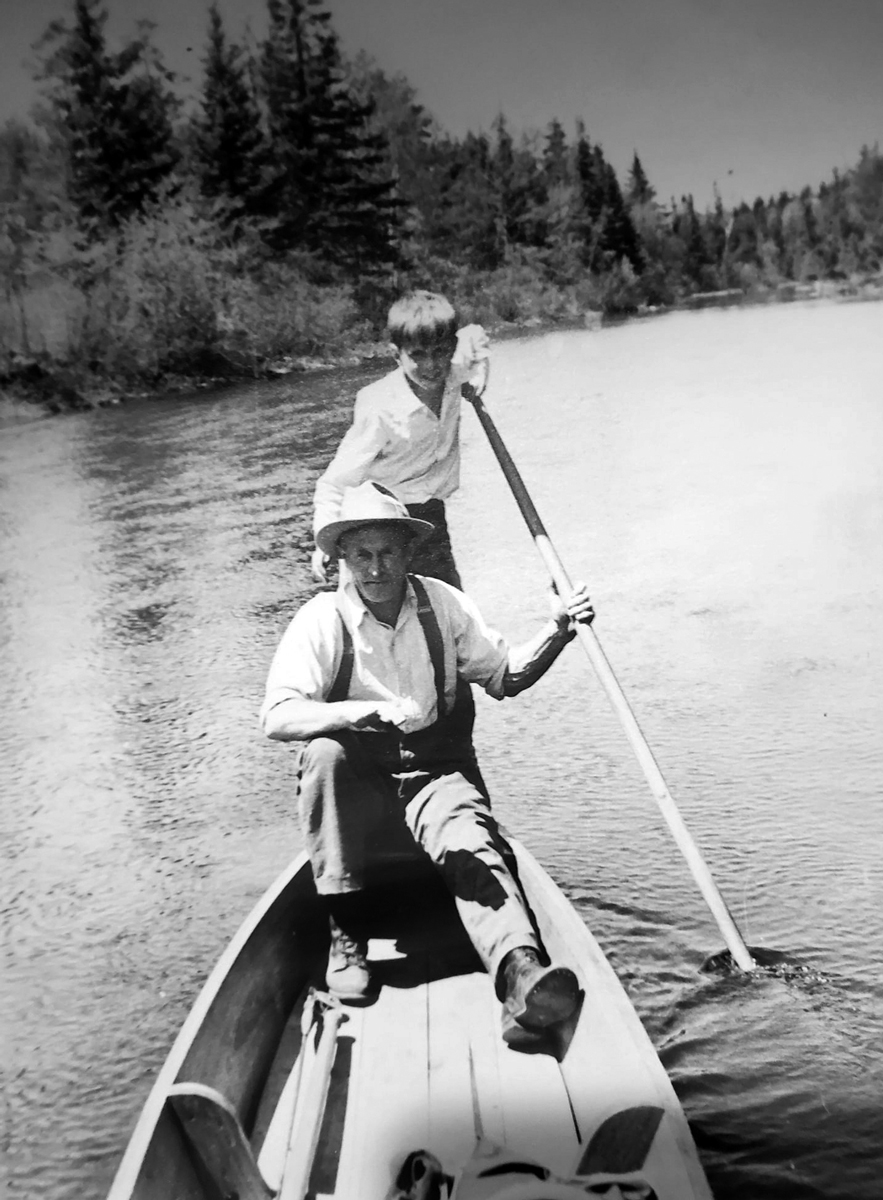
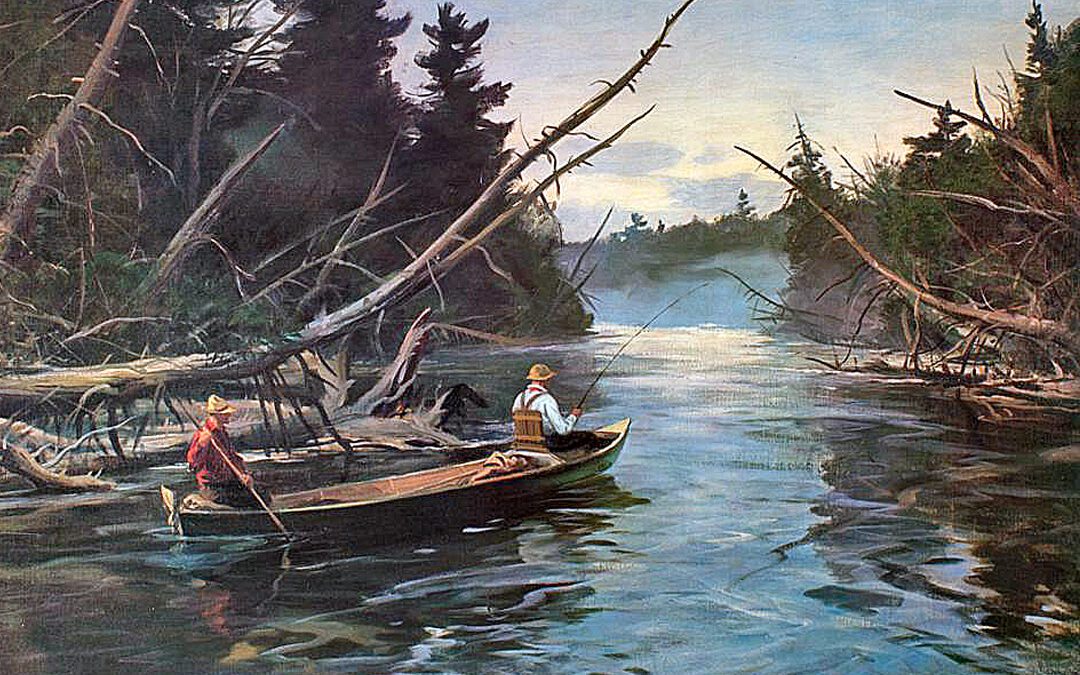
The third night we floated in an Au Sable river boat. Au Sable river boats are a craft like many sporting boats that were designed and built for one purpose—to allow the angler in the bow to make the best presentation possible while the guide/boatman steers the boat with a push pole and drags a log chain to slow the boat’s drift. They are long and narrow, draft in skinny water and are perfect for the sweeping bends of the Au Sable system. These historic boats have been a subject for an Ogden Pleissner painting and are described in detail by Earnest Schwiebert. Like both men, they are classics.
Only the temperatures dropped, the wind howled and rain fell hard. No bugs were seen, but the fish were looking for them and fishing a size 4 hex-colored woolly bugger of mottled yellow and brown on a short sink-tip was productive. One thing for certain, when we beached the boat that night, while I was wet, cold, and my watch read 2:30 A.M., I was exhilarated. I was a night fisherman.
Shortly after those nights almost 40 years ago, I moved to Michigan. Immigrating north for three reasons—trout, grouse and woodcock—as a graduate of the Ohio State University it certainly was not for football. As autumn days here, even Saturday afternoons are too valuable to spend inside watching a ball game even if it is the Big 10. I was a bachelor my first couple of years in the state and exploring not only the Au Sable system, but also the Manistee, both big and little, the Pere Marquette, the Boardman, Black and Jordan Rivers, not to mention the local Rogue River. One season fishing 67 straight nights into the darkness, that may be one reason I was single, but not the only one. I may not always have been the first guy to the river, but I was most likely the last to leave. Even as the early hatches of Hendricksons and sulphers dwindled at dusk and the fish stopped feeding, I would cut back my leader, tie on a large webby wet fly, something tied with black schlapplen and brown or olive chenille with maybe a tuft of pheasant fibers as a tail, and swing for the fences on my wade out. This pattern was designed to push water with a big enough profile of a hearty meal to enthuse a nocturnal feeder, only quick and simple to tie, as I continue to this day to lose flies to woody debris and trees in the dark.
It was through these nightly experiences that I learned both angling and life lessons. First and foremost, I learned that one need not cast a great distance to land a strong trout. One only needs to learn to judiciously wade, make the first cast count and present the fly proper. I learned that the best tied fly with drag, even in the pitch black of a new moon, doesn’t stand much of a chance but the worst tied fly with a positive presentation will fool a fish. The most important lesson of all is not to jump to conclusions.
The abandoned railroad bed along the Rogue River near my home in Rockford, Michigan, a bedroom community just 10 miles north of Grand Rapids, had just been refurbished into a rails-to-trails linear state park named the White Pine Trail. Folks flocked to the trail each evening including those with dogs, both leashed and unleashed. On numerous nights just before dark, an off-leash Newfoundland retriever would bounce down the bank and into the pool I was fishing, take a quick swim, woof at me a couple times and return to his owners. One evening, I was set up below a riffle at the head of a long run and deep bending pool downstream, just waiting on hexes when a black fury shape appeared on a peninsula created by the next sharp river bend a couple hundred yards below. With the hexes mating above me and falling into the run, the trout, small ones but trout none the less, beginning to feed, all I could think was this hound was going to swim upstream and ruin my sport.
I yelled “Rover, go home.” He “woofed” back and began walking slowly up the bank. It was a hot humid night with a low ceiling of dark gray clouds as a front moved east. A decent fish fed and then there was a sound like a bowling ball crashing into the water as if dropped off the trail above—the sound of a good one. The fish fed again, this time loud but more controlled, like a fish that had found its feeding lane and was comfortable, and my stalk began. I was wading downstream while Rover was wandering up.
He “woofed.”
I told him to “go home and get a treat.”
There was no moon, and I was fishing by sound alone. Timing both the fish and my drift upon hearing the rise, I would cast the deer hair extended body feather wing spinner above and count thousand-one, thousand-two, thousand-three, mend, thousand-four, in the target zone, thousand-five, thousand-six, pick up and make another cast. All the while Rover was rustling in the floodplain’s berry canes just beyond my cast, “woofing” every so often. Focused solely on this fish, my only negative thought was he would crash this party and the fish would be put down for the remainder of the night. He stayed back until I hooked the brown trout and the thrashing began.
Tight to the fish, it wallowed on the surface before running upstream. Not wanting to leave the deeper placid flow of the run, it stopped at the bottom of the riffle and turned downstream. This commotion caused Rover to come to the bank’s edge and, as I turned on my headlamp to net the fish, I saw not a Newfoundland but an immature black bear boar.
He “woofed.”
I cursed loudly.
The brown trout came unpinned, and my night was over, except for my long circuitous hike back to the truck, placing distance between me and Rover.
What typically was a 15-minute hike came closer to an hour as I walked a ways up the far bank before crossing back across the creek and bee-lining it toward my truck.
The next morning, the local newscasters were aghast, reporting that an immature male black bear had been killed by a car just beyond the city limits of quaint Rockford near the White Pine Trail. They quoted a Michigan DNR biologist who surmised the youngster was searching for a territory along the river to claim as his own.
I was saddened; Rover was not referred to by his apt nickname.
Fly-fishing in the dark, night fishing, lends itself to all sorts of bumps and bruises, frights, falls and entertaining escapades. It is amazing how much a tail slap of a beaver can sound like a feeding brown trout. Also amazing is the amount of backing said beaver can spool off one’s reel once hooked. Bats and birds are another story. The phrase “Like a duck on a June bug” can be rephrased into “Like a merganser on a mouse” for night fishing implications. All I can say is pliers are better suited than forceps for some releases.
My night fishing years past were about the big fish. Those big boy brown trout that may come out at night, carnivorous creatures with kype jaws, big spots, albeit dark ones, as they reside beneath root wads or an undercut bank hidden from light. Then I realized these fish were just an excuse. I truly wasn’t searching for boisterous brown trout; I was searching for myself. I was reaching into the darkness with a fly to light my path—a personal journey separate from family and friends. These solo nights then and now still find me searching, contemplating in the camaraderie of late night sounds and a river’s tactile flows. Both can be calming but also terrifying, no different than day-to-day life.
These days my night fishing is mainly on the upper reaches of the Manistee River. There is a driftwood log at the tip of an island where I have sat for more than 20 years. Its location allows me a view both upstream and down. By chance, there happens to be an opening to the sky above the river’s channel. Before darkness is full, I can watch brook trout feed in the black-water braids above me, while swifts swoop the river’s corridor for the early emergers. Some nights, I leave the log and cast at the first audible feeder, other nights I wait until the feeding is as rambunctious as a morning kettle of tea, and sometimes both the bugs and fish are absent. On those nights, my ponderings intensify, as I am not distracted by angling, focusing only
on being comfortable wading home in the dark.