
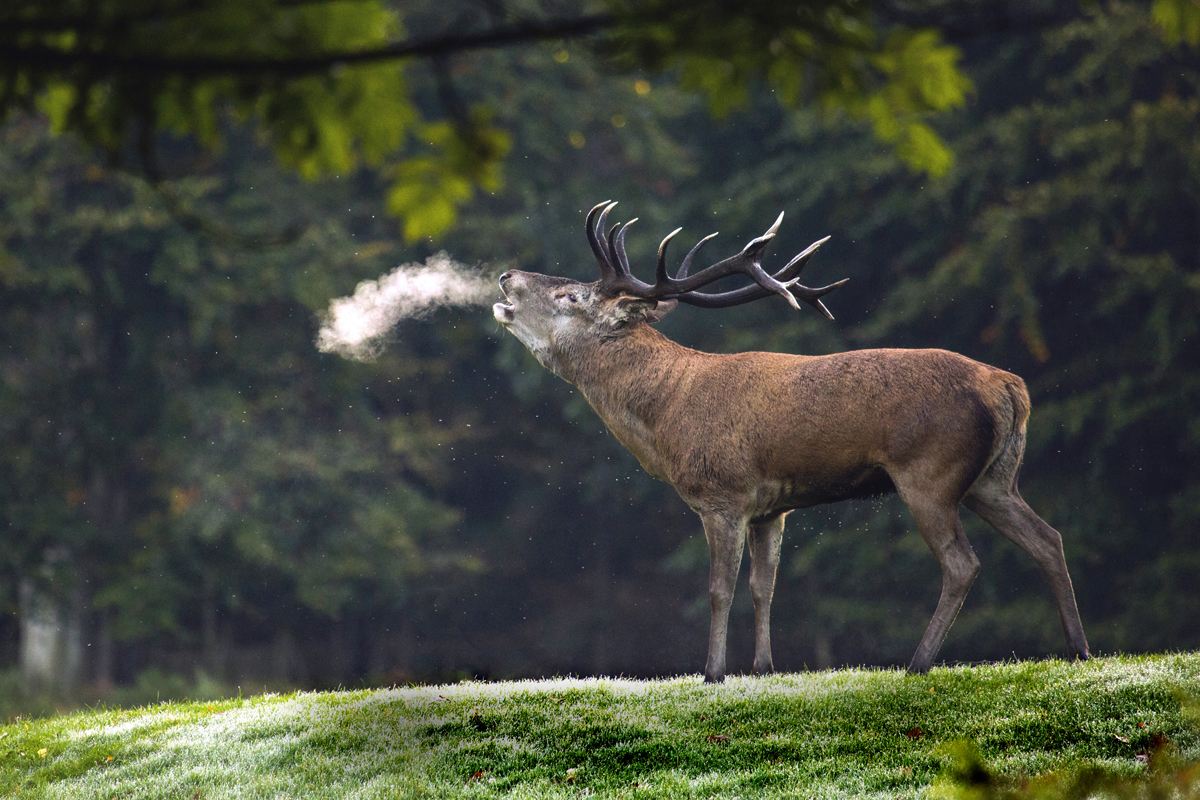
The stag understood who he was.
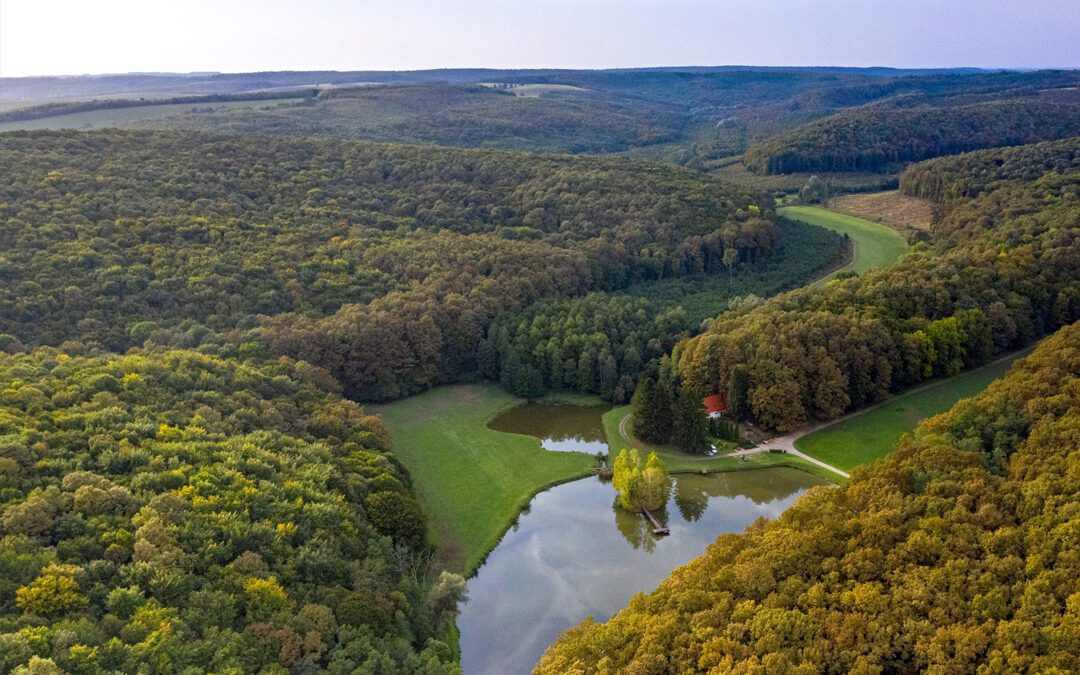
He stood next to a tree line in Hungary’s Zselic Mountains where his hinds could admire him and the smaller stags hidden in the forest would know they were trespassing. The stag’s head was crowned with heavy antlers that stretched out 18 points, all rubbed white from use.
The stag was old and proud, wise and wary. Even from our small, wooden ground blind some 400 yards away, I could make out the gray rings around his eyes. His survival had been a considerable accomplishment, and a testament to Hungary’s excellent management of game and hunting areas. In this country, only mature, strong animals are hunted.
We were hunkered down near Vörösalma hunting lodge in southwestern Hungary, near the village of Zselickisfalud. The area is famous among hunting cognoscenti for its trophy red deer. Without the expertise of Beretta’s Peter Horn, who has organized stag hunts for four decades, the area would have remained a mystery.
On this late September day, as the sun edged lower, the stag was surrounded by at least 15 hinds that we could see. Tamás Simon, a professional hunter who worked for the forestry company that controlled the area, had seen the stag at this spot at various times over the past three years. Today, for unknown reasons, and a lot of luck, the monarch of the mountain decided to reveal himself. Unfortunately for him, it was hunting season, and his judgment was corrupted by the rut.
We had approached him in a single-file line through an adjacent agricultural field, then crossed over a dry creek bed. We had moved slowly, careful to not make a sound that could be picked up by the hinds. Finally, we’d arrived at a wooden ground blind on the creek’s edge where we sat on a long board and brought out our binoculars.
We watched the stag pace back and forth, about like a soldier guarding the entrance to a presidential palace. Sometimes, he stood triumphantly still. Sometimes, he roared in celebration of himself and to remind other stags who, as trespassers, were intuitively contemplating regicide.
If the day stopped at this point, it would have been enough. To be with wild things, in wild places, is a precious gift. Anything else that happens just enhances perfection.
Of course, these moments, especially during the rut when the hunting senses are heightened and super activated, often push the experience to a higher level. Hunters in pursuit are part of an ancient challenge. They get to match wits with a worthy opponent who knows all the contours of the land, and who uses wind and sound and patience like a shield.
The stag, as is true of old game, had a preternatural understanding of safety and distance. Perhaps he had been shot at during a previous season. Even though his harem surrounded him, fanning up the hill to our left and behind him in the trees, the stag anchored himself in a safety junction created by the end of the valley and the forest that crept upward to the mountain.
Though out of my shooting range, the old stag was magnificent to behold. He would stand broadside to us, then turn from left to right and back again to look at his hinds. He sometimes circled through the trees only to reappear in the same spot. As he moved, younger stags hidden in the forest roared. They were intent on convincing the hinds that the hierarchy in this mountain valley could change. The behavior of the hinds, and the old stag, demonstrated nothing had changed.
When a hunt is underway, and your rifle is leaning against the side of the blind or held in your hands as if in prayer, the powers of telepathy are sometimes summoned. I tried that day to use the power of thought to send a message to the stag. My silent entreaties for him to move at least 100 yards closer, or to visit his overly alert hinds who were closer to our ground blind, had no influence. The range-finding button on my binoculars reinforced the futility. The stag was unwilling to cross some invisible line on the valley floor.
The sun and moon soon began to conspire against us. The sunlight was close to fading into shadows, and our shooting light would then burn out like a candle. If that happened, the stag might never again be seen, at least not by me.
I asked Tamás if we could somehow close the distance to the stag. He did not answer, but remained sitting on his side of the blind, never looking away from the stag or the hinds. The girls on the hill knew something was wrong. They continually looked toward our ground blind. Maybe they saw our outlines. Maybe they saw our white faces. The wind was in our favor, but nothing else. In the game we were playing, we were losing.
Finallly, Tamás decided it was time to recalculate our geometry. He rose slowly, then crouched low to the ground, using the ground blind to hide us from the hinds. I followed. After re-crossing the creek bed, we walked slowly to avoid creating a silhouette or stepping on twigs that had fallen from the oak trees. Dried leaves were everywhere. We emerged on the other side of the gully into the same field that brought us to the blind. From there, the stalk was on, and I silently stepped where Tamás stepped. We moved up the field for at least 75 yards, carefully walking along the tree line. Suddenly, Tamás turned to the left and I followed him back across the creek into the dense forest.
The forest smelled musky. The scent was atavistic, heavy and hypnotic. It hung in the air like fog, automatically quickening every stalking sense and slowing all human motion. The forest was alive. One mistake, one snapped branch would end the hunt and send the stag running.
Tamás was blessed with exquisite hunting senses and a granular knowledge of the forest. He knew where to step to avoid thick patches of dried leaves, downed branches and anything else on the forest floor that would warn the herd of danger.
After slipping silently through the trees, we came to the edge of a tree line. We raised our range-finding binoculars to reestablish distance and find the stag. He was some 200 yards away.
At last, we were in shooting range.
Tamás set up my shooting sticks and the Tikka 300 WSM followed. When the stag’s vitals were covered by the scope’s reticle, I squeezed the trigger. The stag ran off, crossing the valley floor and heading for the dense forest area, where his hinds had failed him. Just before he disappeared, which would have taken him up the mountain, my next shot hit him hard in the neck. The thwack bounced back at us. The stag did not stop. We waited, lest the pressure push him away from us.
Hungarian stags are strong. Toni Török, the hunter and Pannonvad partner who organized our hunt, said they are tougher than bears. During the rut, when testosterone is raging, a shot into a stag’s vitals may not be fatal. Toni has seen the animals run long distances with half a heart muscle.
We thought we saw the stag lying down at the end of the valley in front of the trees where we had first seen him. We moved off in single-file, Tamás leading the way. This time, we moved swiftly, but in the wrong direction.
Shadows change contours. Tall blond grass can look like antlers. What we thought were antlers lying at the valley’s end turned out to be tall tufts of grass. Rather than looking straight ahead, which can create tunnel vision, I moved my head left and right and then noticed the stag lying in a patch of tall grass.
He had apparently tried to run into the trees that edged the dry creek bed we had initially crossed.
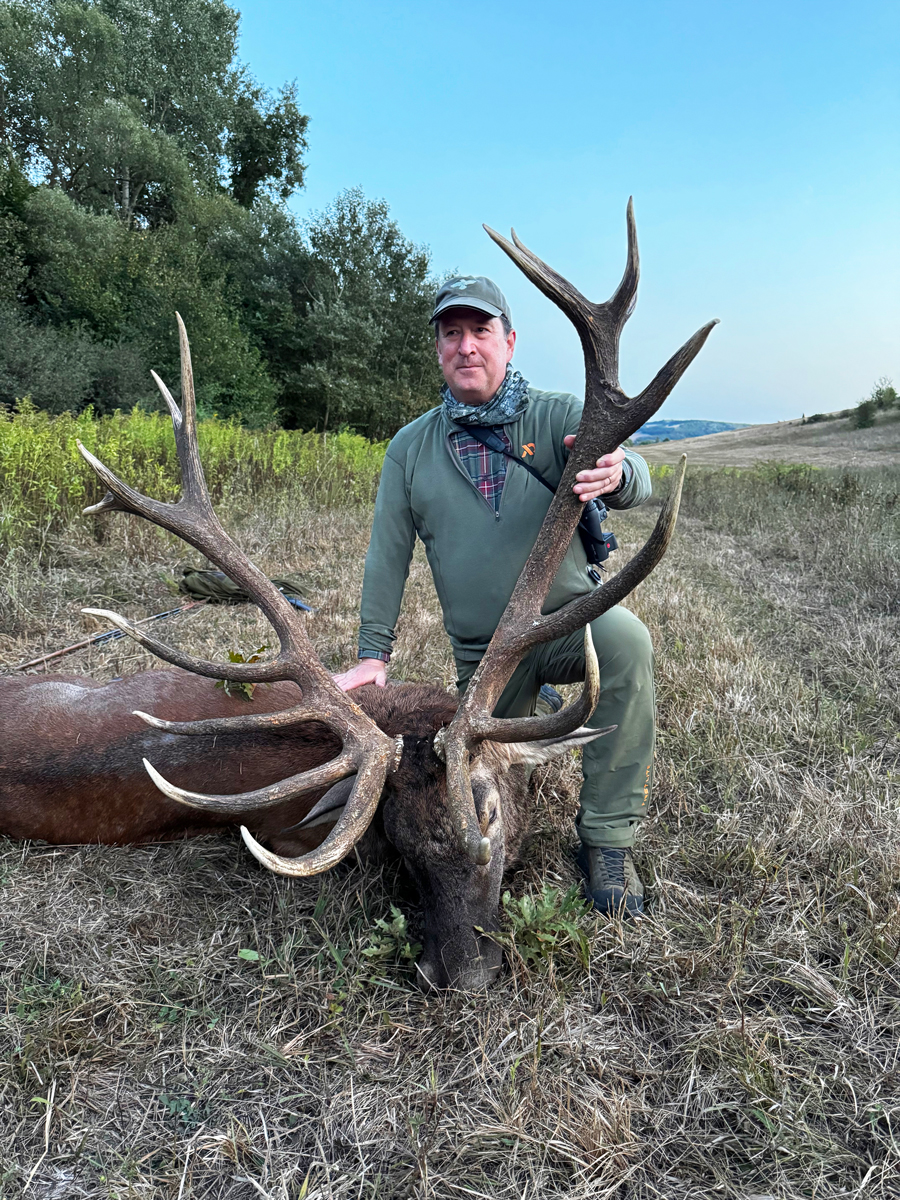
The stag’s body was huge; his antlers massive. We could not wrap our hands around them. Tamás, Toni and I pulled the stag into the open space of the valley. There, we stood shoulder to shoulder, gazing down at the magnificent creature lying before us. No one spoke. We understood each other without speaking.
Comfortable silence has been described as a sign of true friendship. Real bonds between people exist when comfortableness exists in quietness. The absence of words can have a strange bonding effect. Among hunters, especially those who are fortunate enough to travel and meet other hunters from different countries and traditions, silence has always transcended borders and language.
The hunt, and all that it entails, is something that should not be quickly metamorphosized into spoken words. The feelings should be kept private for as long as possible to provide time for them to deepen before they are shared. Perhaps this is why hunters who have never met can be together and never experience awkward silences. That fact is never truer than in a foreign land when all that unites the hunter and guide is the hunt. Silence among hunters is tangible evidence of membership in an ancient fraternity. The same is true of old words.
In America, many hunters silently pray after taking game. Those of a certain generation were taught as boys that the Indians of the great American West honored game that way. It has become a tradition, and a reflex. In Europe, the traditions seem almost operatic, drawn from the stage of a great continental theater.
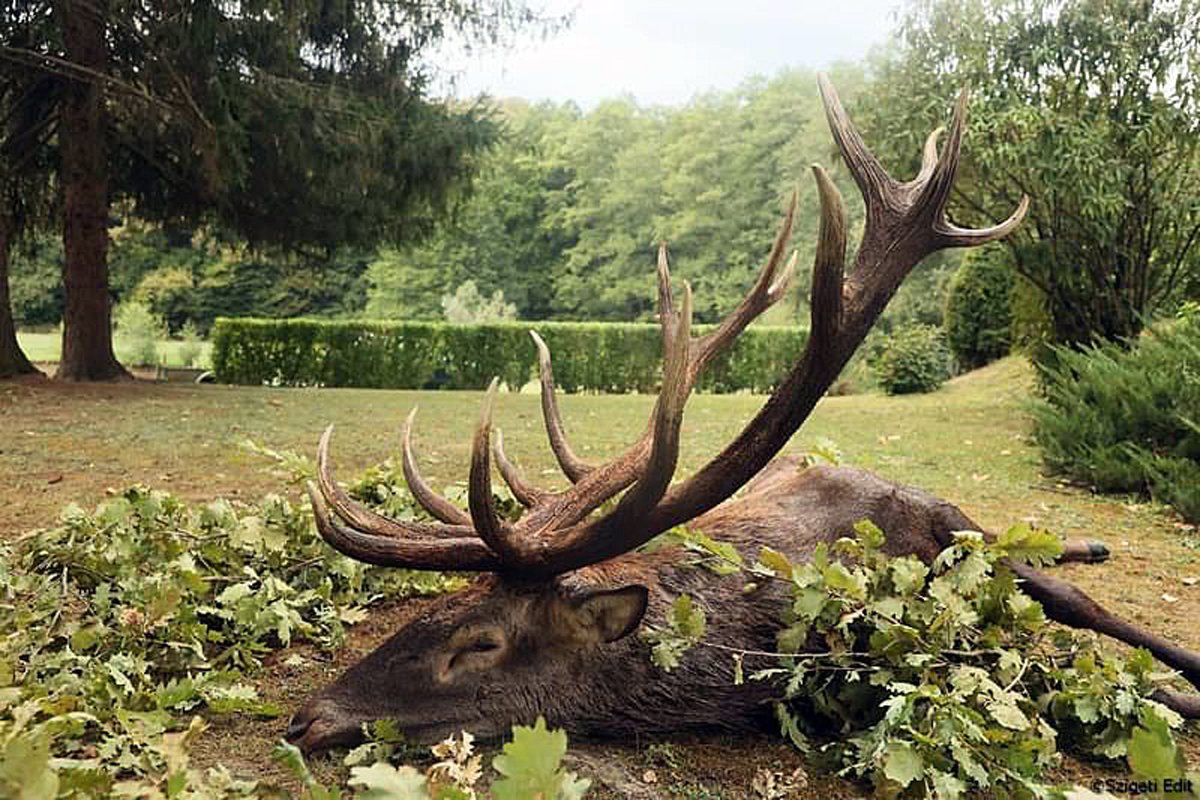
Tamás has great dignity. He adjusted the stag so his head was upright, then he walked into the forest and returned with branches from an oak tree. A branch was put in the stag’s mouth. This was the letzte Bisse, or Last Bite, the stag’s final meal. Another branch was dipped in the stag’s blood where he had been shot. This was the Erlegerbruch or Hunter’s Branch,
Tamás attended to this with the solemnity of a priest summoned to perform an important rite. Toni, the son and grandson of professional hunters and foresters, stood and watched like the high priest of hunting that he is. The ceremony concluded with the maximum economy of words.
Tamás removed his hat and faced me.
“Waidmannsheil,” he said, shaking my right hand. He touched the Erlegerbruch to his hat and handed it to me.
“Waidmannsdank,” I responded.
I took the branch with my left hand and joyfully placed it on the right side of my hat in homage to an ancient feast of the gods attended by Diana, goddess of the hunt.
After the old words were spoken, Tamás and I were once more separated by language. But not for long. The stag changed that. Something more needed to be said. Tamás spoke Hungarian. Toni, a true hunter of great erudition, spoke seven languages.
Tamás stood facing me and began talking, while Toni interpreted. He told me he had known this stag for four years, and that it was stronger than ever, despite its old age. Of the many stags he had hunted, Tamás said this bull was the best he had ever seen. Toni said Tamás has taken about 20 stags a season over the past 25 years.
Then, Tamás’ demeanor changed. Throughout the hunt, he had been elegantly self-contained as befits someone in deep thought. Now, he smiled broadly as if we had known each other for more than 30 years, as was the length of his friendship with Toni. Tamás hugged me. He hugged me with real joy. I told Tamas that I had long waited to hear Waidmannsheil spoken to me. I told him that I would aways remember him, and this stag, and this hunt. And I will.
Soon, the headlights of Toyota Hilux trucks illuminated the dark mountain valley. The head game warden for Somogy County had heard the news. A colleague of Tamás came to see the stag and to help with what needed to be done. Somehow, this giant stag, big as a kudu, was winched into the back of a forest green pickup and driven back to the hunting lodge.
The next morning, a tableau was set. The stag was arrayed in the front yard, his body framed by a large wreath of oak leaves. In his mouth, the last meal. Tamás and a few other professional hunters sounded their jagdhorns, sending the stag on his final journey.
I know some hardened hunters in Scotland who think continental hunts are theatrical, but the pageantry is more meaningful than that. The tableau, if you let it, renews hunting vows and celebrates the hunt and the animal. Such a statement may seem gilded, but traditions bind us to the past and remind us of our future responsibilities.
To become part of a significant stag’s life, and for him to become part of yours, is a singular bond. The day will always be an important memory that vividly defies time. The day also bestows a great debt that cannot be repaid. The stag must be honored on all future hunts with better shooting, better stalking and a stronger stewardship of that which we love so much.