
Deep in the wilds of Africa, dealing with a deadly snake in your camp latrine can be a messy proposition.
One of the most terrifying encounters I have ever had with a dangerous snake took place on an early October morning in Zambia, on the Munyamadzi River. It had been very hot the previous night, and I had slept under a mosquito net on a cot outside the hut with just a kikoy loincloth, lions or no lions.
I awoke for the hundredth time at dawn, well basted in sweat and padded bleary-eyed across the 30 yards to the chimbuzi, a wraparound, grass-walled latrine or “high-fall” on a bluff near the riverbank.
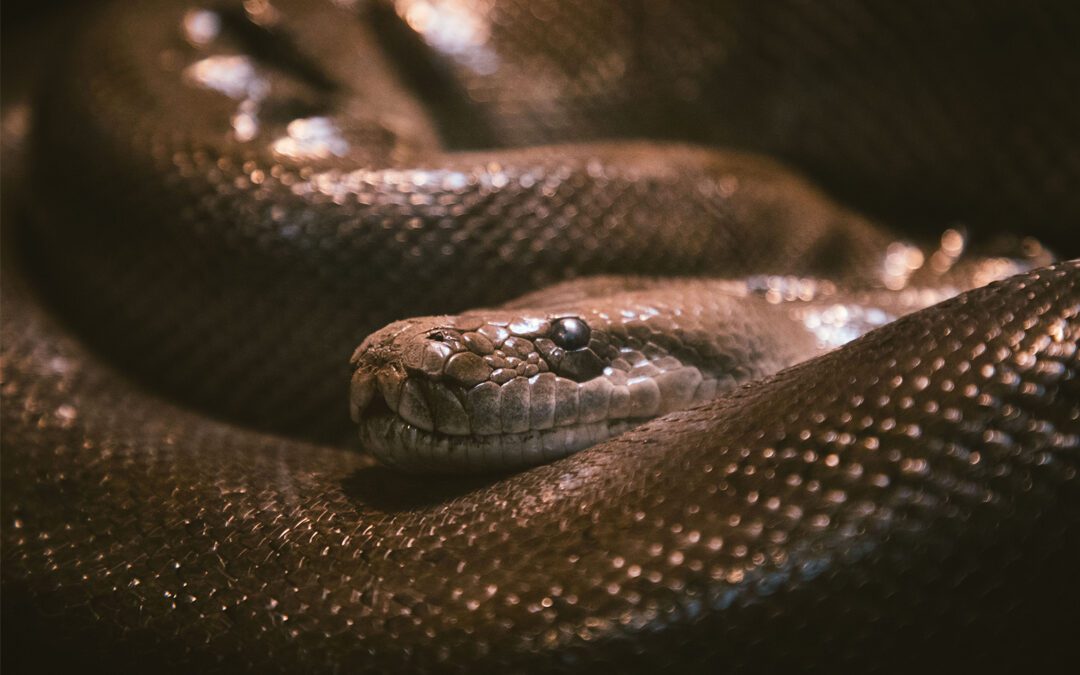
Still half-asleep, I started to enter and was chilled by a hiss like a ruptured air hose. Half across the open toilet seat bolted to a cutoff 55-gallon oil drum set into the top of the hole reared an eight-foot black mamba. His head was as high as my throat, his tongue flickering from his partly open mouth.
I clearly remember seeing a couple of strings of saliva stuck between his upper and lower jaws like thick spider webs. That I woke up in a hurry is a masterpiece of understatement. Without thinking, I threw the towel I had in my hand at his head and, not waiting to determine the results, bolted out of the latrine and across the space to my hut in a flesh-colored blurr, like a Road Runner cartoon.
Shaking the big buckshot loads out of the shotgun, I reloaded with birdshot and carefully, very carefully, approached the chimbuzi again. As I inched up, I peeked around the grass baffle. Nothing, no sign of the snake, which bothered me one hell of a lot more than being able to see it would have. The only thing worse than seeing a mamba at close quarters is not seeing a mamba at close quarters.
After carefully checking the grass walls, I went outside and looked over the bare dirt. I couldn’t even find a crawl track on the hard earth. Where in blazes had he gone? Aha! Obviously, he had gone down the open toilet and into the latrine hole, I reasoned. With the safety off, I edged back inside the roofless structure.
Sneaking up to the toilet seat, I pushed the muzzles of the double-barreled shotgun up to the edge and levered them downward. There was no movement. In a flash I leaned over the seat and pulled off both barrels, one after the other, straight down the drop-hole. The secondary results were not unlike dynamiting a septic tank while sitting on it, and I certainly got a solid dose of the basic contents of the hole.
After, as the British say, purging myself, I managed a cold shower from last night’s water, shouting to my understandably confused staff (who might have been wondering what the bwana was doing blowing up the crapper) to keep an eye out for the snake until I was no longer hors de combat from my sneak raid on the can.
Invisible brought over a flashlight and a couple more shells for the gun, although if that mamba was in the hole, I strongly doubted that he would need any more persuasion. As Invisible held the torch, I held my nose and peered down into the black shambles of the shaft. Whatever else was in it, there was sure no mamba. Where he had gotten to in the less than a minute it took me to get the gun was beyond me, but I couldn’t shake the idea that he might be in the walls or had even crossed over to my hut, where he could be hiding right now.
Not about to spend the rest of the season wondering if there was a mamba under the bed, I took the only alternative. I got a live brand from the campfire and, after removing the toilet seat—a possession rarer than ambergris in the middle of the bush—lit the chimbuzi and watched it burn merrily to the ground without a glimpse of the snake. Since my hut was the only other cover in sight, I had my men drag out the bed and metal footlockers with sticks along with the rest of my katundu, and fired the hut also. I felt a little stupid when it, too, had completely burned without flushing out the snake. It may have been a somewhat extreme gesture for a little peace of mind, but then mambas really give me hives.
Except there was one problem still remaining: Where was the flaming snake? The way my men were glancing at me sideways, I was starting to wonder if I’d been hallucinating.
Since I did not have a client at the time, the rest of the day was spent building a new hut on the other side of the camp and digging another john. The following day, as I was eating lunch, one of the men came running over to say that there was a big mamba sunning on the edge of the river near where the old latrine had been. I grabbed the scattergun and killed him with one shot, his writhing carrying him over the edge and into the water.
A few weeks later, I was hunting across the river from the camp and suddenly realized where the snake had escaped to that day we met. Below the lip of the cliff were many deepish holes in the clay dug out by nesting colonies of carmine bee-eaters, one of Africa’s most spectacularly beautiful birds, which breed there each year. Almost certainly, the snake had disappeared straight over the edge and into a hole while I ran for my gun. From our side of the river, the holes were invisible and, because of the possibility of the undercut banks collapsing, nobody would have thought of walking out to the edge, over the croc-filled water, to investigate.
I was mightily relieved that the snake was finally dead. I have often wondered what might have happened had it been darker in the latrine or if I had sat down on him. I probably would have had hell’s own time with the tourniquet! n
Editor’s Note: From Death in the Long Grass by Peter Hathaway Capstick. Copyright ©1981 by the author and reprinted by permission of St. Martin’s Press. Also, a special thanks to Fiona Capstick.