
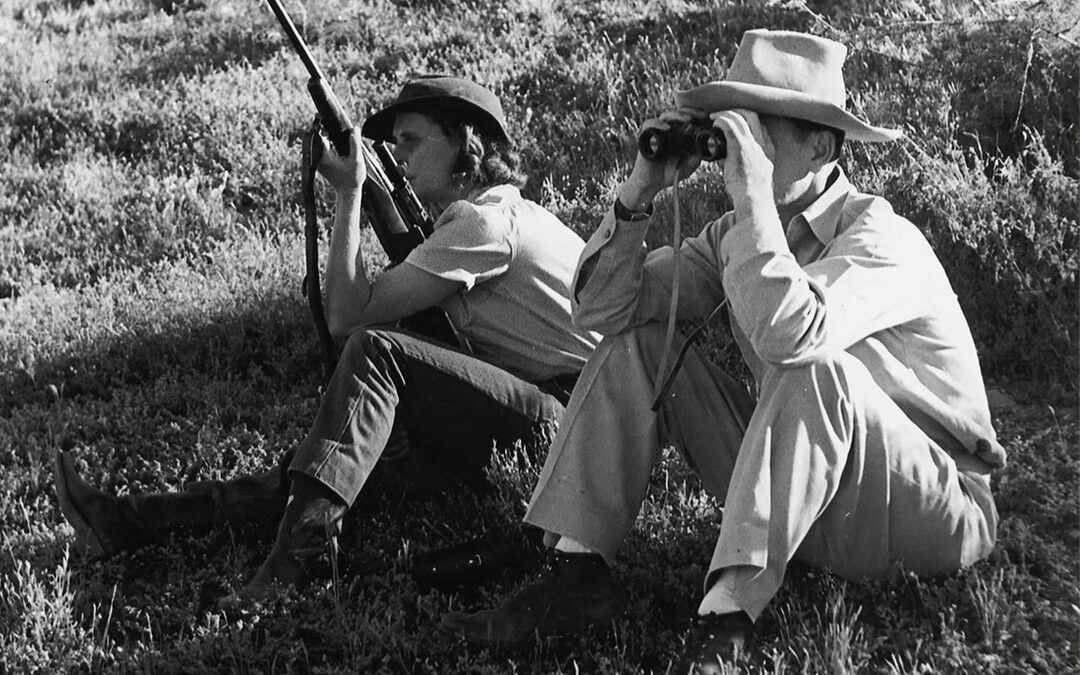
The legendary hunter sets out to find the little ghost deer of the high Mexican desert.
All of my life I had heard of a delicate little fairy deer even smaller than the regular Arizona whitetail. He’s a tiny little fellow and the smallest deer that scientists recognize as inhabiting the United States. A big Arizona whitetail buck will dress out at not much more than 80 pounds, but the mysterious little toy deer, according to old-timers and Mexicans, is not more than half as large. He will dress out at 40 pounds or so, they say.
The mystery of whether this miniature creature exists or not had always interested me. Every time I heard the story, I resolved some day to hunt them, either to scotch the story or to prove to scientists that hundreds of old-timers weren’t talking through their hats.
Mexicans who told me about them called them venados cavritos, or “little goat deer.” Americans call them the “little Sonora deer.” They all agree that the adults are red in the summer, whereas the regular Arizona whitetails are gray, that they are very small and very hard to find. And even mature bucks never have more than two points to an antler.
My chance came last December when, over an excellent meal of tortillas, enchiladas, frijoles and other fiery Mexican viands, Pete Embrick of Nogales, Arizona, told me he had seen a good many of the mysterious little elves in the southern end of the Cucurpi Mountains of Sonora. He even offered to lead me to them.
Did I go?
Well, you answer that one. It didn’t take me long to cancel my plans to hunt sheep and antelope on the Sonora Coast and turn my attention to the little mountain fairies.
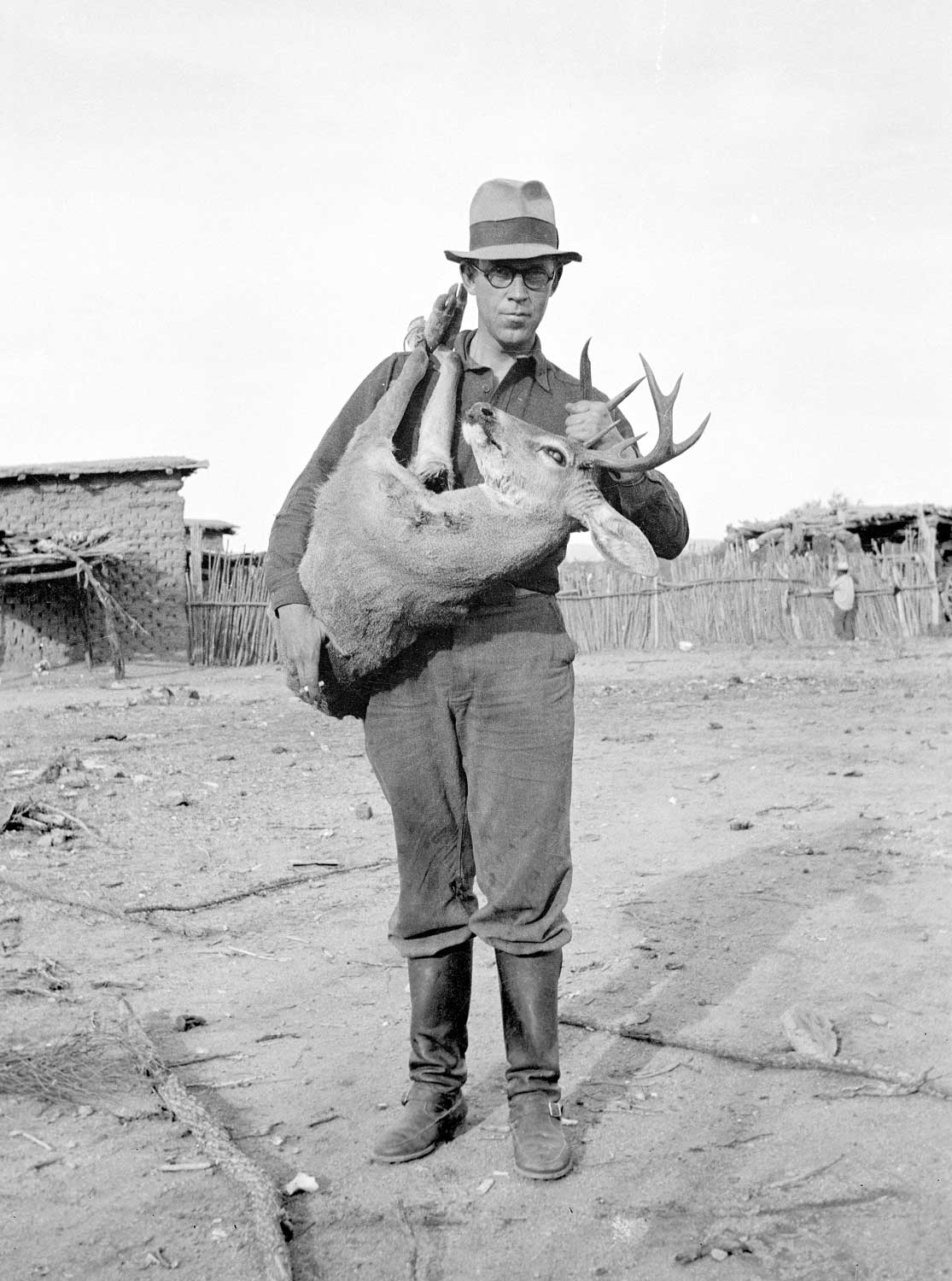
Jack O’Connor had little trouble toting his first cavrito back to the Mexican hacienda where he and his wife Eleanor stayed during their hunt in the Cucurpi Mountains of Sonora.
So late one afternoon toward the end of 1935, my party landed at a little ranch on the south end of the Cucurpis, where the Purgatorio River tumbles out of the mountains into lowland desert. North of us the mountains rose between 4,000 and 5,000 feet straight up in crags and pinnacles almost rough enough for mountain sheep. South of us was a fantastic, rolling Mexican desert made harsh and dangerous by cholla, ironwood, mesquite, palo verde and ocotilla. Everything wore thorns. Even in December it was warm. Yet the mountains above us were clad in oaks and abounded in wide grassy pastures where little streams wandered.
There were five of us – Eleanor, my wife; H.B. Barry, my father-in-law and an official of the Frisno Railroad; Harvey Fergusson, the distinguished Southwestern novelist; Jose Parada, head of the Sonora State Tourist Bureau, Pete Embrick and I. The others were after whitetails. Only Pete and I believed cavritos might actually exist. I wanted a cavrito. If a big whitetail came my way, well and good – if not, there would be no hard feelings.
In a few minutes we got our duffles out and dickered with the owner of the adobe ranchhouse for use of his rooms as a kitchen and for the rent of some horses.
“Are there any cavritos in the mountains?” I asked Julio
“Oh, si!”
“Are there many?”
“A few.”
“Are they high or low?” I pressured him.
“High,” he answered indifferently.
“Can you show them to me in the morning?”
“I believe so. If not, we’ll see plenty of whitetails.”
“But I’m more interested in the cavritos.”
He shrugged his shoulders. If the nutty gringo craved the little cavritos whereas the venados furnished twice as much meat, it was O.K. by him. He aimed to please.
Leaving Julio meditating on the sadness and futility of life, my wife and I, along with Pete and Harvey, headed west along the foot of the range while Barry and Parada hiked up the canyon. We didn’t have long to hunt before darkness fell, but we did want to get the cricks out of our legs and to look the country over.
A few hundred yards from the house I watched a whitetail doe scurry up the mountainside. Sign was everywhere. A mile farther on Pete suggested that Eleanor and I occupy a saddle between two hills while he and Harvey skirted them. We had hardly seated ourselves when I saw a deer sneak out of the brush on the side of a hill about 250 yards away. The glasses told me it was a large whitetail buck, but before either of us could shoot, it was behind a bush. When it came into view again it was running. I tried a quick shot and missed, but Eleanor shot and connected. We saw the buck fall in the thick brush and I crossed the canyon to hunt it up.
I found a blood-trail but no luck, and I was starting to track it when I heard a storm of shots from the other side of the hill. It was Harvey. I found him seated on the hillside sending 30-06 bullets after a couple of microscopic deer climbing a steep hillside almost a quarter of a mile away. He told me he had missed two close shots at them as they flashed through the brush and that they were both bucks. Both were lively and unwounded – plainly not Eleanor’s wounded deer.
So I took up the trail again. When it became too dark to see, I was still on it. I never found the buck, a circumstance which grieved me but which sometimes happens. That night I didn’t sleep as well as the prospect of meeting my mystery deer had me in a dither.
Early next morning Harvey and Parada went east, Pete and Barry climbed to the top of the range back of camp, and Eleanor and I followed Julio on horseback along a steep trail into the high country after cavritos. Ours was a weird outfit. Eleanor and I rode two ancient saddles and Julio went bareback. With us there were three of the mangy and utterly worthless curs every Mexican keeps. Julio led our strange cavalcade past another ranch on the Purgatorio a half-mile above ours, and we commenced to climb into mountains of tumbled red lava, steep and treacherous. A thousand feet above the ranch, cactus began to give way to oak and manzanita and a thousand feet more found the mountain sides covered with catclaw and gramma grass and with oaks and manzanita chaparral in the draws and under the rimrocks. The only hint of the desert that remained was an occasional clump of organ cactus.
But a piece of luck on Eleanor’s part kept us out of cavrito country that day. About 9:30 we were skirting the edge of a deep basin when I saw a deer trot out of the chaparral near the bottom. He was too far away to see horns, even with glasses, but the way he carried his head told us he was a big whitetail buck. As we wanted a couple of good specimens from that section, we piled off and shot.
Again my wife proved the female to be more deadly by registering the longest hit I had ever seen. The buck was clear across that deep basin, after escaping two prayerful shots of mine and three of Eleanor’s, and even through the scope he was no more than a speck.
I am sure that buck was no more astounded than I was. But it was a hit and no mistake. For five minutes I watched the spot where it had disappeared before we collected our horses and rode as close to it as we could get. Then the dogs took a hand. Barking and yelping, the worthless curs darted toward the place where we had last seen the buck and emerged on all sides of it, so close I was afraid to shoot. Down they went, into the very bottom of that thousand-foot-deep basin, and I had to follow and kill the deer where they had cornered it at the foot of a big rock.
It took Julio and me the rest of the morning to get the buck up to the horses. It was heartbreaking labor. The sides of the basin were loose, sharp rock, hard on the feet and ankles, and about every 50 yards we had to drag our burden up a cliff. But the buck was worth it. With his 16-inch spread he was the best Arizona whitetail my wife had ever killed, and the distance at which he was brought down made him something to remember. Her 500-yard shot had broken both front legs just below the knee.
Back to the ranch we found Pete and Barry had each secured a small buck, and that Harvey and Parada had taken several fruitless shots at deer in the brush. No one had seen a cavrito. We had three deer hanging in the big mesquite in front of the ranch house but we were as far from a solution of the cavrito mystery as ever.
As far as I could find out from Julio, the cavritos were much smaller than regular whitetails, they were red in the summer instead of a rufous gray, their noses are more pointed, and even old bucks never have more than two points to an antler. Everything agreed with what American old-timers had told me of the ghost deer of Arizona.
Fired up by all of this information, we set out once more later in the afternoon – Harvey, Eleanor and I. Again the dogs tried to follow me, so a quarter of a mile from camp I whirled from my horse and rode after them beating them with a lariat. I was leaning over to crack one pooch, when one of the cinches broke and I landed on the ground under the feet of a wildly bucking horse. The saddle, along with my rifle, my camera and all my equipment, was under his belly, and it took about two minutes to scatter it all over the country.
When we finally got it together we found the camera dented, one strap torn off the saddle boot, and a jagged hole in the butt-stock of my beautiful tailor-made Springfield. My remarks about Mexican dogs turned the air blue for about a hundred yards.
We rode that afternoon over some of the roughest country I’ve ever taken a horse over. We saw no cavritos but Harvey did kill a nice whitetail buck running at 328 long paces.
That night I visited with the Mexicans who had gathered at our camp to observe the strange and fabulous Americans. Many were the tales they told. One husky fellow said he and his brother cornered and roped a jaguar that had been killing their cattle and beat its brains out with stones. Another bragged that he killed whitetails with bow and arrows. They told me of three kinds of quail in the Cucurpis, one they called gordonises and which I knew to be Gambel’s quail, and two others they called perdisis. I knew one was the Mearns quail, and I suspected the other one was the scaled quail that was common on the other side of the range. Merely as a matter of record, I decided to try to get a specimen of each.
Our third day was rather uneventful. Pete killed a doe at long range thinking it was a buck, and Barry wounded a buck he could never find. Harvey, Eleanor and I hunted the edges of the hills in the brush. Eleanor got her second buck – another large one, but Harvey and I found neither the mysterious cavritos nor whitetail bucks big enough for trophies. We did, however, see about 12 deer.
The next morning the three of us and Julio decided to take a lunch and ride to the very top of the range to a spot where a Mexican said he had seen many cavritos. We saw deer from the first – all whitetail does and fawns.
At noon we stopped in a beautiful little mountain valley with high rimrocks all about. A little brook meandered through it and gramma grass grew high and thick all over the bottom. We had spread a blanket and had taken out our lunch when Julio came up and told us there was a cavrito in a little gap in the rimrock about 300 yards away.
I put the scope on the Springfield, sat down in the grass and held on the spot the Mexican indicated. Sure enough, there in tall grass was a tiny deer! I squeezed the shot off carefully and the deer fell, or at least Eleanor and I swore it did, but Harvey was convinced it ran around a point to the left. So we finished lunch. If the deer was dead it would still be up there, and if it was merely wounded, it would have time to stiffen up. After a cigarette, I picked up my rifle and began the long, slow ascent of the hill, planning to approach the spot where I had seen the deer from above so I could run him down to Eleanor and Harvey if he was only wounded.
When I was about 30 yards from my objective, I heard a deer running and saw a fine big whitetail buck crashing through the brushes, head thrown back and flag up. He was going places in high gear, and I proceeded to prove my weakest point is brush-shooting by missing him twice at close range. As he disappeared I ran over the ridge and to the edge of the canyon, sat down and waited for him.
As he came up from the bottom of the canyon and began tearing up the other side in the open, I swung past him and pulled the trigger. He tumbled over and lay still. It was a sweet shot and one to thrill any hunter’s heart – that knocking over a fine buck in full flight, killing instantly and cleanly.
When I got to him I found him to be one of the heaviest whitetails I had ever seen. While dressing him out, I discovered he had been hit once, low and just back of the shoulder, a fact that caused me to ponder. If he had been hit only once, he couldn’t be my wounded cavrito. In fact, he wasn’t a cavrito at all! So I washed my hands in a pothole and began climbing the opposite side of the canyon to investigate.
When I topped out, Eleanor and Harvey rode up with another buck – a tiny two-point whitetail that Julio swore was a cavrito. In spite of the three shots they had heard me fire, Eleanor remained convinced that the deer I had fired at first had fallen dead and she had found him exactly where she marked him down. The 150-grain, high-speed bullet had struck him low in the lungs just behind the foreleg, and he hadn’t moved from his tracks. An amazing piece of luck – a cavrito and a big whitetail within less than a quarter of a mile.
We laid the two together, examined and photographed them. The little fellow did have a longer muzzle, and he was slightly more reddish all over. However, he was probably no new species but instead he
had all the appearances of being simply a small Coe’s whitetail. Still, though he was about the size of a yearling fawn, his teeth showed him to be about three and a half years old, and he otherwise showed all signs of maturity. Elated, we loaded the two bucks on one horse and set out for camp seven miles away with Harvey and I alternating at riding.
But that day was our lucky one. Three miles from the ranch Julio yelled, “Cavrita, cavrita!” and Eleanor piled off and broke the neck of a little doe with a beautiful running shot through the brush. We now had a pair to turn over to the scientists.
And the end of our amazing luck was not over. When we were cooking supper, Eleanor’s father stalked in and threw down a couple of quail.
“What kind of quail are they?” Harvey asked.
“Oh, some kind of Mexican quail. I don’t know what they are.”
When I examined them I gave a gasp of astonishment. The second type of “perdis” that the Mexicans had told me about was not the scaled quail, as I had suspected, but the beautiful Benson’s quail of tropical Sinaloa. Taking those two specimens moved the northern limit of the birds’ range some 200 miles north. Both of the birds were cocks with long, straight pink plumes, red-and-brown mottled bodies, with blue-gray underparts spotted with white. Truly an amazing discovery and one that bears out the theory of D.M. Gorsuch, wildlife specialist for the U.S. Forest Service in Arizona, that the Benson quail may at one time have crossed the Mexican border into what is now the U.S.
The next morning Eleanor, Harvey and I took our shotguns and hunted Benson quail while Pete, Parada and Barry tried for deer one last time. The quail, however, were in a tangle of brush so thick as to be almost impenetrable. Eleanor and I heard their curious piping call, which is unlike anything I have ever heard before. We saw several flush at a distance, and when we invaded the brush we could hear them getting up at close range. We didn’t get a shot, though Harvey made his one opportunity good. We were disappointed to find it another cock instead of the hoped-for hen.
When we returned, we found Barry had got another buck, which we later gave to the Mexican garrison at Nogales. An hour later we were packed and bouncing along on an incredibly bad road toward the border.
Our Benson quail became the first specimens of their kind in the fine quail collection of Arizona State Museum, and the cavritos will also go on exhibit when the scientists get through with them.
Did we get the ghost deer that so long have been part of folk-lore of the Southwest? I think we did. What are they? I don’t know and the scientists have not yet said. Are they a new sub-species, or are they simply individuals that are undernourished and hence very small?
Prof. A. A. Nichol of the University of Arizona agreed that both of the tiny creatures were fully matured and about four years old, yet the doe weighed but 34 pounds dressed and the buck 39. At any rate they are the most delicate and beautiful little creatures I’ve ever seen and beside them the little Arizona whitetail looks as big as an elk.
Note: Jack O’Connor’s mysterious cavrito was indeed the Coues deer, a subspecies of whitetail today found in northern portions of Mexico, southeastern Arizona and southwestern New Mexico. The deer is named after U.S. Army surgeon/naturalist Dr. Elliot Coues (pronounced cows), who collected and classified the race as Odocoileus virginianus couesi. Mature bucks stand just over 30 inches at the shoulder and weigh between 65 and 100 pounds. The Coues whitetail is perhaps Arizona’s finest big game animal.
Jack O’Connor’s story originally appeared in the December 1936 issue of Sports Afield.