
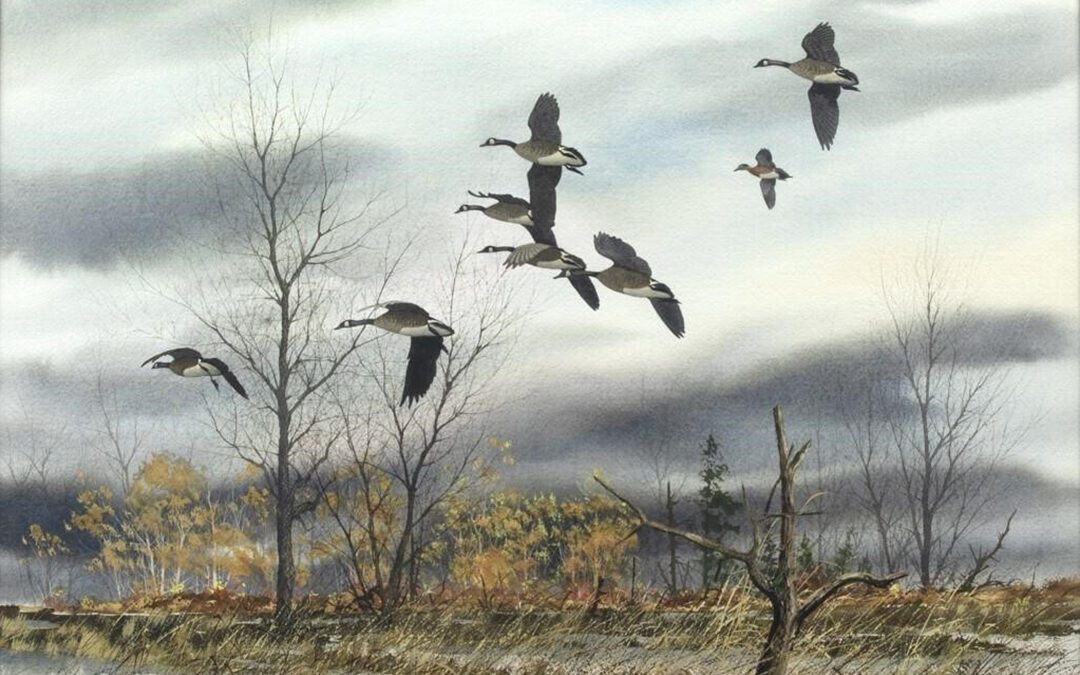
The eloquent writings of Nash Buckingham (1880-1971) were relatively unknown until Derrydale Press published several of his books in the 1930s. But “Mr. Buck,” as he came to be known to his legions of devoted readers, had been writing magazine articles for years. This captivating story appeared in the April, 1914 issue of Caspar Whitney’s Outdoor World & Recreation. It is vintage Buckingham, right down to the setting at his beloved Beaver Dam. An interesting aside was his byline, T.N. Buckingham. Why the “T” appeared with this story and none of his other writings remains an intriguing mystery.
Nature had at last smeared a layer of frosting upon our slice of the earth’s cake, and we duck and goose shooters, full hungry through months of shot and powder fasting, looked on with overjoyed expectancy and were glad in it.
Here it was turning winter again and last January had seen me saying good-bye to my friends, the Rileys, when they left our club at old Beaver Dam, and moved down into the “Bend.” I had heard from them occasionally; how little Mike was growing clean out of his boots; how Mr. Riley was supplying the countryside with the finest of delicate catfish; and of the prospects for a big catch of fur. Mrs. Riley wrote of the wild turkeys that were “using” in her backyard cornfield, and of the quail that fed on the pea patch lawn. For, to identify their whereabouts completely, you must know that the woodland abode of my friends was pitched just above O.K. Landing, some seventy-five miles below Memphis, right in a corner pocket of one of Ole Mississippi’s gigantic elbows.
I recall distinctly that we were all at Sunday dinner. Grandfather had just stuck his specially whetted blade deep into the red heart of a ponderous rib roast. Grandmother was frantically endeavoring to restrain baby’s furious onslaught upon the innocent, but fascinating gravy dish; while Bunk and I viewed this typical home scene with placid expectation and platters held at “ready.” Outside, across the expanse of wet blown lawns, a biting north wind, swooping on the heels of a chilling rain, whirled the leaves end over end in rollicking carnival of winter pranks.
Came then the Melody! Down from the dull grey heights it floated, a wild clangor beating past the barriers of civilization, a vibrant babel above the housetops, chatting o’ chill warped stubble fields in the ice gripped north land left behind, voicing a clamorous longing for warmer climes, white and golden gravelly sandbars, luscious rice, pea and com fields to come.
“Ah — ah-unnncckk — uh — orrnnkk-un-onk — nonk —uunncckk!”
Grandfather’s cherished knife edge bent unheeded upon the hidden skewer, grandmother and Baby Dumpling, sensing it too, forgot the conquest of the gravy dish and paused to listen, keenly alive to those harbinger calls from the wild goose gabblers. Bunk and I met at the window — to look. There they were, scarce rifle shot above the grove elms, a long moulding, melting V, swinging, wafting into and out of line, strict of discipline in response to guttural flight orders, hoarse of chorus — and on their way!
“Unk-ah-unk-ah — ornck — uk-onk — ehuunncckk-onk!”
“Au revoir, gents,” said I, when the flock faded into twinkling specks and almost vanished, beyond the misty park. “I’ll see you afore’ long, when things get right.”
“Me, too, gents,” echoed Bunk, “I’ll see you too, won’t I?” (looking up at me). And back through the lanes of the winds that blow came a faint, defiant, “UUNNCCKK-ah-ah-ONK!”
We had climbed a score of times since then, Bunk and I, into the dim vaults of the attic, to delve and potter in our treasure trove of hunting and fishing truck. What evenings those were to be sure! Between us, in mid- floor, the battered old trunk, and beside it, the length and breadth of our gigantic companion of all trips, “buster” the big suitcase. A long sigh from Bunk.
“Now let me see, IS that everything?”
“Your waders and heavy socks, righto, check ’em offn’ the list!”
“Done done it.”
“Quit foolin’ with those reels and flies, you make me homesick.”
“My boots and stockings?”
“Uuummpphh!”
“My two fleece lined overshirts — is that goose call tied on?”
“Those shirts ought to be washed.”
“You might have saved their lives two years ago — too late now.”
“You’ve shipped the shells, all the guns are here!”
“All present or accounted for, Your Fatheadedness!”
“Don’t as you value your creamy hide cause me to break a lung strapping that luggage and then shriek out that you’ve overlooked your toothbrush or cold cream — or pearls. Is that EVERYTHING — answer me, Yes or No!”
“Yeth — Ivory Knob.”
Two evenings later we “lit out” for Riley’s!
Our first day at the club, shooting ducks, is another story. I could tell you of how I bored deep into the lower cypress brake and made it hot for the big mallards that swarmed and clucked and circled through the tree tops and fluttered down to rich feeding in the loblolly beneath the button willows. I could relate, too, how Bunk drew the New Stand, just behind a wall of buffalo grass in a cove opposite the clubhouse, and boom’ banged away to her heart’s content. And I can prove her part by showing her as she came up through the cotton patch that afternoon with a clean state limit to show for her work. But our story really opens next day, when Riley himself appeared across the lake, with his quick little horse and roomy fish wagon. Bunk climbed up beside our smiling host while I chucked in the two sacks of wooden profile decoys, the war-bag and shells, and swung atop of it all to hold on as best I could. For us it was a voyage into virgin territory and each turn of the sandy loam and buckshot road held something of interest.
A killing frost had fallen, the sun was brilliant in its path of glorious autumn radiance, abundant, snowy fields were alive with darkies, singing and chatting away while picking at their crops. Rapidly we passed from one plantation to another, swinging gradually all the while toward the southwest. Part of our way led along the sloping bank of a vast cypress stretch, another turn and we penetrated the somnolent shade of the forest itself and out again into the open country. We clattered past comfortable plantation homes, flanked by bulging barns, these in turn sentineled by snug whitewashed darky cabins with grinning, playful pickaninnies rolling poached egg eyes from the doorsteps. The countryside seemed teeming with prospects of good cheer; even to the very fatness of grunting unsuspecting porkers laying on fat against the treachery of their doomsday.
At length we reached the sloping bank of the levee, topped it and entered, so Riley said, the borders of our hunting country. Some two miles farther on, through an intervening community of abandoned bottom land, subject to overflow, we turned a comer and sighted Riley’s tent house. And there was Mrs. Riley, as prim and neat and hearty of welcome as ever, and Mike, grown, sure enough, almost like Jack’s beanstalk.
“Light down, folks,” said Riley, “here’s the brown stone front an’ please to notice the magnificent grounds an’ surpassing view. ”
Women like things to first be put in order, and this, to Riley and me, couldn’t spell “time-out” with goose prospects. So we left the afternoon’s setting down to Bunk and Mrs. Riley, while we two, with Mike all in a perspiration to help, set off up the sandbar to explore for territory and get things in readiness for the morrow’s fun. Afternoon was well along. We loaded the light but cumbersome bulk of the decoys into Riley’s boat, Mike bent to the oars and we set off a long narrow strip of muddy water, which, slipping in from a recent slight rise had spilled behind the bar, and cut it in half. Riley packed the 22 Hi-power while I lugged my 16 gauge and a pocket full of shells loaded with number two’s. For thirty minutes Mike pulled steadily up the shallow cutoff, heading in and landing finally under the slope of a major bar. We stacked the decoys on the beach near the boat and set out on a tramp of discovery. Not a goose in sight! On we paced, until Riley, stopping suddenly, put a warning hand behind his ear. Down wind from the distant head gravels of the bar came a faint “Ah-euunncckk!” On went the grinning Riley, until from the height of a sand rise we saw, still far ahead, a few dots that betrayed the sentinels of our strutting enemies — the geese.
“Bob,” said I, “you know this country and the goose hangouts better’n I do, suppose you take the little needle gun, drift on and sorter circle ’em. I’ll drop down behind this snag here, with Mike, and take a chance on some of their royal goosenesses’ flagging down into this side track. Sign what says ‘Derail Here!’ Whatta’ya’ think, Old Timer?”
“I think so,” vouchsafed Bob, “git down!”
Mike and I “got,” and away stalked the weatherbeaten figure of my friend. The huge stranded tree which was to serve us as a blind lay sloping off a dippy sand ridge. Below this dip, snuggled close against the bark of the dismantled willow, I scraped a trough in the soft sand and lay down to wait. In a private nest among the switches Mike cuddled into nothing. On one side I could maintain a far and wide survey of the bar, and by peering underneath the dip, I could also manage to accumulate a pretty fair idea of what was going on toward the river. An eternity seemed to pass. Riley circled far out and disappeared over the east rim of the sand waste. An occasional “eeuunncckk” gave hope. They grew more frequent. No sleeping at the switch for the master goose — Riley was spotted to a certainty. What a babel of alarm preceded the wind-blown pop of the Hi-power. He’d landed on ’em! A cloud of black specks beat into the air, mounted the shore line and flapped down wind my way. Not even an eyebrow showed from my hiding place. Then disappointment dropped like a night shadow — surely, but slowly they were swerving off my line.
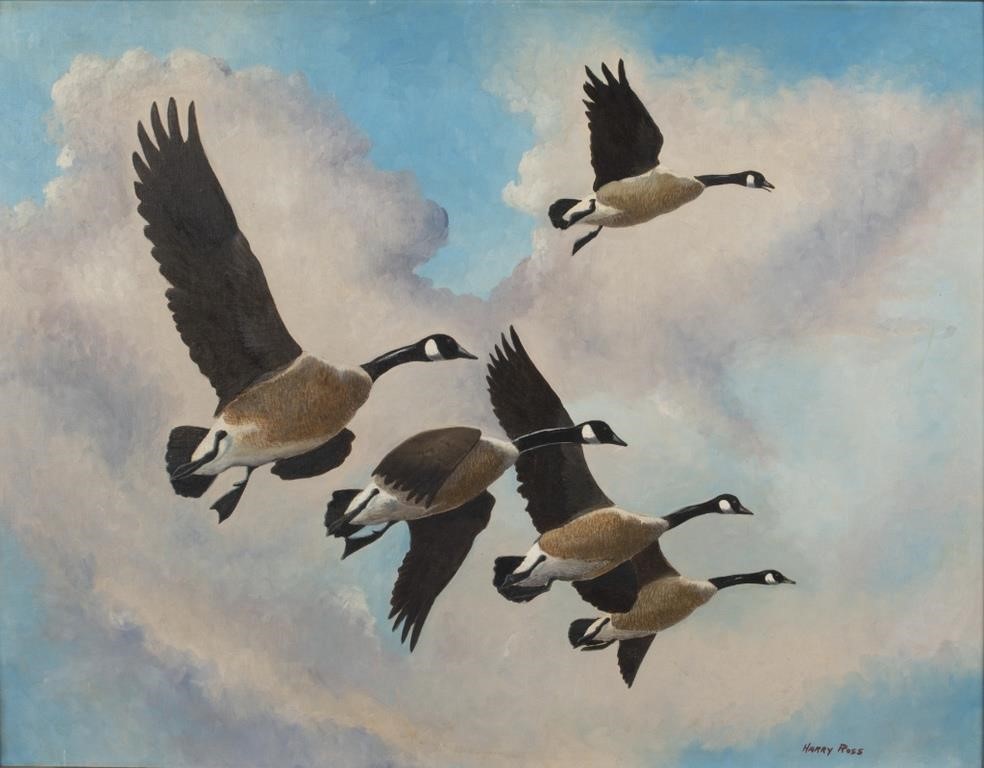
Harry Ross (20th century) Flying Canada Geese, Oil on Canvasboard, 22 x 27 3/4 in. Photo Courtesy Copley Fine Art Auctions
Another pop from the invisible Riley, another cloud of winking dots headed logward. Hope flamed into hot expectancy. Their hunks and honks came blown in a storm of echoed heartbeats. From under my precious log I watched the nearing line and the closer they came, the tighter I squeezed to my dead tree. Cocked, primed and loaded to the muzzle. A faint click of drawn trigger.
Now come on, you great big beautiful geese! What a bedlam of honking!
I saw the puff breasted pilot weaving at their fore and mentally placed him first on the death film. On they swung, right smack dab over the snakelike roots of my treetop. The leader’s hulk loomed black between me and the cloud flecked sky; the familiar little tube caught him, swung ahead — and the opening gun of the goose war of ’13 cracked like a well snapped bull whip.
Didn’t he come tumbling, though! And didn’t the rest of the flock take on something scandalous? Such a hovering, clustering consternation and glutters of surprised dismay, I saw Mr. Leader’s neck flick backward, saw him wilt with an in and out folding of his powerful wings, and by that time the 16 was warmed to its work and in the heart of the flock, spitting and popping like a live thing. A thunderous wallop right behind me, a blurred vision of Mike’s leaping out of the branches, a last despairing shot at a side slanter. Empty! I looked around. The pilot lay breast to sky out front, Mike was retrieving the bird that had almost mashed him in its fall, and while we looked a third goose turned loose all “holts” and plunged to earth — far down the bar. Wasn’t it fine and dandy, though! Three burly geese down and out right off the reel — just on chance prospect, too! Ensued quite a period of lying in wait. Mikey moved up to keep me company, and between us we plotted black doings against the geese.
Several small gangs flew high over us and dropped back upon the northern shallows. At length a far-away speck developed into Riley. Our minds were as one on a location for next day. We hiked to the boat, shouldered the decoys. Mike caught up the long handled shovel and for half an hour there went forward a pit digging bee. Into these we piled the decoys and then dropped down the rippling slough to where Mrs. Riley had put a light in the willow gap that marked Sweet Home.
Someone shook the flap of our compartment. We lay quite still. It couldn’t be Dixie, the black puppy who roomed in a palatial soap box under our bed and occasionally chased her tail for a soft spot.
“Come alive,” said Riley, “three forty-five — Mistis’ gettin’ corrfee.” We were fully awake by now and when I threw back the sheath of bedding, I realized that Old B’rer Frost had driv’up an’ hitched during’ the night. My toilet was elaborate, requiring the side of the bed and a world of speed while I put on my boots, cap and goose call. A pocket flashlight showed me the bucket and basin — then I parted the flap of the home tent and looked in upon an exquisite little stove side setting. Riley — with a toehold on the table leg and his face four inches inside his extra special police positive coffee cup. When it comes to general all-round eating ability, I believe that Riley is a diamond in the rough. With proper training and coaching and a year or so in fast company, he would be worth a bet — any old time.
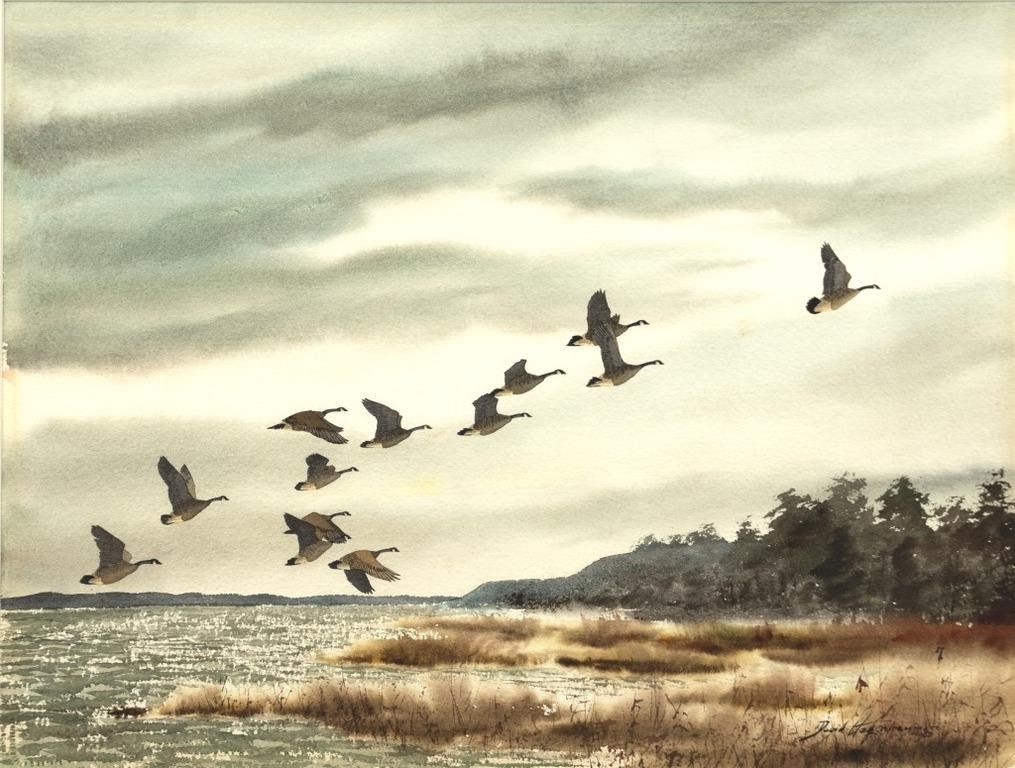
David A. Hagerbaumer (1921-2014) Canada Geese, 1960, Watercolor, 17 1/2 x 22 1/2 in. Photo Courtesy Copley Fine Art Auctions
He is not a flashy eater, nor for that matter a tremendous feeder, but he is busy all the time — all the time, he’s busy.
He has long arms, never wastes a punch and above all is a magnificent judge of distance. And what is even more important, while not wonderfully fast, he is a cracker-jack two handed eater. I have always contended that had Bob ever gone in for playing the “XY- zilliphone,” one of those musical railroad sections with metal cross ties which the musical Zeroes beat with child-size tom-toms, he simply could never have been headed off. At any rate, Mrs. Riley was just shooting a platter of radiant hen-eggs fried “One- eye-to-heaven,” and a pan of hot, obese biscuits, when Bunk came along and “throwed in” with us. That was some “deestruction” when Mike finally homed in against the table and added his voice to the eating.
Bob and I are both pupils of the Old School when it comes to applying the K.O. to an opposition of ham, eggs, and burly biscuits. In the fight game there is a punch called the “one-two” — a hard, well sighted left jab with the right coming along just behind it, real snappy — one-two-zip-bing — even so — just like that! The same principle applies when it comes to landing on fried eggs and buttered sofa pillows. Lead with the left blade — split the egg — flop it onto half biscuit — come up with the right — all off! Four or five eggs and two cups of hot kill-chill drip coffee will take anyone a long way up any sandbar on a cold morning.
There was a smudge of grey on the hearth of the East when we filed down through the willow gap and out upon the yielding carpet of the bar. Its wide expanse and the unseen river beyond might have been an ocean stretching away into unknown regions. From below the Bend came the measured chugging exhaust of a packet driving up against the push of sweeping current. We shouldered our guns and strode off toward the boat, Bunk with a hand in the warm pocket of my coat, all alive and excited over the possibilities of her goose hunt. Into our craft we piled with Riley at the oars. Up the shallow slough we thumped, while flock after flock of roosting mallards took wing in roars of protest.
I have come over timberline in the Rockies, when Dawn, parting her blinds, leaned out and pried deep and smiling into spruce toothed gulches and across the vales and mists of placid lakes. I have seen daybreak on the plains, beyond an arid rimless world; I have caught its first gleam upon the birches and golden tamarack tops in the moose bogs of the North; it has crept down to me through vaulted city canyons and melted breeze blown across southern seas. But never yet have I found a day-birth that labors so tranquilly as night’s demise upon a sandbar. On and on tugged Riley, full busy with his thoughts and we two, listening to the ripple of the boat’s wash, dreamed dreams of a wonderful shoot and flocks of brainless obliging geese, who just would decoy. We spoke in whispers while the daub of grey smoldered into an ash of rose and flamed a threat of sunrise.
And in the heart of day’s opal belt, a great star, diamond blue, burned its defiant, steadfast spotlight. The giant steamboat, rounding a bend, loomed glittering and monstrous as she cleaved a way ahead. Scarcely had our little boat grated hard around upon hidden shoals, before we were halted by the same sonorous, warning “Ah — uunncckk!”
It required probably five minutes’ swift work to set up the decoys, a neat array of confidence goose “come-ons” they were, too. Bunk, neck deep in her pit, looked on eagerly, offering suggestions as to pose and poise in such cases as wronged her sense of style in decoys.
“There,” gulped Bob, shoving his last bird into the powdery sand, “all slantin’ inta the wind, if them geese don’t decoy to ’em they’ve gotta be devilish wise — that’s all I gotta say.” Then he and I dropped down into our double pit and prepared for business. First we put the long handled shovel across the pit mouth and made a gun rack of it, then we shrouded our guns in an old coat. Bunk, meanwhile had arranged a rack of her own, fashioned from a dead drift limb and protected her gun by means of a triumphant tan stocking pulled down over the muzzle and fastened about the stock with a rubber band. The sun was well up now, revealing the vast frost tinted bar, the drab river still steaming off its vapor bath, and the bleak, forest clad outlines of the high Arkansas shore. A light breeze puffed out of the north. “They’ll hav’ ta swing aroun’ to decoy,” said Bob, “an’ them what don’t ’ll come heatin’ up-wind — lookee yonder — there’s a big bunch gettin’ off the water ’cross yonder up the bay. ”
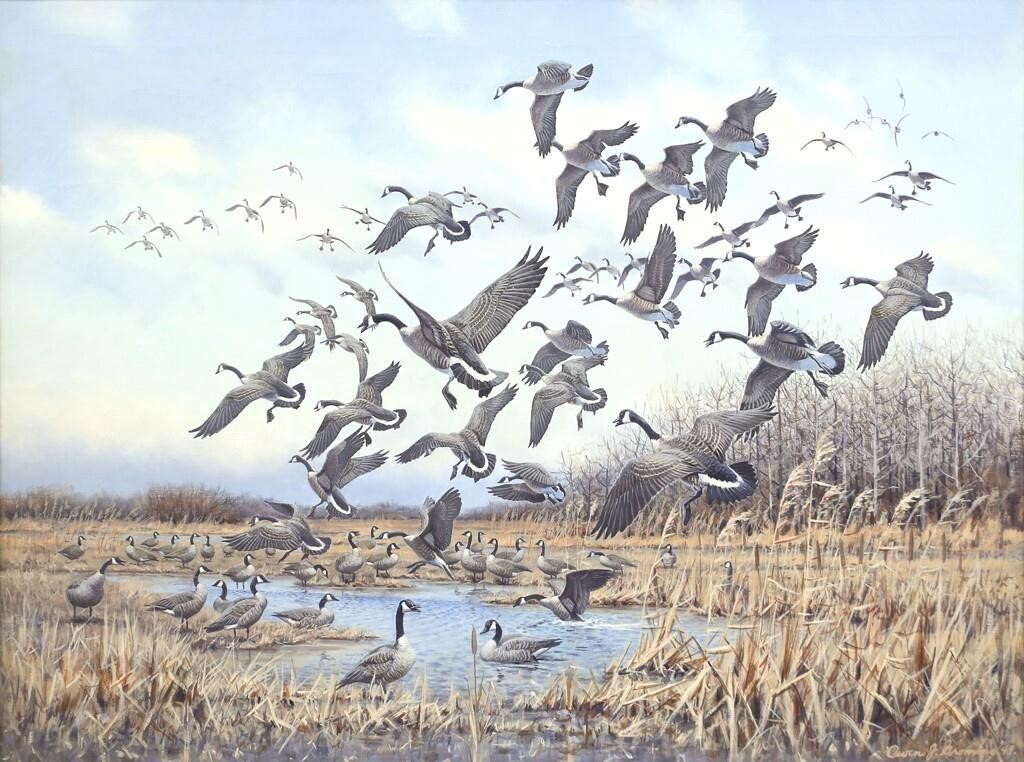
Owen J. Gromme (1896-1991) Horicon Marsh – Canada Geese, 1949.
Oil on canvas, 29 3/4 x 39 3/4 in. Photo Courtesy Copley Fine Art Auctions
We heard their rising clamor and shrank watch-fully into the pits. Out came my goose call and a loud, awkward squawk supposed to be sufficiently succinct of purpose awoke the reaches of the bar.
“They’re swinging, they’re swinging,’’murmured Bob — then — “you be peeper — we’ll keep down an’ open up on ’em when you holler ‘NOW’!” With that both he and Bunk were effaced from the scene pro tem.
My awkward call had proved a stray bullet gone home, for the flock pivoted over the Mississippi shore line willows and headed down the bar — straight for our trap. Talk about your deer stand when the hounds bay behind some poor fagged out, scared to death buck! Talk about chattering teeth on a cold morning and the seductive brilliancy of military rag-time! Why — there is no excitement on earth like a pit, a bunch of decoys and a herd of bugling geese preparing to do business on a sight unseen basis. The rim of my pit dike and the tip of my cap were a hopeless merger and the big honkers had cupped their wings and were sliding along low almost over the decoys. Off flashed the gun cover and just as I pitched the 16 gauge to my shoulder, the lead goose threw a shadow into my pit. Up sprang I, with a shout of “NOW.”
And up sprang Riley and Bunk. Fellow Goose Shooters, I am here to state that for the space of twenty seconds there was something doing in that immediate vicinity. I’ll admit, frankly, that I tried to kill all the geese in the world; that my gun hung after the two first shots and that I added quite a little to the complete uproar by proclaiming bitterly against it. Bob bounced both barrels of number twelve off a particularly unfortunate goose, and little Bunk took her time and nailed a fine fat fellow, too. But my shots had felled two birds and what with all the shooting and excitement and falling geese, it looked as though the rebellion was over for the time being. The disrupted flock beat it off down wind, sorely stricken and thrown into hideous confusion. Was Milady delighted? She was dancing in her pit when I scrambled out to retrieve — chanting something about “Goosey-goosey Gander, where shall I wander,” and making so infernally much noise that I reminded her of the other rhyme about the “Little man who had a little gun and his bullets were made of lead, lead, lead!” I stored the slain honkers in a frost encased cavity beside a neighboring snag and rejoined Bob in our pit.
The latter was just lighting his pipe a bit later and remarking that it took something pretty strong to make his tongue crawl, when Bunk, with watchful orbs turned south, hollered “I spy. ” Sure enough, five geese emerged from the atmosphere in that direction and hunched luggingly up toward us. Once again the call gained their attention to the general direction of our whereabouts. With set wings they deliberately volplaned directly at our wooden sleuths. I was just on the point of giving the signal when up shot Mr. Leader and barely out of range he led his flock of four craftily around the other way. But our wooden heads were there with the foolish powders and having given them the “once over,” in swung Messrs. Geese. We should have got all five of them, but I made a mess of my first bird, and spent all my time on him while Riley and Bunk were plastering several loads of number two’s all over the face of the sky, some of them taking effect in the person of a singularly fat goose who “took the count.” Following a lengthy post-mortem the two victims were put into our cold storage lockup and the scene took on its customary attitude of peace.
During the next few hours only one goose showed up and when he finally circled on off up the river we rose in a body and voted him the foxiest guy that ever lived. He flew around and over and all but under our decoys. He scrutinized them from every direction, read both sides of them and read ’em on the edge. “Not a friend in the crowd, ” muttered Bob as Herr Goose finally came to a decision and went his way!
The sun was probably just past overhead when Bunk suggested that we come out of the pits and set about a little relaxation in the shape of lunch. Now it is a fact, and a well proven one, that the very best method of getting a rise out of laggardly ducks or geese is to just dare to emerge from one’s blind and get gay with the one full of sausage and biscuit and the other laden with coffee, put an end to all goose sense we might, or might not have had. So out we wormed, and pretty pronto Bunk had a little blaze snapping beside the far end of our refrigerator snag and the coffee bucket doing a get-warm stunt.
Riley had just settled himself comfortably against the log, bitten a half moon out of a sausage sandwich and observed that Bernard Shaw made him sick, when Bunk let loose a muffled shriek and pointed due west — toward the river. There, just skimming the tree tops, came a long, wide line of geese making a sneak on our bar. Consternation reigned supreme — and then reigned some more. Cries of “To the pits; Kick out the fire, Douse the glim, Never mind me, save the women and children,” rent the crisp autumnal air. Bunk jerked the coffee can aside just as I made a kick at the blaze; Riley shoved the sausage bucket under a long log and off to the hides we raced, diving into them finally, not a moment too soon.
Had they seen us! The goose call, muffled to a pleasing tone, besought our unexpected visitors to overlook appearances and do business with us.
Widely they circled — once again — far down wind — then a twisting circle and back they headed — wings cupped. But discretion proved the better part of valor — off they veered and lit probably a hundred and fifty yards beyond the outskirts of our “come ons. ” Gradually we arose, peeked and stretched our strained and cramped limbs. The infernal villains! Their big bow-legged scout goose waddled a bit to the fore and set his sharp eyes full upon us. His retainers picked about, cleared their throats or fell to napping. “If I just had that rifle I’d sho’ knock two or three of those rascals up to about 800,” said Riley.
We were standing up by this time, fully visible, but the geese didn’t seem to be apprehensive — just looked, saw our profile decoy and wondered! We fell to chatting in undertones and Riley was just telling us what a magnificent goose bar lay a bit above, when something, either ashore or at any rate beyond the geese, set Watcheye, the scout to running his warning scale. Down we dodged and up went they, swinging our way, too! Would they this time? The only one near enough for a shot. I think all three guns had the old chap spotted for three shots sounded, timed almost as one, and down he came like a ton of brick! Thirteen full pounds he dragged the fish scales to that night. Then we crawled out and resumed lunch, after which I set off up the bar, carrying three folding decoys and having exploration in my mind.
A mile farther along the waste of gradually rising sand brought me to where the island bar meandered out into the gravelly river spits. The district was littered with flood deposit and stranded snags. A deep haze settled about me — afternoon was just about to turn over for another nap. I waded out into the shallows and set down my three folding decoys — for what reason I’m sure I don’t know, and was just wondering, in addition, why I had lugged them and a box of shells all the way up the bar.
Picked up again! Then and there came the goose alarm and, I, looking wildly about for shelter, espied a jumble of heavy boards lodged fantastically about a tree root close by. In two jumps I was into the nest, stretched out full length, watching and waiting. There they came, two of them, as straight up to the bar as a plumb line could have caught them. A hundred yards off they caught my decoys, veered a bit and setting their wings at seeing so congenial a little crowd of friends, swung glidingly in. And I let them do the ridiculous. Just as their bandy legs were wiggling in preparatory ground maneuvers, I sat up and rolled the bones. “Seven-eleven, I yelled — Oh, you Gander! Bamm-bamm-wop-flippity-floppity-baum-woop!”
It was just like shooting fish, even if I did have to throw in a third shot, and retrieving those two burlies within ten feet of each other was a genuine pleasure. But no more geese came along and my patience finally frazzled out.
Riley had gone to the boat for something when I came back to the pits and Bunk was coiled up in her big coat and two gunny sacks — fast asleep in her pit. We had a reunion a bit later on when Bob returned and Bunk came out of her nap. “Time t’was sumpthin’ doin’ with them bullies,” said Riley, cutting an eye at the “low descending sun!” But time waited not for us goose hunters, and half an hour toiled off without hide or hair of gooseflesh. “This ain’t no way,” fumed Bob, “Aw — come on, geese!” And as if in answer to his call, and our prayer, the biggest flock of the day came lugging in from the northeast — the rascals had evidently been feeding over the way. They circled once — then, strange to say, split all asunder; some flew east, some went west, but some flew over the shooter’s nest — and got in awful bad — awful bad. Three of their number went to glory amid a popping of ballistite, honks of dismay and general all around hullabaloo.
When it was all over, Bob and I decided that the time to leave had arrived — there were the decoys to take up and sack, transport to the boat, and heaviest of all, some several geese. Our blacks groaned in anticipatory labor. Bunk was loaded with the guns and her coat and trudged off — the same willing, strong little huntress who always does her share. But it took us two trips to load in the geese and decoys, the former carried strung on the stout handle of the shovel.
Evening was dipping gold tipped sun ladles into the glowing tureen of the west when we dropped down the quiet slough. Across the flaming shadow flecked glass of the great river, above and beyond the gaunt heights of the forest, a trail of smoke curled from the cook fires of some labor camp. Little Mike met us when our craft slid in upon the near bar; we resumed a new division of the spoils — and set out again. Our footsteps were noiseless, we talked little, just walked and watched and walked and were busy with our thoughts. Myriad flocks of ducks winged in zizzing flight to faraway night roosts. A startling honk rasped from shadows beyond the bar shallows on our left. Instinctively we dropped to our knees — graven images upon the sands, in the twinkling of an eye.
“Yonner,” hissed Riley, “the pilot goose, see ’im swinging down the slough under the trees, giv’ ’em a call. ” I did and to our surprise the spy turned sharply on his great pinions and beat straight across the powdery waves of sand to where we crouched. In a moment, it seemed his bulk reared sharp and clean cut above the willow tops and when the ballistite shoved that ounce of 2’s into him, he simply shook himself like a wet dog and plugged ahead. But there were others where those 2’s came from, and the third strike put him plump onto the bar, stricken sorely and with Mike fair atop of him almost as soon as he was struck. And even while we bent over him, tying his warm plumpness into the fold, a hissing of wings came down to us and his friends in whose interests he had attempted the survey of the bar, slid past into security.
It was plum pitch dark when we threw down our burdens before the glow and savory welcome of the tent house. No moon was riding high to show a glim, only a deep and brooding black and awesome stillness down there in the faraway Bend.
The air was sharp with gathering frost. We hung the geese high, washed up and combed our locks; slid into easy slippers and waited for Mrs. Riley to bid us “slide up and pounce upon it.” And when she did, Brethren of the Outdoor Cult, me an’ Bunk an’ Riley did SOME pouncing. Who wouldn’t have — listen to this! Ever eat any fresh water sturgeon — of the fall run? Being loyal to the Stars and Bars, if any one had ever slipped up behind me and shouted suddenly in my ear — “What’s the best fish on earth?” I would have yelled “cat,” quite as naturally as getting up in the morning. But here was a fish, I hate to admit, but it’s true, that had a catfish cornered and with all escape cut off. No bones, save a tiny fern-like back one, just pure white, flaky, sweet meat that sorter ate itself. There were baked spuds, good browned beans, hot rolls picked smoking dreamily from the oven, hot chocolate and some homemade tomato chutney that ate right where you held it. After supper, with the dishes washed and everything made snug, we sat around in the cozy comfort of the tent home and talked of many things.
We of the city, know little of the world whose people dwell so closely in touch with and wrest their bread from nature. We travel our streets, talk business, rates, drive our automobiles, harp upon our sales and losses, our pleasures and the wear and tear of it all. With us, it is a concrete reckoning; a world of stunning human competition. For them, it is a peaceful striving for nature’s yield. Their streets are the aisles of the forest, the paths and trails of the rugged hills; their rates are figured in the cunning of their brains — the jump of a trap, the bat of an eye, the fall of a trigger. Tranquil solvers of world problems — producers, exterminators; furriers by right of conquest of His Majesty, the Universe! We talked that night of the summer agone, of the day’s fun; we went over the trap line of memory! In the quiet lapses, while the old stove purred and hissed, there came from the willow brake hard by the nestling undertone of roosting wildfowl chatter, or through the moonless depth of the jungle there wound down to us the faraway note of some ’coon hunter’s horn.
Finally Mikey rolled his bedding onto the floor and at this signal Bunk and I arose and stumbled into our tent. The light just sorter flickered out — blinking pitiful winks — and all was still.