
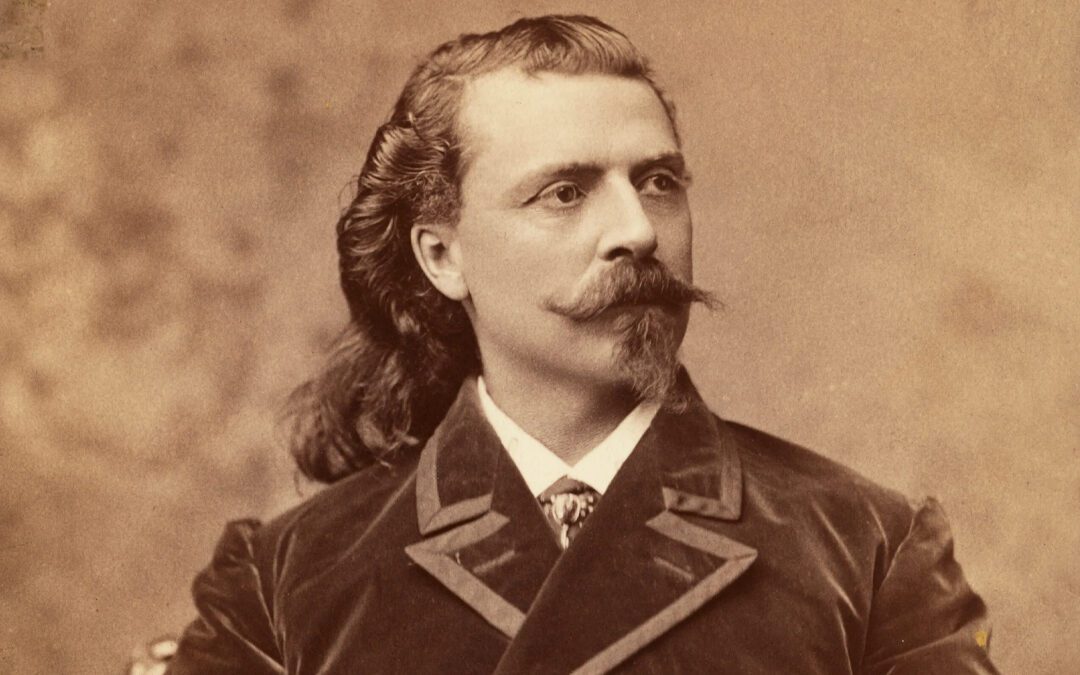
In the echoes of our Civil War, the West drew a tide of emigrants from the rubble of battlefields once communities. Rootless, embittered men drifted across the prairies, in and out of crime. Hostile tribes imperiled settlers who’d endured the privations of wagon travel into wilderness. Slowly the law and the Army gained toe-holds. Rails followed, steel threads east and west inching toward the continent’s spine.
Opportunity often attends chaos. William Frederick Cody saw and seized it.
He was born February 26, 1846, in a cabin on a farm edging the Mississippi near LeClaire, Iowa Territory. His ancestors were Huguenots who’d fled France to escape religious persecution. Records show the Codys owned land in Massachusetts by 1698. His father, Isaac, was born in Ontario in 1811 but grew up in Ohio. As a young man he was twice widowed. In Cincinnati in 1840 he married school-teacher Mary Bonsell Laycock, a descendant of Pennsylvania Quakers. With five-year-old Martha from Isaac’s first marriage, the couple moved to Iowa, where Mary had six more children. Samuel (1841) and Julia (1843) preceded William; Eliza (1848), Helen (1850) and May (1853) followed. Illness kept Isaac from heading for California during the gold rush of 1849, but soon after Samuel’s accidental death in 1853, he moved the family – first, briefly, to Missouri, then on to Kansas. There he supplied wood and hay to the Army’s Fort Leavenworth. He also ran a trading post near the Kickapoo Indian Agency.
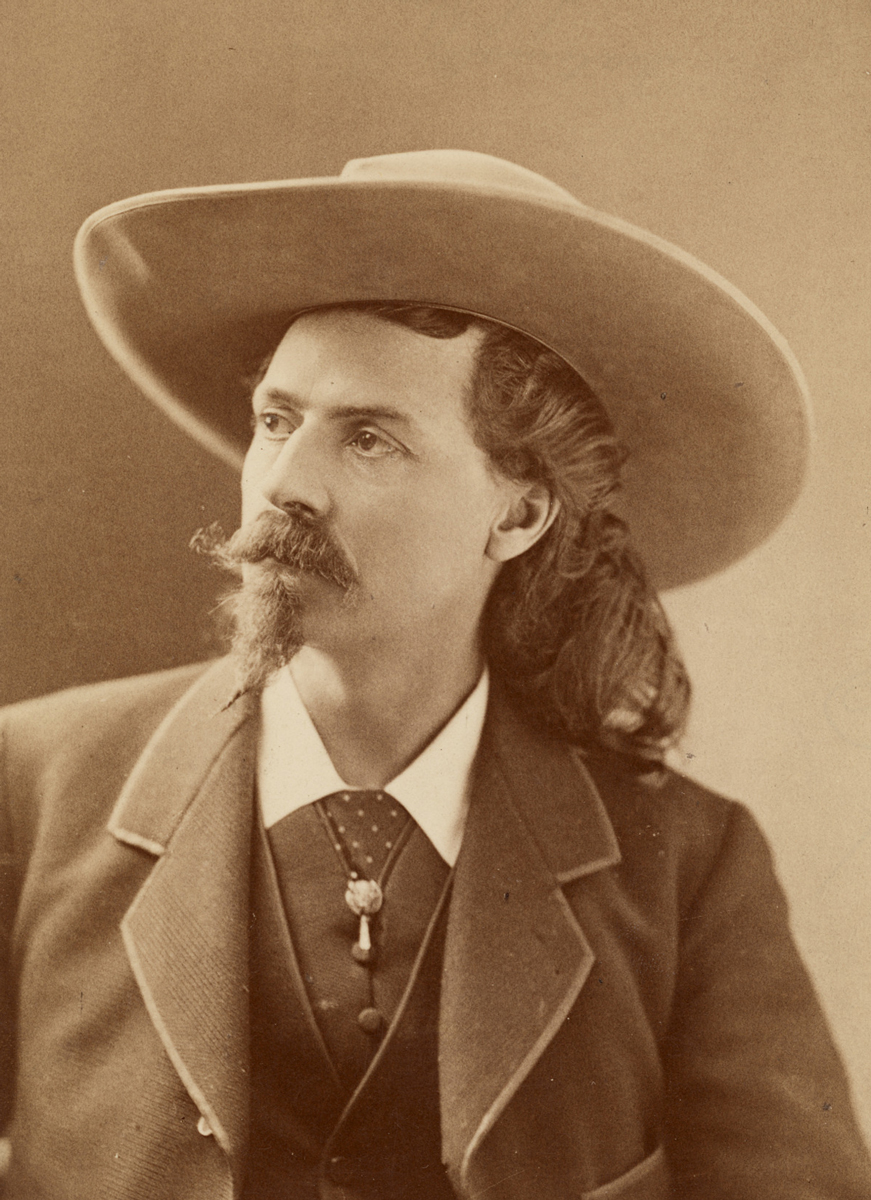
Strife over slavery made “Bleeding Kansas” national news. In 1854, as he spoke against slavery, Isaac was stabbed. The injury was severe but not immediately fatal. In 1855 he and Mary had their last child, Charles. Two years later Isaac succumbed to the knife wounds.
Bill (“Willie”) and Julia cared for their young siblings and worked to support their ailing mother. Their sister Martha died not long after she left to marry. Able now to ride alone and herd cattle, Bill was hired by Russell, Majors and Waddell, a Leavenworth freighting company. A year later he accompanied a wagon train to Fort Laramie in eastern Wyoming.
While his work precluded formal schooling over the next two years, young Cody sought and got basic schooling. He trapped beavers, probed Colorado gold fields and would later admit to joining anti-slavery gangs in the border wars plaguing Kansas. Reports of Bill riding for the short-lived Pony Express, started in 1860 by his employer, have been questioned. His name doesn’t appear in the official records of that mail service, but by all accounts, Cody was adventurous and a skilled horseman. Russell, Majors and Waddell were advertising for those talents in young, lightweight lads with the pluck to ride fast through remote places crawling with bandits and hostile Indians.
Packing messages, 14-year-old Cody rode between wagon trains on regular routes. A 45-mile run assigned him early on hardly prepared him for the 300-mile marathon he completed between Red Butte and Pacific Springs Stations in Wyoming. On that trip he filled in for absent relief riders and rode nearly 22 hours without a rest! Another time, he out-raced hostile Sioux to Three Crossings Station only to find the station keeper dead, the horses gone. He galloped to the next post, then led a small group of volunteers back to trail the stolen stock. They surprised the Indians and recovered the horses.
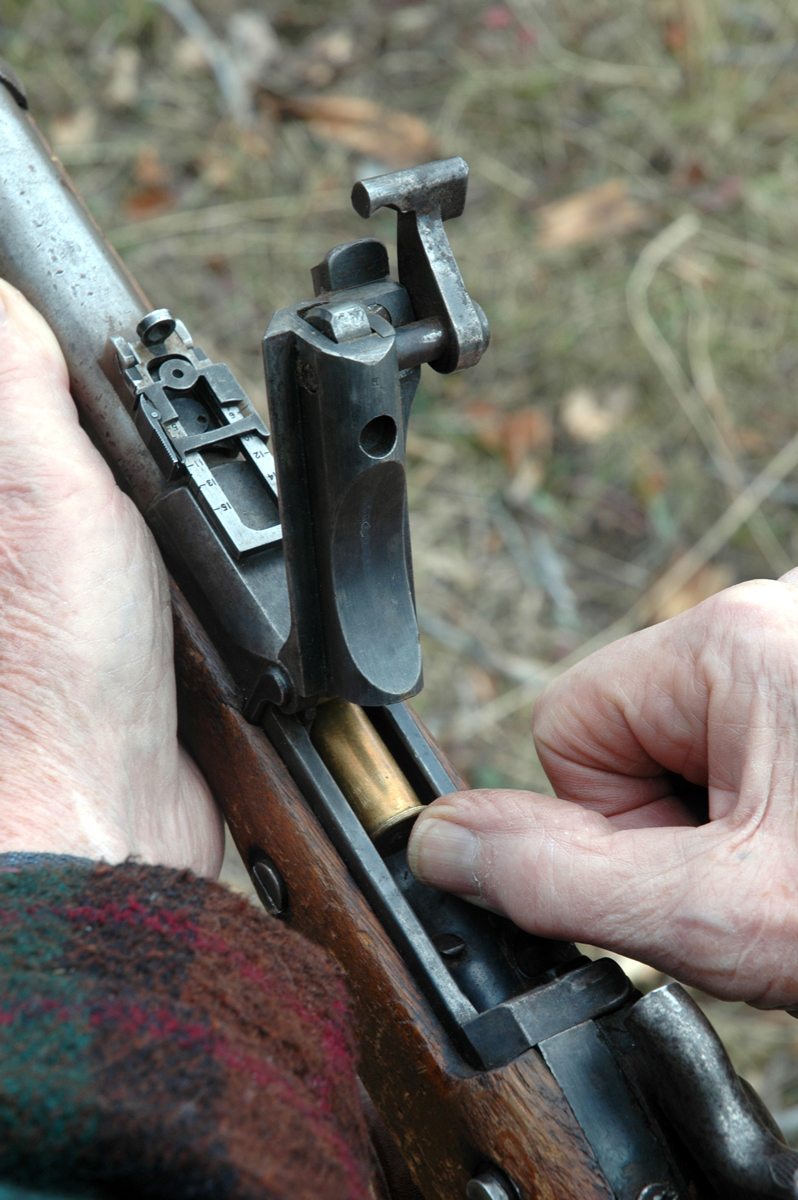
This trapdoor Springfield is bored to 50-70, as was Cody’s. Erskine S. Allin’s breech made cartridge rifles of muzzleloaders. Each required 56 machining operations to produce, cost the Army $5 installed.
During 1861 and ’62, as uniformed armies clashed in the East, Cody served as a Union scout on the plains against hostile Kiowas and Comanches. In 1863 he enlisted with the 7th Kansas Cavalry, which fought in Missouri and Tennessee. A civilian scout and dispatch rider after Appomattox, he was based in Fort Ellsworth, Kansas. There he began hunting buffalo to supply meat to the Army and to construction crews on the Union Pacific Railroad. By his own count, oft repeated, he shot 4,280 buffalo in 18 months during 1867 and ’68.
“Buffalo Bill, Buffalo Bill. Never missed and never will. Always aims and shoots to kill. And the company pays his buffalo bill!” That ditty, attributed to rail crews, may have produced the nickname he was pleased to own, both on the prairie and later as the star of his Wild West Show.
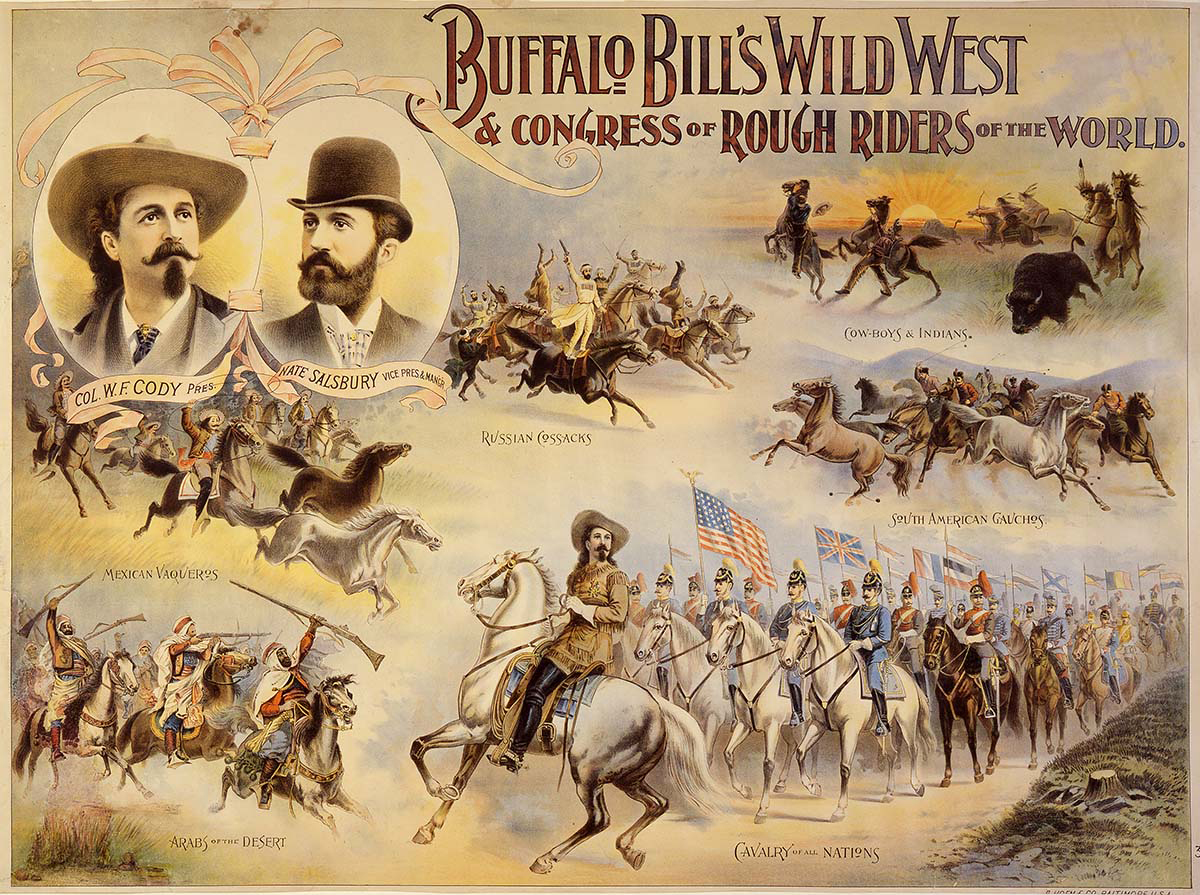
Buffalo Bill’s Wild West Show debuted in 1883 in North Platte, Nebraska. A decade later, after four tours in Europe, it appeared stateside with a longer name and sold three million tickets.
But Buffalo Bill was apparently a contested moniker. Other market hunters were said to claim it. One was Billy Comstock, born in Comstock, Michigan, in 1842. Four years older than Cody, he followed a similar career path, riding for the Pony Express after moving west, then working as a civilian scout for the Army and a hunter for the railroads. Chief of scout at Fort Wallace, Kansas, Comstock impressed Army officers with his marksmanship. In the summer of 1868, he and Cody agreed to a buffalo-killing match. Sponsored by the Kansas-Pacific Railway, the hunt would occur in Logan County, Kansas, east of Fort Sheridan, where there were lots of buffalo.
Cody later recalled the event. “We were to hunt one day of eight hours [with] five hundred dollars a side [going to] the man who should kill the greater number of buffaloes….” He claimed two advantages, declaring his mount Brigham was “the best buffalo horse that ever made a track,” also that he had a better rifle, “known at the time as the needle-gun, a breech-loading [1866 trapdoor] Springfield. Comstock was armed with a Henry [and] could fire a few shots quicker than I could, yet I was [certain] it did not carry powder and lead enough to do execution equal to my caliber .50.”
Cavalrymen betting on the result evidently favored the hunter who supplied meat to their post. Fort Wallace troops cheered Comstock; Fort Hays soldiers laid their money on Cody. It’s unclear if the “Buffalo Bill” moniker figured into wagers.
As distinctive as their rifles were the hunters’ tactics. Cody rode to the front of herds to kill lead animals so others had to dodge mounting carcasses and eventually run in circles. So disposed, the buffalo made easier targets and fell in quicker succession, with less riding than was required of Comstock, who “coursed” or chased the buffalo, dropping them as he overtook them alongside. After eight hours, his 46 kills were strung linearly over about three miles of prairie. Cody tallied 69 buffalo.
In 1868 General Philip Sheridan made Cody chief scout for the 5th Cavalry. He served four years in that capacity, then returned as a scout in 1874 and 1876. He took part in 19 battles, was wounded and cited for valor and “extraordinarily good” performance. The Congressional Medal of Honor followed (to be rescinded later on a technicality, then in 1989, awarded again). A month after the June 1876 defeat of General George A. Custer’s 7th Cavalry on the Little Bighorn, Cody killed a Cheyenne warrior in single hand-to-hand combat.
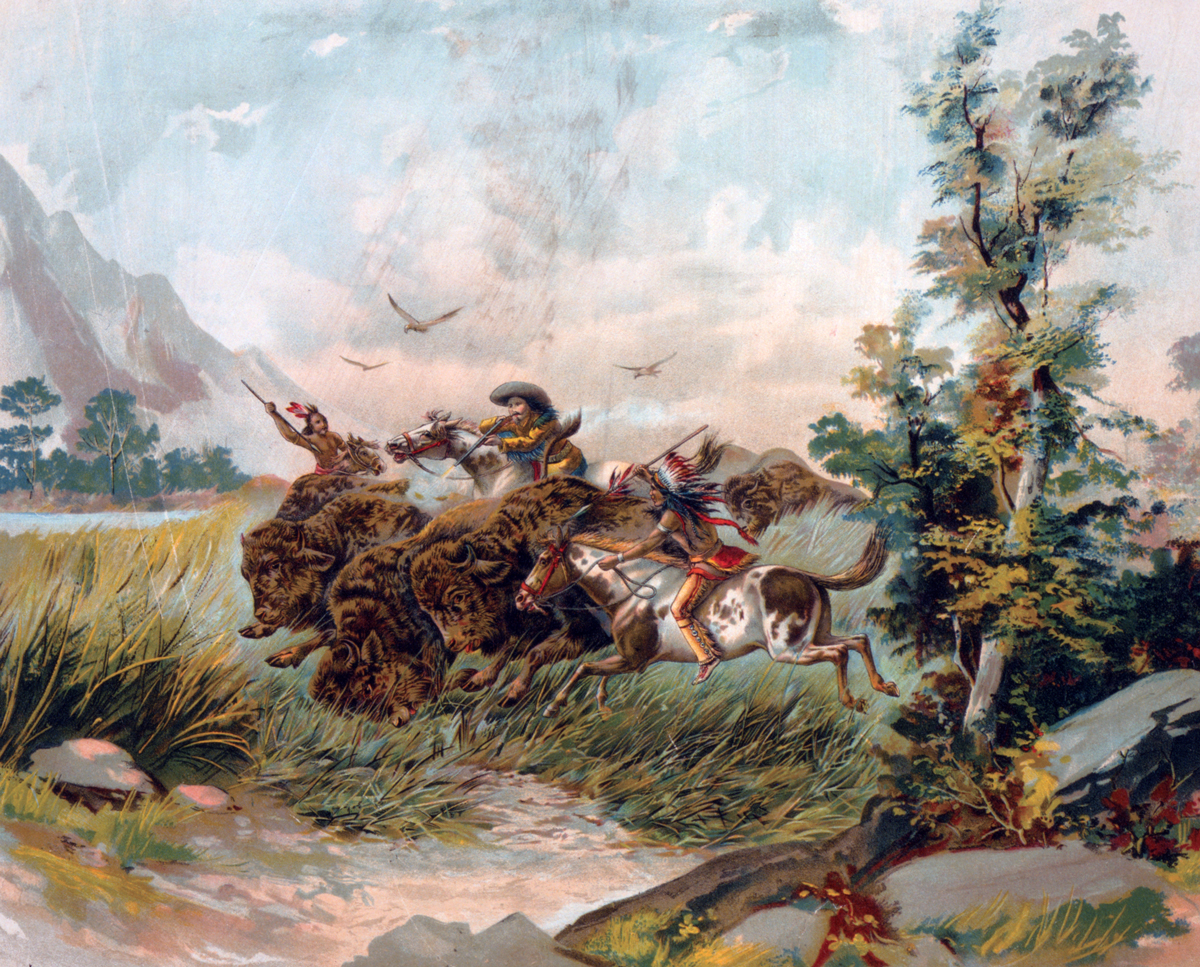
At middle age, Cody left a career of hunting and scouting to turn his frontier experiences into lucrative stage performances. “Dime novelist” Ned Buntline, whom he met on a train, gave him a start.
The nation’s centennial year marked the last great gathering of plains Indians. Their victory over Custer sent them into retreat. On land depleted of buffalo and against superior arms, the tribes could not prevail. Fences were stitching the West, and the meeting of rails at Promontory Point, Utah, in 1869 had hurried its settlement. Continued raids by warrior-chiefs brought stiff reprisals. On Wyoming’s Powder River in late November 1876, soldiers raided a camp of sleeping Cheyennes under Dull Knife and Little Wolf. They killed 40 Indians, destroyed all the food and winter clothing and slit the throats of the ponies. In the bitter cold of the following night, several women and children froze to death.
Justice in towns also came in fits and starts. In May of ’76 Wyatt Earp began work as a Marshal in rowdy Dodge City, Kansas. That September, the infamous James-Younger gang was cut to pieces by citizen gunfire during an aborted bank holdup in Northfield, Minnesota. But law officers were ever in peril.
On August 2, 1876, in Dakota Territory, James Butler Hickok was playing cards in a Deadwood saloon. Wild Bill practiced regularly with his .36-caliber Navy Colts and reportedly shot their cylinders dry daily to keep fresh powder under the hammers. Miscreants feared the lawman’s willingness to use those guns as much as they did his fabled marksmanship. But this day Hickok sat with his back to the door. He fell instantly to the .45 caliber bullet Jack McCall sent through his skull.
A misfire saved the bartender. Caught in Wyoming, McCall stretched a rope in Dakota Territory.
Not all in ’76 was violence. Johns Hopkins University was founded in Baltimore in February. In March, Alexander Graham Bell was awarded a patent for his telephone. Pharmaceutical maker Eli Lilly began operations in May. By December readers had a U.S. printing of Mark Twain’s The Adventures of Tom Sawyer.
But the year brought loss to Buffalo Bill. In Springfield, Massachusetts, on business that would soon launch his career as a showman, he was handed a telegram from a family friend in Rochester, New York. There, his son Kit “was dangerously ill with the scarlet fever.” Cody immediately cut his visit short and took a train to Rochester. “I found my little boy unable to speak, but he seemed to recognize me, and putting his little arms around my neck, he tried to kiss me. We did everything in our power to save him, but it was of no avail. The Lord claimed his own, and that evening (April 22) at six o’clock my beloved little Kit died in my arms. We laid him to rest … amid sorrow and tears.”
Such words reveal another side to Cody, whose adult life had thus far rewarded steel nerves and a watchful eye, whose methodical killing on the prairies he recalled with pride. While it was clear by the early 1870s that the buffalo and the tribes depending on them would not long survive the depredations of his kind, he shot without hesitation or, evidently, much if any remorse. Later he would be eulogized in the press as having symbolized “the passing of the Great West,” instead of one who’d hastened it.
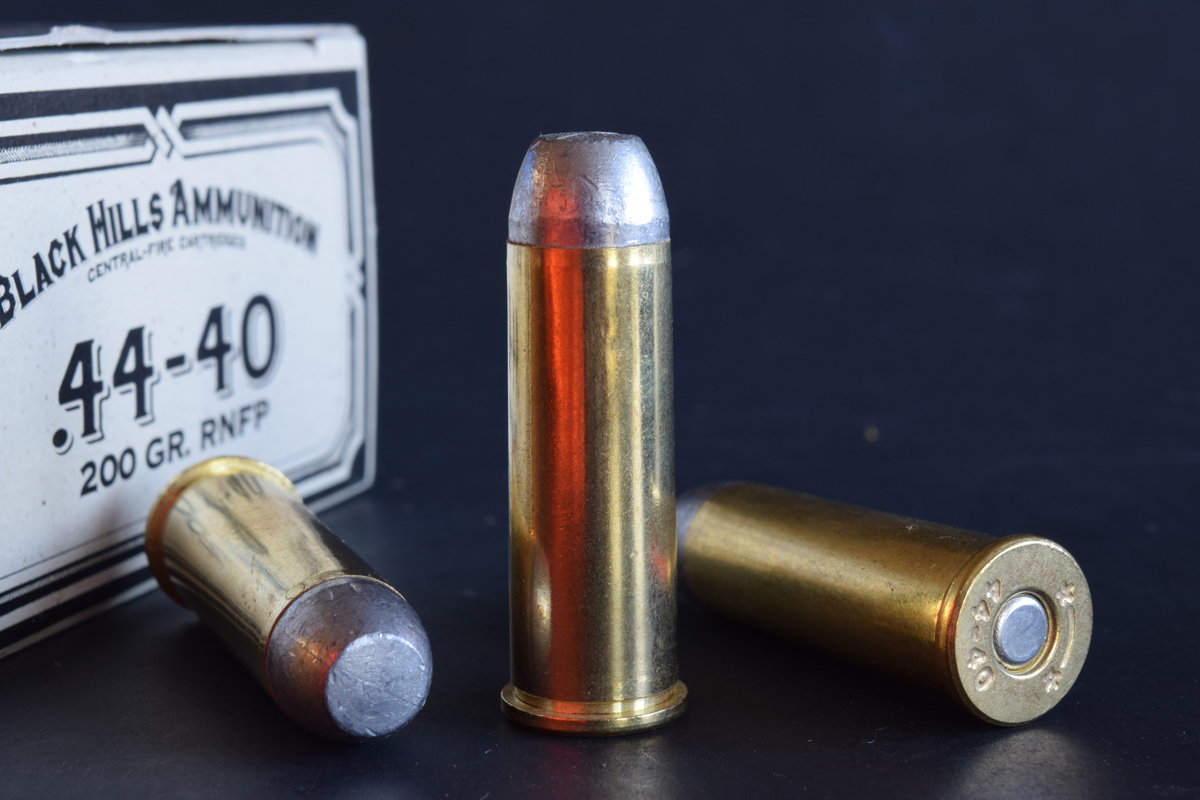
Winchester 1873 rifles in 44-40 appeared in Wild West Shows. But when a stray bullet broke a distant window in a New York performance, Cody ordered smoothbore versions for use with No. 7 shot.
But he also extended that brief era, re-enacting (and embellishing!) life on the frontier for crowds across the country and in Europe. Buffalo Bill’s big break for the stage came long before he was ready to abandon work as an Army scout or hunter. In 1872, under the direction of President Grant and the command of General Sheridan, he and Lt. Colonel George Custer were to shepherd Russia’s Grand Duke Alexis on a much publicized hunt. This complex event came off well. It brought Cody attention from the national press and “dime novelists” whose prose transformed flawed, gritty, enduring men into handsome, dashing, fearless folk heroes who rode like the wind and never sent a stray bullet. One such writer was E.Z.C. Judson, or Ned Buntline. In 1869 he’d penned a novel about Cody, after the two had met on a train. Three years later, that tale became a theatrical production, “The Scouts of the Prairie.” At its debut it starred Buffalo Bill with Ned Buntline, Texas Jack Omohundro and Italian-born ballerina Giuseppina Morlacchi. It toured the U.S. for two years.
After Buntline’s 1874 exit from “The Scouts of the Prairie,” Cody came up with the “Buffalo Bill Combination,” performing for part of the year, scouting in the West for its remainder. Wild Bill Hickok joined the group briefly; but he evidently didn’t enjoy acting and was released after he shot out a spotlight focused on him.
Cody was keen to build on his start in show business. He’d seen how quickly the railroad, hunting and the subjugation of native tribes were changing the West and was now firmly convinced his role in that change could be marketed for a profit. Re-joining the Army’s 5th Cavalry in 1876, he may have had more in mind than military service. Just a month after his posting to southern Wyoming, a party of Cheyennes was spotted pursuing a couple of U.S. couriers. With his commander’s blessing, Cody assembled a small detachment to chastise the Indians. But before leaving he swapped his rough frontier garb for black velvet pants and a red silk shirt with silver buttons. The chase and skirmish were brief. But Cody killed a warrior named Hay-o-wei, or Yellow Hair, then scalped him. According to Cody, he hoisted the bloody skin high and yelled “The first scalp for Custer!” Oddly enough, no other such report would surface; and none of the people involved had been at the Little Bighorn with Custer. Still, the account of Cody’s heroism soon reached newspapers.
Short months later, Cody left the cavalry for the stage. Re-enacting the Wyoming fight, he wore the flamboyant clothes he’d donned that day. He changed “Yellow Hair” to “Yellow Hand” (speculatively because Custer’s flowing locks had made him “Yellow Hair” to the Sioux) and called the fallen warrior a chief. Audiences packed theatres even as they decried the barbarism of the scalping.
In North Platte, Nebraska, in 1883, Cody first offered to the public what would become “Buffalo Bill’s Wild West Show.” He got needed help from producer and partner Nate Salsbury, and from publicist Arizona John Burke, who used what were then innovative techniques: press kits and billboards, celebrity endorsements and product licensing.
The Show played well to a nation still feeling the tug of manifest destiny, but also the results of a male populace increasingly anchored in cities and taking wheeled transport to work in the service of large companies. The “mountain man” was gone. Frontiersmen like Cody, and pioneer families who’d survived to prosper in the raw West by dint of faith, courage, wits, perseverance and physical acumen were being supplanted by tides of followers, less independent and less capable. A generation after the Civil War, few people experienced daily peril. Alas, the security and stability so widely hailed on the cusp of industrial revolution bled the excitement of the untamed. Buffalo Bill’s Wild West Show brought adventure to local arenas, with hard-riding cowboys and howling Indians. The galloping horses, a stage coach and a remnant herd of buffalo stirred up more dust. Gunfire cracked over the din.
Cody built on successful show segments by adding heroes, villains and extras. Real cowboys and real Indians joined actors of all stripes in make-up and garb to suit the drama. From Mexican vaqueros to Cossacks and Zulu warriors, Buffalo Bill offered what brought applause, including famous names and top talent. Guests included Tom Mix, Will Rogers, Buck Taylor and Captain Adam Bogardus. Teton Sioux chief Sitting Bull appeared, as did the Oglala leader Red Cloud, Joseph of the Nez Perce and the truculent Apache Geronimo. Women also participated. Calamity Jane, notoriously rough-edged but capable in the saddle and with firearms, was sacked in 1902 for drunkenness – while pretty, petite shooting ace Annie Oakley became and remained a Show favorite.
She was born Phoebe Ann Moses (or Mosey) in an Ohio cabin in August, 1860. Her father died from the effects of a sudden blizzard when she was six, and she endured a hard childhood. Subsistence hunting honed her natural talent with firearms. At local matches she trounced all comers. A year after visiting marksman Frank Butler who was humbled by the 15-year-old lass, he married her. Phoebe joined his traveling show as Annie Oakley. She kept the name in Buffalo Bill’s Wild West Show, firing over her shoulder at glass balls Frank threw in the air.
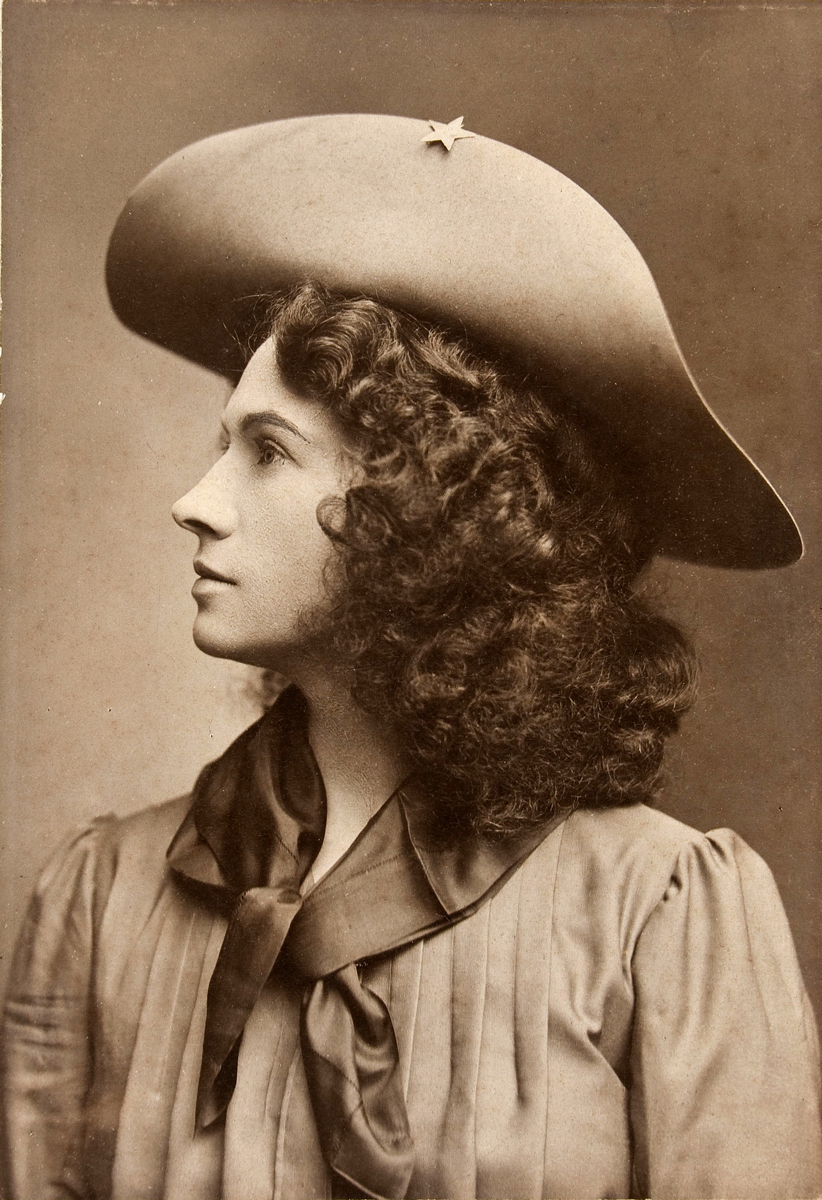
Annie enthralled crowds by shooting coins from Frank’s fingers and firing 25 shots in 25 seconds to tear one ragged hole in a playing card. When Germany’s Crown Prince, to become Kaiser Wilhelm II, asked her to clip a cigarette from his lips, she did. In the wake of World War I she allowed the history of nations had hinged on that shot! Using a Stevens .22 in Tiffin, Ohio, in 1884, Annie hit 943 glass balls of 1,000 tossed. Johnny Baker, one of the Show’s best marksmen, tried for 17 years to outshoot her. “She wouldn’t throw a match,” he said. “You had to beat her, and she wasn’t beatable.” At age 62, crippled by an automobile mishap, Annie could still hit 25 tossed pennies in a row with her .22.
Buffalo Bill’s Wild West Show performed at Queen Victoria’s Golden Jubilee in 1887, initiating four European tours that ended in 1892. Staying stateside in 1893, it played to three million people under a new title: “Buffalo Bill’s Wild West and Congress of Rough Riders of the World.” A crowd of 18,000 attended at the Chicago World’s Fair. Cody took his troupe back to Europe for another four tours from 1902 to 1906. It played 14 consecutive weeks in London. The final circuit brought it to France and Italy, east to Austria, the Balkans, Hungary, Romania and the Ukraine, then west again to Poland, Bohemia (the later Czech Republic), Germany and Belgium.
Back in the southern U.S., where the Show was slated to tour in 1894, flooding ruined that year’s cotton crop adding local pain to an economy already ailing. Ticket sales slumped. Urged by promoters to sell the Show, Cody signed a contract that named himself an employee. So doing, he lost all control of his enterprise. Its sliding fortunes were hurried along by the public’s infatuation with movie theaters. In 1913 bankruptcy loomed.
During its three decades under Buffalo Bill, the Wild West Show had made him one of the most recognized men – in name and face – in the world. But as great armies came to blows in the trenches of France, he was also nearly destitute, his net worth eroded by poor investments. Age had diminished his vitality. So had drinking. Performing with the troupe until age 70 in 1916, Cody had to be helped onto his horse backstage.
Buffalo Bill died of kidney failure in Denver, January 10, 1917. His state funeral has been called the largest in Colorado history.
Judging William F. Cody from another, distant era is pointless. His life influenced what became of the 19th-century West, but he didn’t set its current course. If his embellishments misled, they also called to mind a time that otherwise would have been mis-imagined or given a collective shrug. His adventures breathed life into history. A newspaperman observed, perceptively, “He has been more than picturesque; he has been worthwhile.”
“The Irma”
The hotel Buffalo Bill named after his last child was built in 1902, seven years after he helped found the town of Cody north of his newly established TE Ranch. He called the Irma “just the swellest hotel there ever was,” keeping two suites and an office there for his own use. A businessman with an eye to future prospects, Bill anticipated a spur from the Burlington Railroad bringing visitors to the east gate of Yellowstone National Park. His hotel would serve them.
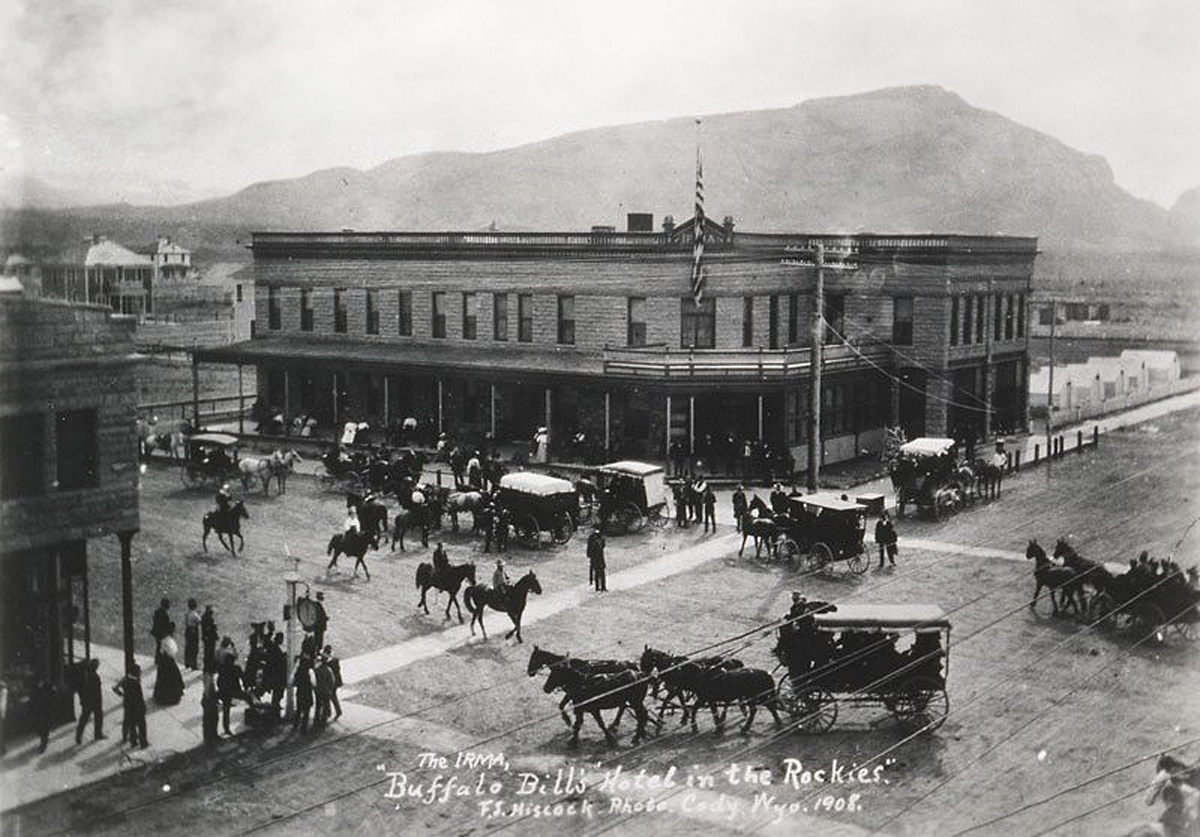
The Irma hotel, circa 1908. named after his youngest daughter, the hotel was built in 1902 with additions in 1929 and 1977. Today, it operates as a hotel and restaurant on Cody, Wyoming’s, main thoroughfare.
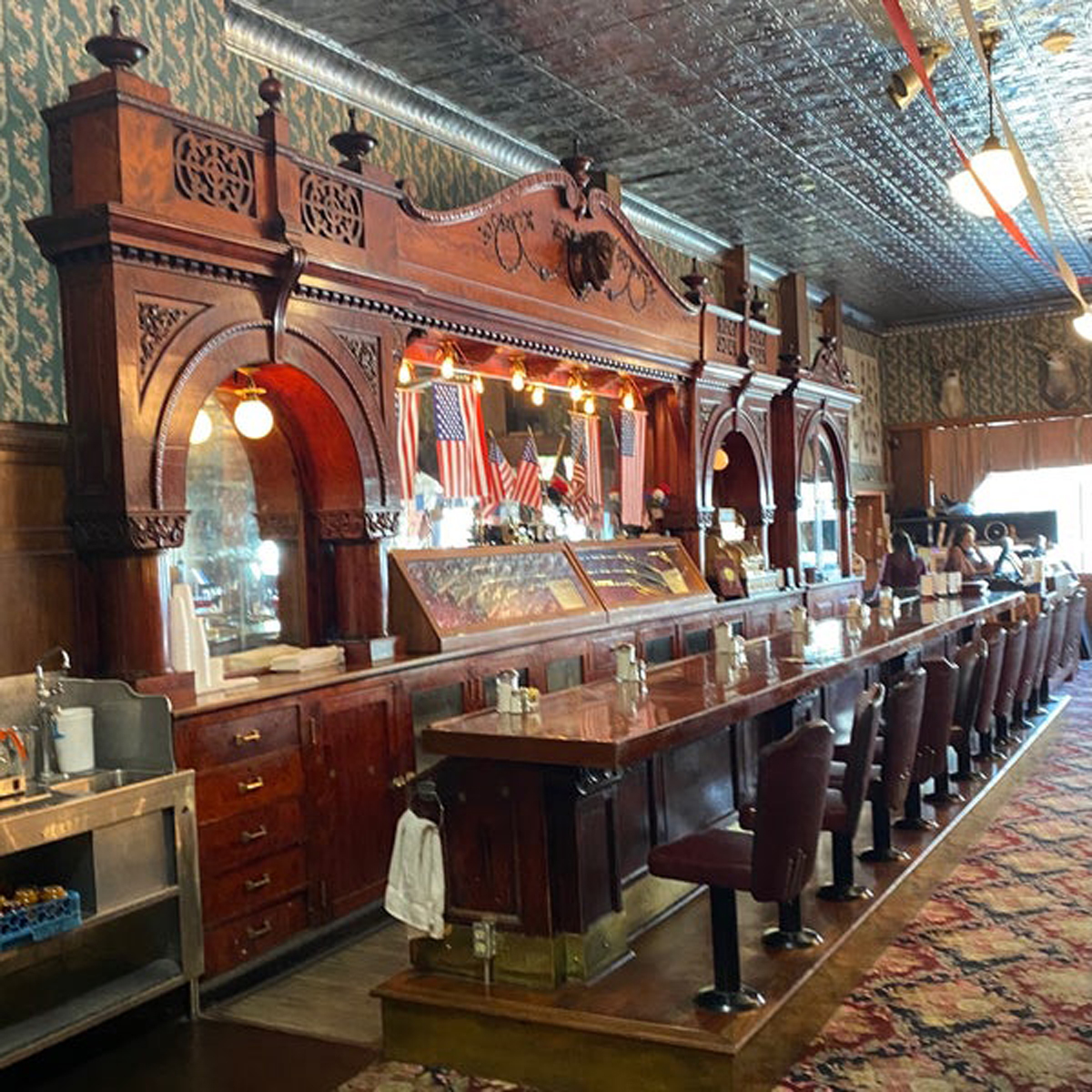
Designed by church architect Alfred W. Woods of Lincoln, Nebraska, the Irma has an imposing, cathedral character. The exterior is largely of river rock and quarried sandstone from nearby Beck Lake. The grand fireplace comprises stone and fossils from the Big Horn Basin. A northwest addition was built in 1929, a southwest wing in 1976 and ’77. Surely the most photographed part of the Irma is its massive cherrywood bar, which dates to the original structure. It is beautifully preserved.
A signature feature of downtown Cody at 1192 Sheridan Avenue, the Irma still welcomes nightly guests in “historic rooms” and daily offers visitors breakfast, lunch and prime rib dinner buffets.
The Family
William F. Cody married Louisa Maud Frederici in March 1866, on her family’s farm in Arnold, Missouri. They’d met in St. Louis where Cody’s military duties had taken him a year earlier. Their first child, Arta Lucile, was born late in 1866. Their only son, Kit Carson Cody, followed in 1870. He died of scarlet fever at the age of six, two years after the birth of a second daughter, Orra Maude. She would live only 11 years, a victim in 1883 of “remittant fever after an illness of several weeks.” That year the Cody’s welcomed a fourth child, Irma Louise. Longevity was denied even the first and last of the four children. Arta passed in 1906 at age 37 following an operation for appendicitis in Spokane, Washington, just a month after wedding her second husband, Dr. Charles W. Thorp, Jr. She was survived by two children from a three-year marriage (to Horton S. Boal). Irma also married twice, to Clarence A. Stott, then Frederick H. Garlow. She bore three children. In October 1918, the influenza epidemic of that year struck Mr. Garlow. Three days after he died in bed, the sickness also claimed Irma. Both died in Cody, where he’d managed the Irma Hotel.
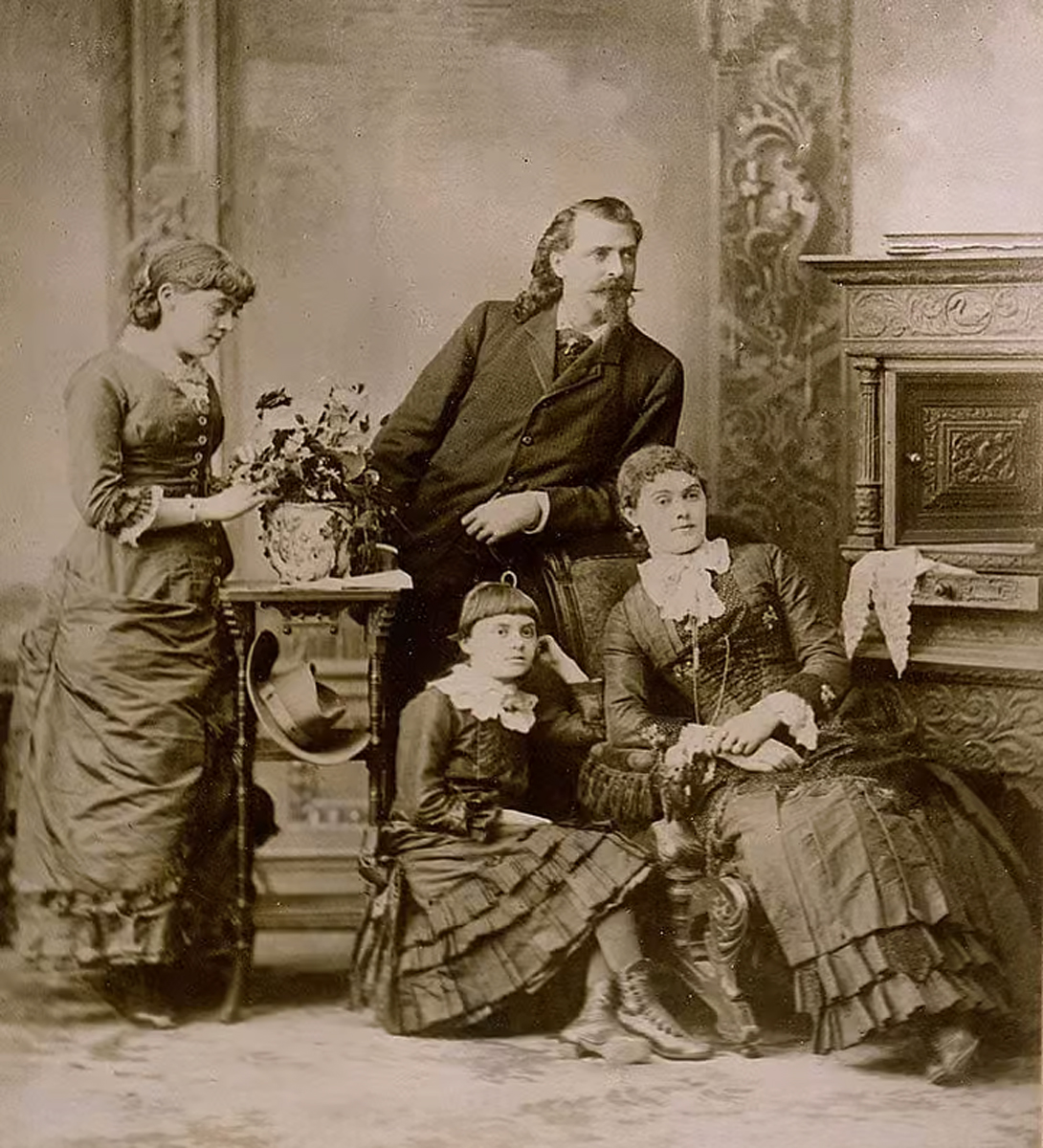
Buffalo Bill and his wife lived many years apart, Louisa mainly in North Platte, Nebraska. Twice he filed for a divorce. She opposed it. After Orra’s death in 1883, he withdrew his first request. A district court in Sheridan, Wyoming, did not grant his second filing in 1905. The couple reconciled in 1910. She often attended subsequent Wild West Shows. Louisa Cody died in 1921 and is buried next to her husband on Lookout Mountain near the town that bears their name.