
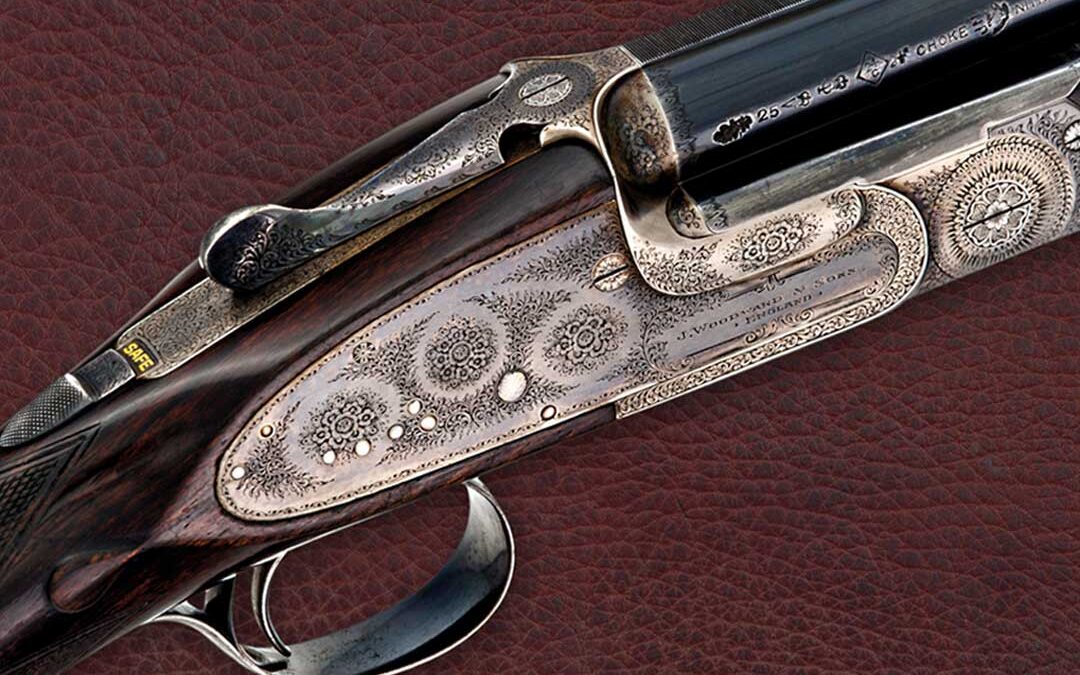
The change from side-by-sides to over-and-unders is unquestionably the biggest shift in game guns during our current era. The undeniable success of the superimposed shotgun at all manner of competition has led most of us who pursue wild birds to believe we’ll bag more of them with a stack-barrel. The single sighting plane, reduced barrel flip and improved pointability are all cited as reasons to change. James Purdey & Sons, whose Woodward style O/U is the subject of this feature, created its first scratch-built O/U in 1871 for the second Aga Khan, but this was likely a muzzleloader. The modern breech-loading iteration dates from the Edwardian period when London’s gunmakers vied with one another to create something special for a sated market. One of the very best was the Woodward, which appeared just before World War I.
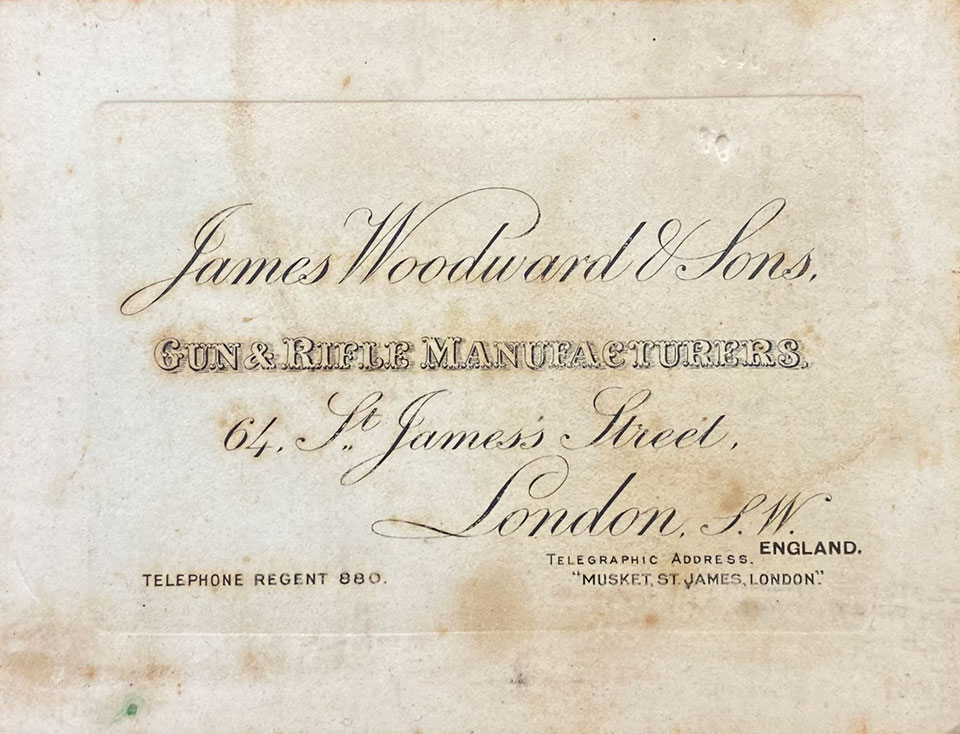
In his 2023 book James Woodward & Sons: Its History and Enduring Legacy, Dr. Nicholas Harlow sheds light not only on the development and success of the design but also on its wide influence on other makers. Years in the making, this delightful little tome traces the origins of fine O/Us, but also brings the business began by James Woodward into sharp focus. The founder of the firm initially found employment with Charles Moore in 1827 but was soon taken into partnership and a little later was trading simply as “James Woodward.” By all accounts, Woodward’s, enjoyed a good reputation during the muzzleloading era that was only enhanced with the introduction of breechloaders.
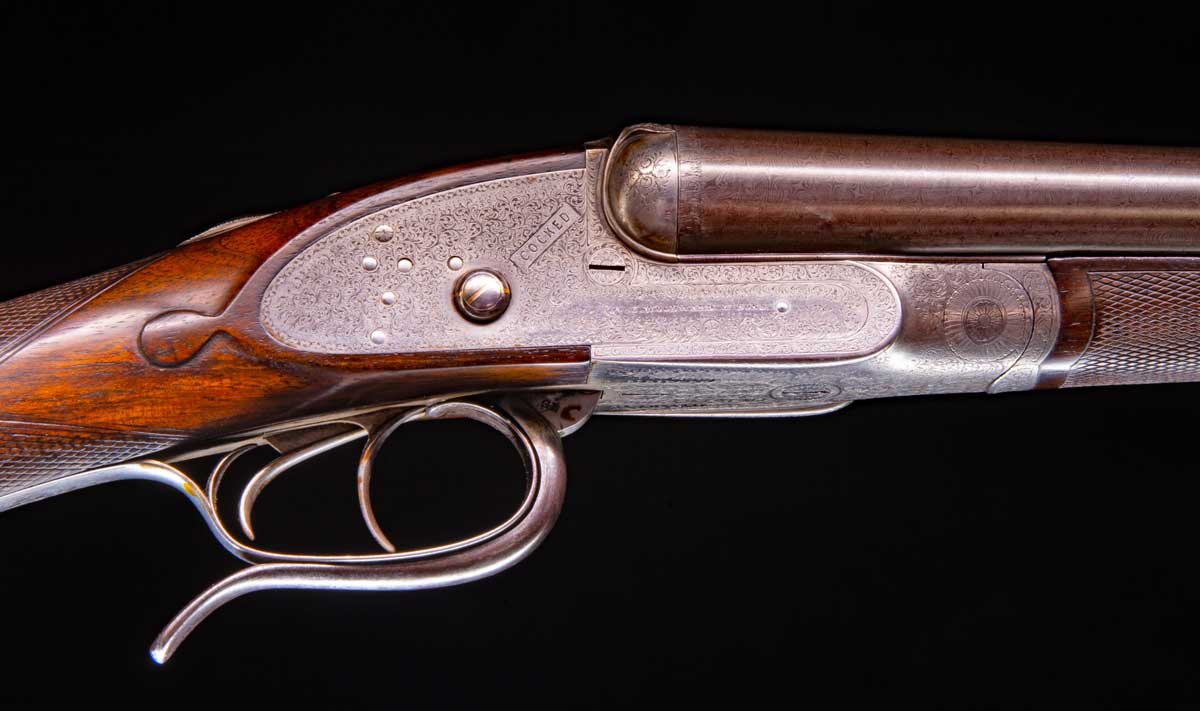
One early success from the 1870s was “The Automatic,” a propriety action, side-by-side hammer gun half-cocked by an underlever that would eventually evolve into a hammerless design. In its later double rifle shrouded action iteration, it would become perhaps the strongest big game stopper for sports heading out to India and Africa. Woodward’s greatest achievement, however, was undoubtedly its O/U. With its introduction, Dr. Harlow’s book hits its stride. He suggests that during the Edwardian era the British gun trade began to consider the possibility of a breech-loading O/U, perhaps more to satisfy its own desire for innovation than from customer demand.
Though it would be adopted by James Purdey & Sons and has been widely emulated, particularly in Great Britain, the Woodward was not the original modern London-made O/U. Dr. Harlow rightly credits John Robertson, trading as Boss & Co., with the earliest British patents for the modern O/U but then tells us: “However, by the time the Robertson’s patents were awarded (December of 1909), James Woodward had already sold its first over & under.” Unfortunately, Woodward’s early efforts were not a success. The initial design was a prototype that featured conventional hinging and under-bolts that made for a clunky gun. Its significance is that it set Woodward on the road to better things.
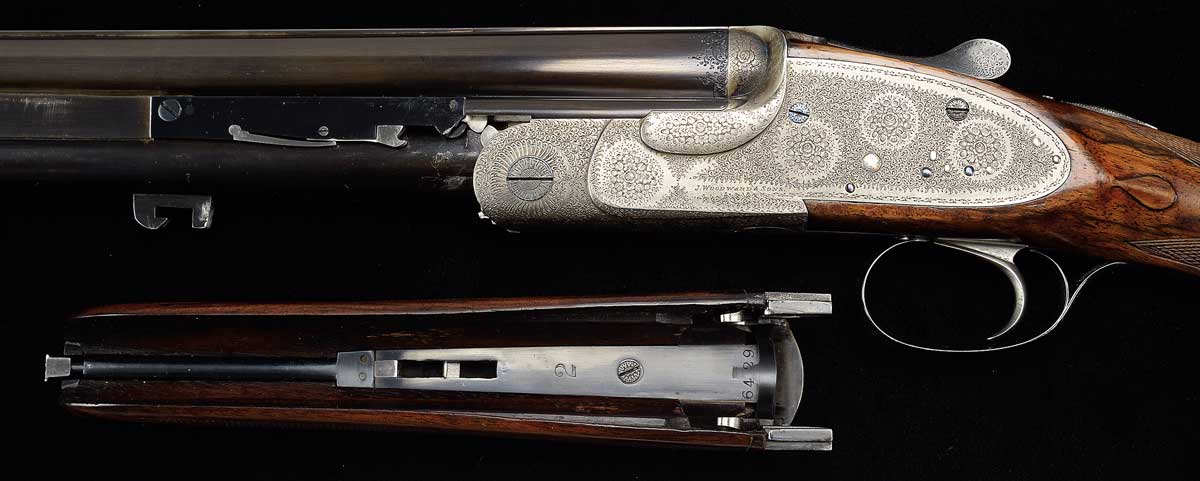
“After this first attempt, Woodward spent the next three years developing an action they were much happier with.” Looking to design a lighter, trimmer and altogether more efficient gun, Charles Hill and his co-patentees, Charles Woodward and William P. Evershed, trading as James Woodward & Sons, registered a couple of designs with the British patent office during 1913. The first of these, No. 4986, was for a tongue and groove bolting system while the second featured a cocking mechanism and an ejector system featuring ejector boxes cleverly secreted in the recesses between the two barrels. “It is widely agreed that Hill was responsible for the principles protected in both patents,” says Dr. Harlow before going on to quote Major Sir Gerald Burrard: “In the Woodward gun, the lumps are bifurcated and placed on each side of the lower barrel, the bites being just forward of the central plane of the two barrels. The forward lumps are also bifurcated and interlock on dovetails on the insides of the two walls of the bar, thus holding the two walls together and preventing them from splaying outwards. This interlocking action is a patent and is undoubtedly a great and marked improvement in the design of over and under guns. The barrels hook on to the housing exactly like those of an ordinary gun, and the fore-end clips on as usual. The locks are bar action side locks and the ejector the Southgate. This is a beautiful action; light and scarcely greater in depth than that of an ordinary gun.”
In striking contrast to its previous design, Woodward promoted its new gun as its “patent Under & Over” with a strap line that read, “Pronounced by the leading experts in England and America as the best designed vertical barrel gun on the market.” This, at a time when rich Americans were travelling to England in order to acquire best guns. Several London makers, including Henry Atkin, E. J. Churchill and Ogden, Smith & Hussey adopted the design, but these were likely actioned in the red brick Birmingham workshop of Charles Hill.
By the early 1920s, The Field was reporting that the O/U “was here to stay.” Woodward had by then established the U.S.A. as a lucrative market with Von Lengerke & Detmold in New York functioning as its American agent. Dr. Harlow diligently provides short biographies for all the rich American swells that sprung for Woodward O/Us as well as providing detailed descriptions of the guns themselves.
And here it’s worth pausing to acknowledge one aspect of Woodward guns in general, and the O/U in particular, that can be confirmed by Dr. Harlow and his book. Gunsmiths who have worked repairing and maintaining them (as opposed to the gunmakers who build them) have often remarked that no two are alike. Each new gun as it was constructed appears to have incorporated incremental improvements. Clearly this is one advantage over machine-manufactured guns. Hand-made firearms built one at a time can be tweaked to accommodate change.
Another advantage of bespoke shotguns is that they can be, and often were, configured in specific gauges. Writing of sub-gauge guns built between the wars, Dr. Harlow notes, “This period also saw the creation of three of the smallest ‘Over & Under’ guns ever made: a 24-bore, a 28-bore and a .410 gun. All three were built on scaled actions and are considered some of the finest examples of inter-war gunmaking produced by any manufacturer. The smaller two guns were both built for the same American client while the 24-bore was completed for a French dealer in 1934.”
The dinky dimensions of these sub-gauge guns are perfectly proportional. It’s difficult to overestimate the effort that went into creating these tiny masterpieces. Every element had to be scaled down yet the firing mechanism—mainspring and striker—still had to be sufficiently strong to tackle a standard primer.
With the adoption of the Woodward design, Purdey found what it was looking for—an O/U design that could compete favorably with the Boss O/U in the lucrative American market.
With the outbreak of WWII, Woodward found itself in a difficult position when the British government stopped all non-essential production in favor of war work. Certainly, the creation of luxury firearms for a rich and privileged clientele would be considered non-essential. At the end of the war, when the London gun-trade began rebuilding its order books, Woodward struggled with rising material cost, heavy taxes levied on its traditional British customers and an aging workforce. The upshot was that only 11 O/Us were completed between 1940 and 1948. The very last O/U departed the Woodward premises as the business was winding down on the 22nd of December 1948.
A lack of orders and an inability to replace an aging workforce may have contributed to why Charles Woodward—the last of the gunmaking Woodwards—decided to part with the business. Dr. Harlow also suggests that a lack of heirs and the lease to his London premises running out may also have been contributing factors. In any event, Charles Woodward approached James Purdey & Sons.
“I cannot bear the thought of any other maker but yourself taking over, will you undertake the handling of my business and the making of my Over and Under?” asked Charles Woodward to Tom Purdey, or so claimed Purdey Managing Director, Harry Lawrence, 33 years after the event. James Purdey did purchase the name and good will of James Woodward & Sons and with it the rights to build its famed O/U. Purdey’s subsequently advertised: “Purdey have acquired the world-famous business of James Woodward, makers of the Woodward O/U gun which has proven so successful that it may be considered the finest O/U that has ever been built by craftsmen in this country or wherever best guns are built by hand!”
Previously, Purdey had flirted with an O/U design by Edwinson Green of Cheltenham, but Dr. Harlow tells us it was, “…complicated and heavily over-engineered.” It was also incredibly ugly. With the adoption of the Woodward design, Purdey found what it was looking for—an O/U design that could compete favorably with the Boss O/U in the lucrative American market, so Athol Purdey crossed the ocean in a quest for sales.
“The wealth of the United States, comparatively untouched by war, seemed the most likely source of customers in the numbers Athol required, so he planned a selling trip to America for 1922,” writes Richard Beaumont in Purdey’s The Guns and the Family, adding, “The Americans, in fact, both individually and through the firm of Van Lengerke and Detmold, were showing growing interest, unfortunately most of the orders specifying once again the ‘chased breeches and special engraving’ so deplored by Purdey.” This latter is a reference to carved fences, which the conservative Purdey thought vulgar.
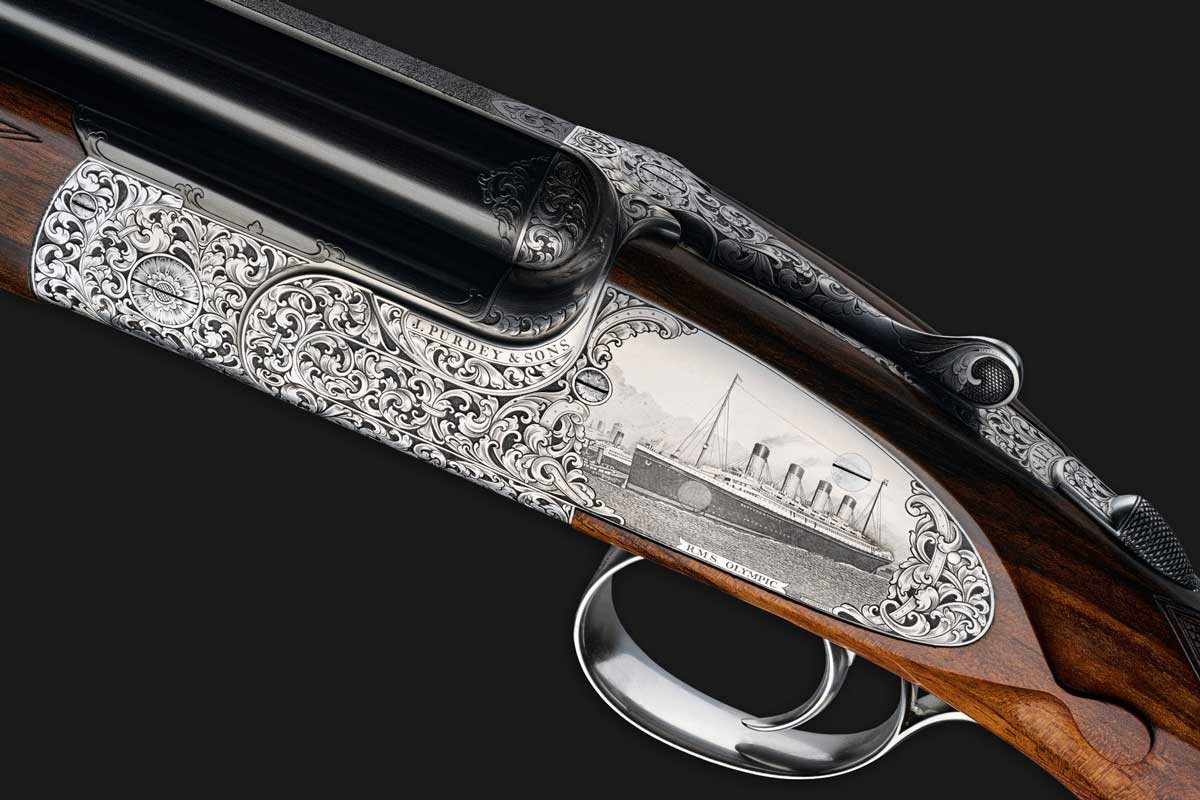
“On 12 April, Athol sailed from Southampton aboard the White Star liner Olympic…” according to Beaumont. During the 1920s, Olympic was a popular and fashionable ship and often attracted the rich and famous of the day: Charlie Chaplin and The Prince of Wales were among the celebrities she carried. One appeal of Olympic was that she was nearly identical to Titanic, and many passengers sailed on Olympic as a way of vicariously experiencing the voyage of the doomed liner. The Commodore was a luxury hotel that opened during 1919 with 2,000 rooms and was said to have the “most beautiful lobby in the world.” The success of the trip would later be commemorated with a Purdey/Woodward O/U featuring the Olympic on one lock plate and the Commodore Hotel on the other engraved by Phil Coggan.
Athol Purdey’s trip was successful. “The orders he took were impressive and filled the factory for some months…” according to Beaumont. More significantly, Athol saw American taste firsthand. The carved fences he disliked were big, as were single-barreled trap guns, but it was the popularity of the O/U that triggered change at Purdey.
Purdey sales catalogs from the early 1950s first announced “Mr. Purdey has decided to build his Over and Under guns in the future on the ‘Woodward’ Principle…” and then offered this: “Mr. Purdey’s personal experience of the requirements of the Shooters all over the United States, where he visited twice in 1949 to satisfy himself on these matters, and in Europe, will ensure the greatest care and practical knowledge in the building of these guns for the exact conditions under which they will be used. There is no doubt that there is a great demand in the United States of America and in Europe today for the Over and Under gun.”
Since then, numerous other makers have attempted to emulate Purdey’s success by offering guns on the Woodward pattern. They include Churchill, Watson Bros., Grant, Symes & Wright, Cogswell & Harrison and Westley Richards. One of the very best of them are the guns created by Westley Richards in England’s West Midlands. Westley’s once had its own propriety O/U called the “Ovundo.” Though lovely and mechanically clever, the Ovundo was also delicate and expensive to build. Anthony Alborough-Tregear, managing director of Westley Richards, announced the adoption of the Woodward with this. “Why try to reinvent the wheel? The Woodward patent action is proven, aesthetically pleasing, reliable and easy to scale up or down for different bore sizes as well as for magnum frames or live pigeon type guns.” No better endorsement for the Woodward design was ever written.
Perhaps the Woodward’s most significant legacy is the way in which the design has influenced the best of Italian gunmakers. Speaking of the O/Us made by Ivo Fabbri, Dr. Harlow has this to say: “The resulting guns are far more expensive than those made in London and produced in even more limited numbers. As he himself admitted, the core of his design owes much to the Woodward action. It is a testament to its versatility that even one of the most technologically advanced gunmakers of the early 21st century based his product upon a design developed by a small London gunmaker 110 years ago.”
Much, of course, has changed in the intervening years, but the design fundamentals of the Woodward/Purdey remain the same. The popularity of the O/U as a game getter has soared in recent years, in part because of its success in competition, but the legacy of the evolving Woodward design, too, has played no small part in the current boom. The Woodward, in all its incarnations, is an unfading star—as desirable now as it was when it first appeared more than one hundred years ago.