

Adam Weatherby is a lot like his grandfather Roy. He’s willing to take a risk, to challenge the status quo, to make a bold statement in the rifleman’s world. And he’s made it with the Weatherby Model 307.
While Roy went 20th century wild with extravagant speed and rakish California styling in the familiar Mark V 9-lug bolt action, Adam seemingly reversed his grandfather’s heritage with the dual-lug Model 307, which borrows heavily from the Remington Model 700. We’ll investigate the “why” later in this column but first let’s scrutinize the Model 307 itself.
In addition to the Mauser-style locking lugs at the front of the bolt body, the Model 307 employs a plunger ejector in its push-feed action. Unlike the Model 700, it includes a beefier M16-style extractor, a conveniently accessible bolt release button on the left side of the rear receiver ring and a TriggerTech field trigger externally adjustable from 2.5 to 5 pounds. An innovation welcomed by many is the toolless, field strippable bolt. You just push forward on the shroud, pull the bolt handle out, and the firing pin and spring slide out in one easy piece. Clean, lube or dry, and reassemble.
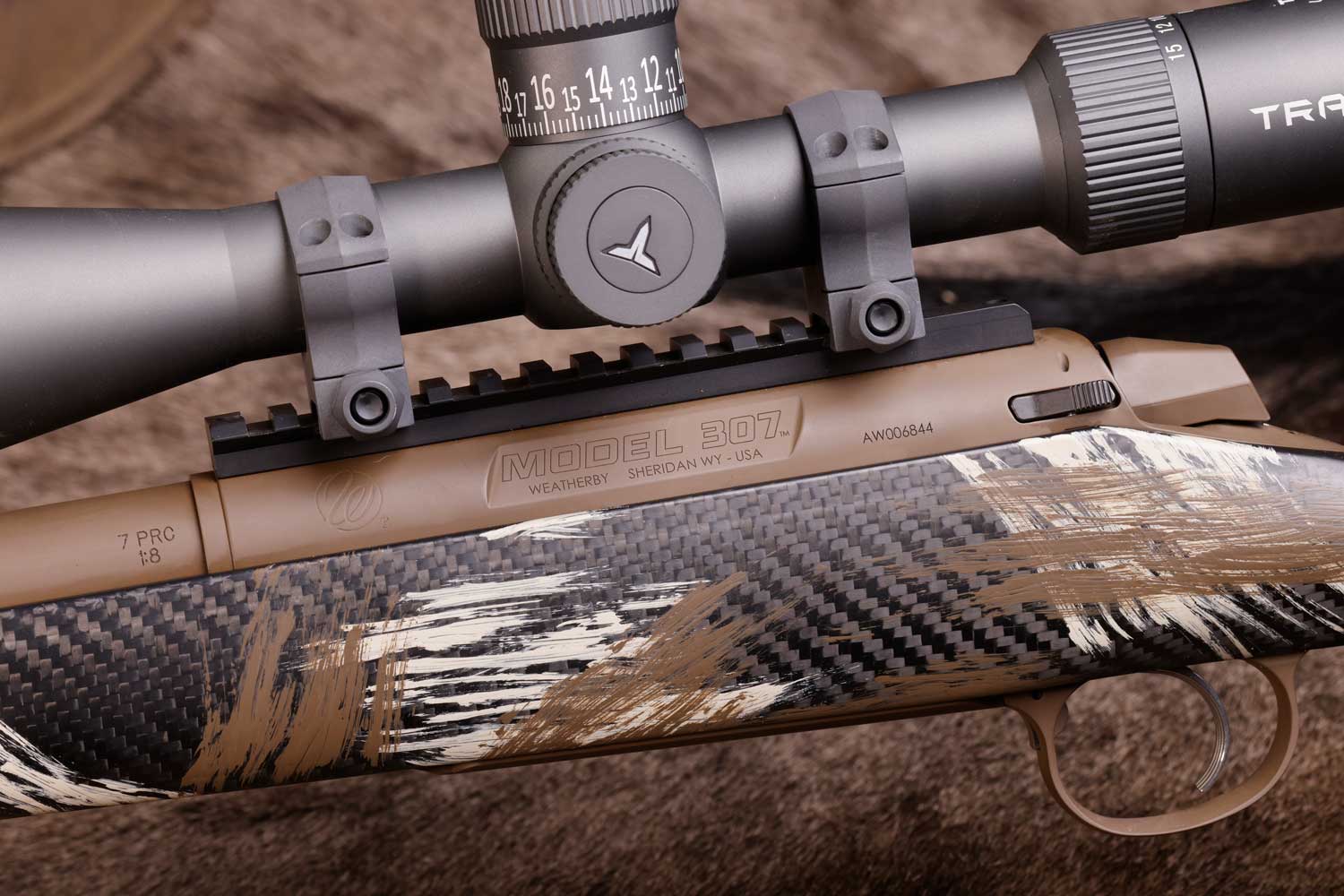
A Peak 44 20 MOA sculpted Picatinny rail comes with the rifle. Note the bolt release knob in the left rear receiver wall.
One of the selling points of a Model 700 receiver profile is easy fit with just about every scope base and ring on the market, but if you like Picatinny rails, you won’t need any because the Alpine comes with a factory installed 20 MOA PEAK 44 Picatinny rail. The benefit of a Picatinny rail is versatile mounting points for setting up perfect eye relief. The disadvantage is the rail can interfere a bit with the ejection port, especially when thumbing rounds into the internal magazine. That issue is largely circumvented by the sculpted bottom of this PEAK 44 rail.
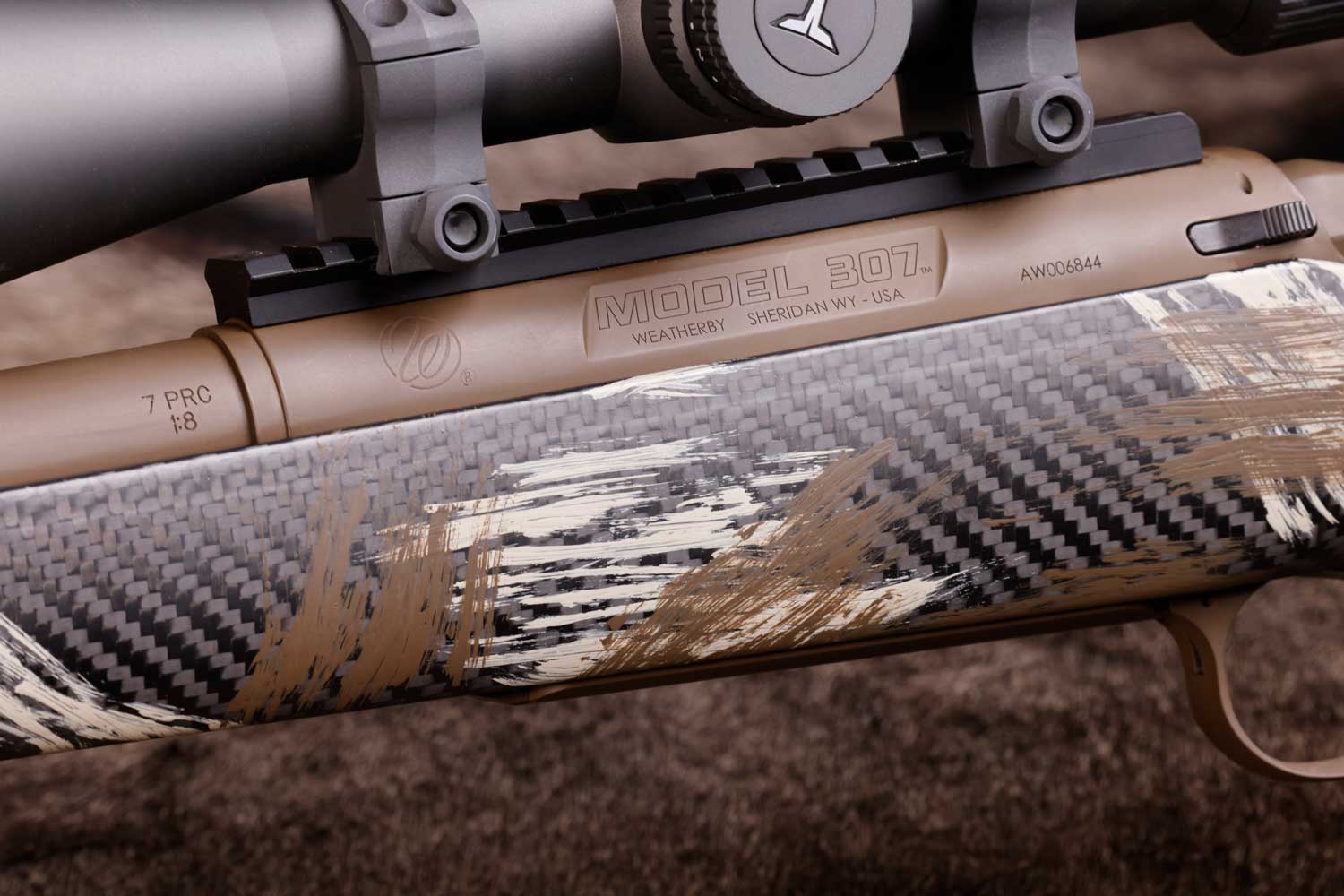
The overlapping layers of carbon contribute to the camouflage look of the hand painted Peak 44 stock.
On the 6.3-pound Alpine CT version of the Model 307 I reviewed, the BSF carbon barrel is a significant part. Unlike some carbon-wrapped barrels, this BSF is tensioned, meaning the internal, longitudinally grooved, 416R stainless steel match barrel slips within the carbon sleeve tensioned between the steel chamber section of the barrel and a steel ring of barrel steel near the muzzle. This leaves significant air gaps between the two components while the equal tension between them reportedly maintains consistency in vibrations and oscillations when a shot is fired. If our sample groups are any indication, this works. Weatherby guarantees sub-MOA accuracy in this rifle, and we easily achieved that, punching closer to 1/2 MOA a couple of times. An aid to fine-tuning accuracy is the supplied directional, tunable muzzle brake. You turn it to adjust fore and aft until you’re printing your tightest groups, then lock it in. This brake, like all external metal parts, is Cerakoted.
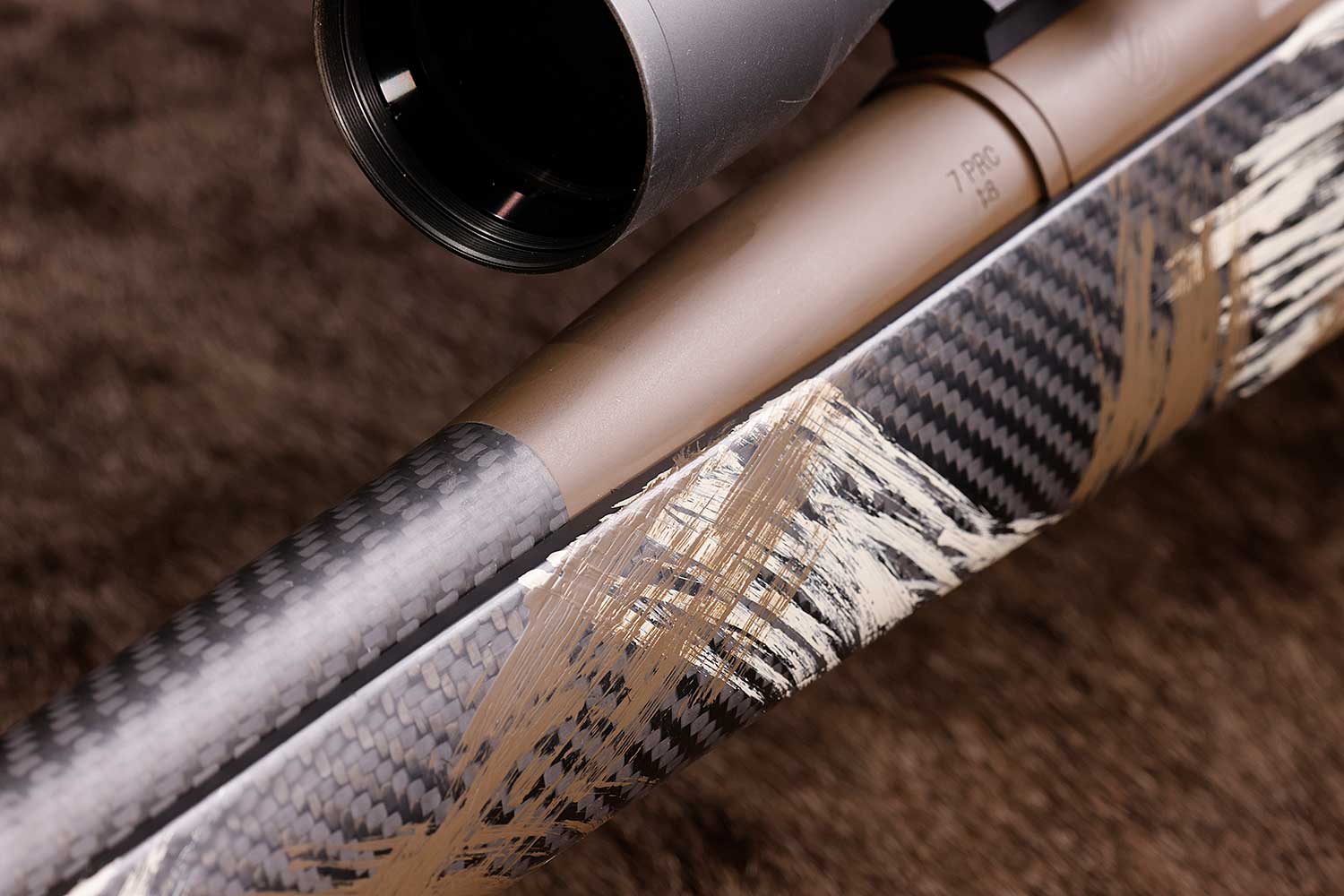
The Model 307 Alpine CT’s carbon barrel stiffening sleeve is joined tightly against the steel chamber section of the barrel and again at the muzzle.
The self-timing brake is a proven system for fine tuning accuracy, but I immediately turned a Banish Backcountry 30 suppressor onto the barrel of this sample rifle and, given the sub-MOA groups it shot, felt no need to try the loud brake. Still, if you don’t appreciate the extra bulk and length of a suppressor, the brake is an alternative.
Additional benefits of the Model 307’s Model 700 platform are familiarity and adaptability. Today’s riflemen are more hands-on, more “gunsmithy” than the typical 20th century rifleman. Back then we expected a new hunting rifle to be field ready. If we added a scope, we generally had the gun shop mount and bore sight it. After final range tweaking, we dragged it thither and yon, saluting everything from pigs to polar bears.
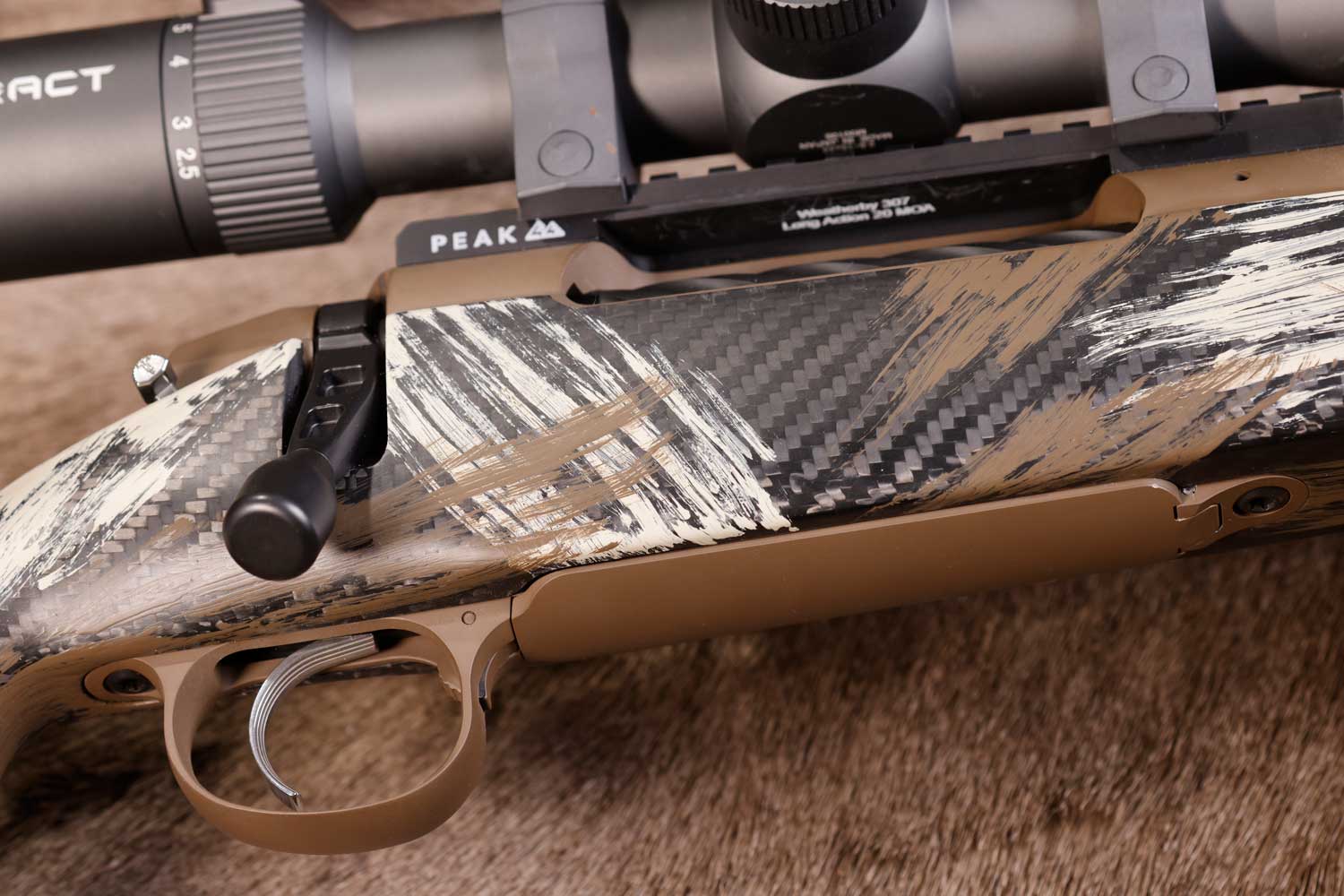
A traditional hinged floorplate covers the internal box magazine that holds three 7mm PRC rounds. Notice the extra room beneath the sculpted Picatinny rail for access to the loading port—nice.
Today we buy a rifle and pick out our own scope bases and rings, mount the scope ourselves, perhaps change that scope for a larger, smaller or more elaborate model based on where and what we’re hunting. We might tire of the factory stock and drop the barreled action into another, perhaps synthetic, perhaps even carbon stock, although the carbon fiber stock on the Alpine CT shows no signs of needing any upgrade unless it is to more classic lines. The factory PEAK 44 Bastion stock weighs 24 ounces and adds just a touch of modern shape with the traditional. The pistol grip is steep and includes a torque controlling palm swell on both sides. The comb rises sharply behind the grip, high and climbs toward the butt for maximum recoil moderation. The forend is flat bottomed but not too wide, a good balance between bench-bag steady and field-carry comfortable. There are two swivel studs up front and one in the rear. A hinged metal floorplate gives access to the internal box magazine.
In an additional break from Weatherby tradition, the Model 307 is chambered in not only many modern cartridges such as the 7mm PRC, but oldies including 300 Win. Mag. plus several belted Weatherby magnum rounds including the fire-breathing 257 Wby. Mag.
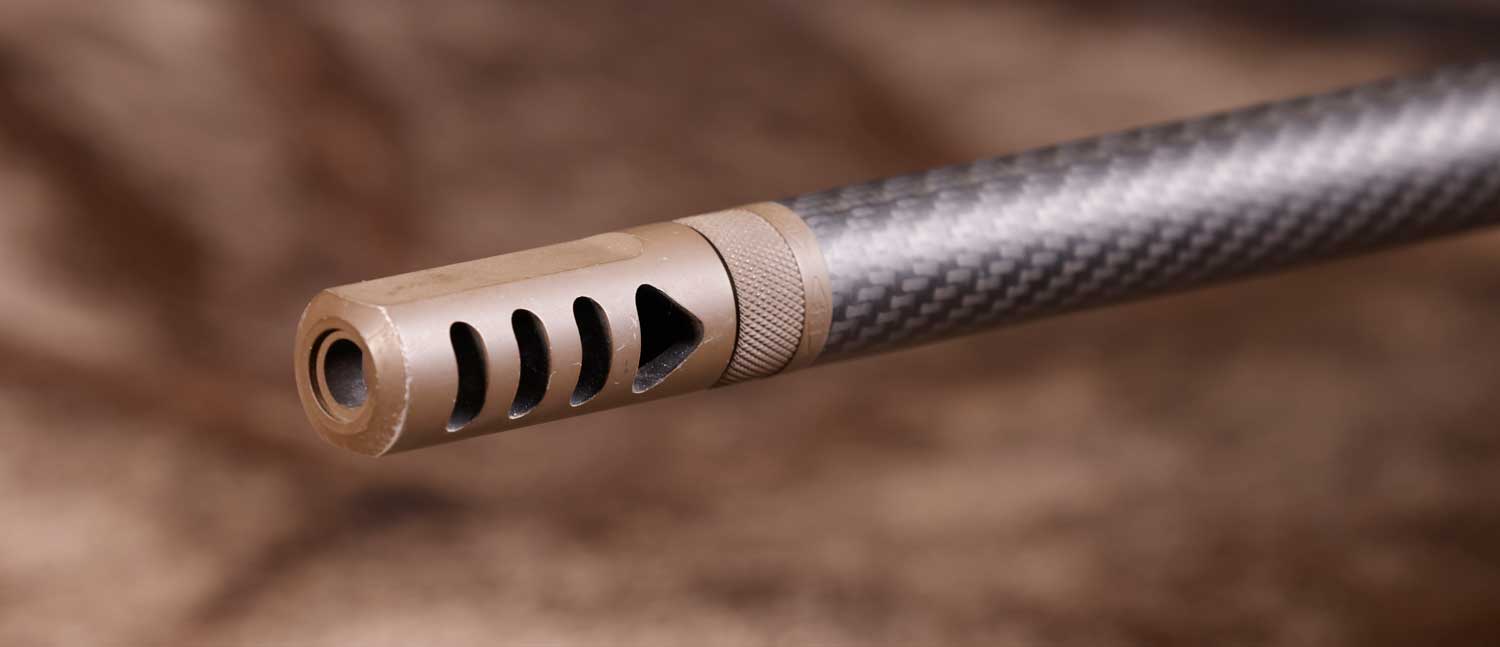
The Model 307’s muzzle brake is bi-directional and tunable for tweaking the last fraction of accuracy from the barrel.
As for why Adam and his engineering team built around the basic style and conformation of the Model 700, well, familiarity and aftermarket parts. Most shooters know and trust the dual lug, push-feed action. Many manufacturers build parts that fit. Upgrading this basic platform with a stronger extractor, strippable bolt, side mounted bolt release and TriggerTech trigger increased its versatility and appeal.
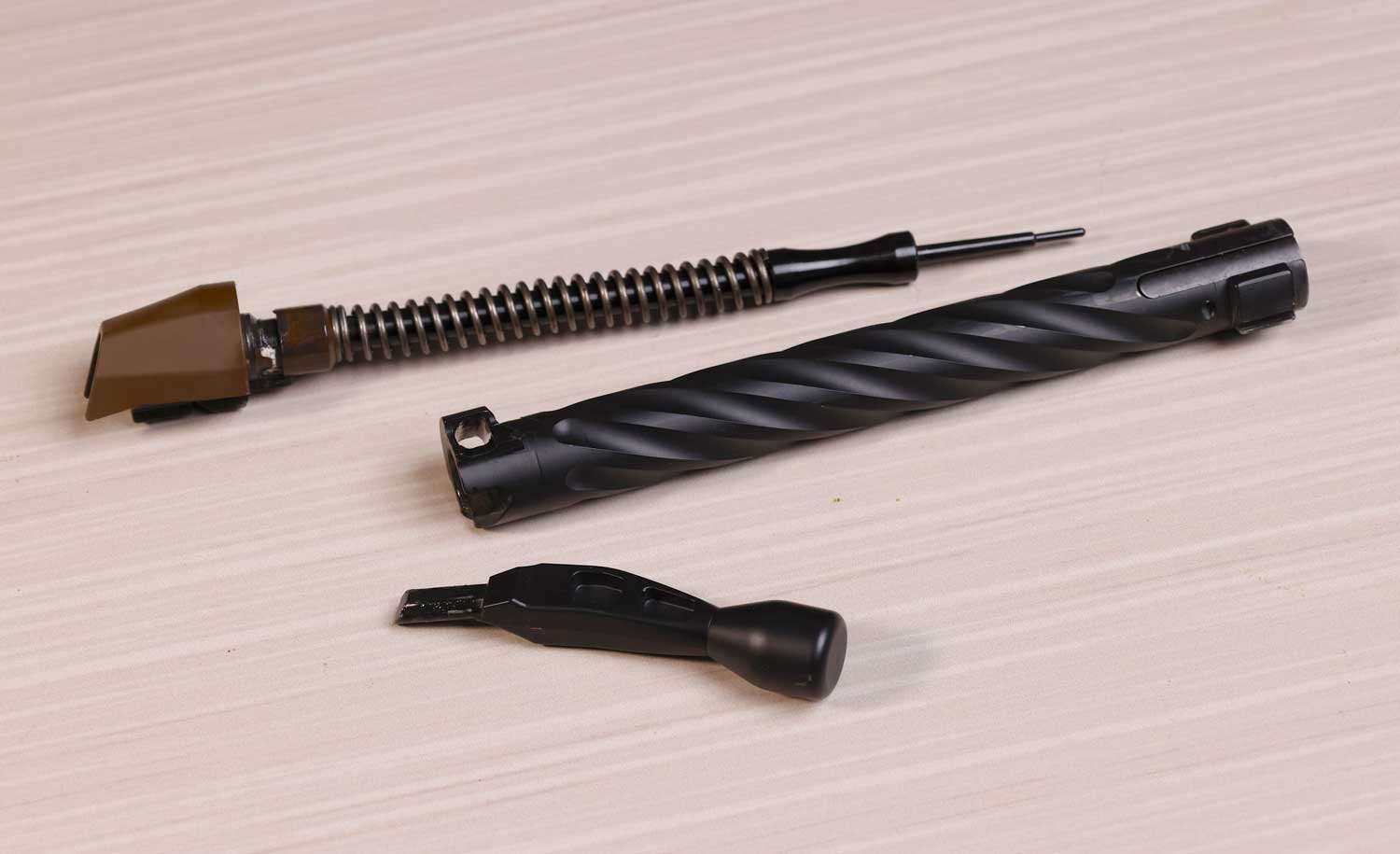
The Model 307’s firing pin and spring are easily and quickly removed by pressing down on the shroud, pulling the bolt handle free and pulling the firing pin and spring out of the bolt body. Reverse the process to reassemble.
Here in the second decade of the 21st century the Model 307 Alpine CT is as bold a move as was Roy’s marbled walnut and high-polish blued Mark V of the middle 20th century. Both broke molds, Roy eschewing the staid styles of his era, Adam breaking with his own family’s iconic rifles.
That doesn’t mean he rejects his progenitor’s concepts or creations. It’s more that he sees the benefits in breaking out of the pattern to provide what hunters value and demand.
Scope Options
Choosing the right scope for a lightweight rifle can hinge on two philosophies: for mountain hunting, select a light scope to keep overall weight at a minimum. Alternatively, and especially if you subscribe to the theory that a heavier rifle is more accurate than a light, use the weight savings you gained with your 6.3-pound Model 307 Alpine CT and apply it to the scope. That enables you to take advantage of some “big scope” attributes such as higher magnification, larger exit pupil for more light transmission, extra adjustment range for distance dialing and oversized, easily read turret dials.