

Peyton Manning and Marvin Harrison in football. Chevrolet and Corvette in automobiles. Rodgers and Hammerstein in song writing. Cotton and blue jeans. Bacon and eggs. Certain pairings make both partners more than the sum of their parts, even among rifles and cartridges.
Three all-American cartridge-and-rifle combinations have bedazzled hunters and built reputations as the ultimate combos in the hunting fields of North America. The 30-30 Winchester and Model 94. The 270 Winchester and Model 70. And the 7mm Remington Magnum and Model 700.
The 30-30 Winchester/Model 94 established the whitetail brush hunting standard starting 131-years ago. This pairing is, and likely always will be, our longevity champ. With more than 7.5 million Model 94 rifles sold, it’s certainly the sales champ. The 45-70 Government of 1873 might have given the 30-30 a run for its money, but the big 45 was never chambered in one stand-out rifle. The relatively weak, single-shot, trapdoor Springfield gave way to the faster, more powerful Marlin Model 1881 followed by Winchester’s Model 1886, but neither of those lever-actions earned a following to match that of the Model 94 in 30-30.
Winchester’s Browning-designed Model 94 and its 30 Winchester Center Fire Smokeless, as the 30-30 Winchester was first labeled, drove a 160-grain bullet 1,970 fps—fast for its day. The round took advantage of the then-new smokeless, high-energy powders. This is why Winchester also advertised it as the 30 Winchester Smokeless. While the rest of the world experimented with various single-shots, expensive double barrels and new-fangled bolt-actions, American hunters wrapped their fingers around the slim Model 94 receiver and hit the woods to enjoy new velocity, reach and energy.
When designing the 30 W.C.F., Winchester engineers had likely been inspired by the then-new 30 Army, better known now as the 30-40 Krag, itself a near copy of the 303 British. It had been announced in 1893 but wasn’t fully operational until 1894. Usually, an official military round will dominate sales in a tight ballistic race, but not the 30-40. The Model 94 and soon the Marlin lever-actions saw to that. The lever-action was too well established as THE hunter’s repeater for a clunky, odd-looking bolt-action to easily dislodge it. The Model 94 was too slick, slim, light, compact and fast to give ground to a clunky Scandinavian bolt-action military rifle.
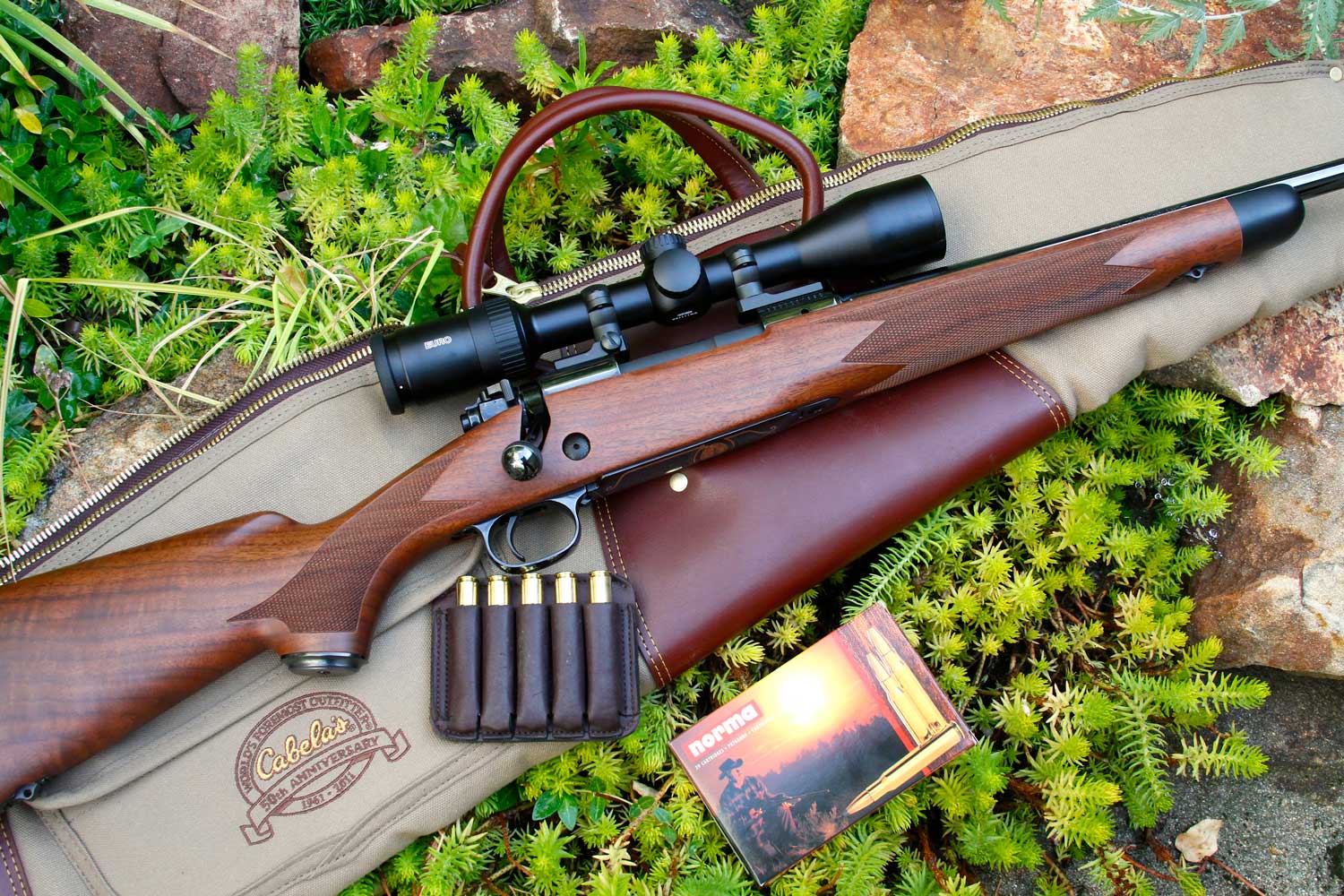
The first modification of the 30-06 Springfield case came in 1925 when Winchester necked in down to hold a peculiar bullet diameter, .277-inch. The world knew 30-calibers, 7mms, 6.5mms, 25-calibers… but the 270 moniker was unique. It might not have generated sales, but it sure helped name recognition.
The 30-40 and 30-30 introduced the 30-caliber; a decade later the 30-06 cemented it as THE all-American bore diameter. It retains that title to this day despite challenges from many 6.5mm and 7mm upstarts plus our oddest caliber and one half of our next most popular duo—the 270 Winchester and Model 70 bolt-action rifle.
Beloved though the “Rifleman’s Rifle” is, the cartridge came first. It debuted in 1925, just five years after the first commercial radio station began broadcasting. Yes, the 270 Winchester is celebrating its 100th birthday this year. That makes it an antique. But we’re not here to retire it but remember why it was and remains one of the greatest hunting rounds of all time. We shall not even broach the question of its superiority over its parent, the 30-06 (30-03 if you’re a stickler.)
Few hunting cartridges have generated as much ink, heat and all out debate as the 270 Winchester. Jack O’Connor and Elmer Keith exemplified that. You can compare its trajectory, retained energy, recoil, muzzle blast and killing power to not only the 30-06 and 280 Remington, but even the 7mm Remington Magnum—and vote any of the bunch the winner. Even the most ardent 270 Winchester detractors must admit this peculiar caliber, spitting bullets from 90- to 160 grains, can and has done it all. And today, with improved powders and bullets, it’s faster and deadlier than ever.
Matching this cartridge is the slick, strong, controlled-round-feed Model 70 rifle. By the time that rifle hit gun stores in 1937, an entire generation of American shooters had come to know, accept, and even love the Springfield ’03 bolt-action. Telescopic sights had become common and dependable enough to take advantage of the longer reach of the 270. Hunters were primed and ready for bolt-action hunting rifles. O’Connor took charge from there, showcasing the rifle and cartridge on everything from jackrabbits to brown bears. When he began celebrating the Featherweight Model 70, beginning in 1952, the King was crowned. The “Rifleman’s Rifle” had it all: classic lines, claw extractor, standing blade ejector, 3-position wing safety, locking bolt, classic stock lines, perfect balance and a 270 Winchester chamber. Bullets were not only sailing downrange at 3,100 fps but landing within an inch of where they were directed at 300 yards.
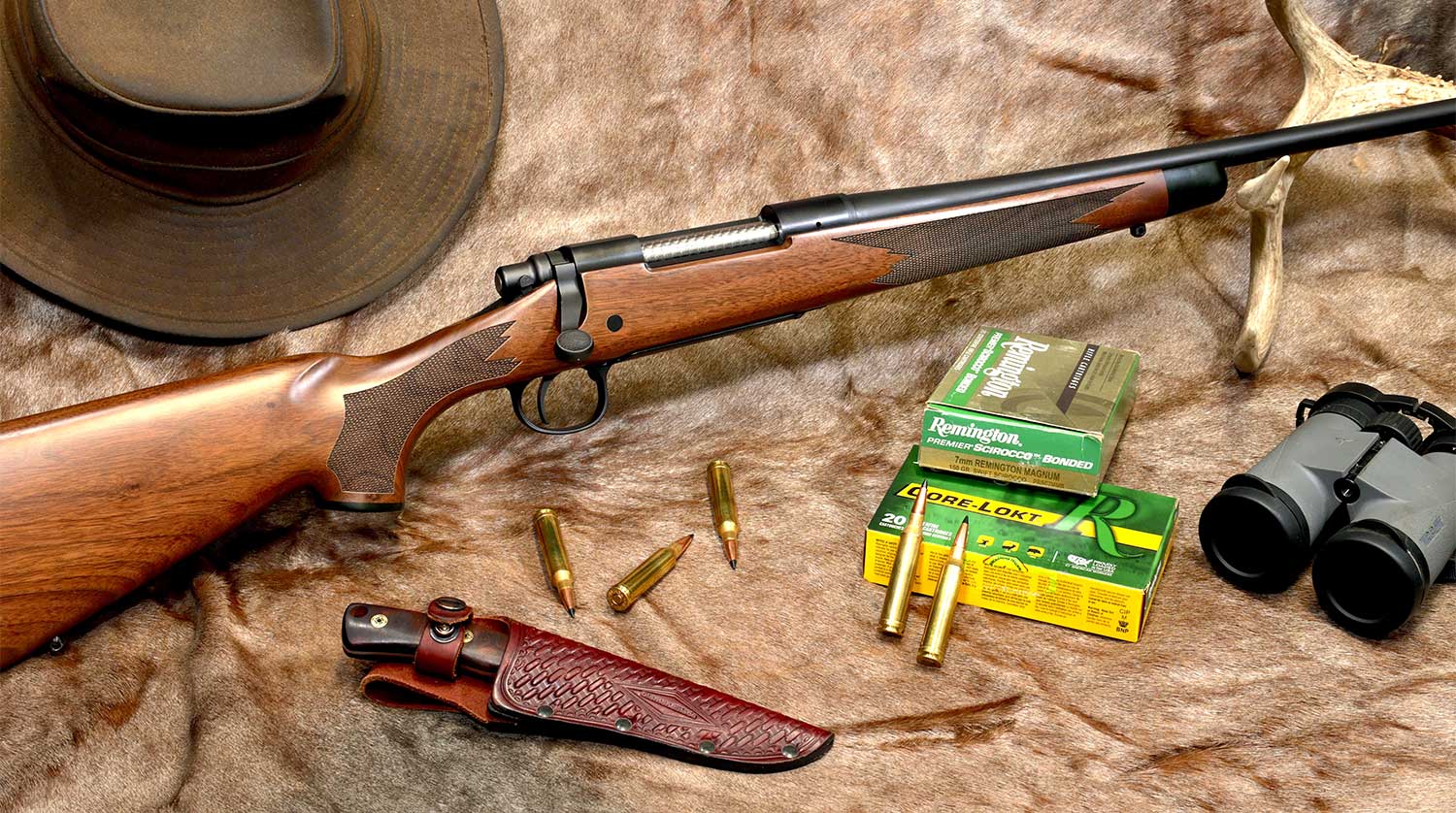
The latest, traditional walnut-and-blued Remington Model 700 doesn’t look much different than the first ones released in 1962. Teamed with the then-new 7mm Remington Magnum cartridge, the Model 700 screamed up the sales charts, soon becoming the most popular mass-produced bolt-action hunting rifle in the USA.
Remington, tired of playing second fiddle, finally stole the spotlight in 1962. The Russians failed to install missiles in Cuba that year, but Remington installed in gun stores hundreds of its new Model 700 rifle chambered for the new 7mm Remington Magnum.
Shooters weren’t sure which was more impressive, rifle or cartridge, but taken together they were hot stuff. The Model 700 combined tight chamber and bore tolerances with fast lock time and a simple cylindrical receiver that reduced manufacturing costs. The Model 700 sold for about 25 percent less than the Model 70, yet retained the familiar strong, twin locking lugs. The Model 700 abandoned the controlled round feed for a simple push feed system that further reduced costs. A recessed bolt face gave savvy marketers a novel pitch—“Three Rings of Steel” encasing the chambered cartridge.
Yet another ring was glistening on that new 7mm Remington Magnum cartridge. Given the belted Weatherby and H&H magnums of the era, it was easy to let shooters imagine the 7mm Remington Magnum was so powerful it had to be strapped in! It spit 150-grain deer bullets as fast as 3,100 fps and 175-grain elk bullets around 2,700 fps. No 270 Winchester was matching that. Gilding this lily was the belted-power appeal made famous by Weatherby magnums and the famed 375 H&H. Any round requiring a belt to hold it together had to be smoking! Never mind that at least three other commercial rounds had already plowed this ground. The 7mm Rem. Mag. in the Model 700 lapped the field, selling more copies than the 270 Win. and 30-06 chamberings combined. Within a year or two it was credited with sending Winchester’s earlier 264 Winchester Magnum to the bench. The 7mm Rem. Mag. wasn’t just a great deer round; it was an elk, moose and big bear slayer.
Despite its immediate and enduring popularity, the Model 700/7 Mag. pairing could not bury the 270 Winchester/Model 70 partnership. That one was just too established, too cemented into the history, lore and allure of the hunt.
More surprisingly, neither the 7mm Rem. Mag. nor 270 Win. has been able to dethrone the 30-30 and Model 94 as the sales champ. Slow and old fashioned though that pair may be, they continue appealing to American hunters. The Model 94 30-30 meets and satisfies the demands of whitetail and black bear hunters who make up most of the rifle, cartridge and hunting license sales in this country.
How much longer any of these famous duos will continue selling remains to be seen. None of our traditional, 20th century hunting rifles are dominating sales. With all the new carbon stocked-and-fast-twist-barreled rifles chambered for new, fat cartridges topped with hyper efficient, high B.C. bullets, the competition has gotten fierce. But I have a hunch our embarrassment of choices will prevent any new rifle/cartridge combinations from matching the fame of these historic old champions.
This article originally appeared in the 2025 May/June issue of Sporting Classics Magazine.