
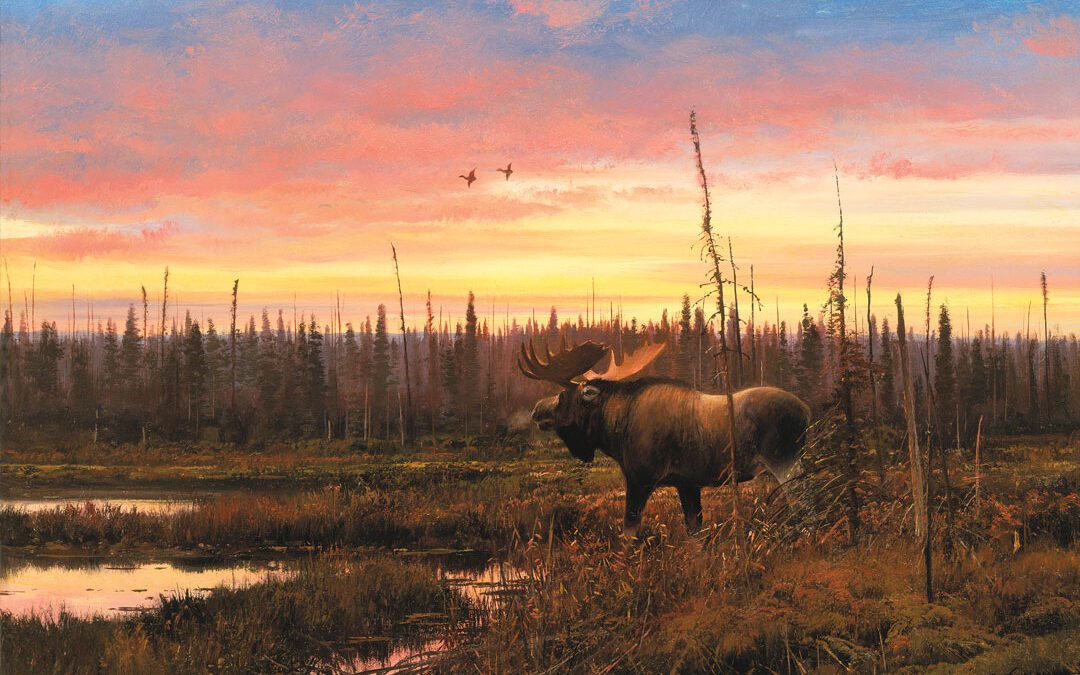
In this 1938 classic, a teenager takes a giant step toward manhood while hunting big game in the Alaskan wilderness.
The three great Kanai bulls were bedded down in a frost-painted alder clump close above the shingle beach of a timberline lake. Unless you knew exactly where to look, it would have been impossible, even with binoculars, to make them out. Their dark autumn coats blended perfectly with the shadows of the wind-brushed alders, and the ruddy tint of their antlers was within a half-a-shade of the color of the sun-cured redtop. Side by side they lay, heads into the wind, forelegs drawn up under their bodies, necks outstretched in the manner of sleeping dogs to relieve them of the weight of their massive antlers. Save for the restless flicking of their ears, alert even in sleep – if you could call such hair-trigger response sleep – they were motionless.
Johnny shivered nervously and changed position as his back began to cramp. He wet his lips, glanced at his rifle for the hundredth time to make sure it was chamber-loaded and the sights were properly adjusted, then flashed an inquiring look at me. I shook my head. There was nothing to do but wait until the bulls stood up. From our position on the ridge above the lake we could get a shot when they got to their feet. Meanwhile, it was a question of patience.
Johnny was only 16, the youngest hunter I had ever guided, and while he had not yet shown any signs of buck fever, I wasn’t taking any chances. Further, I couldn’t make an estimate of the bulls’ heads at this distance until the animals stood up. So we waited.
Another half-hour passed. A gust of wind fanned my left cheek. I glanced at the alder scrub farther up the ridge. The wind was shifting. A moment before it had been striking me full in the face. If it happened to eddy a bit under the brow of the ridge, caught by a crosscurrent off the lake, the bulls would get our scent. Then Johnny would have to shoot. I was thinking about easing down the hill with the idea of getting as close as we could before the inevitable happened when Johnny reached out suddenly and caught my arm.
“Look!” he whispered, nodding toward the alder jungle fringing the head of the lake.
A seal brown shadow showed in the depth of the tangled brush where no shadow had been a moment before. I half-closed my eyes to shut out everything but that shadow, strove to separate it from its background, to trace its outlines. The color was right, and I knew – Suddenly a single flicker of motion brought the object sharply into view. It was a cow moose standing in the entrance of a narrow lane that twisted back among the alders. She had raised her head, and that movement had made her stand out apart from the weaving shadows and the confused color pattern of the autumn-tinted branches.
“Get ready,” I whispered. “She’s going to upset the apple cart.”
The cow wheeled to face us, great ears turned forward. I had her squarely in the field of my glasses, and knew the exact second when she got our scent. She flinched and squatted a bit, in the manner of a horse getting ready to make a flat-footed jump. Then she tossed her head and snorted, a sound like the tearing of a strip of canvas.
In a flash the three bulls heaved to their feet and stood staring about them in the half-timid, half-belligerent attitude of bull moose during the rut.
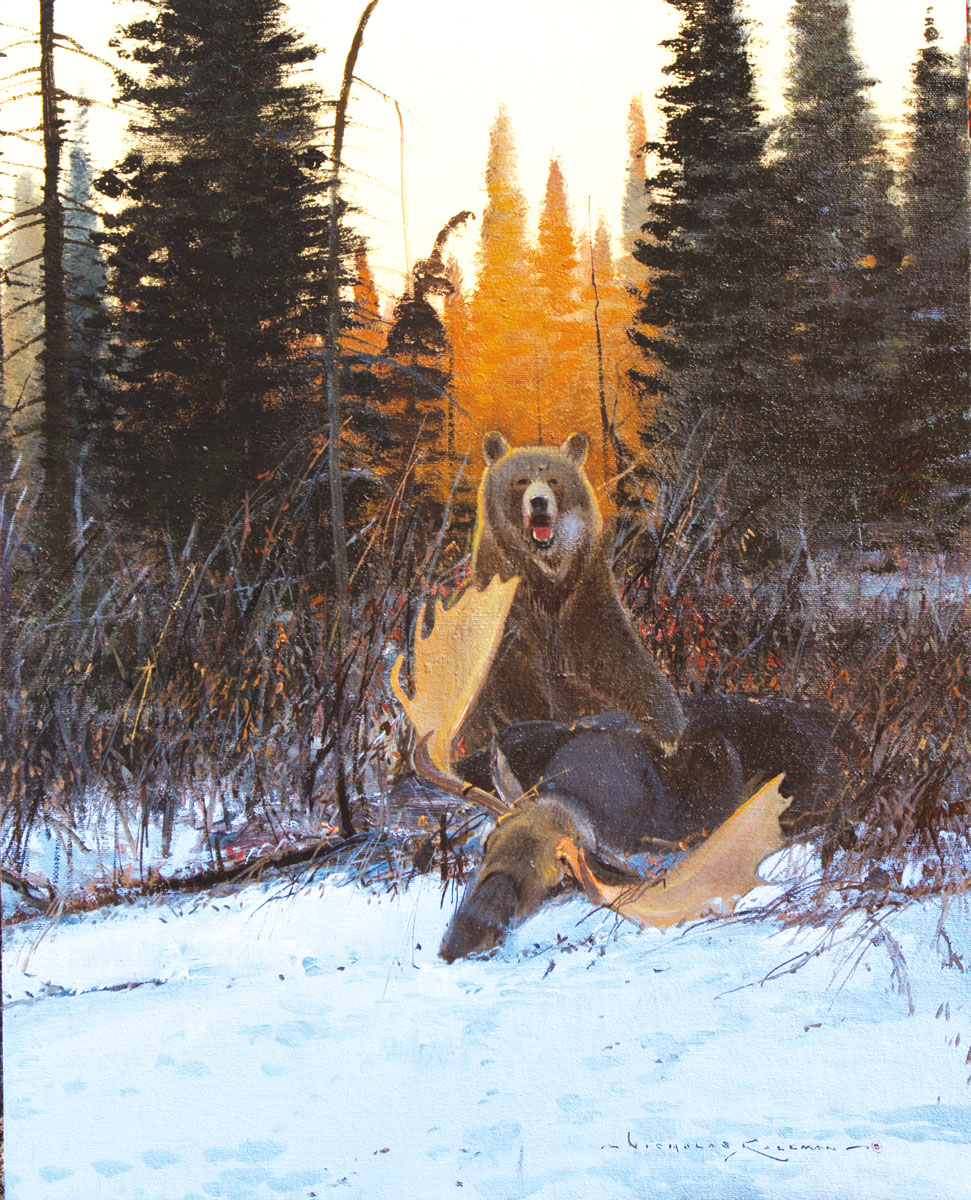
Grizzly by Nicolas Coleman
One of them had a first–rate head, wide and branchy. There was no time to count points and estimate inches of spread, but I knew the trophy was a good one. The rule of thumb I had used in a hundred close appraisals of moose heads applied itself automatically in the brief moment I had to size up the bull with my glasses. He had no bell, his antlers looked to be two-thirds as wide as his body was long, they came out from his skull at an angle made for a good tape-reading. The palms were wider than the longest point I could see, and the brow antlers appeared to be symmetrical.
“Take the big bull on the right . . . the one facing the lake,” I told Johnny. “Hold high on his shoulder and keep shooting as long as he’s on his feet. Get some lead into him.”
Johnny stood up and raised his rifle. At the crash of the shot the bull swiveled around and trotted toward the brush, but lurched and went to his knees before he had covered a dozen yards. I couldn’t tell where he was hit.
Johnny cast the empty shell as the bull lunged to his feet and started for the brush again. I waited for the second shot, but it didn’t come. Johnny muttered something under his breath, and I heard him working furiously at the action of his rifle. I wanted to see what had gone wrong, but didn’t dare take my eyes off the bull. The shock of the soft-nose was wearing off now. In a moment he would be into the alders.
“This b-bloody gun,” Johnny half sobbed. “It’s jammed. See what you can do, will you?”
I turned and grabbed the rifle. The bolt was back and a cartridge was jammed halfway into the chamber. I drew the bolt and pried the cartridge out with my belt knife. With another shell chambered, I handed the rifle to Johnny. He swung around, the rifle at his shoulder, but it was too late for a shot. We had a glimpse of one of the four moose streaking through the alders, but there was no way of telling if it was the wounded bull. In a moment he was lost to sight.
Johnny started to say something, but his voice choked in the middle of the first word. I never saw a youngster look so sick with disappointment. He swallowed hard, stared at his feet for a moment, blinking, then said in a low voice, “Well, I sure let you down, didn’t I?”
“It was the gun, not you,” I said. “Hand it over. Let’s see if we can find out what’s the matter with the old smoke-pole.”
I examined the rifle carefully, but couldn’t see anything wrong with either the bolt or the chamber. The faulty cartridge lay on the rocks at my feet. I picked it up. It was a .30-03. Johnny’s rifle was chambered for .30-06.
“This ’03 cartridge caused all of the trouble,” I said. “It came up second in the magazine and the shoulder jammed.”
“B-but how did it get into the magazine? Where did it come from?”
“Well, the cook’s got an old government .30-03 at camp. You must have picked up some of his cartridges by mistake.”
“I guess so,” Johnny said dully. “And that boner cost us a moose. Dad’ll think I’m a swell hunter, after all that time he spent teaching me about rifles. I hate to think about facing him when he comes in from that spike camp with Jim tomorrow.”
“We aren’t licked yet,” I said. “Maybe I can track down the bull. But I’ll have to get at it, because there aren’t more than two hours of daylight left. Think you could find your way back to camp alone?”
Johnny squared his shoulders and looked me straight in the eye. “If you go after the bull, I’m going with you. Doggone it, it was my fault he got away, and I want to help find him.”
He fiddled with the sling strap of his rifle for a moment. Then: ”And anyway, maybe I couldn’t find the way back to camp.”
“That’s a stall,” I said. “But if you insist, come on. We’ve wasted enough time gabbing about it.”
We followed the bull’s trail two miles over a saddleback pass and down into a wide jackspruce flat. Part of the way it was possible to keep on it at a trot. The bull had been bleeding a good deal, and his hoofs had made clean, sharp impressions in the frozen mass. Figuring he would lie down presently, I circled downwind from each spruce clump and went in under the trees as quietly as I could. But always I found his tracks coming out the other side.
The sun wallowed down through a bank of honey-colored clouds. Then the western glow faded to salmon pink, to rose, to a fairly steely wash. The swift twilight was deepening to darkness.
Off to our right, a shelving rimrock ledge rose above a thin, cold creek. The wind had blown a great heap of dead leaves into the lee of a granite boulder. I gathered some squaw wood and built a fire.
“Here’s where we bed down,” I told Johnny. “And if I’m any weather prophet, you’ll wish before morning that you’d gone back to camp. It’s going to be plenty cold. The wind is blowing straight from the North Pole, and it hasn’t got any warmer on the way.”
Johnny spread his hands in the warmth of the fire. He grinned, and said, “This is swell. It’s a lot more like a hunter’s camp than a bunch of tents we’ve got back on the river. Shucks, I wouldn’t miss this part of it for anything.”
The stars snapped hard and clear. The creek tinkled icily. Somewhere above us a pair of Arctic owls were talking. I piled a couple of spruce windfalls on the fire, then lay down on a mattress of leaves and dropped off to sleep.
It was breaking day when I woke. I sat up shivering beside the dead fire and looked out at nothing but faint, even, pearl-grey light. A mountain fog had filled the flat from rim to rim. The ghostly spruces were drenched and dripping.
I started to rebuild the fire, but decided against it. We had nothing to cook and would get warm soon enough when we hit the trail.
“Roll out, bucko,” I called. “Daylight in the swamp.”
Johnny was buried to his ears in the dry leaves. He got up stiffly, shoulders hunched against the penetrating chill of the fog, teeth chattering despite his obvious efforts to keep them from doing so. He combed some leaves out of his hair, tightened his bootlaces, took a hitch in his belt, and said, “All right. I’m ready. But you don’t happen to know where a fellow could get a cup of hot coffee and a sandwich or two, do you?”
“You bounce pretty well for a lad that’s just spent his first night in a siwash camp,” I said. “Darned if I don’t think you might make a hunter some day.”
“I’ll bet you’re just as hungry as I am.”
“Son,” I said fervently, “I could eat a boiled mule.”
The bull’s trail led straight across the flat, but he had made slow going of it. We slipped through the timber at a trot, our pacs making no sound on the wet moss and forest litter. After perhaps 20 minutes we came out at the rim of a redtop meadow. As we started across it, following a dim trail through the frosted grass, I saw something moving against an old snowdrift at the farther side.
I stared through the fog, trying to make out what kind of animal it was. It showed light brown, almost yellow, against the snow, and seemed to be standing upright like a man. I took a few steps forward, holding my rifle cocked and ready. The animal dropped to all fours, and gave a hoarse whoof! Then I knew what it was – a grizzly. It had found Johnny’s moose, and was breakfasting on the carcass.
“Take him, Johnny – it’s a grizzly! Hold up front; get the first one in his chest.”
The bear was moving about uneasily. He half-turned and started toward the timber. Then Johnny found him in his sights and squeezed the trigger. The bear went over backwards, clawing at the moss. Johnny took a step forward and fired again. I heard the smack of the softnose getting home in bone and flesh. The bear lay still. We waited a moment, then went over to him.
He had fallen within 30 feet of Johnny’s moose. The kid stood and gazed at the two trophies. He didn’t say a word; just looked at the dead animals as though he was trying to fix the sight of them so firmly in his memory that he never could forget them.
I built a quick fire of pitchy spruce-limbs and propped a flat shale slab at an angle beside it. Then I cut from the moose four thick tenderloin steaks. When the rock was hot, I greased it with kidney fat and put the steaks on to broil.
We were sitting beside the fire eating when the sun broke through the fog. A pool of jagged brilliance showed to the eastward, and through it we caught a glimpse of the Kenai range, sharp-cut and gleaming in the morning light.
Johnny pulled a handful of grass and wiped his greasy fingers.
“What do you suppose Dad will say,” he asked, “when I tell him I’m going to be a big-game hunter instead of a lawyer when I grow up?”
Note: This classic originally appeared in Annabel’s Tales of a Big Game Guide in 1938.