
Never in history has one man so devoutly pursued and killed as many man-eaters as did Jim Corbett, saving untold numbers of human lives in the process. What follows is Corbett’s exciting conclusion to his tale of “The Thak Man-Eater,” which originally appeared in his 1946 classic, Man-Eaters of Kumaon.
There are few people, I imagine, who have not experienced that feeling of depression that follows failure to accomplish anything they have set out to do. The road back to camp after a strenuous day when the chukor bag is full is only a step compared with the same road which one plods over, mile after weary mile, when the bag is empty, and if this feeling of depression has ever assailed you at the end of a single day, and when the quarry has only been chukor, you will have some idea of the depth of my depression that evening when, after calling up my men and untying the goats, I set off on my two-mile walk to camp, for my effort had been not of a single day or my quarry a few birds, nor did my failure concern only myself.

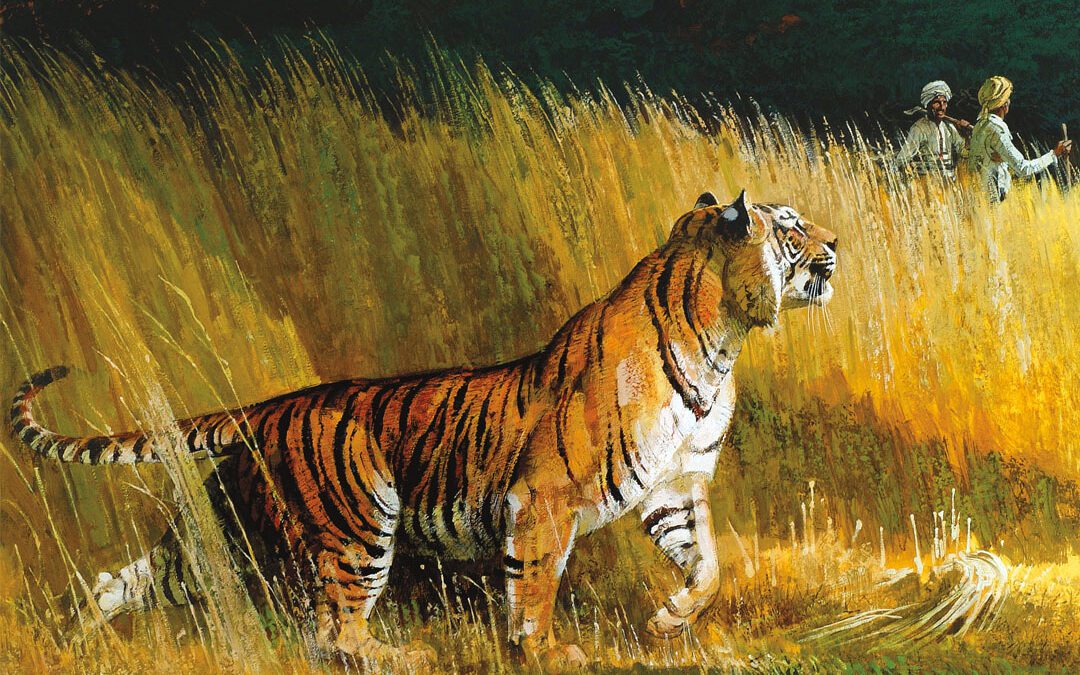
Angry Tiger by Bob Kuhn
Excluding the time spent on journeys from and to home, I had been on the heels of the man-eater from 23 October to 7 November, and again from 24 to 30 November, and it is only those of you who have walked in fear of having the teeth of a tiger meet in your throat who will have any idea of the effect on one’s nerves of days and weeks of such anticipation.
Then again, my quarry was a man-eater, and my failure to shoot it would very gravely affect everyone who was working in, or whose homes were in, that area. Already work in the forests had stopped, and the entire population of the largest village had abandoned their homes. Bad as the conditions were, they would undoubtedly get worse if the man-eater was not killed, for the entire labor force could not afford to stop work indefinitely, nor could the population of the surrounding villages afford to abandon their homes and their cultivation as the more prosperous people of Thak had been able to do.
The tigress had long since lost her natural fear of human beings, as was abundantly evident from her having carried away a girl picking up mangoes in a field close to where several men were working, killing a woman near the door of her house, dragging a man off a tree in the heart of a village, and the previous night, cowing a few thousand men into silence.
And here was I, who knew full well what the presence of a man-eater meant to the permanent and temporary inhabitants and to all the people who passed through the district on their way to the markets at the foothills or the temples at Punagiri, plodding down to camp on what I had promised others would be my last day of man-eater hunting; reason enough for a depression of soul which I felt would remain with me for the rest of my days. Gladly at that moment would I have bartered the success that had attended 32 years of man-eater hunting for one unhurried shot at the tigress.
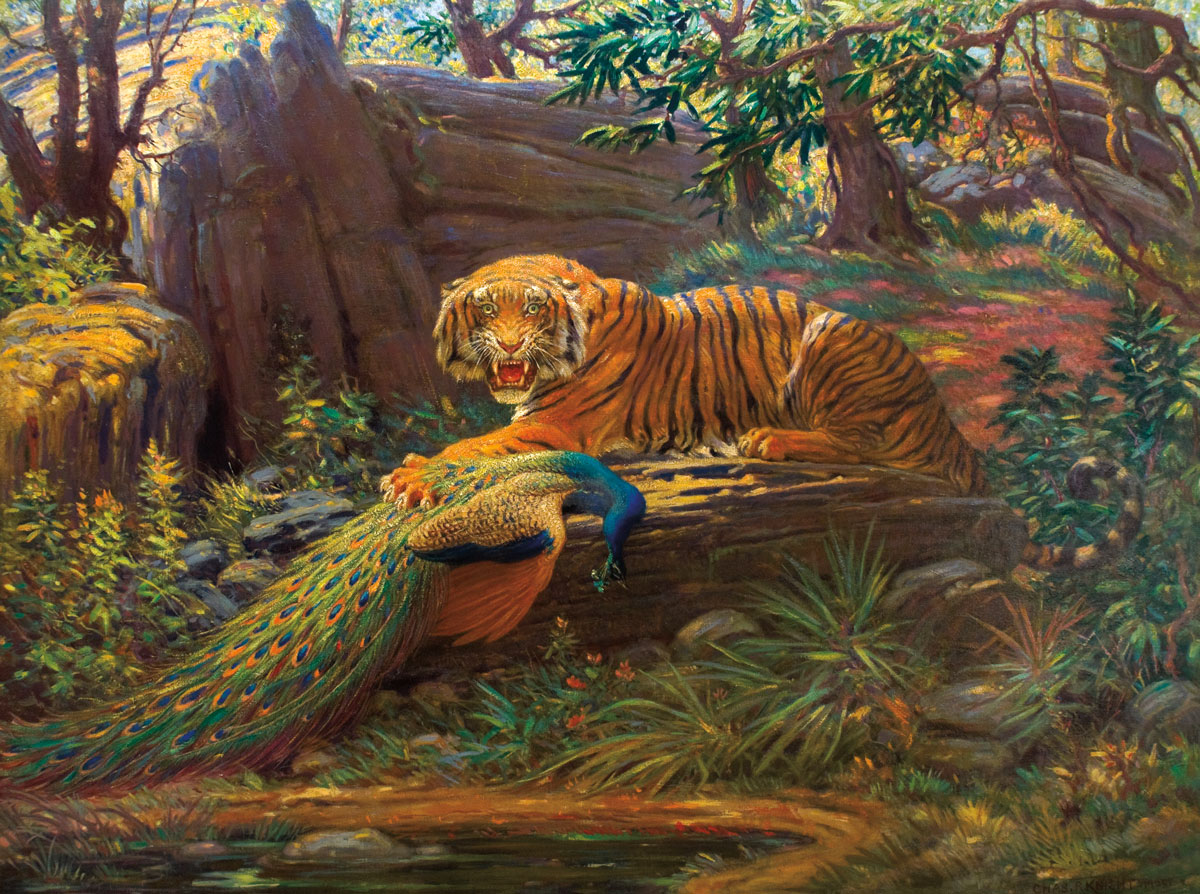
Bengal Tiger and Peacock by Charles Knight
I have told you of some of the attempts I made during this period of seven days and seven nights to get a shot at the tigress, but these were by no means the only attempts I made. I knew that I was being watched and followed, and every time I went through the two miles of jungle between my camp and Thak, I tried every trick I have learnt in a lifetime spent in the jungles to outwit the tigress. Bitter though my disappointment was, I felt that my failure was not in any way due to anything I had done or left undone.
My men when they rejoined me said that, an hour after the kakar had barked, they had heard the tigress calling a long way off but were not sure of the direction. Quite evidently the tigress had as little interest in goats as she had in buffaloes, but even so it was unusual for her to have moved at that time of day from a locality in which she was thoroughly at home, unless she had been attracted away by some sound, which neither I nor my men had heard; however that may have been, it was quite evident that she had gone, and as there was nothing further that I could do, I set off on my weary tramp to camp.
The path, as I have already mentioned, joins the ridge that runs down to Chuka a quarter of a mile from Thak, and when I now got to this spot where the ridge is only a few feet wide and from where a view is obtained of the two great ravines that run down to the Ladhya River, I heard the tigress call once and again across the valley on my left. She was a little above and to the left of Kumaya Chak, and a few hundred yards below the Kot Kindri ridge on which the men working in that area had built themselves grass shelters.
Here was an opportunity, admittedly forlorn and unquestionably desperate, of getting a shot; still it was an opportunity and the last I should ever have, and the question was, whether or not I was justified in taking it.
When I got down from the tree I had one hour in which to get back to camp before dark. Calling up the men, hearing what they had to say, collecting the goats and walking to the ridge had taken about 30 minutes, and judging from the position of the sun which was now casting a red glow on the peaks of the Nepal hills, I calculated I had roughly half an hour’s daylight in hand. This time factor, or perhaps it would be more correct to say light factor, was all-important, for if I took the opportunity that offered, on it would depend the lives of five men.
The tigress was a mile away and the intervening ground was densely wooded, strewn over with great rocks and cut up by a number of deep nullahs, but she could cover the distance well within the half-hour – if she wanted to. The question I had to decide was, whether or not I should try to call her up. If I called and she heard me, and came while it was still daylight and gave me a shot, all would be well; on the other hand, if she came and did not give me a shot, some of us would not reach camp, for we had nearly two miles to go and the path the whole way ran through heavy jungle, and was bordered in some places by big rocks and in others by dense brushwood. It was useless to consult the men, for none of them had ever been in a jungle before coming on this trip, so the decision would have to be mine. I decided to try to call up the tigress.
Handing my rifle over to one of the men, I waited until the tigress called again and, cupping my hands round my mouth and filling my lungs to their utmost limit, sent an answering call over the valley. Back came her call and thereafter, for several minutes, call answered call. She would come, had in fact already started, and if she arrived while there was light to shoot by, all the advantages would be on my side, for I had selected the ground on which it would best suit me to meet her.
November is the mating season for tigers and it was evident that for the past 48 hours she had been rampaging through the jungles in search of a mate, and that now, on hearing what she thought was a tiger answering her mating call, she would lose no time in joining him.
Four hundred yards down the ridge, the path runs for 50 yards across a flat bit of ground. At the far right-hand side of this flat the path skirts a big rock and then drops steeply, and continues in a series of hairpin bends down to the next bench. It was at this rock I decided to meet the tigress, and on my way down to it I called several times to let her know I was changing my position, and also to keep in touch with her.
I want you now to have a clear picture of the ground in your mind, to enable you to follow the subsequent events. Imagine then a rectangular piece of ground 40 yards wide and 80 yards long, ending in a perpendicular rock face. The path coming down from Thak runs onto this ground at its short or south end, and after continuing down the center for 25 yards bends to the right and leaves the rectangle on its long or east side. At the point where the path leaves the flat there is a rock about four feet high. From a little beyond where the path bends to the right, a ridge of rock, three or four feet high, rises and extends to the north side of the rectangle, where the ground falls away in a perpendicular rock face. On the near or path side of this low ridge there is a dense line of bushes approaching to within ten feet of the four-foot-high rock I have mentioned. The rest of the rectangle is grown over with trees, scattered bushes and short grass.
It was my intention to lie on the path by the side of the rock and shoot the tigress as she approached me, but when I tried this position I found it would not be possible for me to see her until she was within two or three yards, and further, that she could get at me either round the rock or through the scattered bushes on my left without my seeing her at all. Projecting out of the rock, from the side opposite to that from which I expected the tigress to approach, there was a narrow ledge. By sitting sideways I found I could get a little of my bottom on the ledge, and by putting my left hand flat on the top of the rounded rock and stretching out my right leg to its full extent and touching the rock with my toes, retain my position on it. The men and goats I placed immediately behind, and 10 to 12 feet below me.
The stage was now set for the reception of the tigress, who while these preparations were being made had approached to within 300 yards. Sending out one final call to give her direction, I looked round to see if my men were all right.
The spectacle these men presented would under other circumstances have been ludicrous, but was here tragic. Sitting in a tight little circle with their knees drawn up and their heads together, with the goats burrowing in under them, they had that look of intense expectancy on their screwed-up features that one sees on the faces of spectators waiting to hear a big gun go off. From the time we had first heard the tigress from the ridge, neither the men nor the goats had made a sound, beyond one suppressed cough. They were probably by now frozen with fear – as well they might be – and even if they were, I take my hat off to those four men who had the courage to do what I, had I been in their shoes, would not have dreamt of doing.
For seven days they had been hearing the most exaggerated and blood-curdling tales of this fearsome beast that had kept them awake the past two nights, and now, while darkness was coming on, and sitting unarmed in a position where they could see nothing, they were listening to the man-eater drawing nearer and nearer; greater courage, and greater faith, it is not possible to conceive.
The fact that I could not hold my rifle, a D.B. 450/400, with my left hand (which I was using to retain my precarious seat on the ledge) was causing me some uneasiness, for apart from the fear of the rifle slipping on the rounded top of the rock – I had folded my handkerchief and placed the rifle on it to try to prevent this – I did not know what would be the effect of the recoil of a high-velocity rifle fired in this position. The rifle was pointing along the path, in which there was a hump, and it was my intention to fire into the tigress’s face immediately when it appeared over this hump, which was 20 feet from the rock.
The tigress, however, did not keep to the contour of the hill, which would have brought her out on the path a little beyond the hump, but crossed a deep ravine and came straight towards where she had heard my last call, at an angle which I can best describe as one o’clock. This maneuver put the low ridge of rock, over which I could not see, between us. She had located the direction of my last call with great accuracy, but had misjudged the distance, and not finding her prospective mate at the spot she had expected him to be, she was now working herself up into a perfect fury, and you will have some idea of what the fury of a tigress in her condition can be when I tell you that not many miles from my home, a tigress on one occasion closed a public road for a whole week, attacking everything that attempted to go along it, including a string of camels, until she was finally joined by a mate.
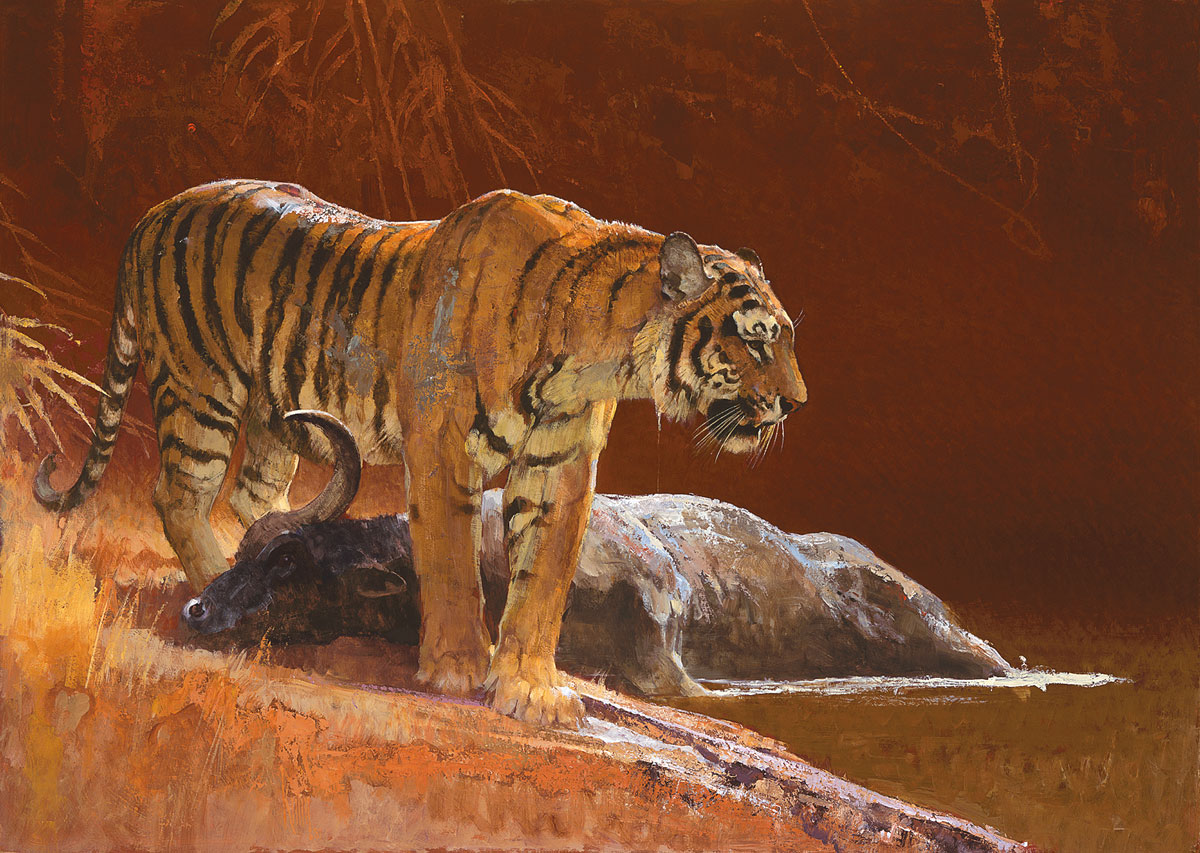
Stillness by the Pool by Bob Kuhn
I know of no sound more liable to fret one’s nerves than the calling of an unseen tiger at close range. What affect this appalling sound was having on my men I was frightened to think, and if they had gone screaming down the hill I should not have been at all surprised, for even though I had the heel of a good rifle to my shoulder and the stock against my cheek, I felt like screaming myself.
But even more frightening than this continuous calling was the fading of the light. Another few seconds, 10 or 15 at the most, and it would be too dark to see my sights, and we should then be at the mercy of a man-eater, plus a tigress wanting a mate. Something would have to be done, and done in a hurry, if we were not to be massacred, and the only thing I could think of was to call.
The tigress was now so close I could hear the intake of her breath each time before she called, and as she again filled her lungs, I did the same with mine, and we called simultaneously. The effect was startlingly instantaneous. Without a second’s hesitation she came tramping with quick steps through the dead leaves, over the low ridge and into the bushes a little to my right front, and just as I was expecting her to walk right on top of me she stopped, and the next moment the full blast of her deep-throated call struck me in the face and would have carried the hat off my head had I been wearing one. A second’s pause, then again quick steps; a glimpse of her as she passed between two bushes, and then she stepped right out into the open, and looking into my face, stopped dead.
By great and unexpected good luck the half-dozen steps the tigress took to her right front carried her almost to the exact spot at which my rifle was pointing. Had she continued in the direction in which she was coming before her last call, my story – if written – would have had a different ending, for it would have been as impossible to slew the rifle on the rounded top of the rock as it would have been to lift and fire it with one hand.
Owing to the nearness of the tigress and the fading light, all that I could see of her was her head. My first bullet caught her under the right eye and the second, fired more by accident than with intent, took her in the throat and she came to rest with her nose against the rock. The recoil from the right barrel loosened my hold on the rock and knocked me off the ledge, and the recoil from the left barrel, fired while I was in the air, brought the rifle up in violent contact with my jaw and sent me heels over head right on top of the men and goats. Once again I take my hat off to those four men for, not knowing but what the tigress was going to land on them next, they caught me as I fell and saved me from injury and my rifle from being broken.
When I had freed myself from the tangle of human and goat legs, I took the .275 rifle from the man who was holding it, rammed a clip of cartridges into the magazine and sent a stream of five bullets singing over the valley and across the Sarda into Nepal. Two shots, to the thousands of men in the valley and in the surrounding villages who were anxiously listening for the sound of my rifle, might mean anything, but two shots followed by five more, spaced at regular intervals of five seconds, could only be interpreted as conveying one message, and that was, the man-eater was dead.
I had not spoken to my men from the time we had first heard the tigress from the ridge. On my telling them now that she was dead and that there was no longer any reason for us to be afraid, they did not appear to be able to take in what I was saying, so I told them to go up and have a look while I found and lit a cigarette. Very cautiously they climbed up to the rock, but went no further for, as I have told you, the tigress was touching the other side of it.
Late in camp that night, while sitting round a campfire and relating their experiences to relays of eager listeners, their narrative invariably ended up with “and then the tiger whose roaring had turned our livers into water hit the sahib on the head and knocked him down on top of us and if you don’t believe us, go and look at his face.” A mirror is superfluous in camp and even if I had had one, it could not have made the swelling on my jaw, which put me on a milk diet for several days, look as large and as painful as it felt.
By the time a sapling had been felled and the tigress lashed to it, lights were beginning to show in the Ladhya valley and in all the surrounding camps and villages. The four men were very anxious to have the honor of carrying the tigress to camp, but the task was beyond them, so I left them and set off for help.
In my three visits to Chuka during the past eight months I had been along this path many times by day and always with a loaded rifle in my hands, and now I was stumbling down in the dark, unarmed, my only anxiety being to avoid a fall. If the greatest happiness one can experience is the sudden cessation of great pain, then the second greatest happiness is undoubtedly the sudden cessation of great fear.
One short hour previously it would have taken wild elephants to have dragged from their homes and camps the men who now, singing and shouting, were converging from every direction, singly and in groups, on the path leading to Thak. Some of the men of this rapidly growing crowd went up the path to help carry in the tigress, while others accompanied me on my way to camp, and would have carried me had I permitted them. Progress was slow, for frequent halts had to be made to allow each group of new arrivals to express their gratitude in their own particular way. This gave the party carrying the tigress time to catch up, and we entered the village together.
I will not attempt to describe the welcome my men and I received, or the scenes I witnessed at Chuka that night, for having lived the greater part of my life in the jungles, I have not the ability to paint word-pictures.
A hayrick was dismantled and the tigress laid on it, and an enormous bonfire made from driftwood to light up the scene and for warmth, for the night was dark and cold with a north wind blowing. Round about midnight my servant, assisted by the headman of Thak and Kunwar Singh, near whose house I was camped, persuaded the crowd to return to their villages and labor camps, telling them they would have ample opportunity to feast their eyes on the tigress the following day. Before leaving himself, the headman told me he would send word in the morning to the people of Thak to return to their village. This he did, and two days later the entire population returned to their homes, and have lived in peace ever since.
This article originally appeared in the 30th Anniversary Issue of Sporting Classics magazine.