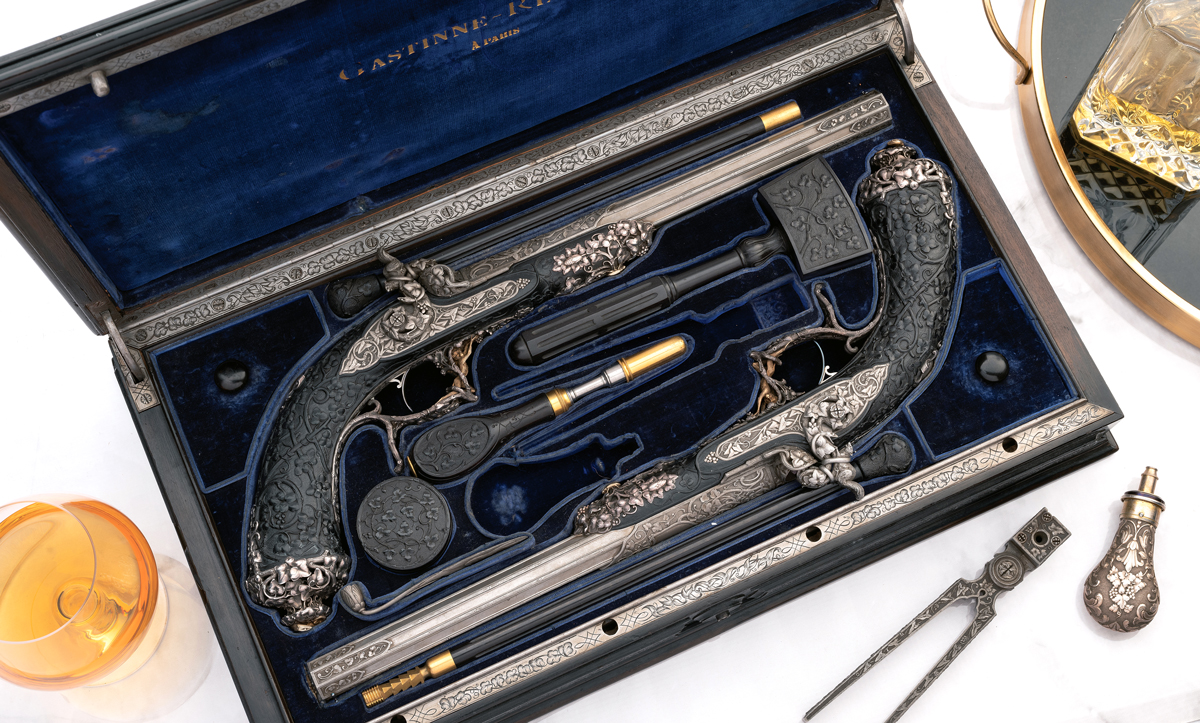
From exquisitely decorated pistols to firearms adorned with precious materials, the world of fine firearms has provided ample opportunity for artistic expression throughout the centuries.
In the past, every royal palace in Europe featured a cabinet d’arms displaying everything from swords to sidearms to shotguns and rifles in gleaming vitrines. Just as firearms are tools for hunting, there was also once a tradition of arms serving as trophies. In December of 2023, Rock Island Auctions presented part one of the Norman R. Blank collection, which perfectly exemplifies this lost world.
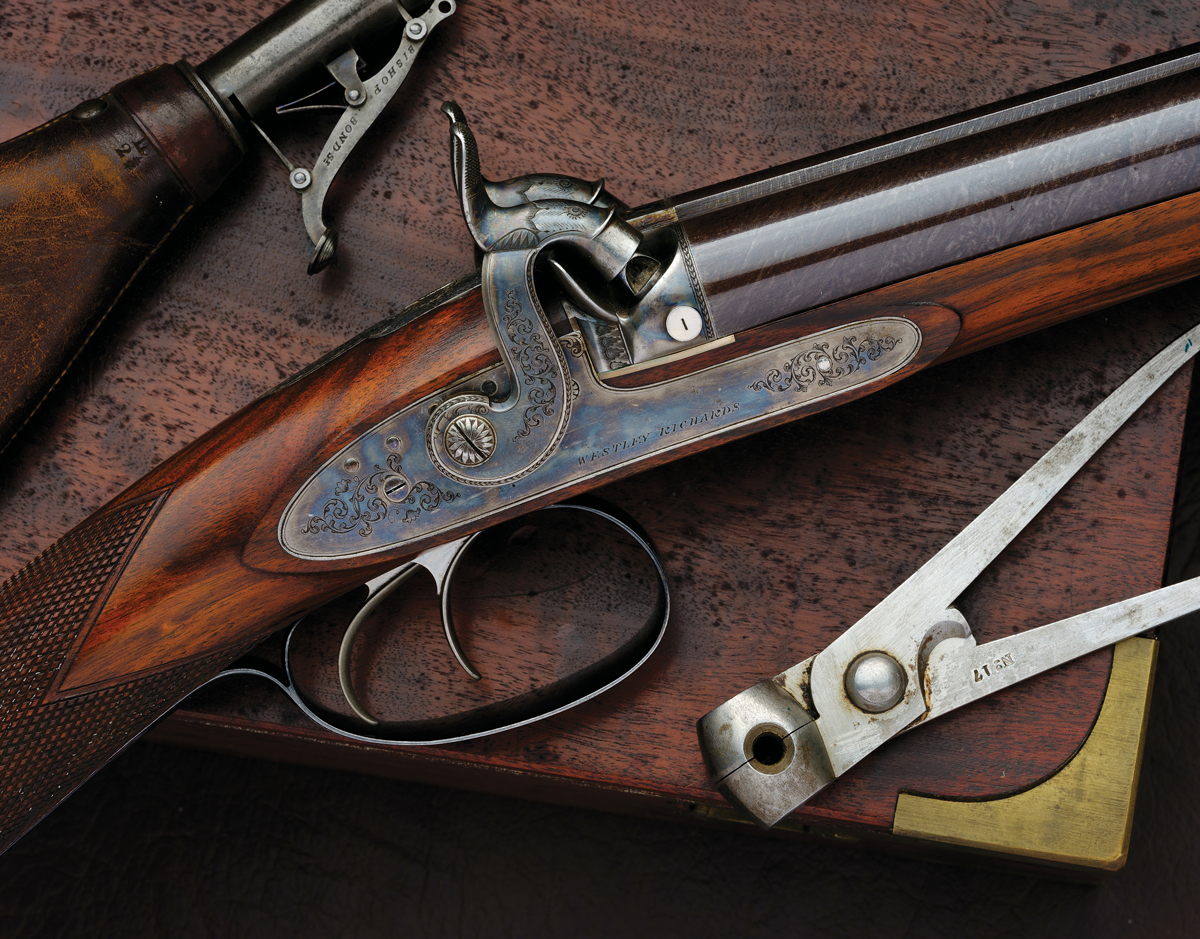
This exceptional cased Westley Richards side-by-side shotgun was manufactured circa 1880 per the data provided on page 127 of Nigel Brown’s British Gunmakers Volume One: London. The browned Damascus barrels have a bead front sight and “WESTLEY RICHARDS 170 NEW BOND ST LONDON.” on the concave rib. The locks are also signed “WESTLEY RICHARDS.”
Beneath a banner that read: “A Sleeping Giant,” Rock Island Auction Company’s slick preview read, “Unchartered and largely forgotten the last of the great European arms collections in private hands, from the last of the great students.” Norman Blank was a cultured individual knowledgeable and proficient in a wide range of areas and was possessed of great taste, but he was also closemouthed about his acquisitions. Many of us in the fine firearms world heard of his treasures but I, for one, only saw one example and it was genuinely extraordinary.
He was rumored to possess multiple extravagant treats, most of which had never been seen in public. From 17th century wheellocks through to modern nitro express breech loaders, all were said to be by Europe’s finest firearm makers and, perhaps even more significantly, decorated by the greatest engravers, inlayers, carvers and precious metal workers of each epoch.
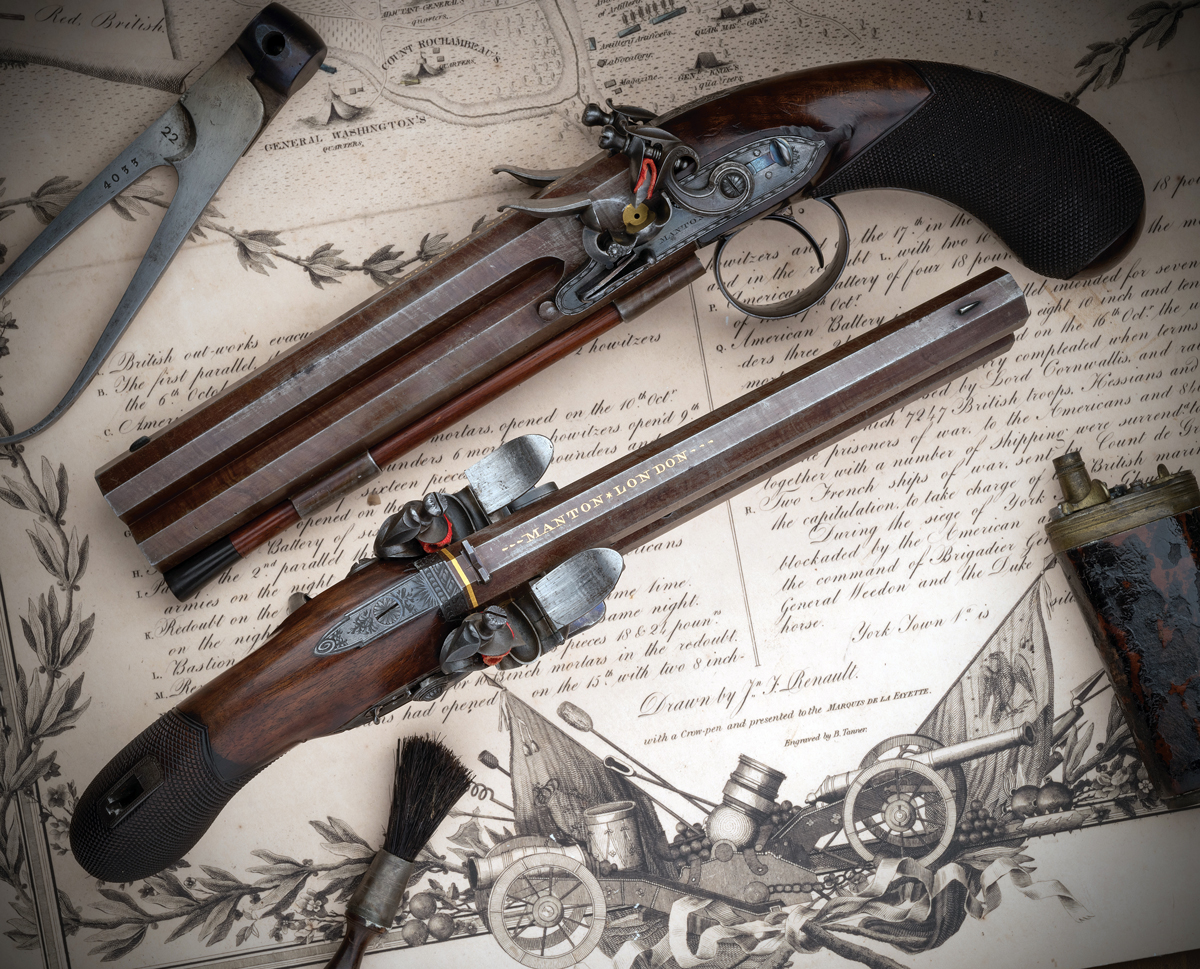
This pair of “Hair Rifled” John Manton single trigger over/under flintlock 22-bore pistols dating from circa 1802 have single trigger mechanisms that operate the left lock first. This fires the lower barrel, Manton’s normal practice, since the recoil of the lower barrel “disturbs aim less.”
RIA pulled the wraps off just 22 lots from the Norman R. Blank collection with two future sales planned to encompass the whole. Despite the relatively eclectic nature of Blank’s guns, a couple of themes emerge. One is the technological progression of fine British firearms throughout the 19th century while the second is the artistic expression and ornamentation on guns from Continental Europe.
The British Progress
During the 18th century, flintlocks were both unreliable and slow to ignite making them unsuitable to all but stationary game. Henry Nock arrowed in on the problem with his “patent breech” of 1787. Here it’s worth quoting Mike Yardley, “…it may be said without exaggeration (Nock’s breech) revolutionized firearms ballistics. Nock’s great advance combined a chamber in the breech plug and an ante-chamber drilled cross-wise from the barrel touch hole and closed on the other side with a screw plug. Though it might seem a rather trivial development, Nock’s breech was, in fact, an invention of the greatest importance. Powder was now confined loosely in the ante chamber. When the priming ignited, there was an explosion rather than mere burning as before. Ignition and combustion of the main charge were much improved; less powder was needed. Wingshooting became easier (because of the reduction in delay between pulling the trigger and the gun firing) and barrels could be chopped down without loss of performance. The double-barreled fowling piece began to be a practical proposition and, as a result of these developments, a new style of sporting gun appeared toward the end of the 18th century, typically half-stocked, with one or two barrels of about 30 inches.” Nock’s patent breech was cutting edge technology during the Regency. In 1789, Nock was appointed gunmaker-in-ordinary to King George, III, largely as a result of his patent breech.
Henry Nock is represented in the Norman Blank collection by a 4-bore single-barreled big game rifle of the type a Georgian gentleman might ship out to Bengal or Ceylon in pursuit of rhino and elephant. The standing breech is engraved with floral scrollwork and features a small martial trophy typical of master engraver William Palmer who is perhaps best known for his work for the Manton Brothers.
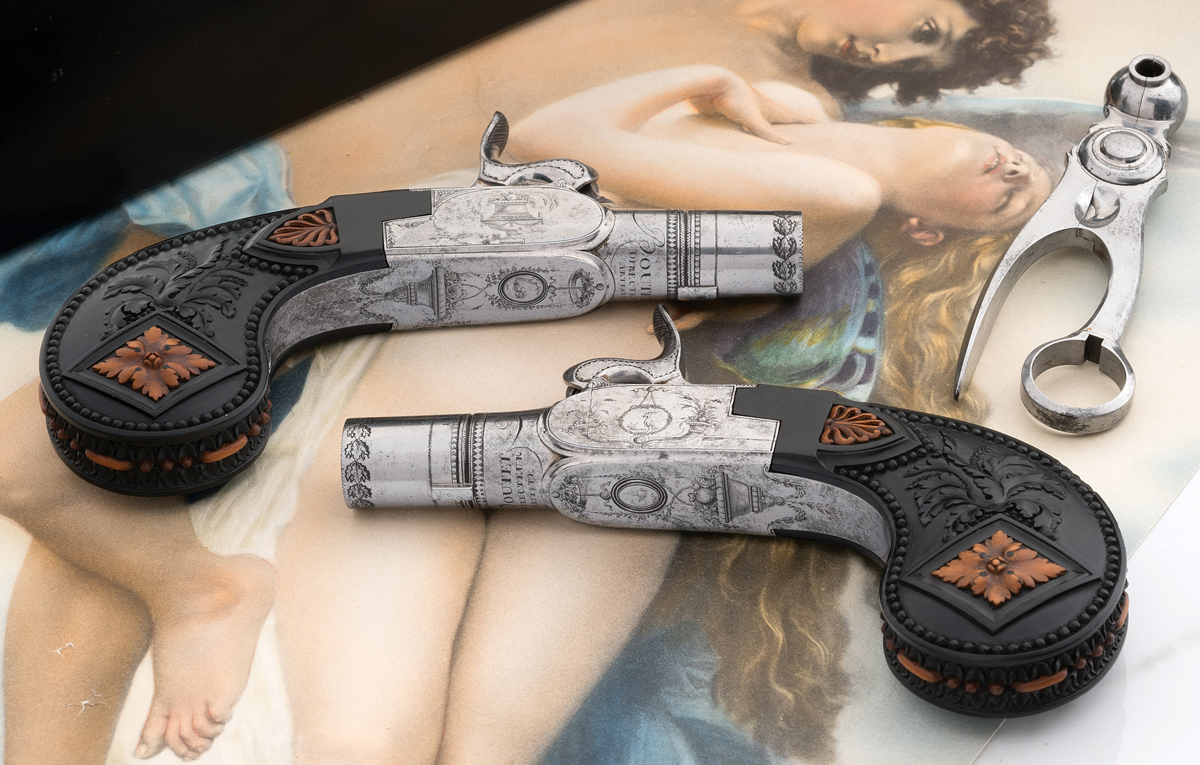
This stunning cased pair of pistols were manufactured at the famous Versailles Manufactory run by Nicolas-Noël Boutet in circa 1810 and were subsequently expertly converted to percussion between 1830 and 1840. The pistols feature very finely detailed engraving that coordinates on the pistols but varies in the details.
The Manton Brothers were amongst the first in Britain to practice the art of the bespoke firearm. Joe Manton in particular was “styled the inventor of the double-barreled gun” by sporting historian W. Willmott Dixon. Inevitably, any talk of the great gunmaker Joseph Manton leads to discussion of his equally talented brother, John. John Manton appears in Blank’s collection in the form of a 13-bore side-by-side shotgun from the late flintlock era. The escutcheon is engraved with the crest of the Earl of Plymouth, grandson of Clive of India.
During the Victorian era, flintlocks were slowly supplanted by percussion locks in which an explosive compound inside a metal cap ignited the main charge when stuck by a falling hammer. Westley Richards created an exceptional example that found its way into the Blank collection with Damascus barrels, platinum breech plugs and an emerging floral scroll engraving that would evolve into a standard for the British gun trade.
In 1958, Norman Blank bought a big bore .470 hammerless ejector double rifle by John Rigby & Co. With many of the Rigby signature features such as dipped edge lock plates and the maker’s name in gothic script on the chopper lump barrels, it is a prime example of an Edwardian express rifle. The sober scroll engraving by “Doncaster” is in marked contrast to some of Mr. Blank’s more elaborate pieces. Shortly after finishing it, John George Doncaster was killed by a horse drawn tram during The Great War blackout.
If Mr. Blank’s British guns illustrate advances in British double design in the same way that a diagram of progressively more upright hominids illustrate human evolution, then his guns from Continental Europe are a Hermitage Museum of the decorative arts.
Ornaments of Continental Europe
There’s not a single lot that I wouldn’t want to own from the Norman R. Blank collection, but I’m especially besotted by those firearms with lavishly applied decoration. The emergence of the wheellock in the early 16th century was the ideal candidate for enrichment by ornamentation since high cost and a complex mechanism restricted its use to the princely class.
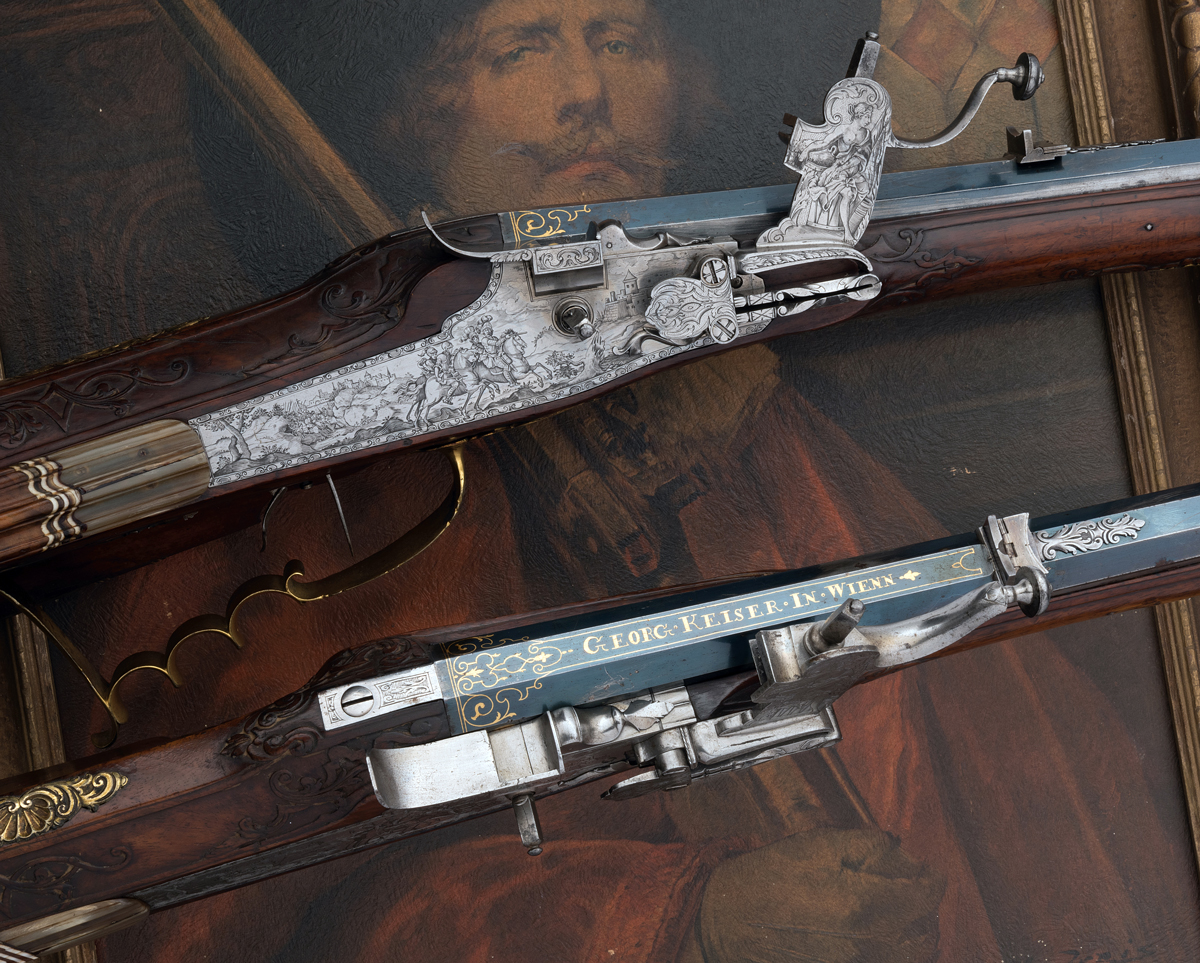
Georg Keiser (1647-1734) was one of the most talented gunmakers in Vienna in the 17th century and early 18th century and became a master in 1674 in the Vienna Guild of Gunmakers. Given his quality of work, it is no surprise that many of his surviving pieces are found in the state and imperial collections across Europe. The coat of arms on the side plates of these rifles indicates they belonged to the Austrian Habsburgs, almost certainly Holy Roman Emperor Charles, VI, (1685-1740, reigned 1711-1740) given the pair stylistically fits within the 1720-1730 time period.
George Keiser was the most distinguished of the Vienna court gunmakers. He is represented here by a pair of internal wheellock rifles created for Charles, VI, Holy Roman Emperor. Wheellocks worked when a spinning wheel sparked pyrites held tight in the jaws of a “dog-head,” which ignited priming powder through a touchhole to the main charge. Their intricacies demanded the skills of a clockmaker hence their great expense. The bearing plates on the Keiser pair feature cavalrymen whose captain appears to be brandishing a dag, while his mount is clearly equipped with a saddle holster. The dog-head cover plates portray Athena, the Greek deity associated with wisdom, craft and warfare, depicted with martial spoils.
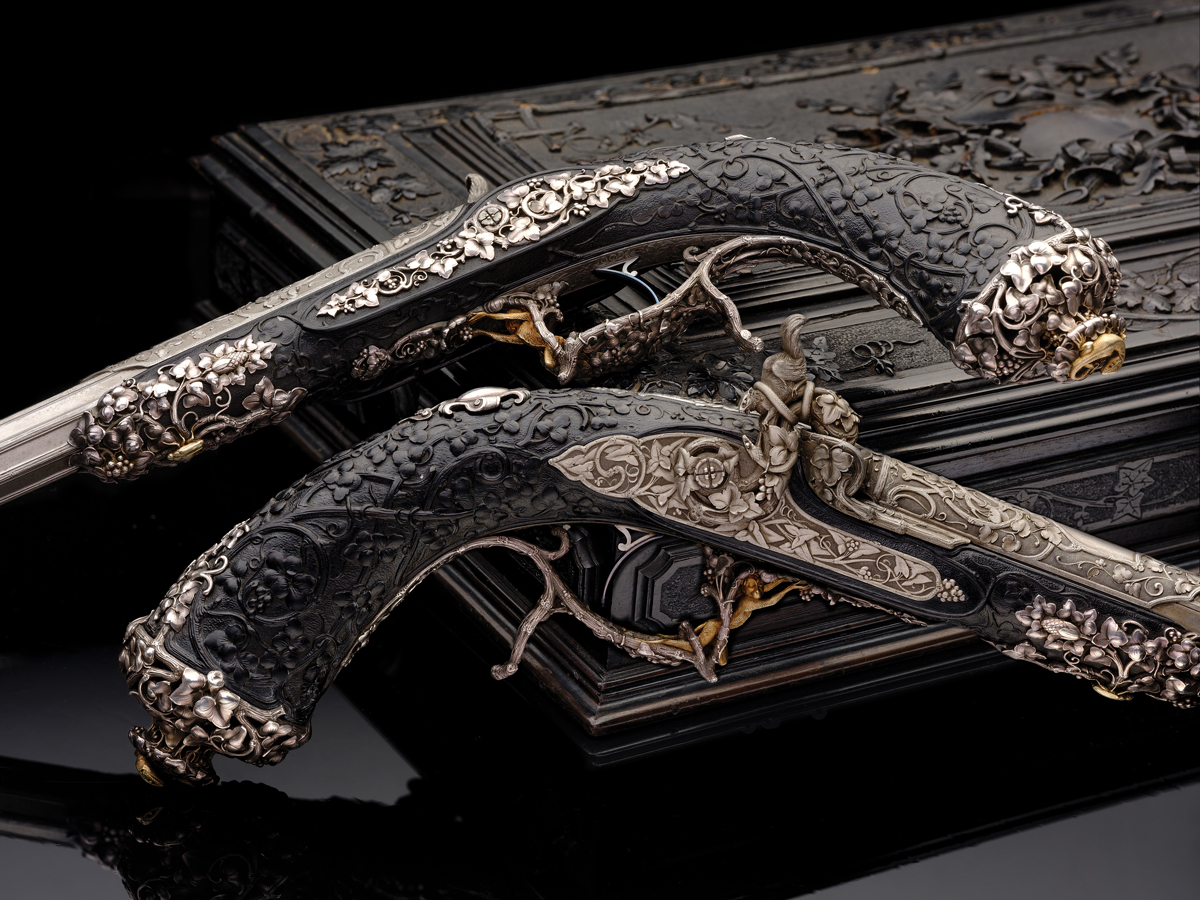
These extremely opulent pistols numbered amongst the finest exhibition arms displayed by Gastinne-Renette in the 19th century, including at the Exposition Universelle of 1855, the year of their manufacture. The pair would have been one of the finest products of excellence in Gastinne-Renette’s catalog of fine exhibition arms which were regarded as among the finest deluxe arms ever produced and remain revered as among the most beautiful and luxurious firearms ever produced in France.
At what point does a simple firearm transcend the realms of practical tool into a full-blown work of art? One answer is certainly provided by the work of Nicolas-Noël Boutet who became directeur-artiste of the Versailles Arms Manufactory during 1792. Boutet’s artistry spanned everything from the ancient régime’s Rococo style, through Napoleon’s love for classicism with its gaudy references to Egyptian motifs, to the fine scrimshaw like detail seen on Norman Blank’s percussion pistol pair. Converted from flintlock and cased upright in a manner familiar to Boutet’s pocket pistols, they are delicately engraved with urns and cornucopias and are, perhaps, unusual in their restraint. Simple ebony grips with a lighter wood inlay add to the impression of moderation. Boutet was charged with creating richly decorated firearms for presentation to heads of state such as Simon Bolivar and his most lavish examples feature in the UK’s Royal Armouries and in the U.S.’s Metropolitan Museum of Art. But those depicted here are unique in both style and taste.