

Wind seems to be an almost constant on mountain peaks in sheep country. Exposed on a ridgeline in Idaho’s highest mountain range, the wind whipped hard and relentlessly as our party of three picked apart the terrain with spotting scopes mounted on tripods.
It had taken close to five hours of climbing, none of it on any kind of man-made trail, to reach this place. On our backs we carried food and gear to last the next three days. We had passed the tree line more than an hour prior, and now we were in a land of grey rocks and cliffs. Perched on this mountain top, we hoped to find a bighorn ram.
The allure of hunting sheep is not only in the three feet of curling horns that a mature ram possesses but also being able to hunt the land they call home. My friend, Courtland, had the tag and I was accompanying him and his son, Chess, on this hunt. We’d seen ewes and immature rams, which was exciting, but we strained our eyes for the dark body of a mature ram carrying good horns.
The only thing above us was blue sky punctuated with white flowing clouds. Below us, through my spotting scope, I saw an eagle soar by, undulating slightly by the thermals under his wings. All around were mountains, seemingly endless mountains and, in them, scattered here and there, were bighorn sheep.
“I’ve got some rams,” Chess said.
By guiding us through terrain features, he showed us where to find them through our optics. The three rams lay against the next mountain, below us and across the canyon. As soon as I saw the largest, I knew it was a ram that would be difficult to pass up.
I took my eyes off my optics and looked at Courtland.
“Let’s go for him,” he said.
When your dreams come in the form of pursuing curling horns above the tree line, you need some serious luck in the state draws or you have to fork over quite a bit of money to hunt wild sheep. Courtland is by far the luckiest person in state hunting draws I’ve ever known, been associated with or even heard of.
The year prior to drawing his Idaho bighorn ram tag, he obtained the top non-resident rifle deer tag in Utah, and the top rifle elk unit in Nevada. The deer tag was about 1/1,000 odds, and the elk tag 1/500. He put the work in and took two great animals. That was just one year of drawing great tags, and he’s had several like that in the past.
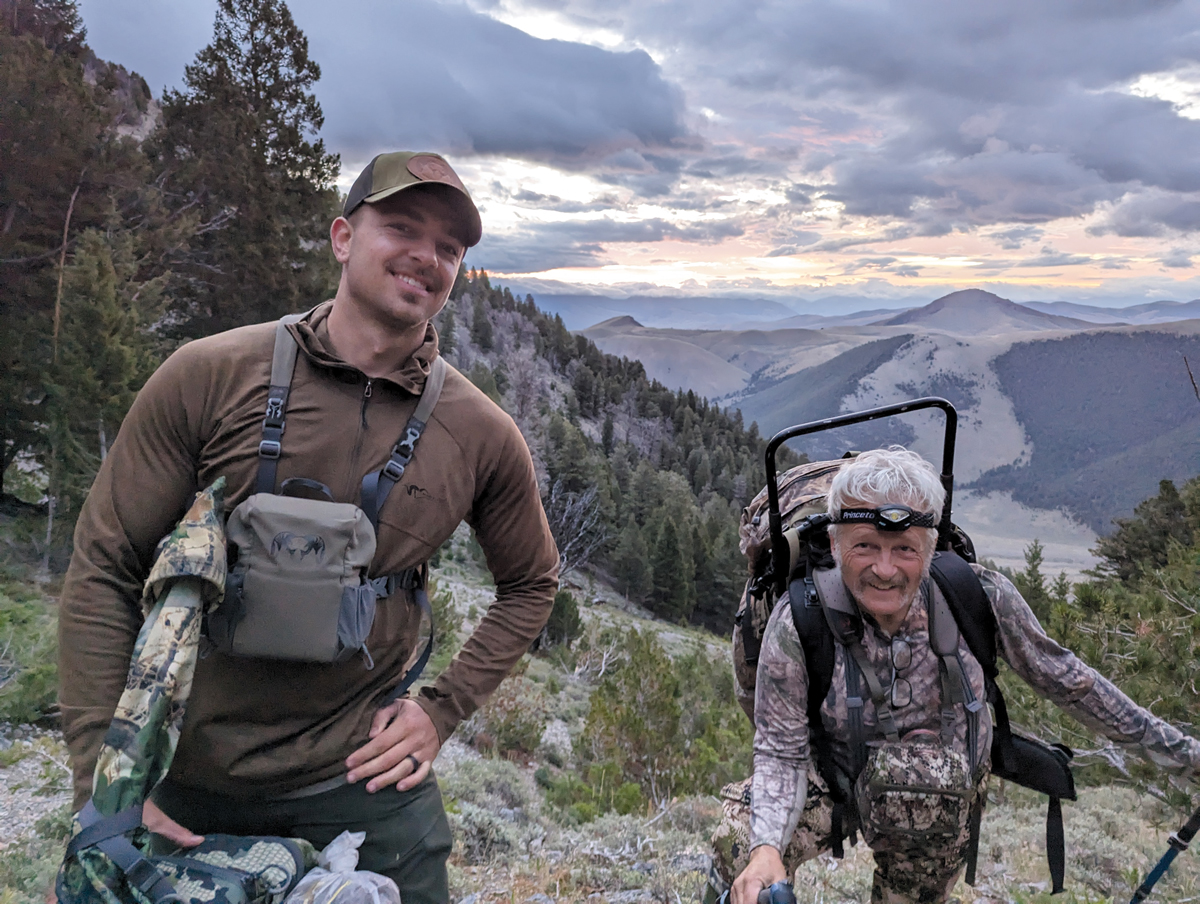
Chess and his dad, Courtland Carbol, reached the tree line around sunrise, after more than three hours of climbing in the dark.
At 68 years old, Courtland had taken two of the Grand Slam of North American Sheep. As a former resident of British Columbia, he scored a Stone sheep earlier in life. Then, ten years ago, beating lottery-type odds, he drew a Silver State desert bighorn tag in Nevada, which enabled him to pursue a ram in any open management unit in the state. He killed an incredible ram after several trips and a lot of sweat and work.
I’ve shared some great adventures with Courtland, and am best friends with his son, Chess. The joke between Chess and me is how unexcitable and nonchalant Courtland is about drawing tags. What seems to be “once-in-a-lifetime” tag for a normal person is “one-or-twice-every-fall” type of tag for Courtland.
Courtland entered the drawing knowing the unit he chose was one of Idaho’s top areas to hunt bighorn sheep, and the terrible odds that the tag carried. Chess and I usually calculate drawing odds versus the return in relation to animal density, trophy quality and past harvest success rates. We typically try for tags that have higher odds with less desirable tags, because we want a better chance to draw and go hunting. We have spreadsheets and tables and look at draw odds and come up with predictive models based on past draw patterns. We spend hours each spring discussing state draws and debating these things.
Courtland just kind of smiles at us and tells us his strategy is to simply put in for the best units. Then he draws them, leaving Chess and me scratching our heads wondering if some lucky digital leprechaun rides his name to success in the state fish and game computer systems.
Before the draw results came out, my plans for September were chasing bugling bulls with archery equipment. When Courtland told us about striking gold on a ram tag, my plans changed for the better. I’d be chasing sheep with those two.
During summer scouting, Chess sent some grainy photos of bands of rams taken through his spotting scope with the following assessment: “There are a lot of sheep, but we will have to do a lot of climbing to get to them.” That was great news. The climb is a given, so it is better to be climbing into high densities of sheep.
Courtland’s plan was to hunt Labor Day weekend and keep hunting until he got a ram. With this type of tag, he knew that taking his foot off of the gas wasn’t an option.
I arrived Friday evening while the two of them were out hunting. I had a little time to glass an area they had given me to check out. Through my spotting scope, in the late evening, I saw the dark body and headgear of a ram for just a few seconds near the top of the mountain they’d told me to concentrate on.
He seemed about as far away as the moon.
When I met up with Courtland and Chess, they showed me photos of a decent ram they had passed on. I told them what I’d seen. I explained I thought it was a good male, but it was in fading light and too quick to get a good look at the horns. They told me they’d seen a band of rams up there in the summer with a good ram in the herd. Courtland decided we would try that mountain in the morning.
We would be traveling to the moon, it seemed.
A lot can go wrong sheep hunting. Visibility is key, so a low cloud ceiling or rain can put a pause to hunting. The weather for Labor Day weekend did not look great. Rain Friday night, then a pause in weather, then thunderstorms for Sunday and Monday.
Since the weatherman isn’t always right, we left camp from the bottom with three days’ worth of food and camping gear. Maybe he could kill one early. Maybe there would be a break in the storms on Sunday and Monday. Maybe we’d be hunkered in a tent for two days hoping lightning didn’t strike us. It was anyone’s guess. Since fish and game departments don’t add extra days to sheep season for inclement weather, hunting regardless of the conditions is part and parcel for the limited time the tag is good for.
We picked a route on our map, because there were no trails going up the mountain. We figured it would take three hours to get to the tree line, and then another hour to the summit. We wanted to hit the tree line right around shooting light.
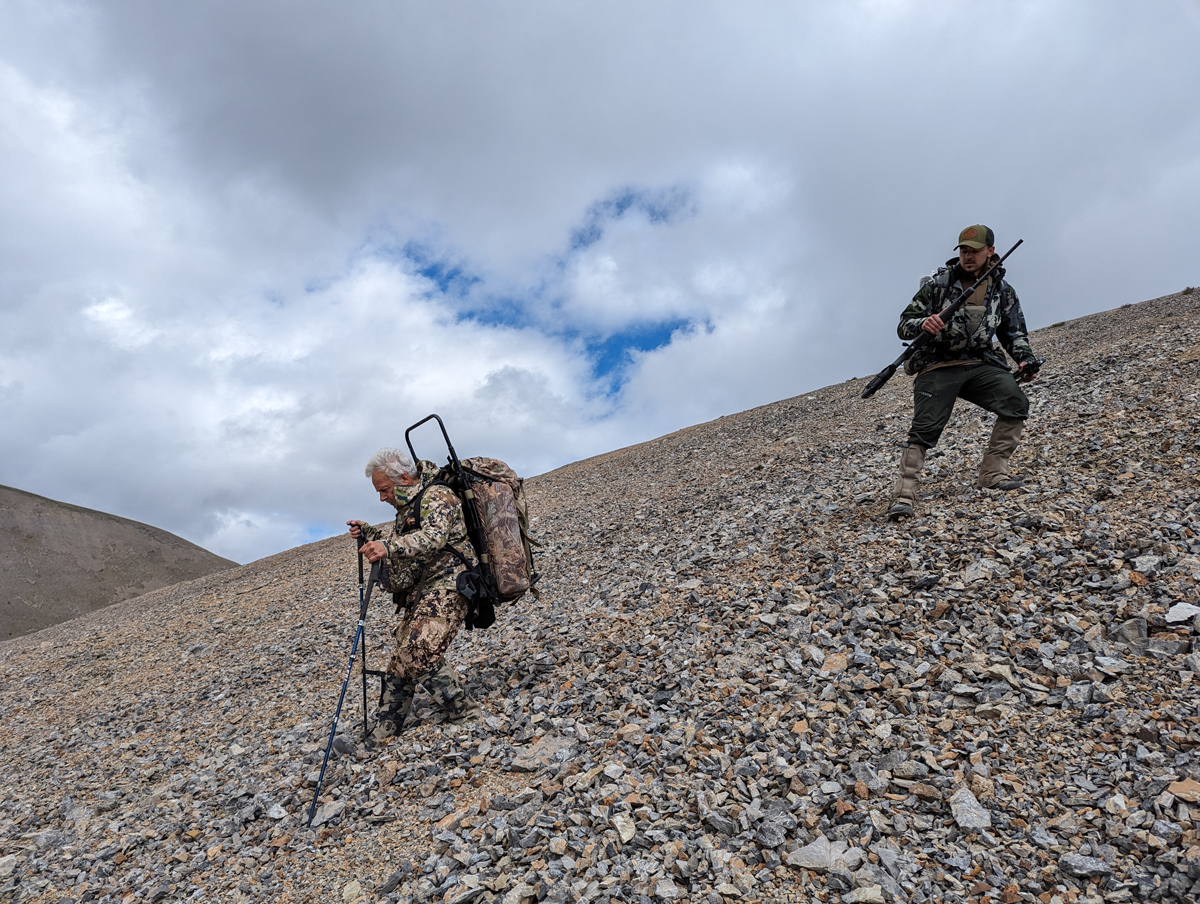
Chess and Courtland begin the long journey down the mountain and back to base camp.
There was no fire at camp that night. I think we were all a little apprehensive about the climb with gear. We hastily set up our base camp tents and tried to get as much sleep as we could before our 3 a.m. alarm.
In the dark, laden with heavy packs, we moved forward and up, with less forward and more up the farther we went. We navigated some blown-down trees in an avalanche chute, which are a bit tougher with several days of food and camping equipment, as well as some small scree slopes where one step forward could end in three steps back. Mostly, it was putting one leg in front of the other on an increasingly steep slope. The climb is part of sheep hunting and rarely is there a way to get around it. Hunting sheep means sore legs, a strained back and hard breathing with the feeling of never getting enough oxygen. Bighorn sheep prefer to be where people aren’t, and most sane people don’t like to climb mountains without established trails.
When we hit the tree line at first light, we were greeted by a herd of ewes and lambs. Interestingly, they didn’t seem too concerned with us, but I knew that likely this wouldn’t be the case with a mature ram.
We continued upward, glassing periodically and finding some young rams. The air was thin, and our lungs were burning. Our pace wasn’t fast, but we steadily made our way to the ridgeline.
Reaching the summit was spectacular. The wind proved constant, and the place just felt wild, because it was wild. The spot was unreachable by mankind except by putting one foot in front of the other for a very long time, or by helicopter, which wasn’t legal. Even a horse wouldn’t have been able to get where we stood.
Sheep hunting isn’t fun in the traditional sense. It pushes a hunter to his physical and mental limits. Physical training is important, but mindset is even more important. Courtland looked exhausted, but he knew what the costs of sheep hunting were and, even more importantly, because this wasn’t his first sheep hunt, he knew the reward at the end.
Jack O’Connor’s famously wrote: “There is no halfway. After his first exposure, a man is either a sheep hunter or he isn’t. He either falls under the spell of sheep hunting and sheep country or he won’t be caught dead on another sheep mountain.”
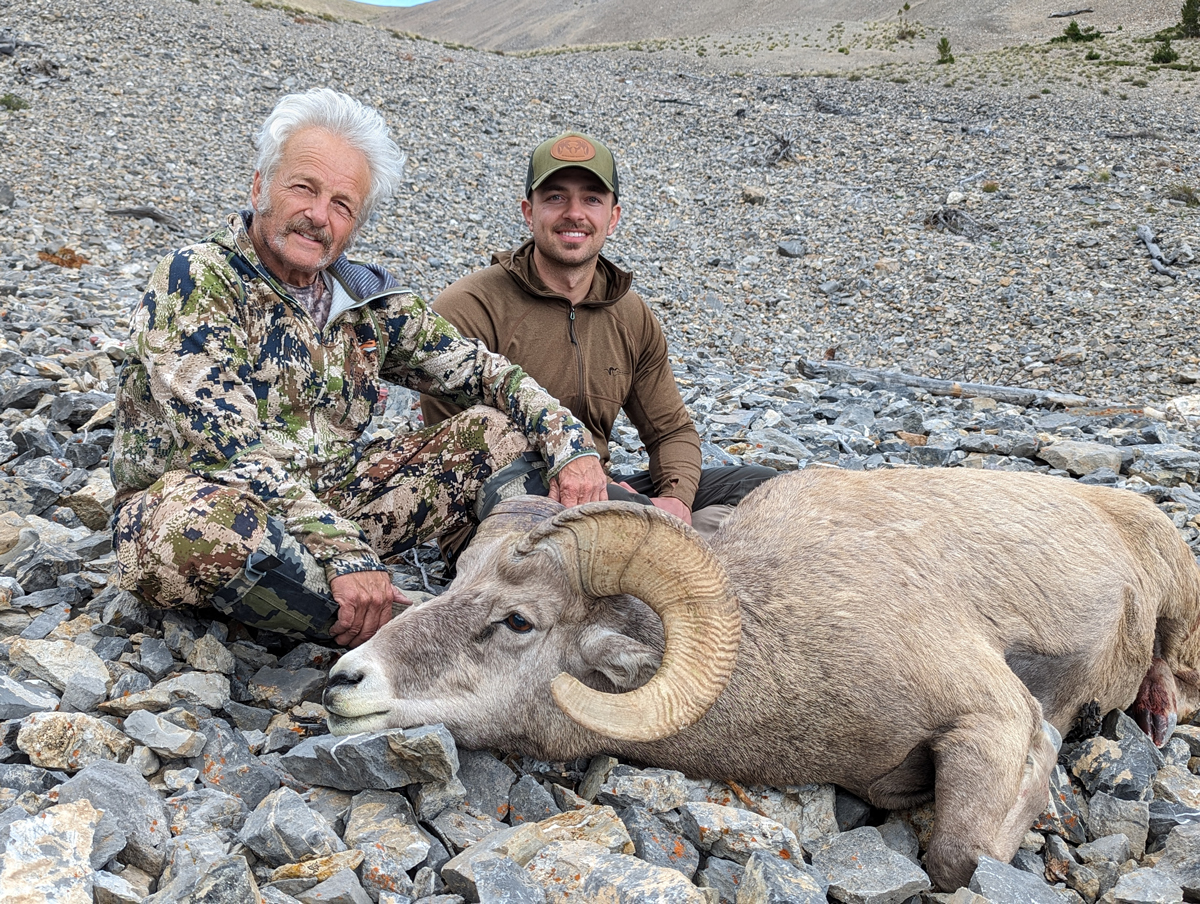
Courtland and Chess Carbol with Courtland’s Idaho Rocky Mountain bighorn ram.
On the windswept ridge, hunkered over a spotting scope on a tripod, I glanced over at Courtland. His age didn’t matter. His recent knee replacement surgery meant nothing other than the practicality that it simply would not bend more than 90 degrees. What mattered was that he wanted to be here, on this cold mountain, looking for a ram. The hike would have sent plenty of 25-year-olds back to the truck. I’d seen it happen on lesser hikes than the one we’d done, and we had food and gear for another three days on our backs. A young body cannot compensate for determination and grit.
The physical hardships didn’t faze him. Being tired and sore meant nothing; hunting sheep meant everything. He’d fallen under the spell decades ago, and never looked back, just quietly waited for opportunities at tags that would put him in sheep country hunting rams.
“I’ve got some rams,” Chess said.
There were three rams, but one stood out as mature; the circular curl in his horns the most prominent feature through the spotting scope.
It didn’t take Courtland long to decide that we would make a move on the ram. He was below us, but across the canyon. The problem was that there was only one move to make, and it was less than ideal. We couldn’t go around and above the ram, because we’d be cliffed-out before we got where we needed to go.
We had a small amount of cover for a few hundred yards with some terrain features, but after that, we’d be visible. We would have to approach in plain sight and hope the distance was enough of a buffer to keep him around until we got into range.
We made our way down and toward the rams, carefully placing our feet on the steep slope. In the areas with settled rocks under us, twisting an ankle was a concern with so much weight on our backs. In the areas where the rocks were loose, gravity and momentum could cause a disaster.
Downward we went, and I was keenly aware that if it didn’t work out on this ram, we’d have to regain all of the elevation we lost. When we made our way to a small roll in the terrain, we confirmed the rams were still where we’d left them, but we were out of any type of cover.
We took about three steps into the open, the ram saw us and immediately stood up, followed by his two small comrades who hadn’t locked onto us, but knew from the alarm of the big ram that something was amiss. The ewes and young rams we’d seen had seemed almost indifferent in our presence, but not this ram. He hadn’t grown those horns by being stupid or careless.
He was up and not planning on hanging around. This would require some long-range shooting. That was the bad news. The good news was that I knew Courtland could shoot because I’d seen him make some great shots on game before.
The ram began to move up and away from us.
I took the range while Chess helped Courtland arrange his backpack for a rest where he could shoot prone. He dialed for the distance. The wind was tricky, but Courtland had it figured. Shortly after the report of the rifle, we were rewarded with a watery smack from across the canyon, and the ram hunched and dropped. A second shot anchored the ram, and his great horns met the earth under him. We watched him for a minute, but it was clear that he breathed no more.
These moments, at least for me, are a release of built-up pressure. I felt it, and I was just tagging along. The difference in Courtland was that he simply seemed pleased, and at no point had I sensed the anxiety I get when a great tag is drawn and hunted.
It dawned on me why he seemed so even keeled the whole hunt and preparation for the hunt. Maybe he knew through experience that, despite all of the seeming complexities of sheep hunting—long-range shooting, the weather, doping the wind, dehydrated meals, camping equipment and finding a needle-in-a-haystack on a mountain—that, ultimately, sheep hunting is simple.
You climb a mountain, find a ram and kill it.
We took a break from where he shot. It was a bit of a hike to get to the ram, but there was no rush. We celebrated where we were and took in the surroundings before making our way across the canyon.
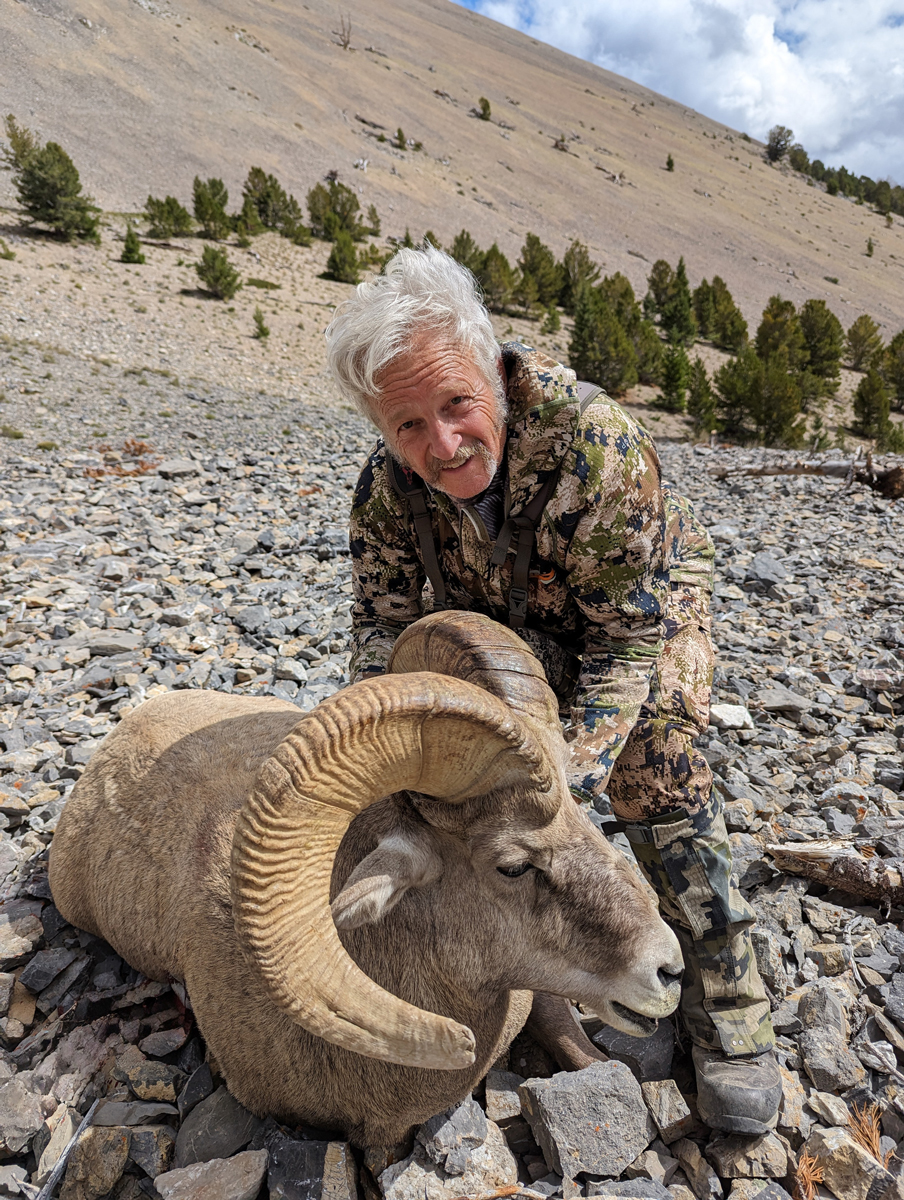
Watching Courtland claim his ram was a special moment and, in Idaho, a hunter can kill only one Rocky Mountain bighorn sheep in his lifetime. His ram was perfect, with a nice curl and some wear and tear on the bases. A mature bighorn ram is the pinnacle of North American hunting, in my opinion, and Courtland’s ram was a true trophy.
Chess would accompany me later that month to Nevada where I’d drawn a desert bighorn sheep ewe tag, a hunt in which we backpacked six miles into a blizzard with eight days’ worth of food before success. One of Courtland’s other sons, Chess’ brother, had drawn a New Mexico barbary sheep tag for that winter. They hiked around the desert crags for several days before even spotting a sheep, but he eventually connected on a ram.
It is safe to say that Courtland passed on the sheep bug to his sons, and they continue pursuing them. When you taste the reward, the cost seems insignificant.
We caped the ram and broke down and divided the meat among the three of us. We had a long hike back down the mountain, and it would be through a lot of thick timber with no trail, but we knew that the weight of success on our backs wouldn’t feel so bad.
As we began our descent, I looked at Courtland.
“You think you’ll try to finish off your slam with a Dall sheep?” I asked.
Courtland considered.
“We’ll see,” he said with sly grin.
I hope he lets me tag along.