

From: African Hunting and Adventure
Ramshua—29th. I found five bull elephants, gave chase, and singled and drove out the largest, and gave him a couple of pills to make him quiet; he shortly turned and stood at bay, about forty yards off, and then came on with a terrific charge. My newly-purchased horse, Kebon, which I was riding for the first time, stood stock still, and I intended to give the elephant my favourite shot in the chest, but at every attempt to raise the gun for the purpose of so doing, my horse commenced tossing his head up and down, and entirely prevented me from taking aim. During my attempts to pacify and steady him the bull charged, and I fired at random, and whether the ball whistled uncomfortably near the horse’s ear or not I can’t say, but he gave his head so sudden a jerk as to throw the near rein over on to the off side; the curb-chain came undone, and the bit turned right round in his mouth.
The huge monster was less than twenty yards off, ears erected like two enormous fans, and trumpeting furiously. Having no command whatever of my horse, I dug the long rowels in most savagely, when Kebon sprang straight forward for the brute, and I thought it was all up; I leaned over on the off side as far as possible, and his trunk was within a few feet of me as I shot close by him. I plied the rowels, and was brought again to a sudden stand by three mapani-trees in a sort of triangle; a vigorous dig, and he got through, my right shoulder coming so violently in contact with one of the trees as almost to unhorse me, slewing my right arm behind my back, over my left hip.
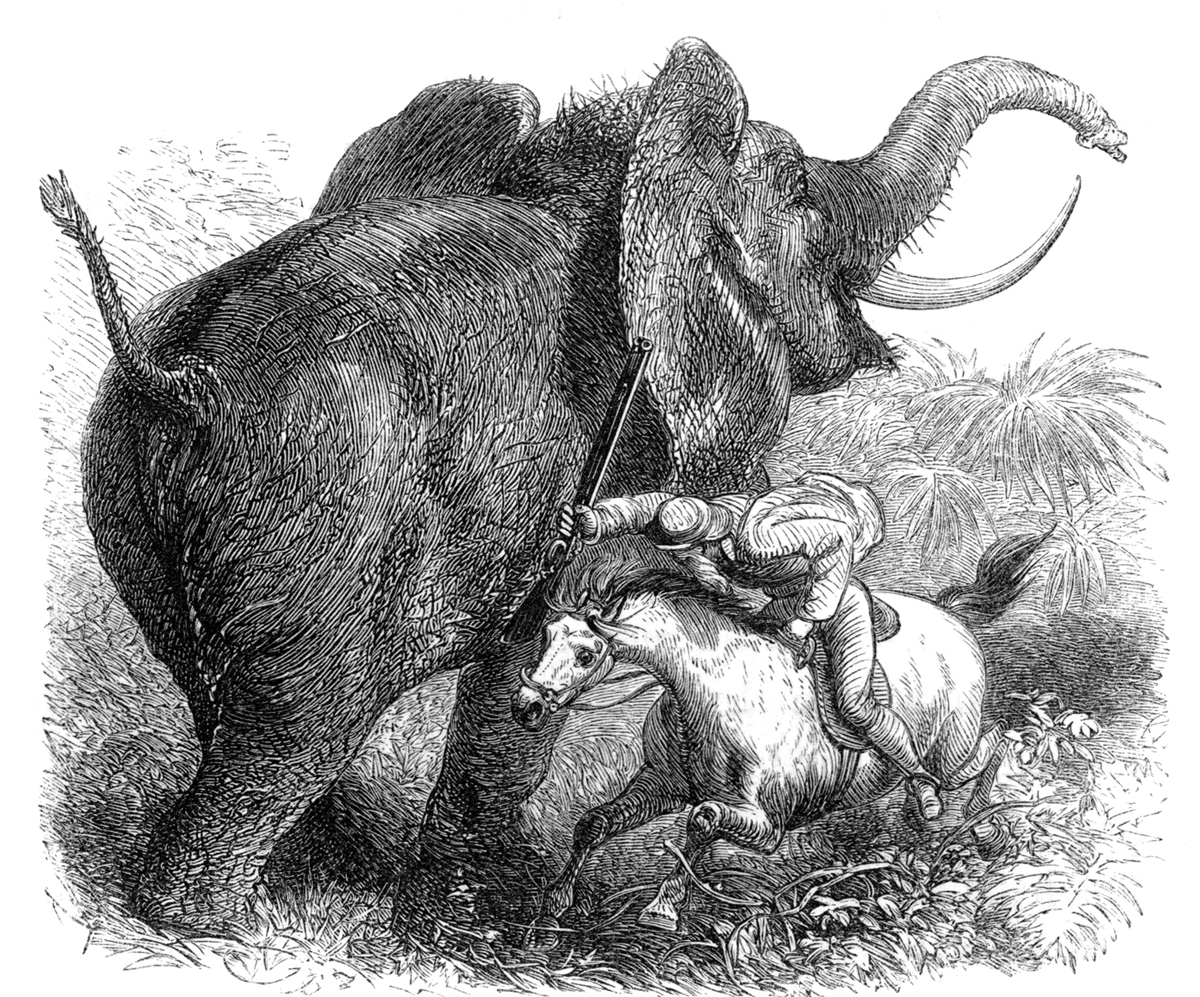
I know not how I managed to stick to my gun, 14 lb. weight, with my middle finger only hooked through the trigger-guard, my left hand right across my chest, holding by the end of the reins, which, most fortunately, I had in my hand when I fired, and in this fashion we went at a tearing gallop through a thick tangled bush and underwood, mostly hackthorns, over which my nag jumped like a buck. He was very nearly on his head three or four times, as the soil was very heavy, sandy, and full of holes. The monster was all this time close in my wake; at length, I got clear from him, and he turned and made off in the opposite direction at his best pace.
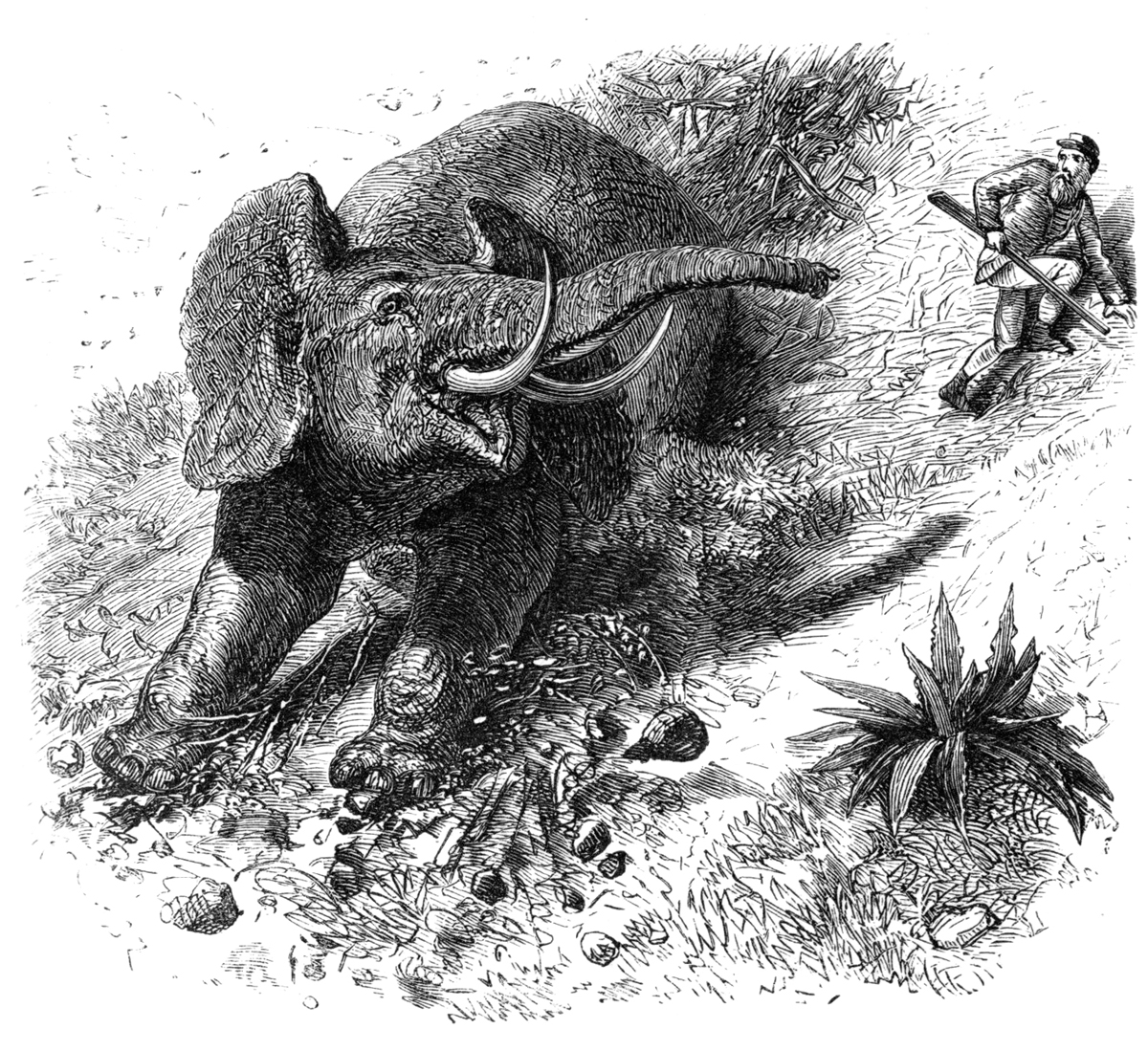
As soon as I could pull up, which I managed after performing three or four circles, I jumped off, righted my bridle, and went after him like the wind, as he had a long start, and I was afraid of losing him in thick bush. After giving him ten shots, and sustaining three more savage charges, the last a long and silent one—far from pleasant, as my horse had all the puff taken out of him, and he could only manage to keep his own before the brute—to my great satisfaction he at length fell, to rise no more.
I had long been quite exhausted, and could not even put a cap on the nipple. Boccas, on Batwing, turned up about an hour after; he said he fired all his powder away, giving his elephant sixteen bullets to no purpose; but the horse looked quite fresh, and both barrels were loaded, and every man has a perfect right to form his own opinion as to the reason why and wherefore.
Elephant hunting is the very hardest life a man can chalk out for himself. Two blank days, riding five hours at a foot’s pace to a vley, where the Masaras tell you they have drunk; sleeping in the bush, with nothing to eat; a drink of muddy water in the morning out of a dirty tortoiseshell, which serves for breakfast, dinner, and supper; all day in the saddle, under a broiling sun, following after three half-starved Masaras in greasy, tattered skins, who carry a little water in the belly of a quagga, which is nauseous to a degree, and never seeing life the whole day. Two days like this, followed by two successful ones, is about what you may expect.
Nothing more miserable and dirty can be conceived than a Masara encampment. It consists of temporary half-thatched sheds, and a few bushes stuck in here and there to break the wind, with half-putrid dried flesh, water vessels, and shreds of old skins hung up in the surrounding trees.
My trusty after-rider brings two or three armfuls of grass and makes my couch in the most eligible corner, with my saddle for a pillow, and here I court sleep till daybreak, lying close to a greenwood fire, the smoke of which passes over you when you lie close to the ground, and keeps off the mosquitoes.
There is something quite overpowering in the death-like stillness of the forest at night—a brilliant sky, innumerable stars, bright and twinkling, dusky figures in all possible attitudes lying around, the munching of our faithful horses, which are tied to trees all night, and frequently the jackal’s cry, the hyena’s howl, the occasional low growl of a lion, or the heavy tramp and crash in the bush of a herd of elephants, with a scream which can be heard at an immense distance. This is the way our nights are usually passed in the bush, and the most lighthearted fellow in the world, when all alone for months, must have occasional fits of despondency.
Full of thorns and bruises, and half dead from thirst, I offsaddled Kebon, kneehaltered him, and then lay under the shade of a tree, having not the most remote idea as to my whereabouts, shouting and firing blank powder to bring up the Masaras. To add, if possible, to the many mishaps, my horse had strayed, and I had to follow his spoor, and did not overtake him for nearly a mile, and then I was obliged to retrace my own footsteps, which was not so easy. I had not long returned, when January turned up, and he led the way back at a trot on foot, distancing all the Masaras, and just at sunset got to the waggon, where I first got a drink. Such days as these are rather more than sport.
I was much amused by watching the tick birds trying to alarm an old white rhinoceros that we were approaching from under the wind, quite ignorant of his danger. They ran into his ears, and fluttered about his eyes, keeping up an incessant chirping, but he would not be warned till we got above wind, when he elevated head and tail, snuffed, trotted, and snorted, and went away in grand style at a swinging trot.
We had better game in view, but to-night I am going to watch the water, as the moon is high, and then he must be more wary. My fellows have just made a hole at the edge of the water, as game is very scarce, and we are hard up for meat.
Tamashaki—July 8th.—After much consultation and deliberation, I have decided, in spite of all the remonstrances of the Boers, to trek due north, and stand my chance of tsetse, kief (poison), with which the bush in many places abounds, thirst, and other impediments. I have a hankering to reach the Zambesi and see the great Falls, which is so strong as to overrule all minor difficulties, though I cannot hide from myself the great risk I incur to horses, dogs, and oxen. Still, something urges me on, and I will follow my fate, good or evil, and am already three hard days on my route, without accident.
This story and more is from the book Lords of the Veldt & Vlei, order your copy today!
 This volume carries the reader through a representative collection of those who pioneered and popularized sport in Africa from 1837-1910. Chronologically, they include: William Cornwallis Harris, William Cotton Oswell, Roualeyn Gordon-Cumming, Sir Samuel White Baker, William Charles Baldwin, Charles John Andersson, John Parker (“Ubique”) Gillmore, Paul Belloni Du Chaillu, William Finaughty, Arthur Henry Neumann, Frederick Courteney Selous, Abel Chapman, Theodore Roosevelt, Nicholas Potocki, Chauncey Hugh Stigand, Sir William Northrup McMillan and Frederick Vaughan Kirby. Buy Now