
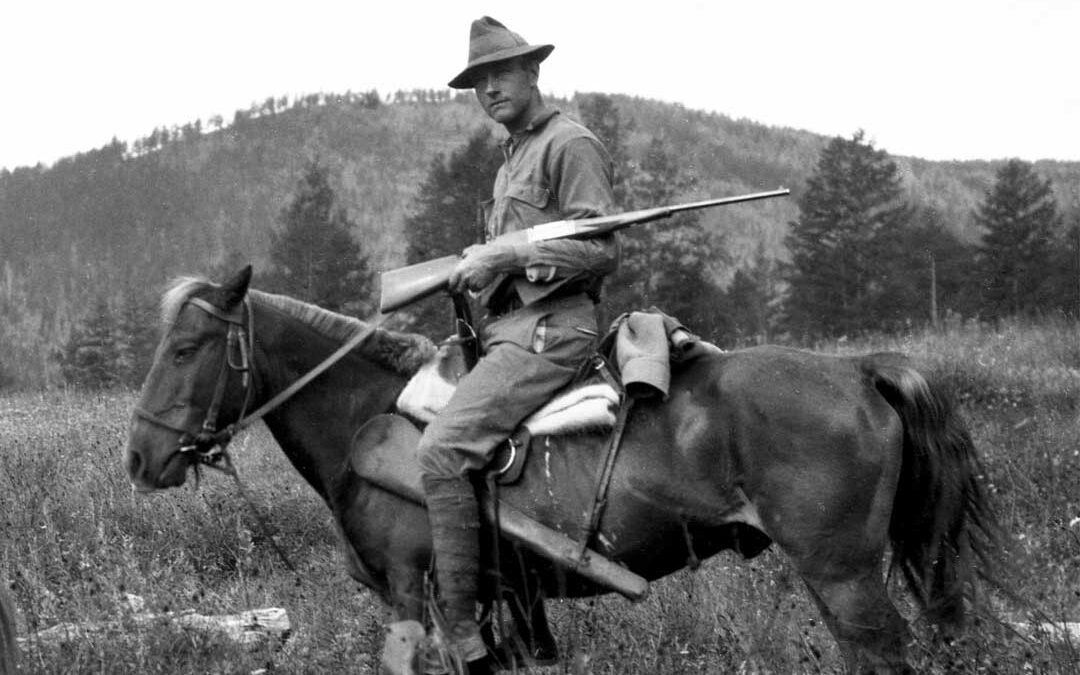
Beloit, Wisconsin, was a small town of just 6,000 people, but that was still too many for young Roy Andrews. The boy lived on the western edge of town, close to a mosaic of fields and woods and rushing streams, and those became his solace and his guide.
By the age of nine, his father had gifted him a single-barrel shotgun and he began to teach himself the ways of wildlife and wild places. It would take years to perfect stalking, marksmanship and the persistence needed for success.
Using that gun, he once blew up three geese out of a flock of six. Yes, blew up. They were rubber decoys owned by another hunter, who jumped out of the bushes when he saw them deflate. The incident so tickled Roy’s father—who couldn’t stand the decoys’ owner—that he promptly bought the boy a double barrel “so you can get ’em all next time.” I believe this is an early form of dad joke.
An old proverb tells us that there are only two people you should try to impress in life, and they aren’t your parents, your boss, your friends or (heaven forbid) your spouse. No, it’s 8-year-old you and 80-year-old you. That’s a tough crowd, and the first will likely be harder than the second.
You’ve probably never heard of Roy, but you grew up with him, even if you don’t know it.
As a student at Beloit College, Roy went to a lecture delivered by a visitor from the American Museum of Natural History. It spoke to him somehow and he later journeyed to New York to meet the museum’s director, who flatly told him there was no job to be had.
Roy was devastated but quickly showed the drive that would become a trademark of his life. “I’m not asking for a position. I just want to work here. You have to have someone to clean the floors. Couldn’t I do that?”
The director must have been intrigued by the young man’s sincerity. By the time the visitor walked out the door, Roy was employed as an assistant in the taxidermy department for $40 a month. He was assigned every morning to mop the floors in the studio, with the afternoons devoted to real taxidermy.
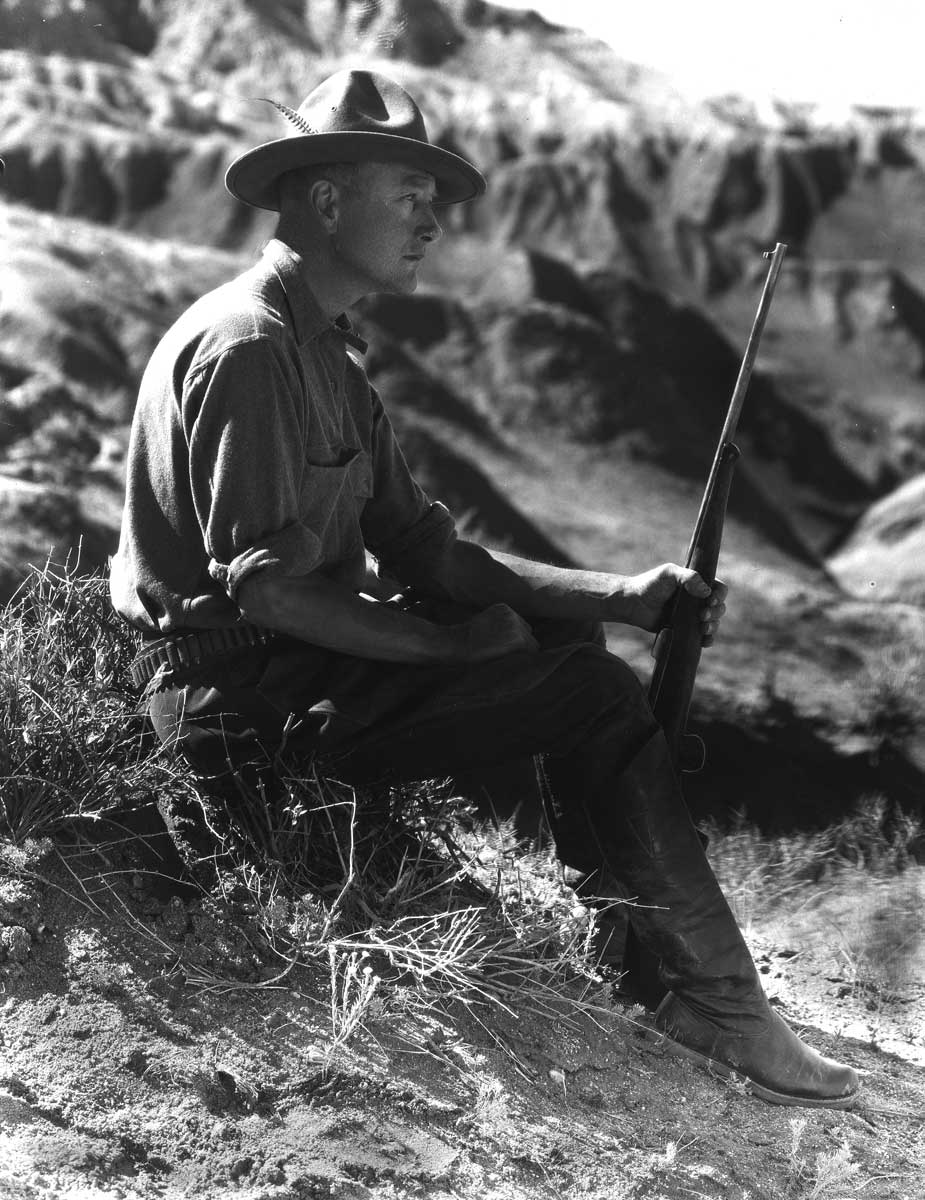
Roy worked closely with James Clark, who had studied under the famous Carl Akeley, widely regarded as the father of modern taxidermy. In their first assignment together, Roy and Clark were tasked with salvaging the skeleton of a right whale that had washed up in Long Island Sound. It was a huge, nasty job that took a week of slaving in blizzard conditions.
They worked in waist-deep water, while at other times sand covered the carcass. Young Roy thrived in the harsh environment, setting the tone for his future expeditions. He studied as he worked, earning a Master of Arts in mammalogy from Columbia University.
Adventure came to him quickly. In Canada he sought out whalers, photographing and recording everything about the whales as they were caught and processed, despite his heavy seasickness. It was an education in the power of images—his work began to appear in newspapers and journals. It was not long before Whale Hunting with Gun and Camera appeared in print. Money—and paid invitations to speak at prestigious events—began to pour in.
A new life beckoned and he was off to hard-drinking ports in Japan, the East Indies, Hong Kong, the Philippines and China. He tried opium, cocaine, morphia and hashish but left them alone thereafter. In Egypt he got a taste of the desert life that would one day fully take hold of him. It was his apprenticeship in foreign lands and sketchy situations. By the time he got back to New York, he had five cents left to get a cab back to the museum.
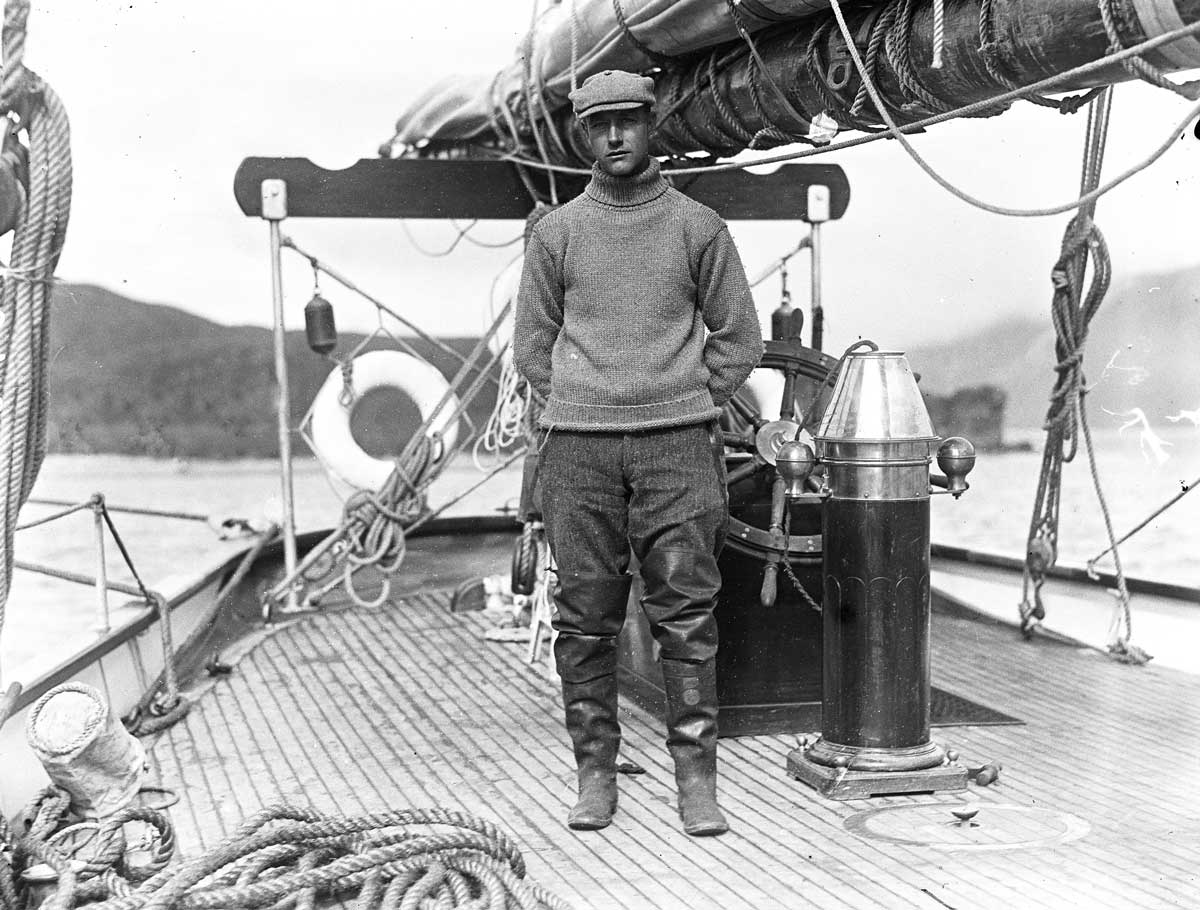
Other trips followed—Korea and Russia, then Alaska aboard the gaff-rigged schooner Adventuress. There the group hunted caribou, ptarmigan and ducks, mountain goats and huge bears in the shadow of the Pavlov volcano on Kodiak Island. She was a good sound ship—Adventuress is still sailing today.
Roy married Yvette Borup in 1914. Knowing the value of strong images, Yvette twice came on expeditions as photographer and co-leader. She photographed the 1916–’17 expedition to China, Tibet and Burma, where Roy picked up a heavy dose of malaria, and other expeditions to Mongolia and northern China. It was a masterstroke. Yvette’s pictures were new and captured the imagination of an adoring public. At the same time, Roy began using his trip as cover for supplying information to the U.S. government. He was by then working in secret as a major for U.S. Army intelligence.
It was autumn, the loveliest of seasons there, when he first crossed Mongolia’s Gobi Desert, wearing a sheepskin and goggles as protection from the cold and dust. Out of nowhere his writing suddenly leaps from the page, a man instantly and fiercely smitten by a landscape and its people. “I came to like the Mongols,” he wrote, “they were wild, independent folk, hard-living, virile, meeting life in the raw and asking no quarter, as untamed as the eagles that soared above their yurts.”
Western cultures knew very little about places like the Gobi, one of the largest deserts in the world. We have better maps of Mars today than Roy did of Mongolia. There were no roads between many settlements, just the whisper of a pony track. Soon after the start of the first trip, Roy and his companion found their car under heavy fire from five bandits. The steering wheel of the Dodge was shot away in his hands. They killed two of their attackers with accurate fire while the rest faded away.
After that first trip, Roy would go on to lead expeditions to some of the outermost places on earth. The five central Asian expeditions meant months leading huge parties of camels and team members, battling everything a remote wilderness could throw at them—extreme heat and cold, ice and sandstorms, civil war.
Then, as now, the whole area was a haunt for bandits, brigands, criminals and warlords. At a more mundane level, there were days and weeks of cross-country driving, digging out the vehicle many times each day.
Roy discovered early that the skill at arms he developed as a boy would serve him well on these expeditions. Rifles? Well, they matched his Jekyll and Hyde lifestyle perfectly. Just like his town suits, the little 6.5×54 Mannlicher Schoenauer carbine—the very same rifle that Hemingway places in The Short Happy Life of Francis Macomber—was a sleek and elegant number. They are light and easy to shoot, and the butter-smooth bolt and slick rotary magazine are a joy.
Don’t be fooled by the light caliber—the extra-long 160-grain projectile from Kynoch had exceptional penetration. Walter Bell killed 300 elephants with one but went on to be more famous for his work with the 7×57.
For the rough side of life, he had a Savage Model 99 lever action chambered in 250-3000. The 99 used a rotary magazine so could fire spitzers without the risk of primer strike, a remarkable advance for its day. There is an early picture of him with a Fox side-by-side bird gun with semi-pistol grip. For personal defence, he carried a holstered 38-caliber revolver, and he appears to have used it on many occasions.
Collecting for the American Museum of Natural History, Roy would go on to secure specimens of Mongolian and Przewalski gazelle, wolf, bear, musk deer, lynx, wild boar, Asian wapiti, sika, roebuck, waterfowl, partridge and hundreds of small species, some new to science. Much was genuine hunting, racing on swift horses to catch up to the game or stalking the near-virgin forest.
By contrast, the scattered farms and settlements were not safe places. Huge black dogs roamed widely and in number. Mongol people did not bury their dead, but would dump bodies for animals to dispose of, so these dogs saw humans as food. One night, the camp was surrounded and Roy had to quickly shoot three of the mastiff-type dogs as they circled the fire. Two of the dogs were immediately eaten by the pack.
The fact that all of these adventures—many of which were in places that had hardly seen Europeans—was shared with his wife, Yvette, did not escape him.
“We slept at night under starlit skies in the clean, fresh forest; the first light of dawn found us stealing through the dew-soaked grass on the trail of elk, moose, boar or deer…the wide sweep of the limitless grassy sea, the glorious morning rides and the magic of the nights had filled our blood.”
Of those many hunts, one seems to have caught his imagination above all others. The museum needed specimens for the Hall of Asiatic Life, and the king of these would surely be the argali. They are a giant among the wild sheep of the world with enormous spiral horns. The lands they lived in were the haunt of bandits, but that did not seem to concern Roy.
The granite country was steep, with rotten rock and sheer drops. Hunting with a local Mongol guide, the technique would be well known to any alpine hunter today—slowly peering over ridgelines to spy out the land below. His first encounter with a large ram at 200 yards resulted in a miss, and he is honest enough to describe the feeling truthfully: “Never in all my years of hunting have I had a feeling of such intense surprise and self-disgust. I had been certain of the shot and it is impossible to believe that I had missed. A lump rose in my throat and I sat with my head on my hands in the uttermost depths of dejection.”
We’ve all been there, buddy.
Hunting is a strange business. The ram, perhaps confused by the shot rolling around the valley, reappeared. Only his head and neck were visible. In a daze, Roy lifted the rifle, saw the little ivory bead of the front sight and touched the trigger, this time successfully. Back in camp after a horror carry-out, Roy and his fellow hunter, Harry Caldwell, compared their rams. Even with heavy brooming, Harry’s was a new world record, 47 inches in length and 21 around the base. Roy’s was only slightly smaller.
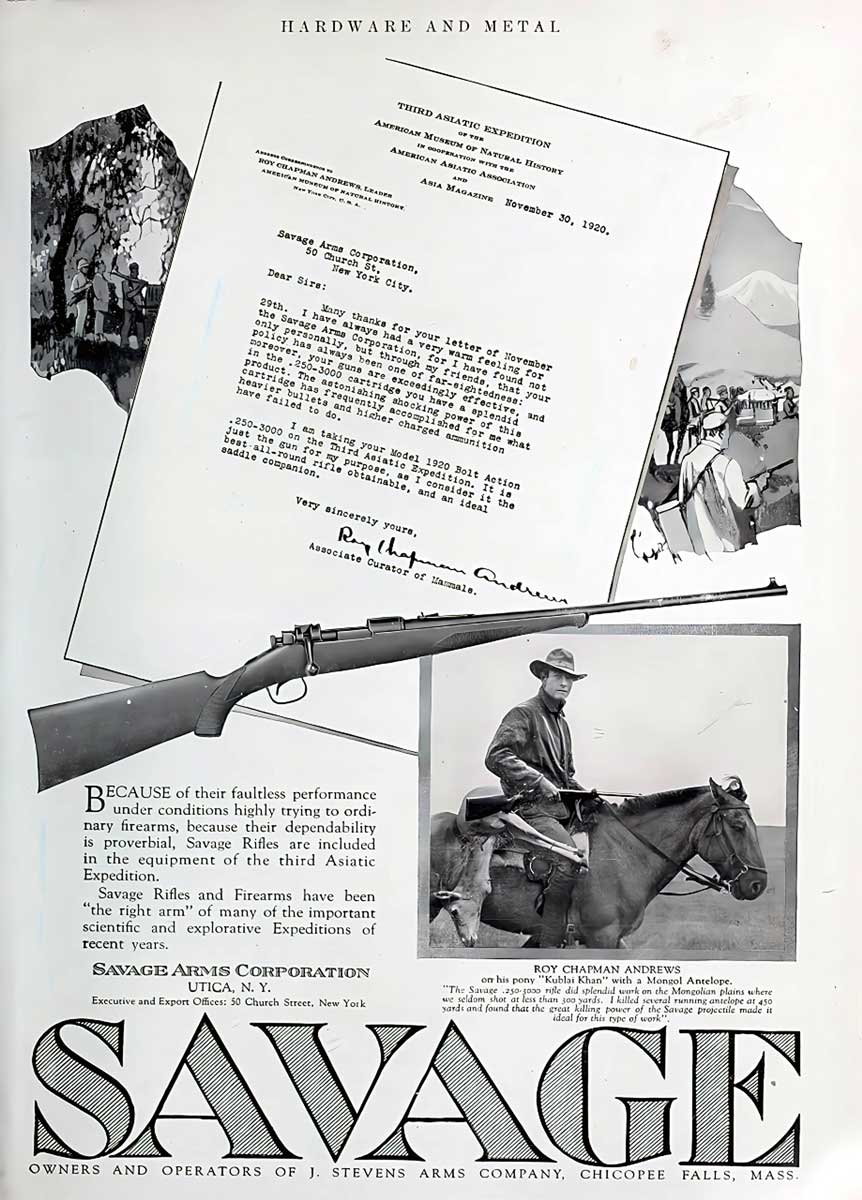
By the time of the third central Asiatic expedition, Roy’s authority as a hunter and explorer was global. He was approached again by Savage, this time to promote the Model 1920, a bolt action. In the ad he is in working man’s clothes, riding his desert pony with a Mongolian gazelle over the saddle, taken either as a specimen or for camp meat. He does not look like an academic lecturer.
Roy promoted the rifle in 250-3000 chambering, and three Savage 1920s were shipped to the American Museum of Natural History for the third Asiatic Expedition on December 17, 1920. However, the last, #5640, shipped “Special Attention, Roy Chapman Andrews” on January 19, 1922, was chambered in 300 Savage.
Today, Roy’s hunting career is overshadowed by his fossil discoveries. The Gobi was once a shallow inland sea, teeming with life. Sandstorms and avalanches of sand buried ancient animals and preserved their remains, creating one of the richest fossil beds in the world. His team uncovered a complete skull of what was then known as Baluchitherium, a hornless rhinoceros five yards tall at the shoulder—much bigger than an elephant. At 15 to 20 tons, it is possibly the largest mammal ever to walk the earth. That was just the start.
Looking at the maps of the day, Roy’s expedition faced a steep mountain range. Worried about negotiating it, the team forged across the desert for three days then took their bearings by the stars. They had not seen a Mongol settlement in the past 100 miles and were low on water. At last, three yurts appeared in the distance and Roy approached to enquire about a well.
In those brief few minutes, a member of the team, John Shackelford, stumbled upon a red sandstone cliff edge where he saw fossils. In fact, the badlands were almost paved with bones and they all represented unknown animals. The Flaming Cliffs, as the team named them, lie a hell of a long way from civilization. To give some sense of how remote this area is, when a follow-up expedition tried to retrace his route, they encountered just one other car in a 1,000-mile stretch. That was in in 1990.
Racing the brutal Mongolian winter, they returned the following year and soon realized the site was a treasure trove. They eventually excavated previously unknown species: Protoceratops, the ancestor of the Komodo dragon, even large fossil mammals. It was right there that Velociraptor was first discovered.
And then suddenly the red sandstone yielded up a holy grail—a nest of fossilized dinosaur eggs. Until that moment, there was little proof that dinosaurs did not give birth, or that they made nests. The eggs also contained fossilised embryos, effectively opening up a new branch of science. It was three major discoveries in one.
The 1925 expedition was the largest at 150 camels, and it recovered many more fossils as well as discovering a lost culture whose members flaked arrowheads, used pottery and wore dinosaur eggshells as necklaces. Dating from 10,000 to 20,000 years ago, these people are mysterious, and to this day simply known as the “Dune Dwellers.”
Roy Andrews, the boy from Beloit, was now a celebrity hunter and adventurer known across the globe. He was high up upon the roof of his own life and had come a long way from the boy who offered to mop museum floors for nothing. I have seen video of his expeditions, grainy black and white footage of camel caravans, of local tribes, of the endless d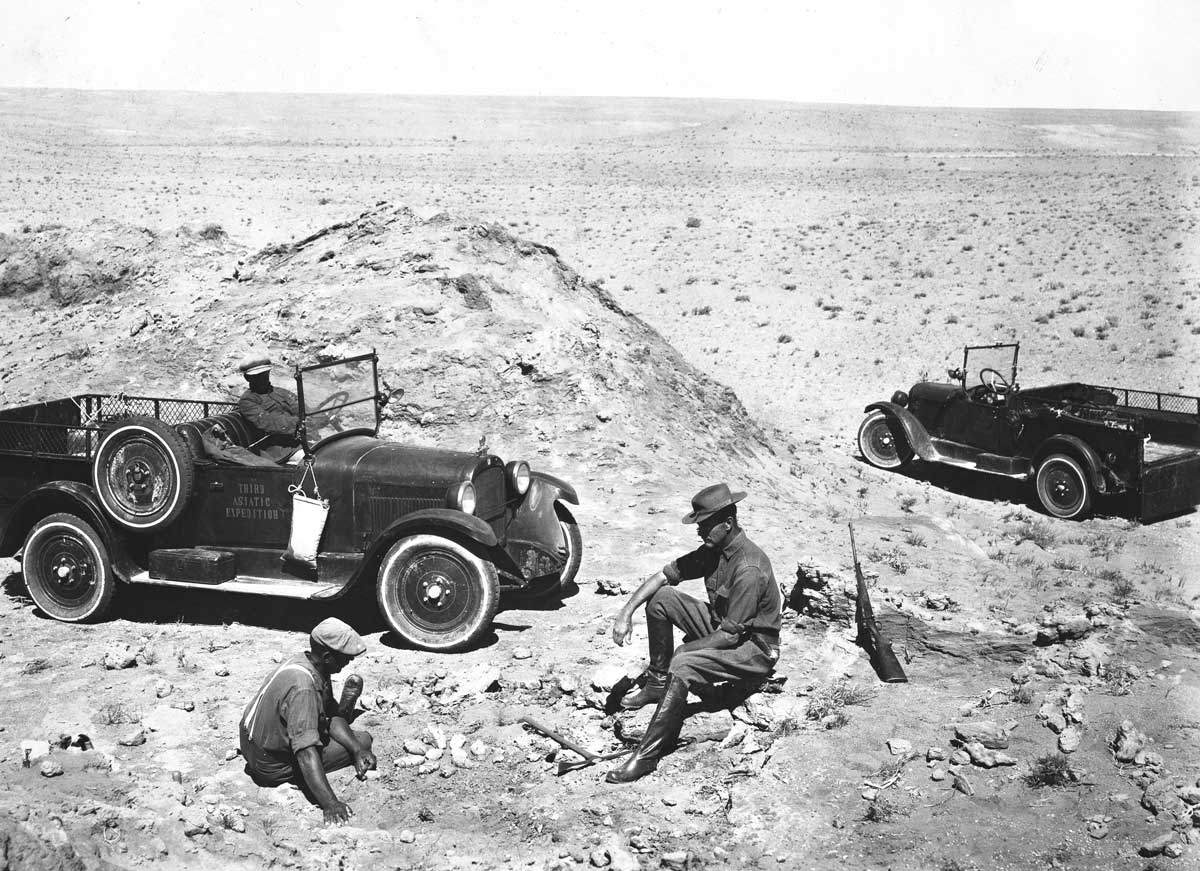 unes and empty mountain ranges that run to the horizon. In among it all is Roy and his rifles and his tiny team, like happy explorers on a faraway alien planet.
It fell apart quickly. Roy lost most of his money in the 1929 stock market crash but took it philosophically. “As long as I have a gun to shoot, a good fly rod and work to do, what can money buy in the way of happiness? Nothing, so far as I am concerned.”
But anti-foreign sentiment in China had led to violence, Japan was preparing for invasion, the door to expeditions was closing. Then another blow—Roy and Yvette divorced after a long separation. Her affair with his close friend “Chips” Smallwood was at the heart of it. In their 17 years of marriage, Roy and Yvette had travelled 35,000 miles, 2,000 of them on horseback, but by the end neither would speak to the other.
Roy suddenly found himself alone and sitting behind a desk at the museum. It hardly suited his dashing personality after years of fieldwork, or whatever grief he had to process. When the museum’s director, George Sherwood, suffered a heart attack, Roy was asked to step into management. It must have seemed like life had lost its joy.
In 1935 Roy met and married Wilhelmina “Billie” Christmas after a whirlwind romance. Younger, glamorous and full of character, Billie would help him stay on an even keel as director for several years, but eventually Roy grew tired of life as a glorified fundraiser and resigned.
Roy and Billie spent his retirement years on Pondwood Farm in Connecticut, where he stocked the dam with bass, built a gun room, fished and hunted and wrote. He put up a cabin in the forest and kept bird dogs. He remained an avid skeet and trap shooter as well as chasing ducks and upland birds —one lovely old image shows him with a hunting license stuck in an old-fashioned tweed hat.
Billie was his proper match, and their years together were happy ones. One photo shows them both with double-barrelled shotguns. She has an English-stocked Fox and he has a sidelock, maker unknown. He once said that “she can kill a woodcock or cast a fly as well as I, and she loves it too.” She shot every opening day with him.
Too old to serve in World War II, Roy was asked to provide special advice to the U.S. government on Asian affairs and the logistics of desert warfare. In later years, the brutal Connecticut winters proved too much. Roy and Billie ended up in the temperate climate of northern California, where he passed away in March of 1960.
He is buried in Oakwood Cemetery in his hometown of Beloit, not far from the fields and forests that he roamed as a boy.
How do you know Roy? Many people have described him as one of the inspirations for Henry “Indiana” Jones. It’s a story that is true in parts.
George Lucas, who conceived “Raiders of the Lost Ark,” says that the idea of a swashbuckling academic adventurer came from the movie serials of the 1940s and ’50s that captured his imagination as a child—and most of those were based on American explorers of previous decades. The story of Roy Chapman Andrews was the best known of these by a country mile, and one that Lucas knew well.
Like the character, Roy alternated between the suits of academia and the rugged field clothes of an adventurous explorer. Both he and Indiana Jones carried a revolver in a leather hip holster, both assisted U.S. intelligence, both wore their distinctive hat on every expedition, both sought rare treasures, both had a deep fear of snakes. You can see Roy’s bullwhip on display today at the Explorers Club in New York.
The velociraptor that Roy’s team discovered bought him worldwide fame, and the same dinosaur would one day be made famous as the predator
of “Jurassic Park,” directed by Steven Spielberg. It was also Spielberg who directed the first Indiana Jones movie, forever shaping the character as art imitated life. Roy once wrote that:
“Today there remain but a few small areas on the world’s map unmarked by explorers’ trails. Human courage and endurance have conquered the Poles; the secrets of the tropical jungles have been revealed. The highest mountains of the earth have heard the voice of man.
“But this does not mean that the youth of the future has no new worlds to vanquish. It means only that the explorer must change his methods.”
A more perfect Indiana Jones lecture hall soundbite is hard to imagine. ν
Peter Ryan has hunted across the globe. This is an excerpt from his fourth hunting book Riding the Echo Down (Bateman Ltd) to be released October 2025.