
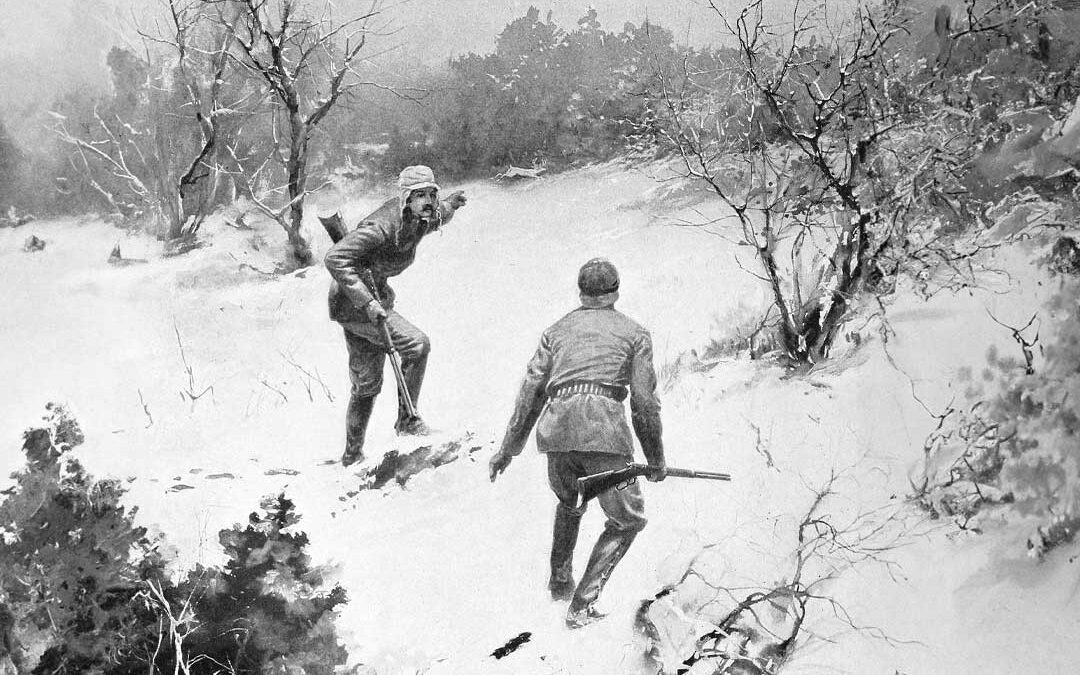
One of the redeeming features of existence in a small Canadian town is that at all seasons of the year some form of woodland sport lies within an hour’s walk or drive or paddle of your door. For the monarch moose and the shy, capricious caribou, one must go far afoot. All other kinds of game that offer reward for the hunter’s toil may easily be found and brought to bag within the compass of the short autumn day.
I remember well a certain November morning when the small hard flakes were sifting down quite rapidly, insomuch that as I looked out upon the fields and hills, the world and its iniquities seemed clothed in an immaculate mantle.
Just then the muffled impact of a moccasined foot was heard upon the veranda, and my hunting chum, Harry, appeared with rifle in hand.
“Hurry up, old man,” said Harry. “There’s no time to waste. Dominique Goodine is just in from the Hanwell, and he says he saw ‘Wandering Willie,’ the big white buck of Cordwood Hill, on the second knoll beyond the Four-Mile Stump. He was heading for the Gornish, and if this wind holds out, we ought to get a crack at him anyhow.”
“How long is it since Dominique says that he saw him?”
“Well, not much over half an hour.”
“It will take an hour and a half for us to walk the distance in this snow.”
“Yes, but Dominique said he would drive us right out.”
As I donned the habiliments of venery the faithful Dominique and his ancient steed swept around the corner on a slue. Hitching a toboggan to one of the stakes, we were soon at the foot of the Hanwell Hill. The Four-Mile Stump was reached in record time. On top of the next ridge the Frenchman hauled up his shaggy horse and pointed excitedly to the tracks of a deer.
“Now boys,” said Dominique, impressively, “I’m hole man me, an’ I never seen no hox more beeg as dat white deer. By jarge, he’s have some horns jus’ lak one hole pine-root you seen ’fore now.”
A moment’s scrutiny convinced us that Dominique still retained his rare gift of romance. The trail was not leading toward the Gornish stream as he had declared, but in the opposite direction toward Spring Hill. If Dominique had seen the white deer, he surely should have known which way the animal was heading. However, the tracks were clearly those of a goodly buck and not much over an hour old, so we started in pursuit.
The ground over which we traveled was rough but fairly open. In many places the big forest fires that followed the Saxby gale had devoured the surface soil, exposing large areas of loose shingle rocks, among which the second-growth birches, maples, beeches and poplars maintained a dubious existence. In the brook bottoms, a few forlorn bunches of spruce and pine had escaped the fire and the axe. The rest was all a shaggy waste of small, leafless trees, through whose limbs the north wind played as on a harp its soothing monotone. Desolation everywhere, but the red deer, keen of ear and clean of limb, were there, and that made it beautiful.
As we plodded slowly through the bushy hollows and over the intervening ridges, the snow ceased falling and the trail grew more distinct. The buck had paused occasionally to feed upon the buds of the young growth. His general course, though winding in detail, led toward a jagged, rocky bluff, to reach which he was obliged to cross a swamp intersected by a brook and then pick his way daintily among the fallen boulders that time and the elements had shoved from the face of the hill. It was mid-day now, and Harry prophesied that the deer would be found lying down on the summit of the bluff. We wormed a path through the treacherous boulders and reached the top, but saw no sign of the deer.
Presently there came a rustle, a thud and a miracle of awakening life where only a snowy shroud had been, a fleeting form that waved a reminiscent flag, a random rifle-shot that ripped the bark from a white birch tree—and behold, our buck was swallowed up of silence and vacuity! It was straightway as though he had never been. We had made a mess of it, that was all. Destiney had dealt us a “pat” hand, and we had dropped the cards. Even in that solemn thought there lurked a secret joy. We had proved that Wandering Willie was not a myth. We had beheld the big white buck of Cordwood Hill that for the past five years had led a bullet-proof existence in the Hanwell region; seen by Dominique, seen by country preachers and school-ma’ams, seen on moonlight nights by bibulous bushmen homeward bound.
Then we settled down to business. We said we would follow that buck, if need be, until a certain populous locality froze over and thawed out again.
There was still sufficient wind fretting the restless, frozen branches to give promise of a successful stalk, though the snow was softening a little and packed beneath our feet. It looked at first as if the buck had left the earth. His desperate swing as he roused from his bed was fully 20 feet in length, and he landed where the ground was almost bare beneath a hermit pine. He soon came down to his regular, working clip, and then our end of the fun commenced.
The cunning old rascal never ran more than a quarter of a mile without doubling on his tracks and jumping out sideways. He tried all the tricks he knew. He followed the slot of another deer, stepping daintily in the self-same tracks. He made us drag the toboggan through all the thickets he could find. When he reached the west branch of Garden’s Creek, he waded the running water for a long distance and then sprang over a fallen tree.
After that he led us into a perfect maze of deer tracks on a windy hillside from which his own could be picked out only by the utmost care. It seemed as if about 100 intoxicated deer had been dancing a set of quadrilles over five or six acres of ground. He must have routed this bunch of deer in his flight, for we soon saw plenty of jumping tracks. We found ourselves at last following the wrong trail, and had to make a long detour downwind to find the right one.
Once he stopped in his swift and silent flight and punched the snow full of holes where he nervously rested and listened for us beneath a giant pine across the Spring Hill brook. He waved his cotton tail at us defiantly on the farther side of an alder swale after we had followed him about four hours. Perhaps he thought the race was over when we stopped at the brook for lunch. He must have gone up the leeward side of this swale for some distance, then crossed it and loped down the other side for, as we topped the bank of the swale, we saw him coasting along the opposite ridge in company with another deer that he had doubtless concluded to employ as a decoy. We fired, of course, but the bullets merely plowed the snow behind him.
The firing must have confused a second deer, which paused and looked in our direction, the wily patriarch having vanished in the meantime. Of course, the latter was simply throwing us this deer for bait. When I fired again—this time at the rear guard—the scrub deer ran about 20 rods spraying the blood from his nostrils over the snow—a sure sign that he was shot through the lungs. He proved to be a fair-sized buck in excellent condition. Instead of being thankful we anathematized the patriarch.
We blazed with our knives a few of the trees leading from the carcass back to the brook in case the snow should disappear before we could return to him, and then resumed the chase of Wandering Willie who must have gained a couple of miles on us.
He had one piece of hard luck, though, that put the laugh on him. In taking one of his reckless leaps, he lit fair upon a snow-hidden sheet of ice in a small hollow, lost his feet, slid the whole length of the pond and collided forcibly with a tamarack stump. This took the conceit out of him, I think, and he played us no more tricks for a time. A bunch of pure white hair clinging to a knot in the stump we removed as a souvenir.
The course of the buck now turned due west. We had hunted deer in this section long enough to know what that meant. He was heading for the Dismal Swamp—an almost impenetrable jungle of dead cedars that lay at the back of the Spring Hill farms. He would enter this swamp and hide, as he had doubtless often done before, and we would be unable to get near him except by a noisy, toilsome passage through a labyrinth of treacherous, swampy turf, shell ice and crackling cedar brush. We would rout him out, of course, but that meant hard work and the loss of valuable time to no purpose, as he would steal out the other side of the swamp, unseen and unheard, whenever he chose, fresh and ready for another five-mile run.
It was now late in the afternoon, and our chance of getting a shot seemed very dubious unless we could hit upon some plan to circumvent the old buck in the swamp. Only one scheme remained that offered any hope of success.
“Do you remember the black stump where the big deer we chased last fall—old Slobber-Heels—went out of the swamp?” I asked Harry.
Harry said he knew just where it was.
“Well,” I said, “I guess the jig is up, but we ought to give him one more try. I will give you just 20 minutes by the watch to work around the swamp and post yourself at the stump. Then I will go into the swamp on this side and rout up the buck. He is sure to jump the swamp on your side, and you can give it to him as he comes up the hill.”
Harry assented to this proposal, dug the damp snow from his moccasin tops and started. The wind had dropped to an almost dead calm, and the sun was sinking in a purple sea over the hills.
It was growing colder as the night drew nigh. As I sat there in silence a rabbit startled me by emerging from his hypnotic trance under a snow-laden bush and chasing himself needlessly up the hill. When the watch showed that time was up, I climbed the ridge, and, so slippery was the ground, almost slid bodily into the swamp.
I had just entered the jungle of cedars, seeking a doubtful foothold on the projecting roots, when I heard the crack of Harry’s rifle and a whoop from the opposite ridge. Tearing through a snarl of almost impassable branches, losing cap and lunch bag in the scrimmage, and plunging up to my knees in the bog, I reached firm ground on the other side. Harry was standing near the stump gazing at the carcass of a big buck deer with a look of blank amazement.
I rushed joyously up the bank. Great Scott (or words to that effect), it wasn’t the white buck after all!
Moved by an indefinable impulse we lifted our eyes from the dead deer and looked across the swamp. On the brink of the farther slope we caught the derisive flicker of a phantom flag and a nebulous form, as white as the snow it spurned beneath its feet, melting like smoke into the twilight of the brush. The white buck had fooled us again. He had doubled on us in the swamp and played us for farmers with another scrub decoy!
Yet is there for every woe of the lover of woodland sports an inner antidote. In after days it was comforting to know that, though Wandering Willie was lost to us, we had brought a brooding fear to his stout heart. For since that sunset hour when he vanished from the swamp, neither Dominique, nor the local preacher, nor the school-ma’am at Gallop’s, nor even the bibulous bushman wending home by the light of the moon, has ever beheld the buck of Cordwood Hill.
Note: This article originally appeared in the November 1899 issue of Outing.