
He was a young man, barely past his 25th birthday, slim and fit in the way of young men who follow dogs in the high mountains. His companion, Big Sam, was a huge, muscular, raw-boned pointer with a head like a mule—in size as well as temperament. Sam was a “big-going, long-range ground eater,” well suited to vast south Georgia bean fields and even bigger stands of piney-woods where the coveys of bobwhite scurried. Perhaps he wasn’t so well suited to the mountains where the grouse lived and where they were hunting today, but he’d do in a pinch. It had worked for them before and it would again.
It always took a couple of hours in the mountains before “Sammy” wore down enough to work grouse. In that time, the mountains would do what the young man could not, and Sam would become more biddable and more effective for the big birds that they found in the heights of the Appalachians. The young man intended to start at the foot of Cullowhee Mountain and work his way a couple of miles up the old logging road that led to the top of Cherry Knob where an old apple orchard crowned the peak. By the time they reached the top, Sam should be subdued enough to work properly, and maybe, just maybe, they’d get a shot at “Old Ruff.”
The young fellow carried an aged 16-gauge, VH grade Parker. Built on the “0” frame in the last days before World War I, it hefted a mere 6 1/2 pounds and would easily carry all day in the mountains. With its 28-inch barrels, it balanced perfectly in the hands, and had already proved that it could handle any upland bird that flew.
It was choked improved cylinder and light modified, and he could think of no gun that would serve better for the task at hand. He dearly loved the old gun in spite of its worn edges and dull gray patina. It was by no means fancy, but it “worked” for him in ways that few guns did. For him, at this particular point in his life, it was as good as he could get, and in his mind, it certainly qualified for the label, “best quality.”
Together, they began the ascent in the faintest pink of first light, hoping to reach the 4,200-foot peak by the time the birds began to stir. The faint dirt trace wound its way, snakelike upward across a couple of ridges and then through a series of switchbacks until it leveled and ran straight out the shinbone narrow ridge for a mile or more to the orchard. Light came slowly as they trudged upward and they arrived at the top shortly after sunrise.
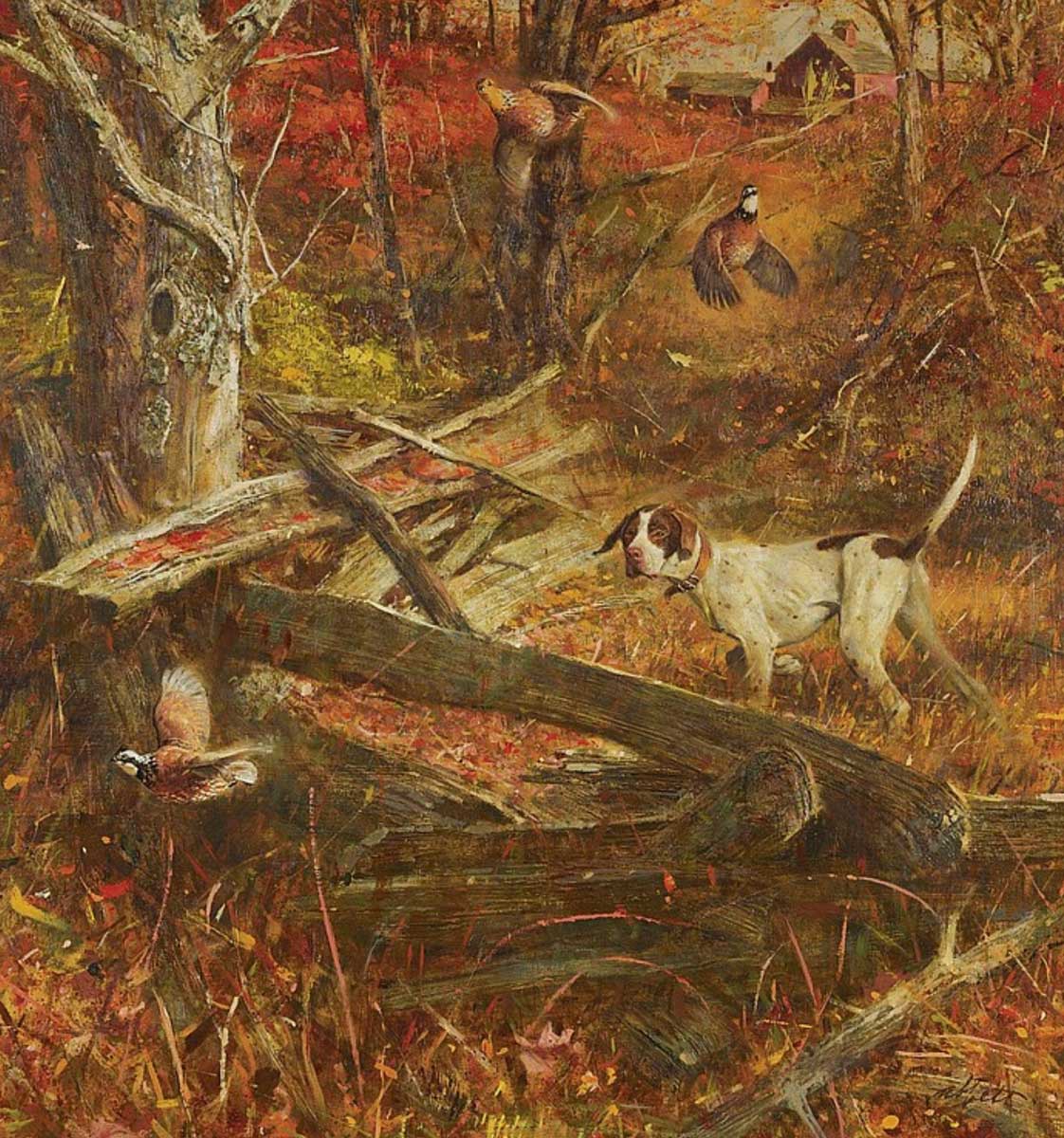
October was in full bloom and the slanting rays of the autumn sun exploded in the red, yellow and gold of the hardwoods. A chill wind sliced through the man’s battered canvas hunting coat. They paused to rest before going on, for this was the place where things got serious and they wanted to be ready. He had hunted this ridge many times and knew from experience that grouse could be anywhere once the sun began to warm the highlands. The hardwoods bordered the entire length of the old road and wild grapes grew here and there along the way. The twin tracks ended at a 100-year-old abandoned orchard that crowned the top of the knob.
There was always a chance to pick up a bird or two from the grapevines, and any bird that escaped invariably flew straight down the road, following it all the way to the orchard. In all the times they had hunted this cover, he’d never failed to get a shot or two at the end.
Grouse, however, are famous for failing to read the script, and the first flush was a big cock bird that rose in silence and slid over the edge without ever attaining an altitude of more than a couple of feet. Then, a couple of hundred yards down the ridge, Sam got birdy where a grapevine spilled over the logging road and two birds flushed wild without allowing a shot. He smiled when they banked in unison to round the little bend in the road on their way to the orchard.
He paused again when he reached the orchard and mused at the perfection of the scene. Cherry Knob was oval in shape, giving a 360-degree view of the prettiest mountains he would ever see. The orchard followed the contours of the land, Lake Glenville lay to the south, while the Tuckasegee River ran the whole length of the mountain on the east. To the north, the cold blue ridge of the Smokies rose in the distance. It seemed to him that nothing could be more perfect.
The morning was cold and clear, the sky was a clean crystalline blue, and the mountains were exploding with the full glory of October. Here and there, the sun broke through the morning mist, casting shards of light that streamed from the treetops to the ground. From where he stood, the road angled left, skirting the grove. If he followed the road, the walking would be easy and Sammy could work the ground between him and the precipice on the far side. They had used the tactic before with success, and that’s exactly what they did that day.
The young fellow sent Sam in and quietly eased around the road while following the big dog’s progress through the acre of stunted apple trees. Twice, Sam crouched into a low point, only to ease slowly forward again, following the invisible tendril of scent. Halfway to the end, the silence was broken by the whir of birds leaving on the far side of the little copse, and the young man wondered if all the birds had escaped.
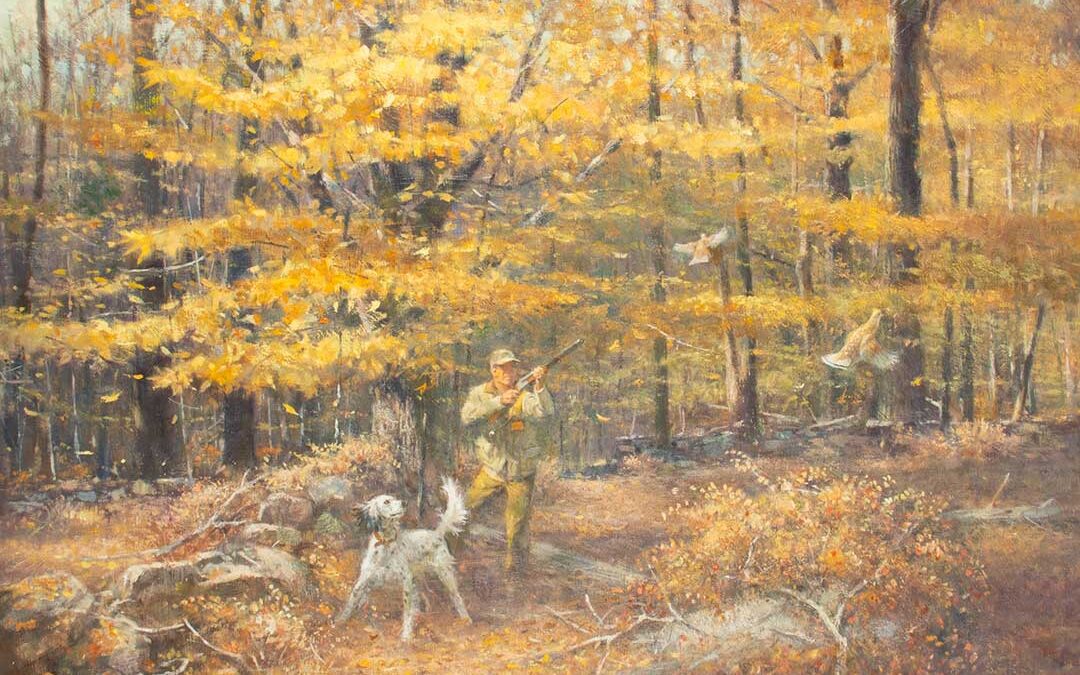
Sam was still on eggshells when the man reached the end of the road and braced himself for the inevitable flush just in time to see the grouse burst from the very last shred of cover where the thicket trailed off into the big woods below. The bird blew out low but quickly climbed nearly vertical. At the peak of his rise, the little Parker pulled in front of his beak so quickly that it seemed the gun moved of its own volition and the cock exploded in a blizzard of feathers spotlighted in a shaft of morning sun before falling in the middle of the little road. And in a single instant, the shot had bound the man and dog and bird and mountain and the sun and the wind and river and the far blue ridge into a splendid cameo of time and space.
As the young man sat cross-legged in the warmth of the autumn sun with the grouse spread across his lap and Big Sam lying in the leaves beside him, he wondered if anything could really be as perfect as that moment. How long, he pondered, would it remain etched in his brain, pure, pristine, perfect and profoundly satisfying? How long?
He couldn’t know and didn’t know. And I can’t tell you now, but I can tell you this, come October, it will have lasted 50 years and the memory is still as bright and clear as the day it happened.