
It was quiet when I drove down the long, sandy, Smith Setters Plantation road. On both sides were fields full of warm weather grasses that were rimmed by a mix of pines and oaks. Two quaint guest houses were on my left, and a big kennel and an expansive horse corral were on the right. There was a line of trucks and trailers parked so meticulously that I figured either this was a dealership or there had to be a cop directing traffic. It was neither, for it was a horseback shooting dog field trial. Everyone just knew what to do.

North Carolina’s Kyle Whitfield and his walking horse ”Mo” stretch it out to keep up with “I Dream of Jeannie” whose call name is Jen.
In a normal year, the legendary breeder, trainer, field trialer and Hall of Famer, Harold Ray, would already have barbequed these quail fields. But this year, the prescribed burns would have to wait as there was one more event to be held—the First Annual Smith Celebration. New events usually take a while to become popular, but this one was the exception. The truck tags I noticed were from New York, New Jersey, Maryland, Pennsylvania, North and South Carolina, Florida, Arkansas, Kentucky, Alabama and Texas. Folks came from around the country to attend this inaugural event.
I arrived at breakfast time, and the only one I saw was a young woman saddling her walking horse by one of the trailers. She was so meticulous in pulling straps and threading buckles that I could tell precision was important to her. I got out of my truck and walked up to her.
“Can you please tell me where the clubhouse is?” I asked.
“Yes sir,” she said and pointed way beyond toward the end of the trailers. “It’s that last building on your left.”
“Thanks,” I said. “Are you riding in the gallery, running a dog or both?”
“I’m doing both,” she said. “I’m running Miller’s Potential Upgrade and Button’s Up later this week. I’ve been competing in youth field trials since I was in 5th grade, but this is my first time as an amateur.”
“I hope you win,” I said.
“Thank you,” she said and smiled. “I do, too.”
At the time, I didn’t know that the young woman’s registered name was Madilyn Tilley, that her call name was Madi, and that her mom, Kaley Lee, was not only her scout but also scouted for Harold’s son, Doug Ray. Writers like me seldom have a spare grand in their wallets but, if I did, I’d have put my money on Miss Madi. Mentors like hers are tough to beat, and I mean that literally, too.
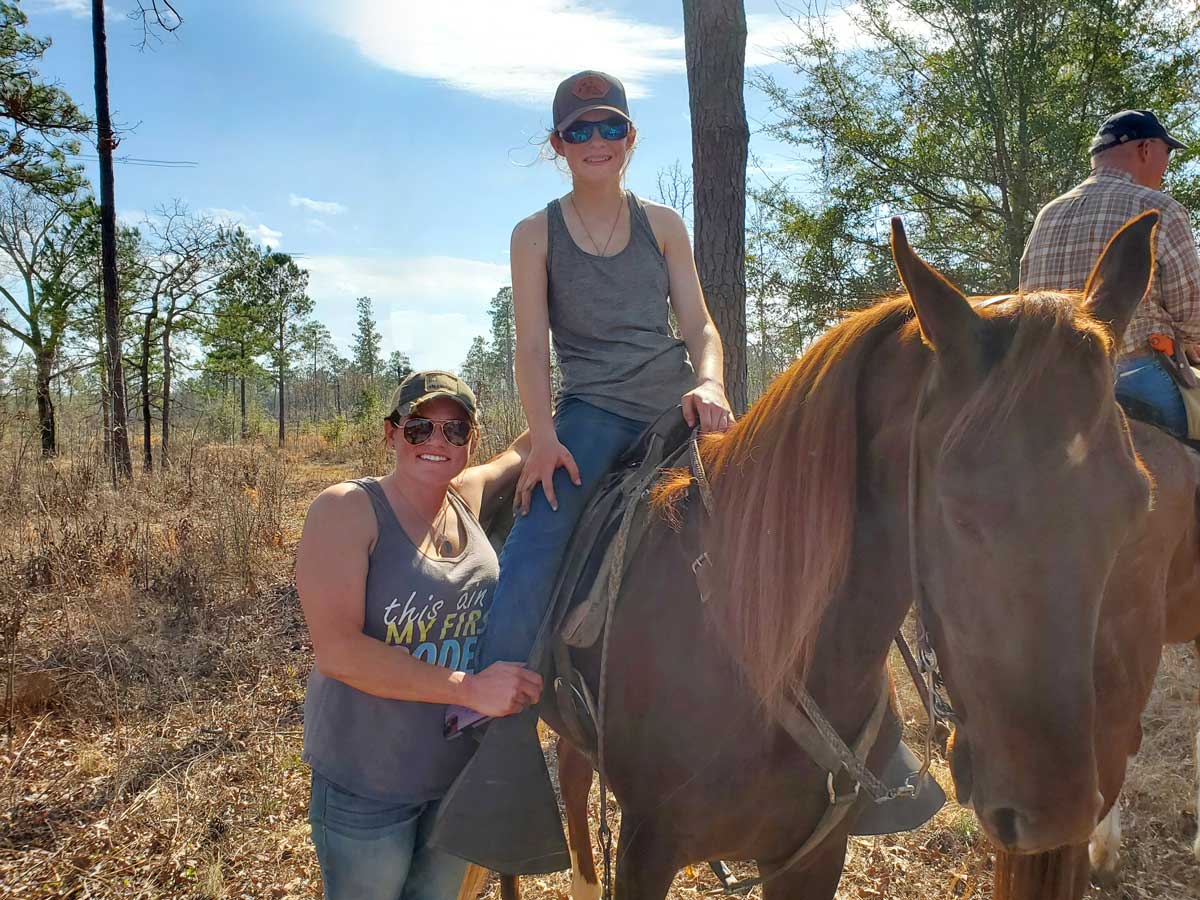
“As a mother, I’m extremely proud of Madi,” said Kaley Lee (standing). “Field trialing at this level takes confidence, character, hard work and real experience.”
Anything done in moderation shows a lack of interest, and that’s probably why the Smith Setter Plantation team was being celebrated in this trial. Sure, there was the magnificent property of more than 2,000 acres of rolling hills, fields and creek bottoms that were portioned into two 800-acre courses and one 400-acre course. Sixty years of thought and passion combined with prescribed burns, planting, cutting and thinning had created this masterpiece of quail habitat.
Dogs were a main cause of celebration, for Elwin and Inez Smith, Harold Ray and Sherry Ray Ebert had created the most consistently successful line of performance English setter in history. It began with Harold’s unique way of thinking represented in the pairing of CH Susan’s Ladybird to Grouse Ridge John, the winner of the Pennsylvania Grouse Championship. Ray believed that combining a cover dog champion with a shooting dog champion would create an elevated standard.
Harold believed that a cover dog champions’ best qualities included running to the front, an excellent nose, outstanding bird smarts, athleticism and style. Champion shooting dogs had speed, power, endurance and heat tolerance. That first lock produced CH Tomoka who went on to sire another six champions and 138 winning setters. Four Smith Setters—CH Tomoka, CH The Performer, CH Destinare and CH Bonafide—landed in the National Bird Dog Museum’s Field Trial Hall of Fame.
And there were the people, especially because time doesn’t really stop for the great ones. Instead, it just wraps ’em up in a cloak of immortality, and that is what the Smith Celebration was all about. The idea to honor the Smiths and Harold and Sherry started with a conversation between their son, Doug, and Joe Cincotta, the president and director of the English Setter Club of America.
“Joe called me up to see if my mom could help get a dog from Oregon to the East Coast,” Doug said. “One thing led to another and, before long, we were talking about the current state of field trialing and that went on to ‘Wouldn’t it be great to run amateur field trials at Smith Setters Plantation like we used to do?’
“Then we talked about moving two namesake events, the Elwin Smith Amateur Shooting Dog Classic and the Inez Smith Open Shooting Dog Classic from where they were run up north back to Waynesboro. Then we were talking about my dad’s impact on the dogs and the sport and that my mom was the first woman handler to win an open shooting dog championship, the Eastern Open Shooting Dog title in South Hill, Virginia, in 1989 with The Performer.
“She was one of the early women field trialers and scouted 25 champions to 60 titles. And all of this happened through the commitment and vision of Elwin and Inez Smith who were so foundational in the plantation, the dogs and in field trials. At one point, Joe said, ‘You know, we’ve got to do something special to commemorate all of these great people and events.’ And so we did.”
One hundred and three top horseback shooting dogs ran in this inaugural event that relaunched an amateur event as had been done in the past. Participation was high and the trial so well received that morning and afternoon braces ran from March 7 through March 23, rain or shine.
Marty Robinson, the president of the Southern Bird Hunters Association (SBHA) and an event sponsor and marshal, is used to hosting and running trials but, according to him, this event was “different.”
“The idea for a trial that honored and celebrated the past while looking toward the future generated a lot of interest from a lot of different people,” said Marty. “Sherry Ray Ebert, Jason Williams, David Huffine and Ashby Morgan were judges. Margaret Drew was the reporter. Chris Mathan was the photographer, graphic designer and marketing arm. I was one of the marshals along with Doug Ray, Lea Ray, Aimee Atkins, Anna Cruse and Brian Sanchez. Joe Cincotta served as the chairman, and Harold Ray was the grand marshal. There were so many other people and companies who supported the event, and we thankfully had so many people pitch in.”
Besides great dog work and lots of smiles, there were a tremendous number of other flags that waved success. Joe Cincotta’s speech before the first dinner brought everyone together and underscored that a fraternity of like-minded people working tirelessly and creatively are capable of making great things happen. There was the acceptance of a plaque recognizing Women in Field Trials by Sherry Ray Ebert and Mary Tracy that now hangs in the plantation clubhouse. There was Clinton Joe Bush’s singing of the gospel hymn “Glory, Glory” that noted the passing of the legendary handler John Rex Gates, and much more. But possibly one of the best examples came from an Athens, Georgia, bird hunter named Jason Needham.
“I’m here to express my gratitude to a lot of people who helped fulfill a dream of mine,” he said. “I always wanted a great bird dog, and thanks to Smith Setters I have two by Tomoka that are the best I’ve ever owned. When I heard of this event, I took time off from work to come up and pay my respects.
“I wanted to thank Harold, Sherry and Doug for what they have developed here at the plantation. I also wanted to see where it all started, and that included honoring the Smith’s legacy. On my way home I’m going to drive down Highway 25 to see the water tower. I mean, how many people can say they own a dog from the dog, Tomoka, that marks an entrance into the Bird Dog Capital of the World? I’ll remember all of that as well as the camaraderie at this event for a very long time.”