

“I’ve been talking with Randall Pence at Ruger,” said my friend Lee Newton. “I’ve got a Ruger No. 1, chambered in .450-400 NE 3-inch, that we think you need to take to Africa and shoot something big! You interested? It’s a sweet-shooting rifle. You likely know a little about the round and the role it played during the early years of the safari industry in Africa.”
I knew it was a favorite among a number of the African “white hunters” and used quite successfully on a variety of Indian game including gaur, the largest of the wild bovine species, as well as man-eating tigers.
Two famous professional hunters were Jim Corbett in India, and John “Pondoro” Taylor in Africa. Taylor proclaimed the .450-400 as “the grandest weapon imaginable for big game.” Corbett used a rifle chambered in that round to dispatch several tigers. Back here in North America, Elmer Keith, who promoted large bore rifles on any sized game, declared the .450-400 NE 3-inch cartridge as his first choice for Alaskan brown bear.
Based on research, I knew that the .450-400 NE 3-inch was created in 1899 by the W.J. Jeffery & Company and was occasionally called the “400 Jeffery Nitro Express.” It had a .450 case necked down to a .410-inch bullet diameter. It was a round of note for many years and served those who used it extremely well.
“I shot the rifle using Hornady 400-grain DGX, Dangerous Game and it is surprisingly pleasant to shoot,” Lee noted. “Soon as we get back to Texas come by the house and I’ll get it to you. For the time being, the rifle will officially be yours so you can properly register it with U. S. Custom on their Form 4457 and whatever paperwork you’ll need to do when you get to Namibia.”
While at the NRA Convention, I also spoke with Neil Davies, who said Hornady would send me two boxes of .450-400 NE 3-in ammo, one box of 400-grain DGX (expandable) and a box of 400-grain DGS (solid).
Back home, I mounted a Trijicon scope on the single-shot, then headed to my range where I bore-sighted the scope. With targets at 25 and 50 yards, I decided to devote four shots from each box for sight-in and then keep the remaining 16 rounds per box for Africa. Thankfully, I did a stellar job of bore-sighting. My first DGX shots at 25 and 50 were dead center, same with the DGS. I put the two remaining rounds into the box of shells I’d be taking to Africa.
Three months later, I boarded a plane en route to Windhoek, Namibia to hunt with Corne Kruger’s then Omujeve Safaris. I had hunted with Corne’s outfit numerous times in the past and loved every moment. I knew my hippo hunt in the Caprivi Strip, now known as the Zambezi Strip, would be no different.
After clearing customs, I met Corne and we headed to his operation’s headquarters where over a most delicious evening meal, he told me that Louis Kotze would be my PH. I had hunted in the past with Louie and had taken a number of outstanding trophies.
“You’ve got tickets for a noon-day flight tomorrow. Louie will meet you at the Katima Mulilo Airport.”
All went well and soon after landing, Louie and I headed to camp. On the way, Louie and I talked about hippo hunting. On past hunts, I had taken several hippos and a rogue bull in the Limpopo region of South Africa. I’d shot him in the water. This time I wanted to shoot one on land. Louie thankfully agreed!
The first day in camp, we decided to hunt impala, so I could get more familiar with shooting the .450-400 NE 3-in. off the sticks. We soon found an old ram, one that would provide meat for Louie’s crew. The rifle performed perfectly!

We also did a bit of exploring where we could glass small inlets to look for on-land hippos.
The next day, we did more scouting and I used the .450-400 NE 3-in Ruger single-shot to take a zebra stallion, which provided an absolutely delicious meal that evening.
Now it was time to cruise the Chobe River in search of hippos. We found numerous pods, had our boat charged by a belligerent bull, but could not find any hippos on land. Same the following day, minus having our boat charged once again. We did see a monstrous croc.
“I got a client coming in the day you leave specifically hunting for a really big croc,” Louie said. “That one, which I think is a bit over 15 feet, will certainly qualify.”
The following morning was a good bit cooler than those earlier in my hunt. “I suspect we’ll find some hippos on land this morning, trying to soak up the warming sun,” Louie predicted. Two hours later, we spotted a huge bull with two cows, on land, albeit not far from the water’s edge.
We looked at several different approaches and decided to walk a couple of hundred yards through tall grass and sedges to get where we hoped we might have a shot. The three hippos were bedded on a sandy strip only about 30 steps from the Chobe. Our intent was to stalk quietly through tall grass, which separated the hippos from the water. Then, if it worked as planned, it would be a 20-yard shot. We knew that at the first sign of any danger, the hippos would likely retreat to the safety of the river.

It took some doing, but we finally got into position just off of a trail that led to the river. To shoot above the tall grass, I had to stand as tall as I could. I extended my shooting sticks to their fullest height, then settled the crosshairs where I believed his spine met his body. I glanced at Louie and indicated for him to shoot if he deemed it necessary. He nodded. I looked back at the monstrous bull and saw exactly where I wanted to place my bullet. I was hoping to hit him so he would drop on the spot and not get into the water.
I had spent time seriously studying a hippo’s anatomy. I knew pretty well the path the spinal column took. My initial shot would be a 400-grain DGS Hornady Dangerous Game Solid followed by a 400-grain DGX Hornady Dangerous Game Expandable. I had hunted a lot with Ruger No. 1s and spent considerable time teaching myself to quickly reload the Ruger single-shot to the point where I did it automatically, purely by muscle memory, without having to think about what to do.
Taking a deep breath, then letting all the air out of my lungs, I started squeezing the trigger. At the shot, the monstrous bull quivered, rocked forward and backward. Before he fell, I ejected the spent case, seated the expandable load and put a shot into his heart and lungs. The bull started going down. I sent another solid where his spine met his skull, far faster than it takes to write about it. With that shot, the bull was down.
As I quickly reloaded and prepared to shoot again, I heard Louis say, “He’s down!”
I kept my rifle trained on the huge beast. I could feel Louie pounding my back, saying something about my shooting, which he repeated a second time: “You put three shots into the hippo with your single-shot faster than most hunters could ever do with a bolt-action rifle!”
I simply smiled and accepted his compliment. I had spent a lot of time shooting and hunting with Ruger No. 1s, one of my favorite hunting rifles.

The overall size of a bull hippo always surprised me. My bull measured 12 feet from the tip of his nose to the tip of his tail. After hearty congratulations from Louie’s trackers, lots of photos and finishing footage for my then “DSC’s Trailing the Hunter’s Moon” television show, a large crew arrived and quickly cut up the huge bull for distribution to the local tribe.
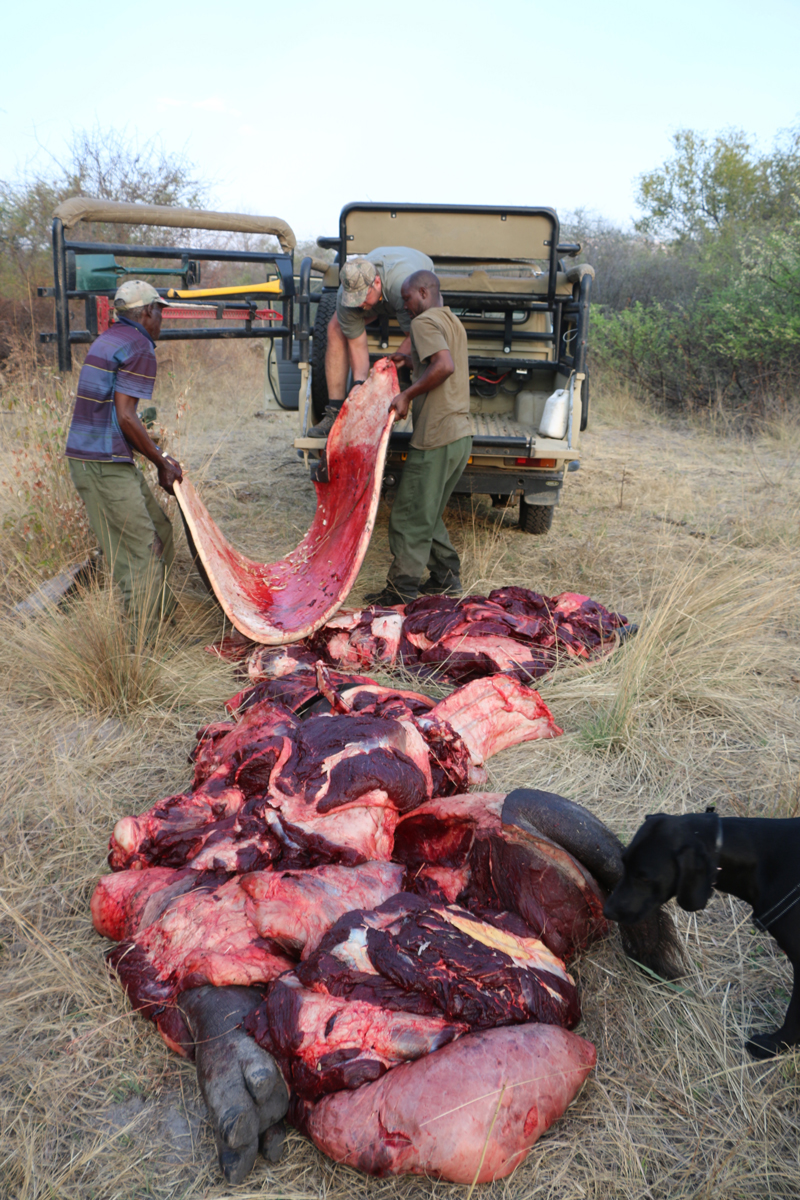
All the meat, skin, skull, over-sized teeth and even the tail went to the local villagers. Because of my taking the big bull, they would be eating well for several weeks. All I took home with me were photos, footage and fabulous memories of shooting a bull hippo on land with a .450-400 NE 3-in Ruger Number 1 Rifle . . . a fantastic trophy taken cleanly and humanely with Hornady’s Dangerous Game! That as it’s prone to be said, “Just doesn’t get any better!”