
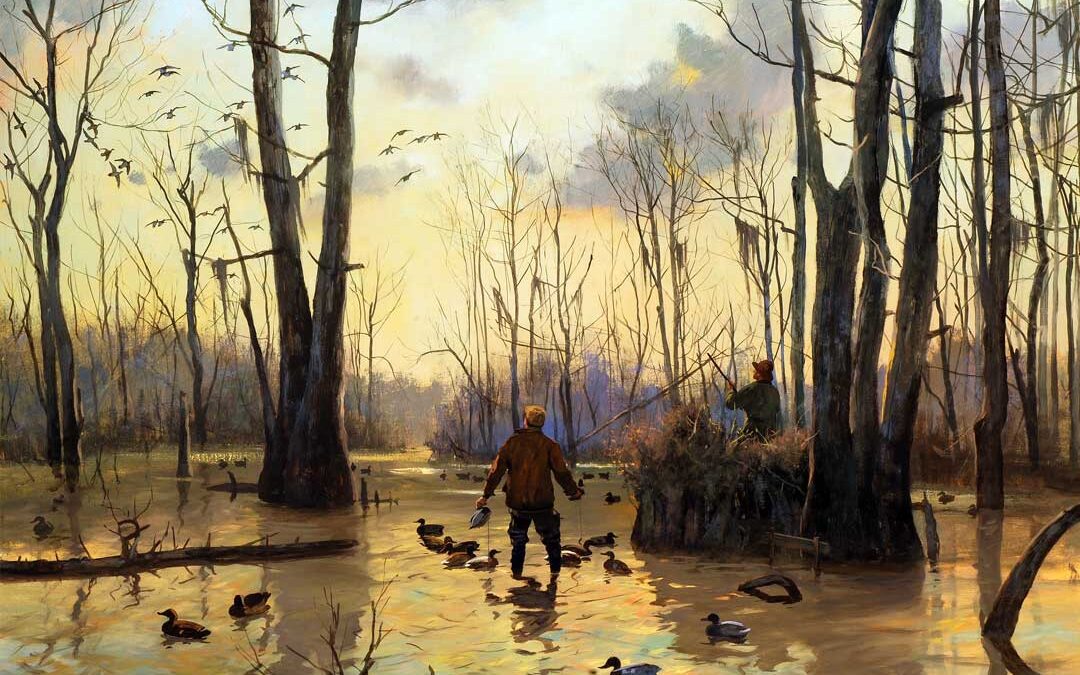
When the ducks come—splayed feet anticipating a frigid plunge into shallows; wings cupped, rocking in a jerky side-to-side; keen eyes scanning—there is no finer experience in the hunting world. Oh, there is the enhanced palpitation of heart when distant leaf crunch suggests a whitetail; the adrenaline explosion that accompanies a robust bugle of elk; the sweaty, chilled shiver that engulfs when in proximity of a Cape buffalo, your eyes wide yet restricted to tunnel vision; the gutsy rattle of a gobbler just downhill. Grand, all these. But when the ducks come, primal instinct and intrinsic admiration flourishes. I hoped to participate in such spectacle come daylight the next morning.
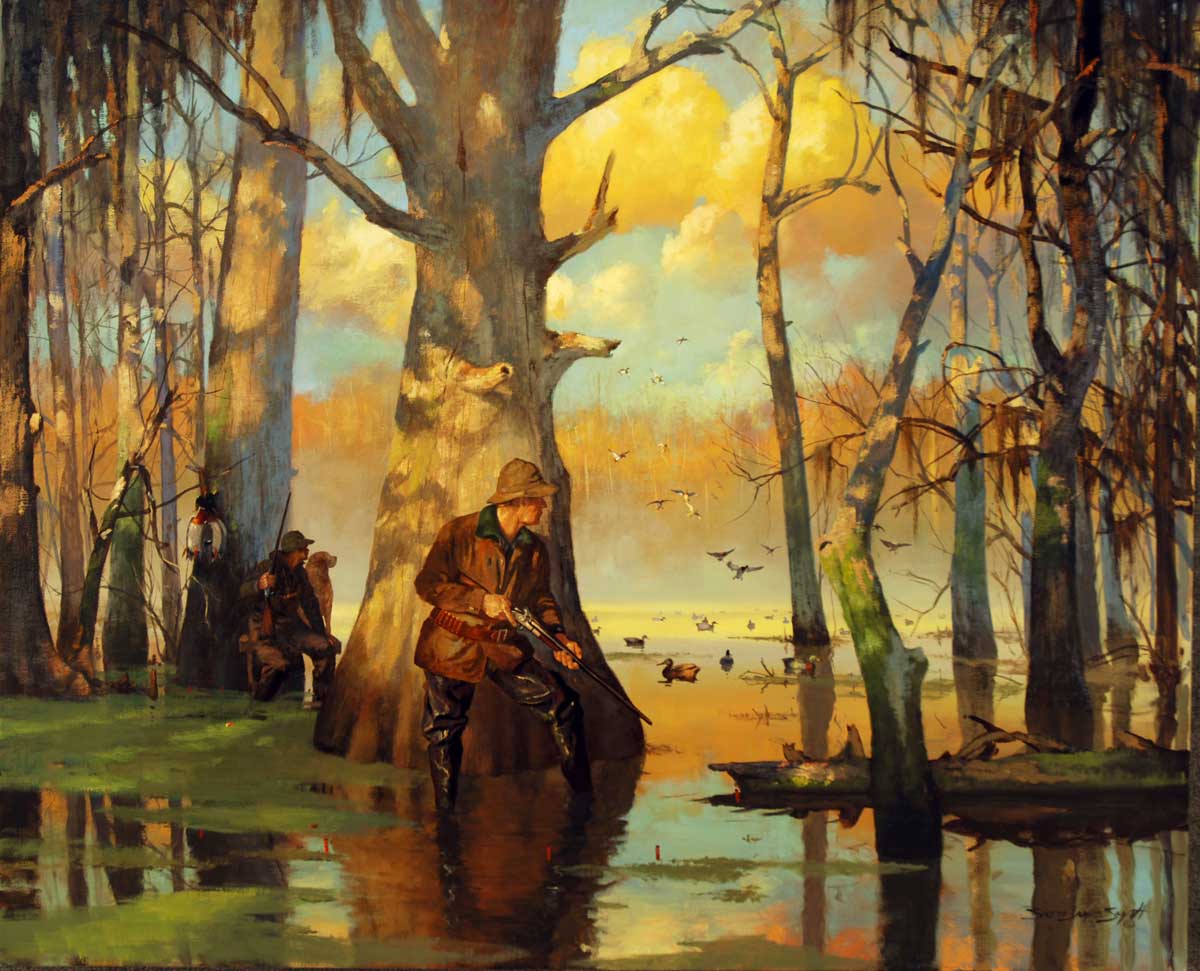
Gunning the Bottoms by Brett James Smith
Sloughs and flooded timber are grand locales for a morning of duck hunting. Catfish ponds left to nature are quickly reclaimed by native plants and trees. Waterfowl drop by regularly in such locations.
Throughout the nearly two-hour drive I had just completed, weather conditions were miserable. Boisterous winds threatened tall pines standing along both sides of a state highway I traveled. Lightning fairly sizzled across a sizable chunk of local real estate. Rain battered the windshield with profuse anger, requiring slow and deliberate progress. The heavens scowled. But as I moved westward, the situation showed moderation. The sky became lighter, though yet stained. Clouds weakened. And presently I stood beside my truck at the bunkhouse, hard against the Sunflower River. In the east-to-west core of what we folks call “The Delta,” I was. Just off the tailgate of my truck and across a two-track, there was a rumpled cornfield, reaching from here to yonder in vastness that was broken only by one wayward slough, willows and Tupelo gums its delineation. Too consistently wet for farming. I stood in silence.
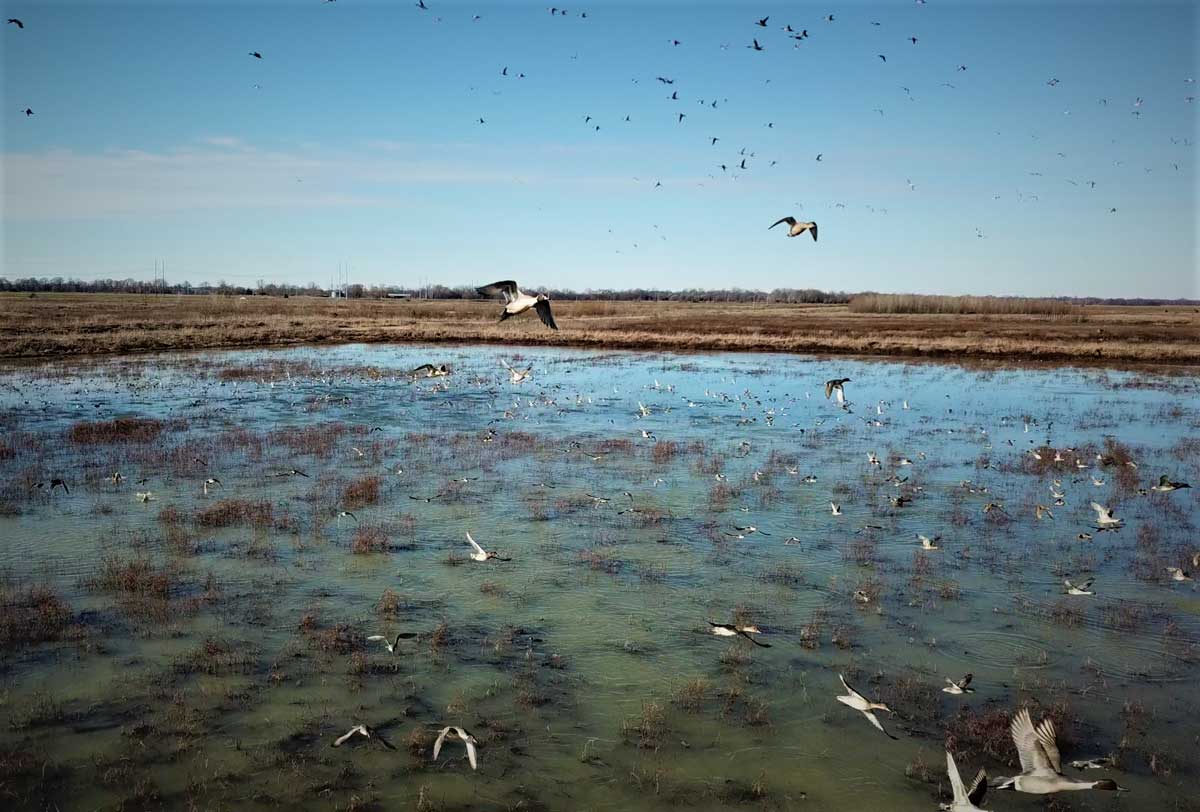
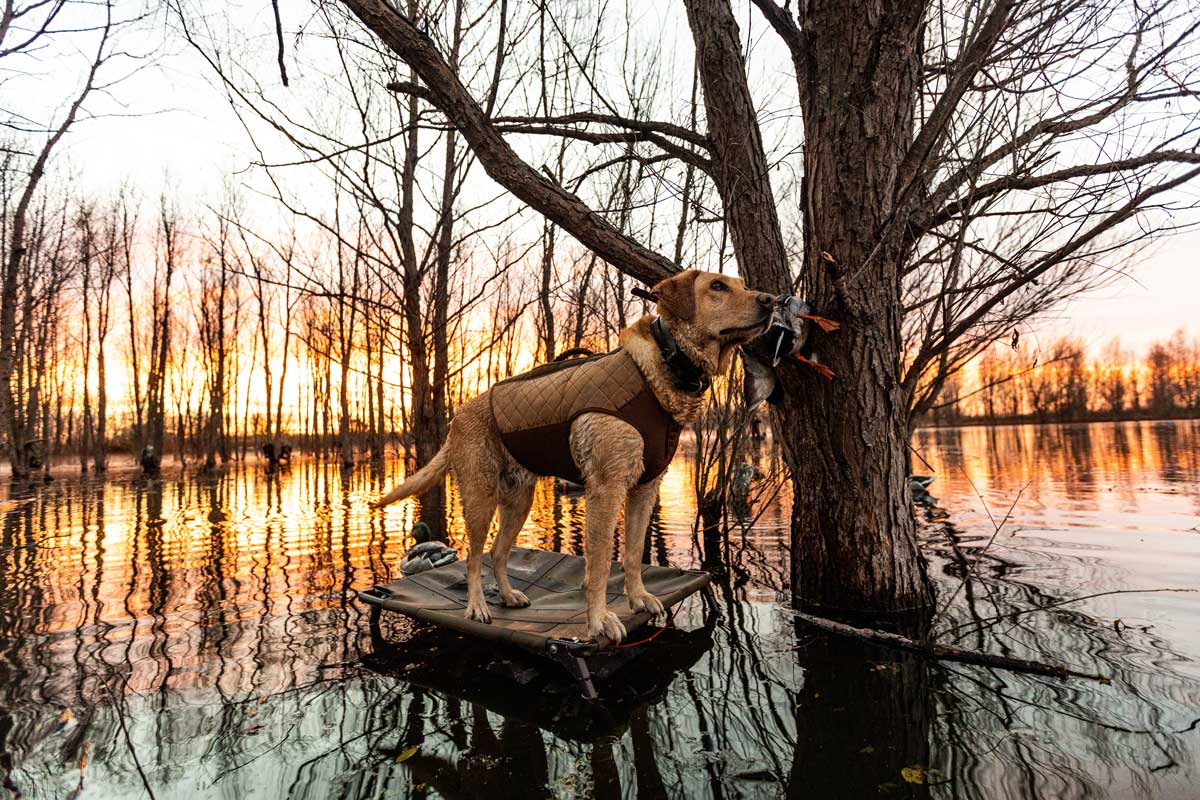
Mallard and pintails are common when hunting in the delta’s old catfish ponds.
But the surroundings were not silent. They were minus noise but not silent. East, the direction that now-gone storm had taken, flocks of snow geese honked and glided and jockeyed for position. Their symphony rivaled that of Dvorak. Sodden ghosts of corn stubble mourned this most recent onslaught of cold that even now lay just west, winter’s announcement reverberating across the Sunflower. The river itself moaned. A lonesome suzy quacked from a far-off puddle. I pulled a wool vest from my duffel and stood longer.
A rainbow materialized, east. An orange sunset commanded, alluring but melancholy. Not unlike those I had seen many times in Africa, but no thudding of tribal drums here. And as darkness began to gain momentum, I saw lights scattered across the openness. Perhaps a secluded dwelling. Maybe a country gas station, the high odor of overflowed fuel and dribbled engine oil permeating. Dusty ball caps and grease tubes and fan belts and tire patches dangling from pegboard displays inside. While I contemplated, Nash Buckingham crossed my mind.
He, too, was a duck hunter. Even hunted this delta, where he enjoyed his last hunt at age 88. But farther north from here, up at Beaver Dam. Still, it was delta, the same black-dirt flatland skirting the Big Muddy as was my current location. He saw vastness and sloughs and lights as I was now seeing. In his famous work “Great Day in the Morning,” Buckingham wrote: “Across dimming cotton fields I saw lights springing up in tenant cabins and winking through low-hanging wood smoke…. Eastward…thousands of forest monarchs towering just as God grew ’em.” I shared his sentiments.
Jacob Sartain drove up. He is a duck hunter and proprietor of Sartains Heritage Properties, so he keeps his finger carefully positioned on the pulse of duck doings in the area. He, Jimmy Sandifer and I would take the waterfowl temperature at daylight. Supper came quickly, marinated and grilled mallard breasts that not only were appropriate for duck camp but were purely superb. We ate well.

Modern shotshells have come a long way. While steel is effective, bismuth and TSS go several steps farther. The author used Apex TSS on this hunt for big ducks.
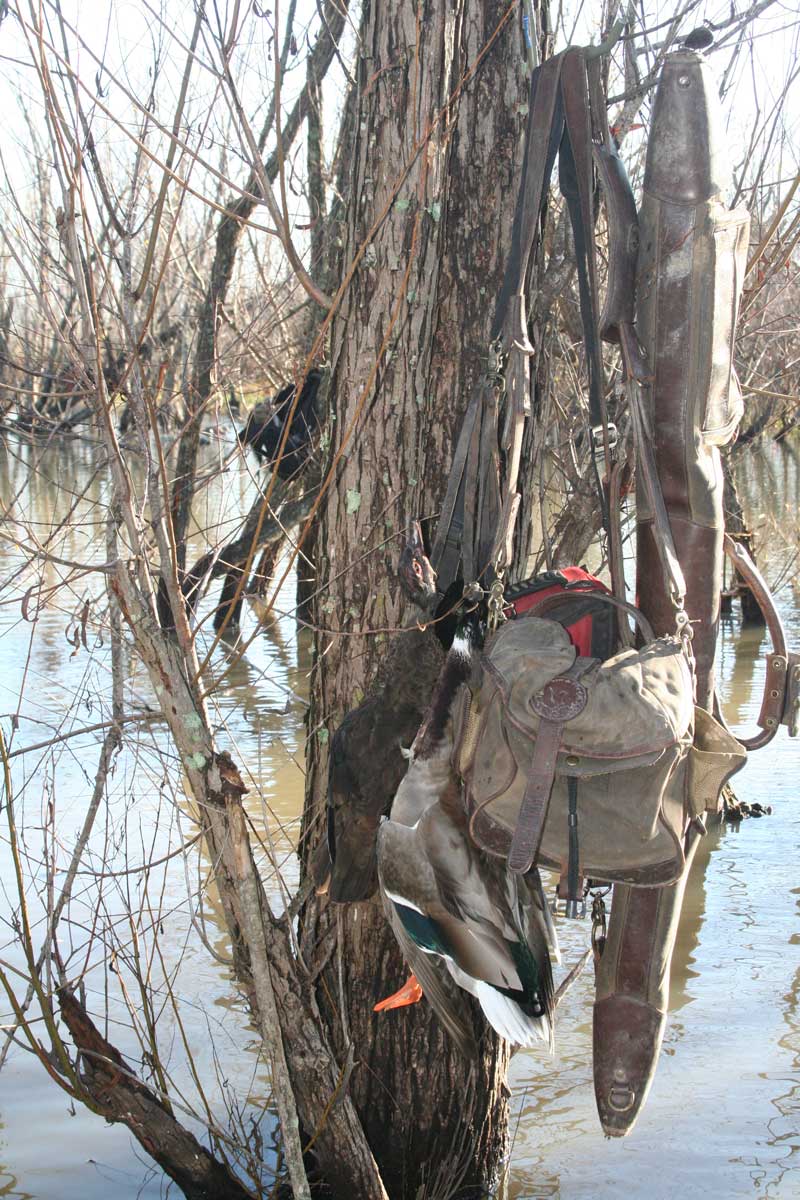
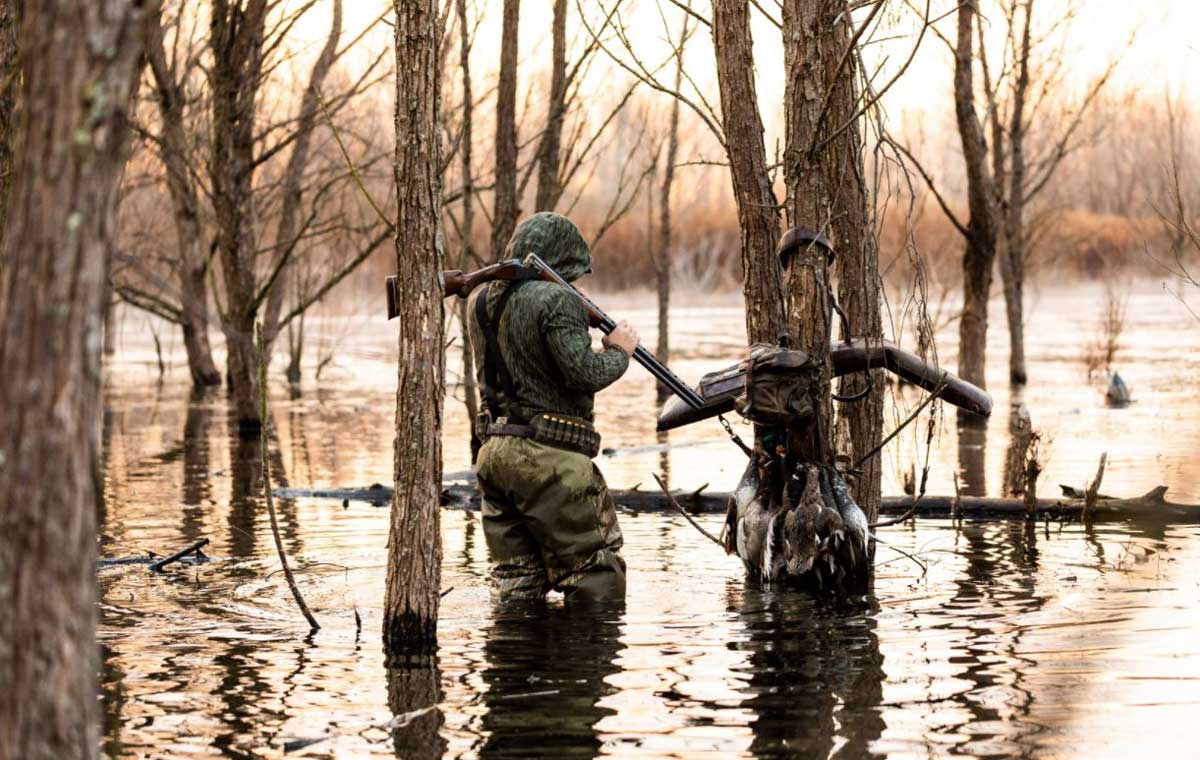
Daylight found us wading knee-deep waters that covered a gooey and grasping bottom strewn with decaying branches. An old catfish pond taken out of service years back. Suspect footing for an old man, but ducks frequented. We took stations among clusters of young willow and gum, these claiming this welcoming wetland as home after catfish farming was set aside. Adequate cover they were. Packs hanging from small tree trunks and shotguns loaded, we waited.
The concept of catfish ponds perhaps demands explanation, particularly for those who have never been to the delta or similar settings where this practice is common. It, in this form, is not a sporting proposition maintained for fishing. It is purely commercial and on a gargantuan scale.
Years ago, catfish farming and subsequently catfish eating came into vogue, the eating dependent upon the farming. Ponds received fingerlings that were fed, tended, raised and later processed for shipment and sale. Practically worldwide this food was offered. Consequently, catfish ponds became attractive, acre upon acre of farmland converted from row crops to fish.
Ponds were set up in a grid pattern, low levees separating impoundments into smaller blocks for ease of maintenance. Each pond—generally five to 10 acres—became an individual entity in a much larger collection that covered hundreds of acres. There were even implements developed for the express purpose of catfish farming. These tools, some impressive in size, were scattered all along those levees. It was, and is now on a smaller scale, an intriguing agrarian endeavor. Catfish farms with their single ponds forming an even grander collection of the same can easily be seen from the window of a passenger jet if it crosses the delta.
As things often do, this farming project and its product underwent changes, making the ponds less profitable. Some were simply smoothed out and put back into crop production. Others, however, were enrolled in CRP. Those so enrolled and so dedicated to the goal were left to go back to a natural form or were planted in crops that would benefit wildlife. This is where we found ourselves that first morning. In a pond that had been allowed to house the trees and brush native to the area.
But that is not the total. Adjacent to this specific pond with trees and brush, there were those planted in corn or milo or some other crop favoring wild things. Planted and left alone. A waterfowl delight. So as seen from above the grid would be a pond with water and native trees next door to a pond growing corn or a pond growing milo and so on. Jacob stays out of the corn and milo and whatever else might be planted and hunts only the water. Truly, an ethical and conservation-minded approach. And then the ducks came.
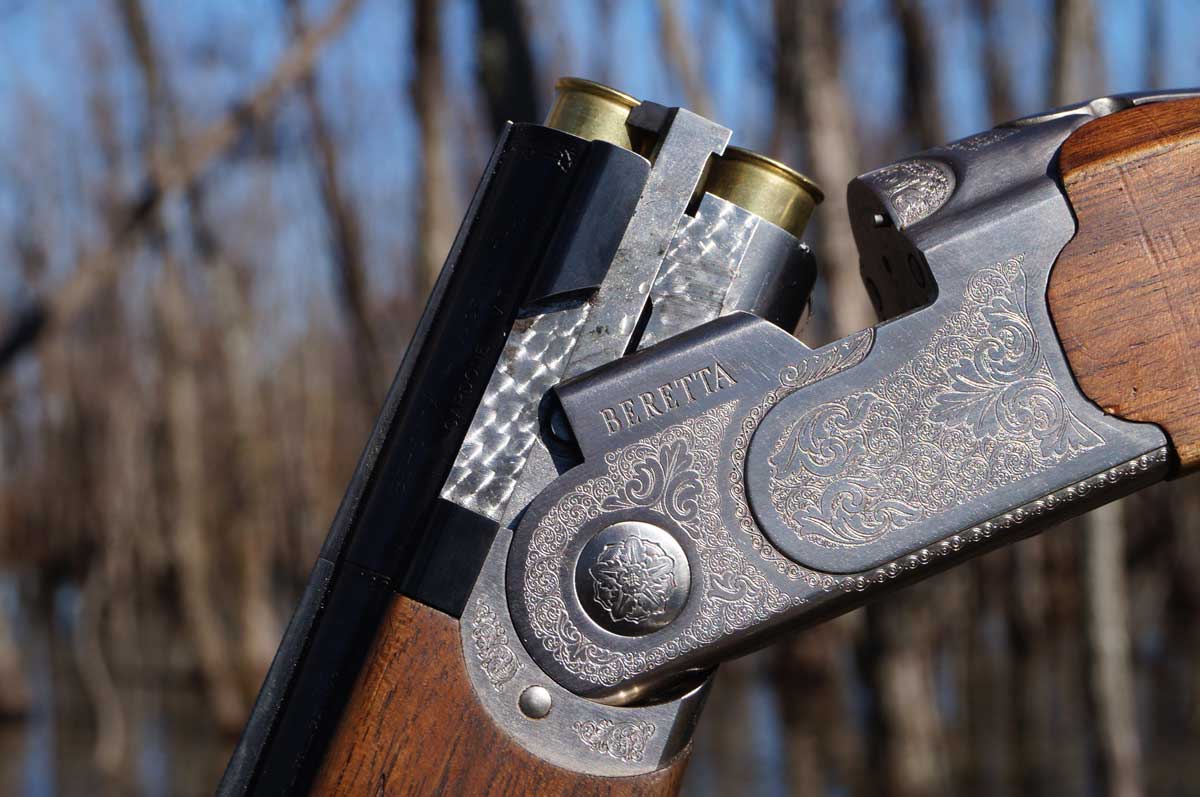
Twin-barreled guns are classy and efficient. They are also handy, allowing the hunter the option of two different choke restrictions. Kinton enjoys his neat little Beretta Silver Pigeon 1.
Not as many as was hoped, but shotguns thudded. Two mallards fell. They had come on a right-to-left approach and didn’t particularly oblige a small decoy spread peeping from the curtain of willows. Jacob and Jimmy. I was sluggish. And a scattering more—front- to-back, back-to-front.
Those on the front-to-back avoided my load, had I chosen to send it, by navigating, expertly I must say, the canopy of willow beneath which I stood. But the back-to-front afforded another opportunity, one that worked well for my position. Out the corner of left eye and from over left shoulder, a rush of whistling wings, an arrow-straight, going-away shot, a going-away that put two drakes past the willows and over open water. One charge of two Apex TSS No. 9s caught up with the departing. The 28-gauge sparkled, not in sunlight but in performance. All settled quietly for a few moments. We whispered.

Danny Thornton shows off a collection of woodies he took during a hunt in flooded grass and bush.
What drew our attention and what we whispered about was that plunge of ducks over there. The spot on that levee from which we had entered those shallows earlier was 60 yards to the southeast, our right. On the opposite side of that spot was another depression sharing the same levee, this pond given over to corn. Another adjacent to that one hosting milo. Ducks, with full daylight and warming skies, were pouring—not drifting or happenstance or with lack of purpose but pouring with dedication—into those fields. We marveled. We watched. We smiled. We whispered. Such a glorious spectacle we were enjoying. And all ducks doing so were immune to any altercation with non-lead shot as long as they continued doing so. Seemed a fitting agreement. The show was marvelous.
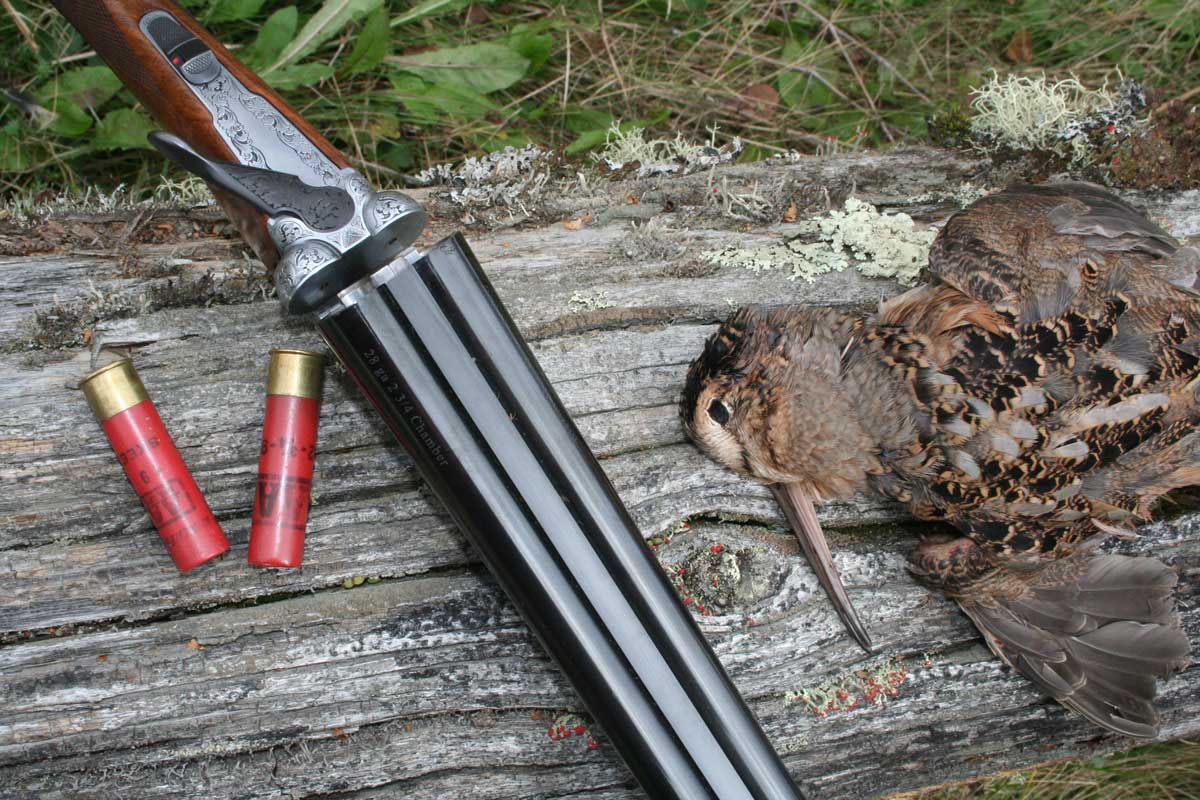
Sub-gauges are growing in popularity, the 20 and 28 getting the most nods. The author elects the 28 as his first choice for most of his hunting.
Hunters, being the curious and sometime argumentative lot they are, can barely escape some discussion regarding gear. Rifles and shotguns and cartridges and shot sizes rise quickly to the surface of such palavers, and every participant has his or her opinions. I found it interesting on this hunt that all three gauge choices were what are often referred to as sub-gauge—20 and down. Two were 20s, one over/under and one side-by-side. I was odd-man-out in the deal. Mine was a 28-gauge over/under. Jacob and Jimmy didn’t blink an eye when I uncased it and spoke of its designation. They knew the subs were adequately proficient.
I love the 20. Grew up with one and have never been without. Everything I hunt regularly has cooperated with a 20. But I must now admit that my 20s stay locked away in favor of 28s; I have a duet. This little unit has seen a great deal of magazine ink in the past decade, and its practitioners appear to grow in number annually. In short, it works. And it works with less fuss and weight and recoil than any of its competitors. Apart from the occasional frivolity with a .410 on doves and quail, this bore filled with intrigue, I now use nothing other than the 28 for doves, quail, chukar and well-behaved pheasants. The latter, however, is difficult to find, and inconsistency is often the only consistency these rocketing beauties afford. I keep a 20 handy.
All that said, the 28 is a gem. And when it comes to ducks, especially close-in decoyed birds in the timber, it is entirely sufficient. But keep in mind that ammo choice is important. Regardless of the gauge, today’s offerings are purely grand, enhancing terminal proficiency in whatever chambers them. I have used the 28 with bismuth in waterfowl settings for teal and woodies. Perfect. And I have used the 28 with TSS pushed through improved and modified chokes on bigger ducks at somewhat extended ranges. Again, perfect. I shall continue its use. And that ends my own opinion spouting and argumentative discourse for the time being.
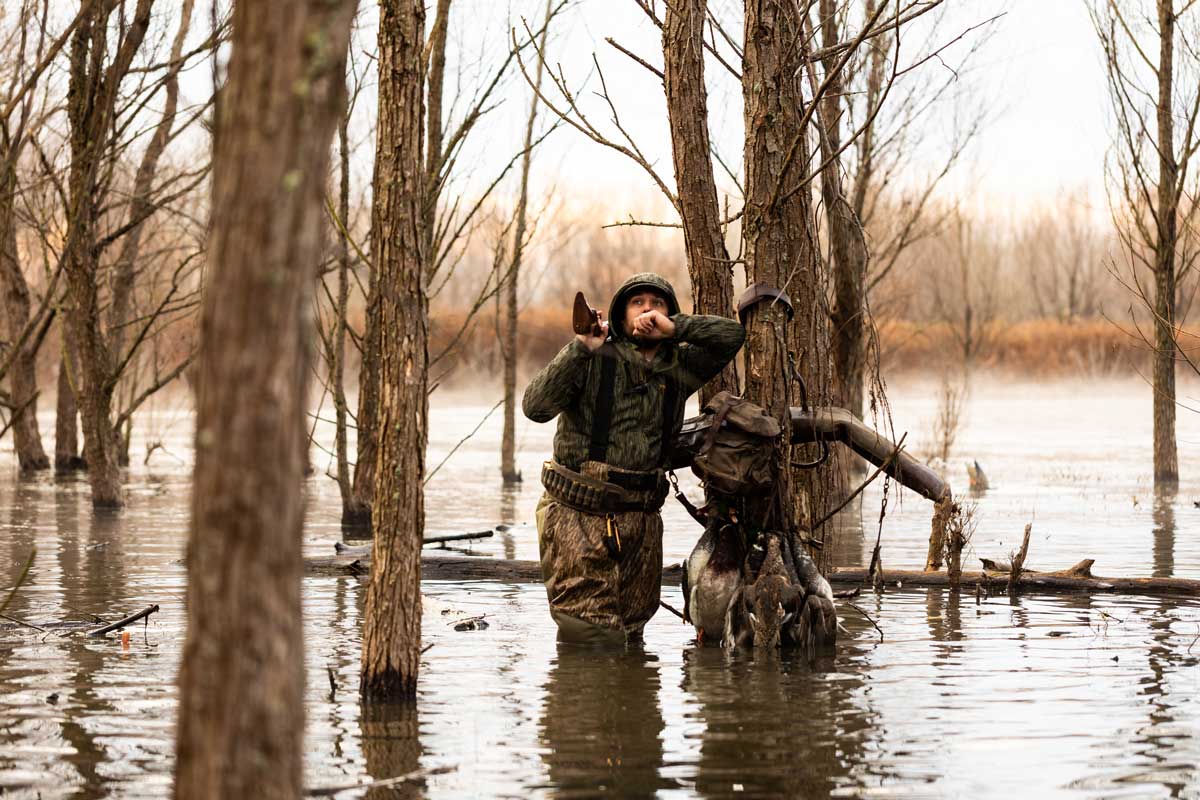
Then just out there over open water, a specter squeal announced arrival and a disconcerting projectile jetted, right and quartering left. A wood duck, skimming willow branches and dodging trunks. Abandoning the open and electing more congested environs. Now just off the water, navigation perfect amongst the tangles, to Jacob’s left. And within the seconds it took to execute, one of those most pleasing and highly dexterous demonstrations of the shotgunner’s art unfolded. Jimmy and I watched expectantly.
Jacob swiveled, mounted the gun, followed through and nudged the trigger, that woodie’s momentum pushing him several feet before splash down. It was awe inspiring. A fluke? Simply good luck? I think not. I saw it, absorbed Jacob’s calmness even in the face of haste. He is, after all, a duck hunter, and he was not then or now new to this regimen. He dotted the “I” and crossed the “T.” It was as it is supposed to be. A fine performance, indeed.
And then it was Jimmy’s turn. A mallard drake, initially enamored of the decoys and wings set to join them, presently chose to do otherwise. He towered. Now among the over-story and then a shotgun’s length above those willows. A brief opening, at a steep angle that was near overhead presented and Jimmy was ready. One 20-gauge crack. The drake dropped.
Now, coming from the right, five or six mallards, maybe one or two on either side of that estimate, banked and circled and then obliged. A leftie, that right was most convenient for me. I played the role properly. Another splash resulted from the 28 and TSS. Morning had grown old by then, so we packed up and made that sloshing hike back to the levee. Ducks were yet occasional guests to our hideout.
Later, after getting waders off and storing gear back at the truck, we opted to drive those many levees and look. Ponds providing corn and milo still held ducks. Some on the ground eating, others circling far above in what must have been duck contemplation. And there were others that got up and moved a short distance only to settle again in the abundant food supplies. As usual, such busy activity is to be expected along the Mississippi Flyway and in this delta, which was once perhaps six million acres of sloughs and swamps and giant oaks but is now some five million short of that original standing. Still grand, though. Farming produces waterfowl food and waterfowl can be abundant along the flyway.
Before I left this land, I once again found myself in thought and wondering. I would have enjoyed that early delta and its giants in the form of oak and cypress. I would have then found a great deal to write about. Buckingham did. Faulkner, too. The “Big Woods” called him and he answered, in presence and in print. And even now as an old scribe, I find much to write about regarding this mysterious black soil and aristocracy and common folk and fortune and failure. Abundant muses, these. Gravitas aplenty. This hunt for shallow-water ducks verified that abundance. ν