
Our tracker pointed his steel-tipped spear at the lion’s spoor. Pug marks indicated the big cat was headed toward the verdant creek bottom that starkly contrasted with the khaki and brown that surrounded us. Green trees indicated the serpentine creek flowed toward the southeast.
We were enveloped in an eerie haze. Breezes blowing across the nearby Sahara Desert brought with it dust, sand and grit. The combination totally obscured the near high-noon sun. It all reminded me of the dust storms I had experienced during my years as a wildlife biologist working in northwestern Texas. But I was far from Texas.
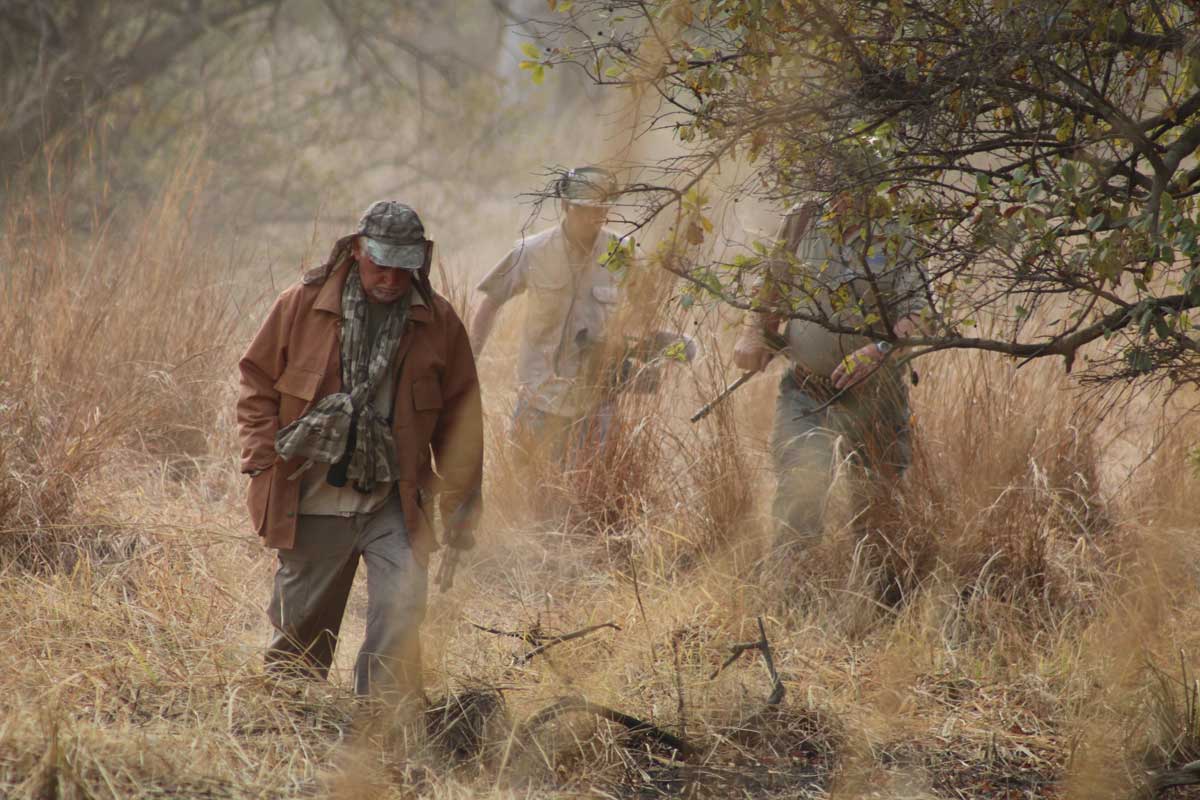
Upon finding fresh lion tracks my hunting partner, Tim Fallon, made certain his 375 Ruger was fully loaded and, if needed, he had quick access to additional rounds in his cartridge belt. Our Professional Hunter, Philippe Lavillette, spoke in French. Neither Tim nor I understood a word he said, but we knew what he meant. The lion tracks were fresh.
Tim was hunting lion. I was hunting western roan antelope. We followed lion spoor into the brushy creek bottom. If we saw the lion and Philippe deemed him at least six years old, Tim would have to shoot quickly, accurately and deadly!
I checked my 375 Ruger even though I knew it was fully loaded with Hornady’s 300-grain DGX Dangerous Game loads. I had no intention of shooting unless things got a bit “western.” I felt safer with my rifle in hand.
We walked into the creek bottom, then paralleled a series of small pools. We followed the trackers, acutely vigilant to every sound, movement and even odors.
“RAAhhhh! RAAHHHH!” roars, sounding like devils escaping Hades a hundred yards ahead startled us!
“Babbbooons!” said Philippe, followed by several, I suspected, French curse words. The lion we were tracking had apparently walked into a troop of baboons. They were not happy about the interloper’s presence! We ran forward and peered around a bend in the creek. Two half-grown lion cubs hastily ran into the tall grass and dense thorn brush. The baboons’ screams continued, alerting all within earshot of impending danger.
We found fresh lion tracks each morning; females with cubs, small males and those of two big-footed males. Burkina Faso had a healthy lion population.
Our hunt in Burkina Faso had essentially started the previous year when Tim and I hunted neighboring Benin with Safari Chelet. On that hunt, Tim unsuccessfully hunted lion. He did take a really nice roan antelope and other big game species. I failed to take a roan antelope in Benin, an animal I really wanted. Actually, I could have taken shots at several really nice bulls, but at the time I owned and hosted the “DSC’s Trailing the Hunter’s Moon” television show and when I could see a roan, cameraman, Blake Barnett, could not. Conversely, when Blake could see a roan through the camera’s lens, I could not. Such is television! My failures only increased my desire and resolve to return to northwest Africa for western roan antelope.
Back home from Benin in Texas, Tim Fallon, who owns the FTW Ranch, home of S.A.A.M., Sportsman All Weather All Terrain Marksmanship, and I started making plans. We have hunted together in North America, Asia and several European and African countries, and this time we decided to hunt in Burkina Faso.
Tim had earlier introduced me to Patty Curnutte who with her husband, Bob, owns The Global Sportsman, a hunting and fishing booking service. She has set up several hunts for Tim and me including our trip to Burkina Faso. To learn more about the country, the game available, hunting camps and the professional hunters, Patty decided to go with us to the northwestern African country.
Before leaving home, I did some research. From the 16th through 19th century the broad savannah which lays south and west of the expansive Sahara Desert was known as the Kingdom of Ouagadougou. It was, and is, populated primarily by the Mossi people. But there are also more than 60 other ethnic groups that call the country home.
According to tradition, the Mossi originated from a marriage between Yennengo, a Mamprusi princess and Riale’ a Mande’ hunter. Their son, Oagadogou, is credited as being the father of the Mossi people.
During Africa’s early colonization by Europeans, the French settled the region, and it became known as French West Africa. Later, the country was called Upper Volta. In 1984, the country established its independence and became Burkina Faso. At the time of our hunt, few Americans had traveled to hunt the savannahs of Burkina Faso. This added to the intrigue of hunting there!
After several long flights, while clearing customs in Ouagadougou, pronounced “Wog-ah-doo-go,” I was told my visa was dated a month later than my arrival. Unless I wanted to return to the U.S.A., I was instructed to leave my passport with the local Customs office to procure another visa. With an “appropriate” cash payment I was promised my passport would be returned to me before I was scheduled to leave the country. I was not a happy camper but reluctantly left my passport with Burkina Faso Customs. To my great relief, true to their word, my passport was delivered by courier halfway through our hunt. My visa “problem,” as it turned out, was not the only “interesting” issue I encountered during my Burkina Faso adventure.
One morning, while crawling onto the hunting vehicle, a tracker stepped in front of me. I swung to the left to avoid him. Immediately I felt a sharp pain in my lower left abdomen. I really didn’t think much about it other than it hurt, probably “pulled a muscle.” As the morning wore on, I hurt more and more. At 10 o’clock we started a lion track. Two hundred yards into the track, I was hurting too badly to walk any farther. I limped back to the vehicle.
Back at camp for a noon meal, I headed to the shower. There, I discovered I was “purple and blue” from my upper left hip and lower abdomen down to my left foot. Apparently, I had ruptured a blood vessel. Over lunch I told Tim about my colorful condition.
Thankfully there was a satellite phone in camp. We called a doctor who Tim and I had met through Navy Seal friends, and I described my situation. He suggested I start taking aspirins immediately and regularly inspect my purple and blue lower body. If black spots or blotches started appearing, he wanted me to call him immediately. I took that to mean if that happened it would not be good! I checked myself morning, noon and night.
Thankfully I stayed purple and blue—no black spots or blotches. Other than considerable discomfort while walking or sitting, I was fine.
Elephants proved to be more than an occasional nuisance. On one such encounter, we were on the spoor of what the trackers signed to be a huge bull roan antelope. On spoor, we followed the tracks out of tall grass where we spotted a herd of elephants—cows with calves.
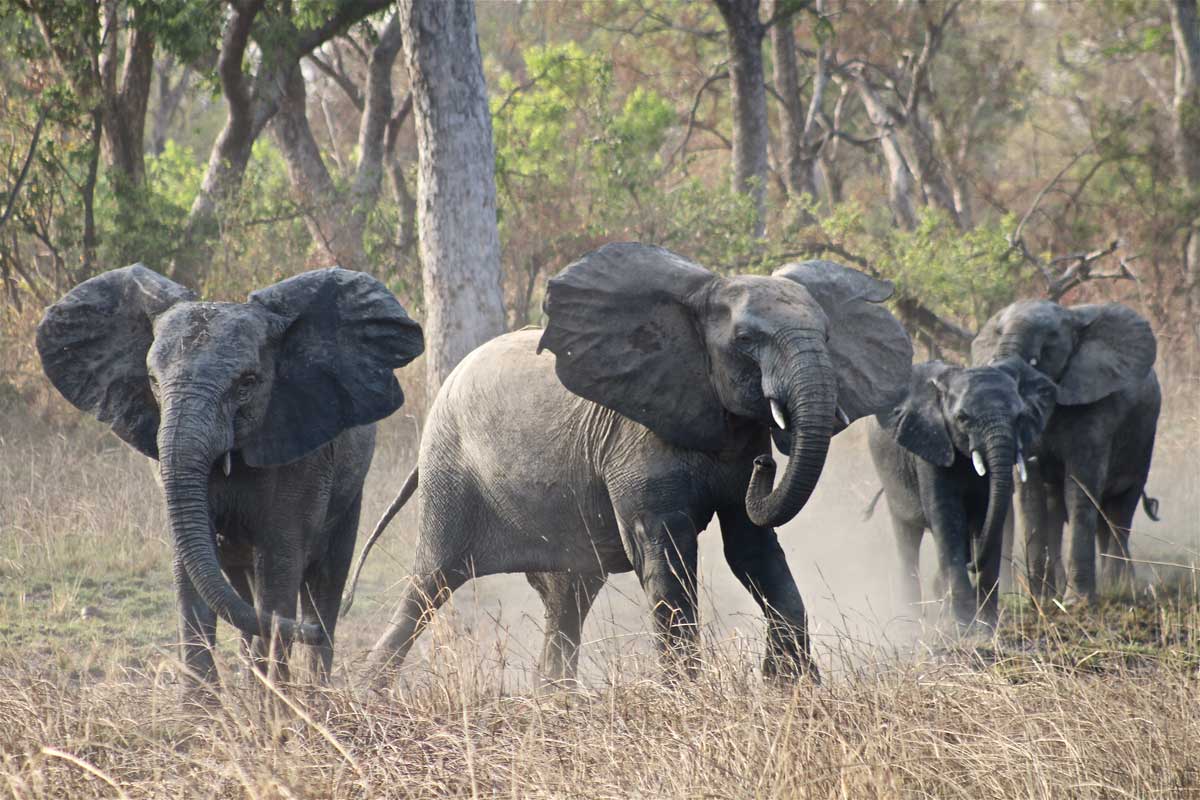
Two of the cows were without tusks. Philippe immediately started backing up, looking for something to hide behind. The smaller of the two tuskless cows stared at us, let out shrill blast, then charged. Both Tim and Philippe had their rifles at half-port pointed in the direction of the fast-coming elephant. I grabbed my camera and took several photos of the enraged, charging cow. I dearly hoped she was bluffing with a false charge.
The threatening elephant stopped 20 paces shy of where we stood. It was then I became aware of the words being shouted at her, Tim in English and Philippe in French. Not sure which language she understood, but she had stopped!
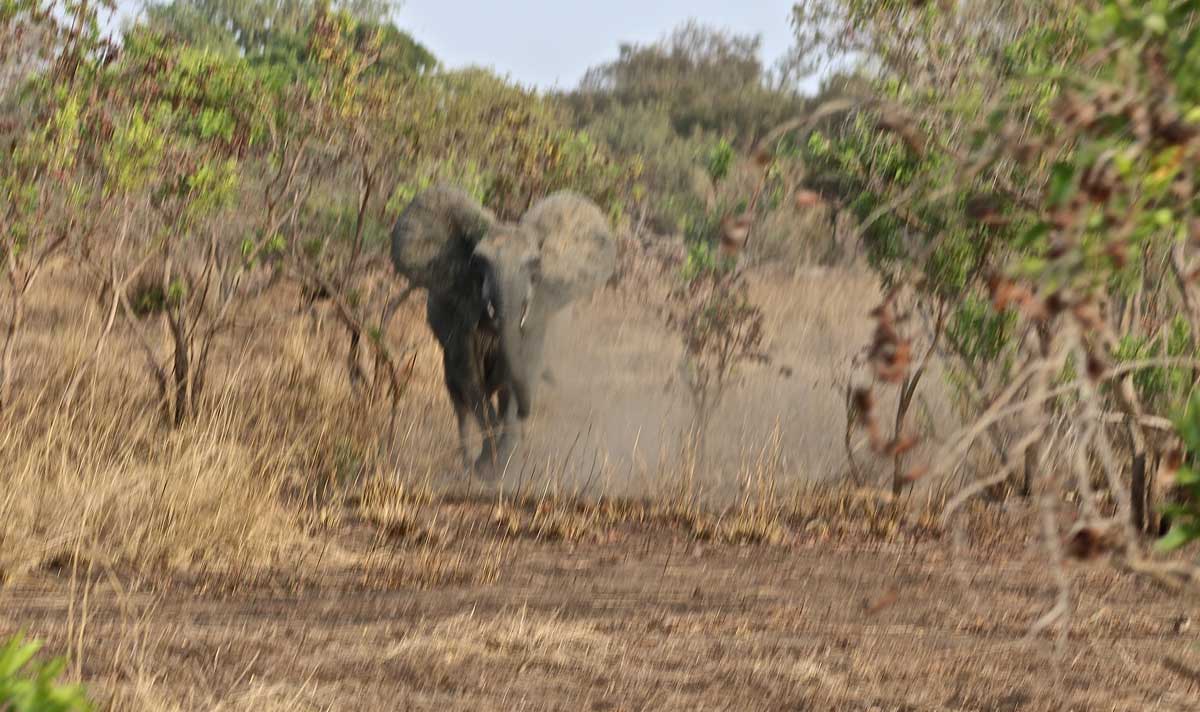
The enraged elephant swung her trunk up and down, then menacingly kicked dirt our way! Finally satisfied she had made her point, the cow turned and walked toward the departing herd. It was exciting to say the least!
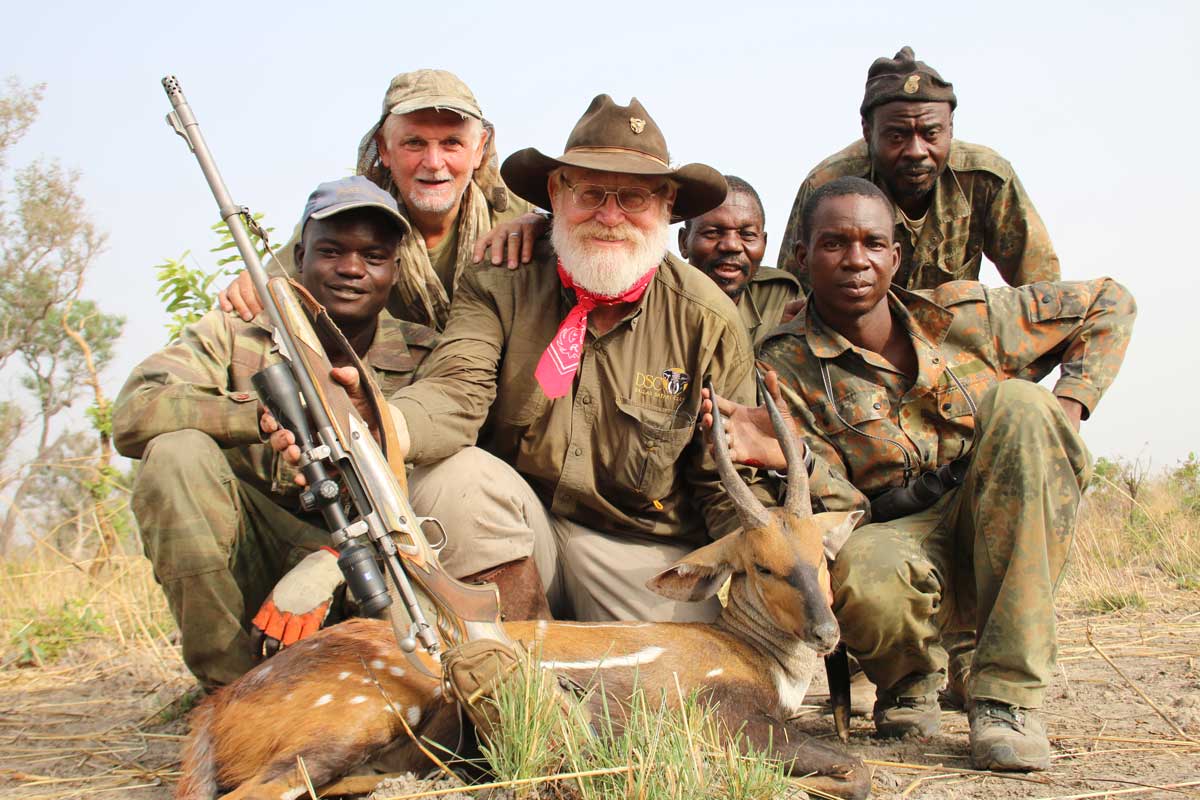
Unfortunately, those elephants walked the same trail as had the roan. We tried, but could not again pick up the roan’s tracks. We did, however, on our way back to the safari car see an extremely handsome harnessed bushbuck that tempted me, so I yielded to temptation!
Throughout our hunt we had seen numerous roan antelope, but unfortunately none according to Philippe were deemed worth pursuing.
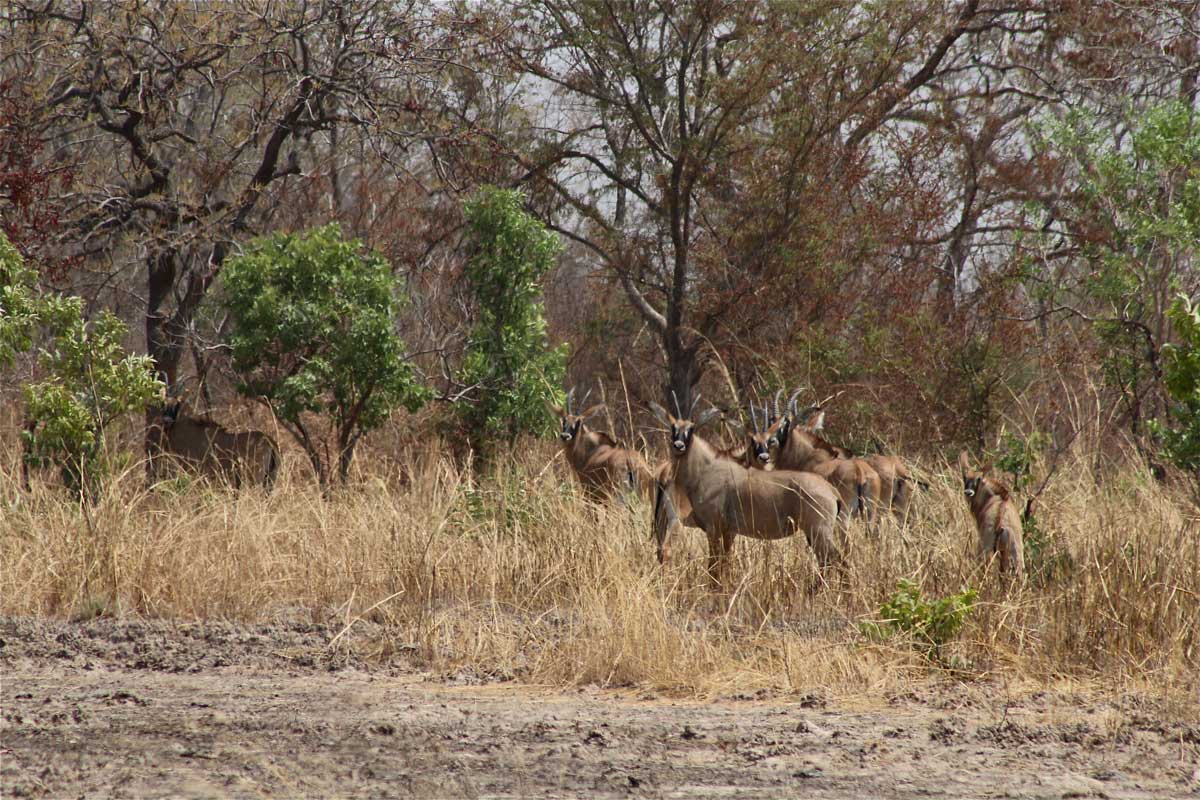
With two days remaining in our hunt, Philippe and I were driving to where Tim and a tracker had been left earlier to watch a waterhole when we spotted three roan antelope bulls. They were at least 600 yards from the two-track we were on. We drove the safari car beyond where they could see it and stopped. Philippe motioned for me to grab my shooting sticks, put a round in the chamber and follow him. We headed away from the trio until the wind blew into our face, then turned and walked briskly toward where we had seen the three bulls. We soon spotted one of them. He was feeding on scrub-brush, but we could not see the other two.
Philippe motioned me to follow him and stay close. Using head-high brush to hide our approach, we cut the distance to less than 200 yards and stopped. My PH glassed. I set up my shooting sticks, then I started glassing. Being a foot taller than Philippe, I spotted the other two bulls. They were just to the left of the first bull. My PH moved to the right then intently glassed the three roan. Lowering his binoculars, he held up three fingers, then pointed at his far left finger. I understood. He wanted me to shoot the far left bull.
I settled the crosshairs on that bull but waited for a better shot angle. A minute later, the bull took a couple of steps and exposed his vitals. I took a quick deep breath, let it all out and settled the crosshairs on his broadside shoulder. Most African antelope’s vitals are a bit more forward than those of our North American big game species.
At the shot, the bull kicked his hind legs high, took two steps and fell. While he was doing so, I chambered a fresh round, then watched my roan laying on the ground, crosshairs solidly on him.
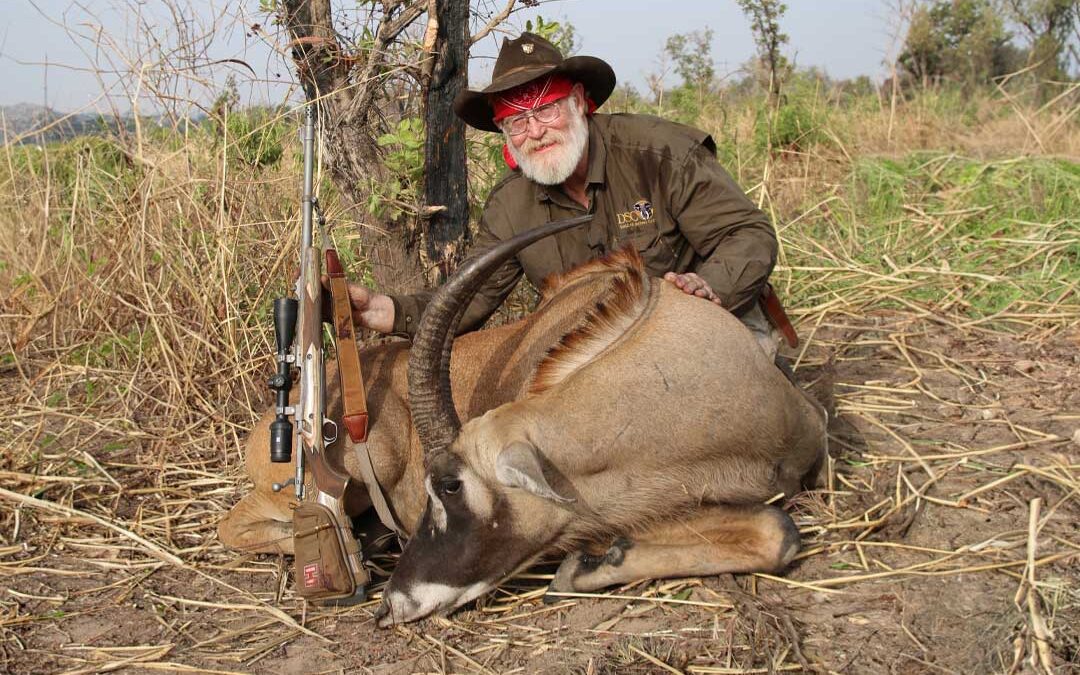
Moments later we stood at the bull’s side. He had considerable black on his face, indicating maturity and dominance. His long, backswept horns were impressive. I was thrilled beyond words! It had taken me two, extremely hot safaris in northwestern Africa to take a western roan antelope.
I happily accepted Philippe’s congratulatory hand and those of the trackers. A few prayers of thanks, then many photos later, we loaded bull, picked up Tim and headed toward the skinning shed where cape, skull and meat would be properly taken care of.
That same day, Fallon caught up with a huge male lion, albeit with a very sparse mane, which is typical of North African lions. But that’s a story for another time.
A few days after we flew out of Ouagadougou to return home to Texas, Burkina Faso was taken over by several terrorist groups. Sadly, there is no chance of returning to hunt that grand land. All safari companies have left the country. Philippe and his family returned to their native France and now conducts hunts in Namibia. Hopefully, someday things will change and hunters will again be able to journey to Burkina Faso.