

The rivers that bounded Juja Farm, not only the Athi, but the Nairobi and Rewero, contained hippopotami and crocodiles in the deep pools. I was particularly anxious to get one of the former, and early one morning Judd and I rode off across the plains, through the herds of grazing game seen dimly in the dawn, to the Athi. We reached the river, and, leaving our horses, went down into the wooded bottom, soon after sunrise. Judd had with him a Masai, a keen-eyed hunter, and I my two gunbearers.
We advanced with the utmost caution toward the brink of a great pool; on our way we saw a bushbuck, but of course did not dare to shoot at it, for hippopotami are wary, except in very unfrequented regions, and any noise will disturb them. As we crept noiselessly up to the steep bank which edged the pool, the sight was typically African. On the still water floated a crocodile, nothing but his eyes and nostrils visible. The bank was covered with a dense growth of trees, festooned with vines; among the branches sat herons; a little cormorant dived into the water; and a very small and brilliantly colored kingfisher, with a red beak and large turquoise crest, perched unheedingly within a few feet of us. Here and there a dense growth of the tall and singularly graceful papyrus rose out of the water, the feathery heads that crowned the long smooth green stems, waving gently to and fro.
We scanned the waters carefully, and could see no sign of hippos, and, still proceeding with the utmost caution, we moved a hundred yards farther down to another lookout. Here the Masai detected a hippo head a long way off on the other side of the pool; and we again drew back and started cautiously forward to reach the point opposite where he had seen the head.
But we were not destined to get that hippo. Just as we had about reached the point at which we had intended to turn in toward the pool, there was a succession of snorts in our front and the sound of the trampling of heavy feet and of a big body being shoved through a dense mass of tropical bush. My companions called to me in loud whispers that it was a rhinoceros coming at us, and to “Shoot, shoot.”
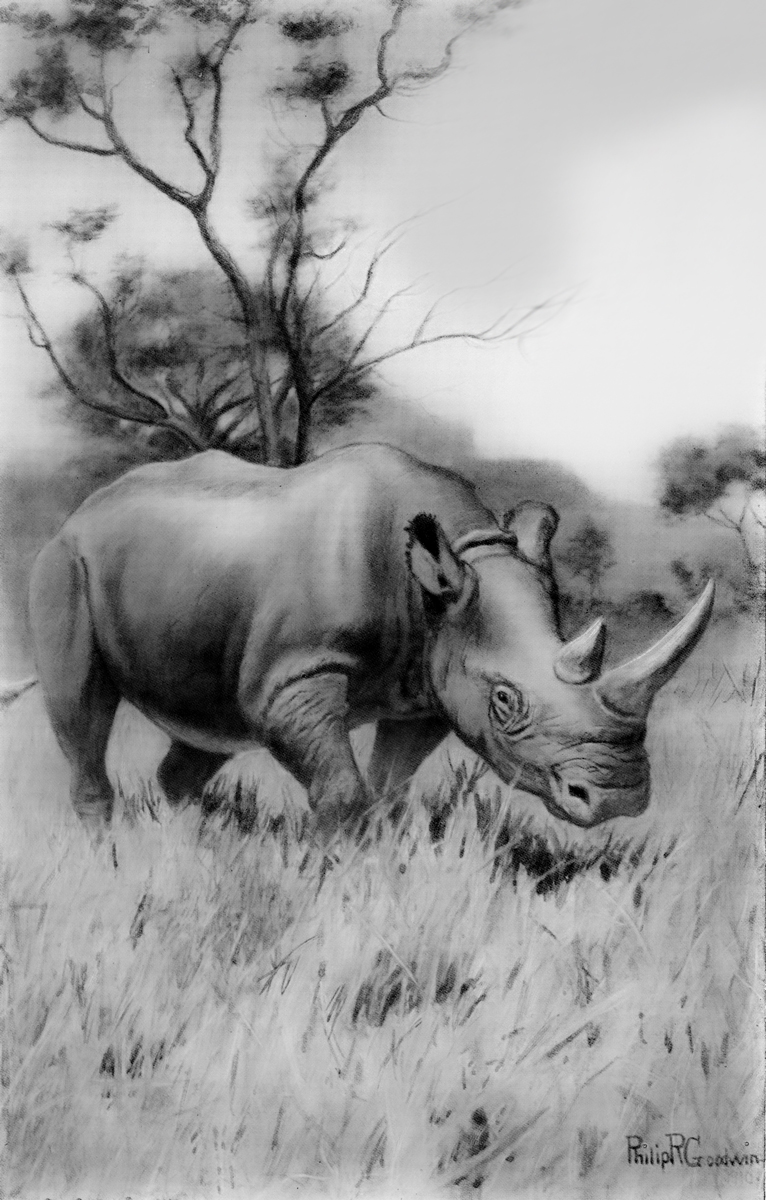
In another moment the rhinoceros appeared, twitching its tail and tossing and twisting its head from side to side as it came toward us. It did not seem to have very good horns, and I would much rather not have killed it; but there hardly seemed any alternative, for it certainly showed every symptom of being bent on mischief. My first shot, at under forty yards, produced no effect whatever, except to hasten its approach. I was using the Winchester, with full-jacketed bullets; my second bullet went in between the neck and shoulder, bringing it to a halt. I fired into the shoulder again, and as it turned toward the bush, I fired into its flank both the bullets still remaining in my magazine.
For a moment or two after it disappeared we heard the branches crash, and then there was silence. In such cover a wounded rhino requires cautious handling, and as quietly as possible we walked through the open forest along the edge of the dense thicket into which the animal had returned. The thicket was a tangle of thorn-bushes, reeds, and small, low-branching trees; it was impossible to see ten feet through it, and a man could only penetrate it with the utmost slowness and difficulty, whereas the movements of the rhino were very little impeded.
At the far end of the thicket we examined the grass to see if the rhino had passed out, and sure enough there was the spoor, with so much blood along both sides that it was evident the animal was badly hit. It led across this space and into another thicket of the same character as the first; and again we stole cautiously along the edge some ten yards out.
I had taken the heavy Holland double-barrel, and with the safety catch pressed forward under my thumb, I trod gingerly through the grass, peering into the thicket and expectant of developments. In a minute there was a furious snorting and crashing directly opposite us in the thicket, and I brought up my rifle; but the rhino did not quite place us, and broke out of the cover in front some thirty yards away; and I put both barrels into and behind the shoulder. The terrific striking force of the heavy gun told at once, and the rhino wheeled, and struggled back into the thicket, and we heard it fall. With the utmost caution, bending and creeping under the branches, we made our way in, and saw the beast lying with its head toward us. We thought it was dead, but would take no chances; and I put in another, but as it proved needless, heavy bullet.
It was an old female, considerably smaller than the bull I had already shot, with the front horn measuring fourteen inches as against his nineteen inches. As always with rhinos, it was covered with ticks, which clustered thickly in the folds and creases of the skin, around and in the ears, and in all the tender places.
McMillan sent out an ox wagon and brought it in to the house, where we weighed it. It was a little over two thousand two hundred pounds. It had evidently been in the neighborhood in which we found it for a considerable time, for a few hundred yards away we found its stamping ground, a circular spot where the earth had been all trampled up and kicked about, according to the custom of rhinoceroses.
They return day after day to such places to deposit their dung, which is then kicked about with the hind feet. As with all our other specimens, the skin was taken off and sent back to the National Museum. The stomach was filled with leaves and twigs, this kind of rhinoceros browsing on the tips of the branches by means of its hooked, prehensile upper lip.
Now I did not want to kill this rhinoceros, and I am not certain that it really intended to charge us. It may very well be that if we had stood firm it would, after much threatening and snorting, have turned and made off; veteran hunters like Selous could, I doubt not, have afforded to wait and see what happened. But I let it get within forty yards, and it still showed every symptom of meaning mischief, and at a shorter range I could not have been sure of stopping it in time. Often under such circumstances the rhino does not mean to charge at all, and is acting in a spirit of truculent and dull curiosity; but often, when its motions and actions are indistinguishable from those of an animal which does not mean mischief, it turns out that a given rhino does mean mischief.
A year before I arrived in East Africa a surveyor was charged by a rhinoceros entirely without provocation; he was caught and killed. Chanler’s companion on his long expedition, the Austrian Von Hohnel, was very severely wounded by a rhino and nearly died; the animal charged through the line of march of the safari , and then deliberately turned, hunted down Von Hohnel, and tossed him.
Again and again there have been such experiences, and again and again hunters who did not wish to kill rhinos have been forced to do so in order to prevent mischief. Under such circumstances it is not to be expected that men will take too many chances when face to face with a creature whose actions are threatening and whose intentions it is absolutely impossible to divine. In fact, I do not see how the rhinoceros can be permanently preserved, save in very out-of-the-way places or in regular game reserves. There is enough interest and excitement in the pursuit to attract every eager young hunter, and, indeed, very many eager old hunters; and the beast’s stupidity, curiosity, and truculence make up a combination of qualities which inevitably tend to insure its destruction.
As we brought home the whole body of this rhinoceros, and as I had put into it eight bullets, five from the Winchester and three from the Holland, I was able to make a tolerably fair comparison between the two. With the full-jacketed bullets of the Winchester I had mortally wounded the animal; it would have died in a short time, and it was groggy when it came out of the brush in its final charge; but they inflicted no such smashing blow as the heavy bullets of the Holland. Moreover, when they struck the heavy bones they tended to break into fragments, while the big Holland bullets ploughed through. The Winchester and the Springfield were the weapons one of which I always carried in my own hand, and for any ordinary game I much preferred them to any other rifles. The Winchester did admirably with lions, giraffes, elands, and smaller game, and, as will be seen, with hippos. For heavy game like rhinoceroses and buffaloes, I found that for me personally the heavy Holland was unquestionably the proper weapon.
But in writing this, I wish most distinctly to assert my full knowledge of the fact that the choice of a rifle is almost as much a matter of personal idiosyncrasy as the choice of a friend. The above must be taken as merely the expression of my personal preferences. It will doubtless arouse as much objection among the ultra-champions of one type of gun as among the ultra-champions of another. The truth is that any good modern rifle is good enough. The determining factor is the man behind the gun.
Note: This story was originally published in African Game Trails.
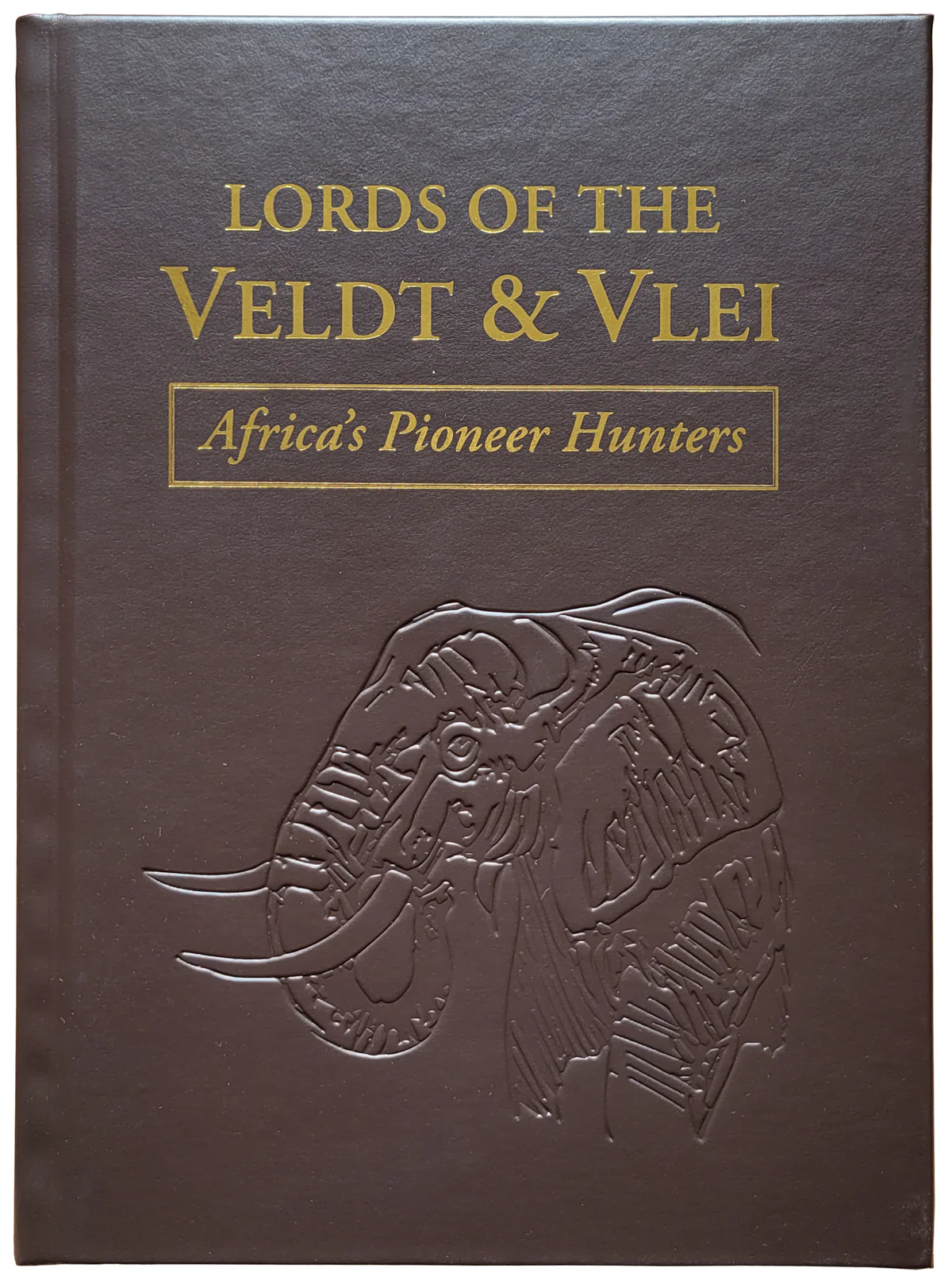 This volume carries the reader through a representative collection of those who pioneered and popularized sport in Africa from 1837-1910. Chronologically, they include: William Cornwallis Harris, William Cotton Oswell, Roualeyn Gordon-Cumming, Sir Samuel White Baker, William Charles Baldwin, Charles John Andersson, John Parker (“Ubique”) Gillmore, Paul Belloni Du Chaillu, William Finaughty, Arthur Henry Neumann, Frederick Courteney Selous, Abel Chapman, Theodore Roosevelt, Nicholas Potocki, Chauncey Hugh Stigand, Sir William Northrup McMillan and Frederick Vaughan Kirby. Buy Now