
A Tennessean born in 1880, Nash Buckingham holds a unique place in American literature. A graduate of Harvard and a four-letter man at the University of Tennessee Law School where he received a law degree, he excelled equally on a sports field, hunting field or in the field of writing.
Cousin Charley and I had figured to turn the hunt homeward. Quite a piece it was, too, across those hardwood ridges, pine domes and sedged hollows that made a skyline for Big Hatchie Basin. Leo and Tom Cotton were off on cast. We trudged across the furrowed aisles of a rustling corn patch and found them staunchly on birds, just where a curlycue broom’s end of weeds plaited in among thinning stalks.
Leo was strictly in character, head and plume aloft, dog aristocracy poised and posed. Brawny, lumbering pointer Tom, having evidently swung offhill a trifle late, was bowed into an upstanding study in pop-eyed liver and white. Since that good day more than half a century agone, the memories of those two valiant comrades and that particular happening have never left me. Their like comes about once in a lifetime, and perhaps rightly so.
Leo belonged to the late Billy Joyner, and Tom Cotton to me. But in those brave days, shooting interests were so unselfishly interlocked that dog sharing was an indissolubly companionate affair. Leo had handled prairie chickens from the Texas Panhandle to the wildrose hedges of Saskatchewan. Many a time he had stopped to stare at the dust trails of antelope. And fight? He and Tom Cotton met in many a sanguinary set-to at catchweight. But their issues, whatever they were, were never definitely settled. Sometimes Tom took the count and limped pitifully for a few days. Again, it was Leo who licked gaping gashes in his burr-curdled hide. From kennel to bird field, in baggage car or buckboard, the air was electric with intoned mutters and snarled dares. Once thrown down on the job, however, and stretched out for a day’s business, no more friendly, cooperative or loyal brace of comradely quail sleuths ever spoored an upland or fought tooth and toenail in common cause.
Many a mob of snipe-snouted, shaggy mongrels have I seen surge forth and wolf down upon Leo and Tom. And just as often their frenzied yowls of impending mutilation would suddenly crescendo into notes of dismay as “our boys” met them more than halfway and filled the impromptu arena with whirling, top-sided casualties. They had a way, too, of traveling meekly past some rural danger zone, one in front as skirmishing decoy, the other lagging warily in support behind our horses. Out would bluster some chunky, coarse-pelted, churlish bully; fat, meaty tail awhirl and ruff abristle, cocked and primed to swarm all over the apparently shrinking and submissive stranger. Camouflage and ambush! Apparently from thin air, a very devil incarnate in dog hair would suddenly fasten upon Shep’s unprotected flanks, nosing for a rib-smashing roll-over and the deadly paw-hold. And sometimes it required apologies and peace offerings of cash after such flurries. But their day’s hunting done, Leo and Tom immediately resumed their private feud.
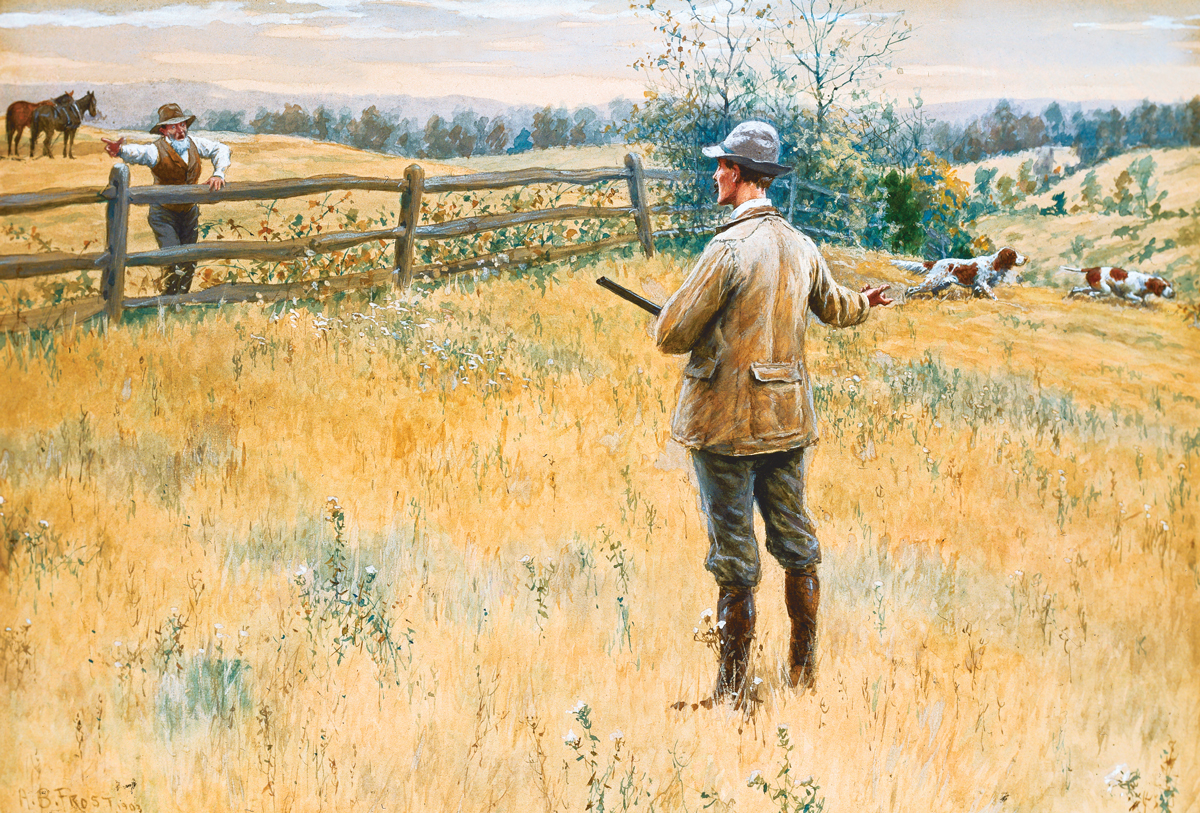
Conflict by A.B. Frost
Well, that’s how we came on them that particular afternoon. I was on the left, with left-handed Cousin Charley beside me. A segment of tumble-down rail fence t’wixt us and the birds. And a sign, “No Hunting,” tacked to a nearby persimmon tree.
Funny how one remembers such things, but that was the setting. It had been an altogether gorgeous day. Lunchtime almost before we realized it. We found a sunny spot just off Fish Trap dam and lazed on the pine needles while we munched well-browned soda biscuits and lardy spareribs.
The Big Hatchie is a rare study from the eminence of Fish Trap. It comes curving and slushing past an arrowheaded island, above where the darksome Sally Hole swamp juts its fist of cypress into the river bottoms among the hardwoods. Then it fans, as the light hits it, into a sheet of greenish-black enamel with a habit of switching to lumpy amber when heavy thunderstorms scour the scattered faces of the basin’s red headlands.
But up and on our way again! It was ideal bird-finding time when we broke out atop the hogback and slanted down in search of our dogs. Our shooting coats were bulging toward completed quotas – much larger then than now. Another find or two meant finis. We paused in disturbed contemplation of that “No Hunting” sign. Cousin Charley grunted, “Got ’em sure as shootin,’ but that’s jes’ exactly what we kain’t do – shoot.”
“Why,” I questioned, balancing gingerly on a rotting rail and peering past him at Tom and Leo, sculptured against the dun swale, “how come we can’t shoot?”
“Ol’ man Pomp Eddins’ place – tha’s how come – see that sign don’t you? Well – he means it.”
“Who th’ – who is Pomp Eddins? Must be hard-boiled.” Cousin Charley clucked tongue into cheek mournfully. The situation was ruinous. “Ol’ man Pomp Eddins,” he explained gravely, “is one o’ them kind o’l gent’mans it don’t do no good t’fool with – that’s all.”
“Bad actor?”
“Well, naw, not exactly what we know as a bad actor, but if he gits in behin’ you f’ good cause, he’ll jes’ natcherly run you right on t’ degredation – an’ we’re a long ways from home t’ start runnin.’ ”
“Can’t we ease around and drive those birds off his land?”
“Might, but I guess we better not – ou’h folks an’ Master Pomp has always bin ve’y fren’ly – but I ain’ presumin’ nuthin’ – they tell me folks that does don’ hav’ no luck.”
To the infinite consternation of Leo and Tom, Cousin Charley quietly flushed a luscious bevy that scattered enticingly on a hillside not far away. Cousin Charley as host-shooter was also using his wits and sense of propriety.
“Now then,” he grinned, “let’s go to th’ house an’ as’t his permission to shoot a few birds on his property – I know him well enough t’ do that – an’ we ought to – anyhow – I hav’ t’ run poachers off my lan’ ev’y now an’ then.”
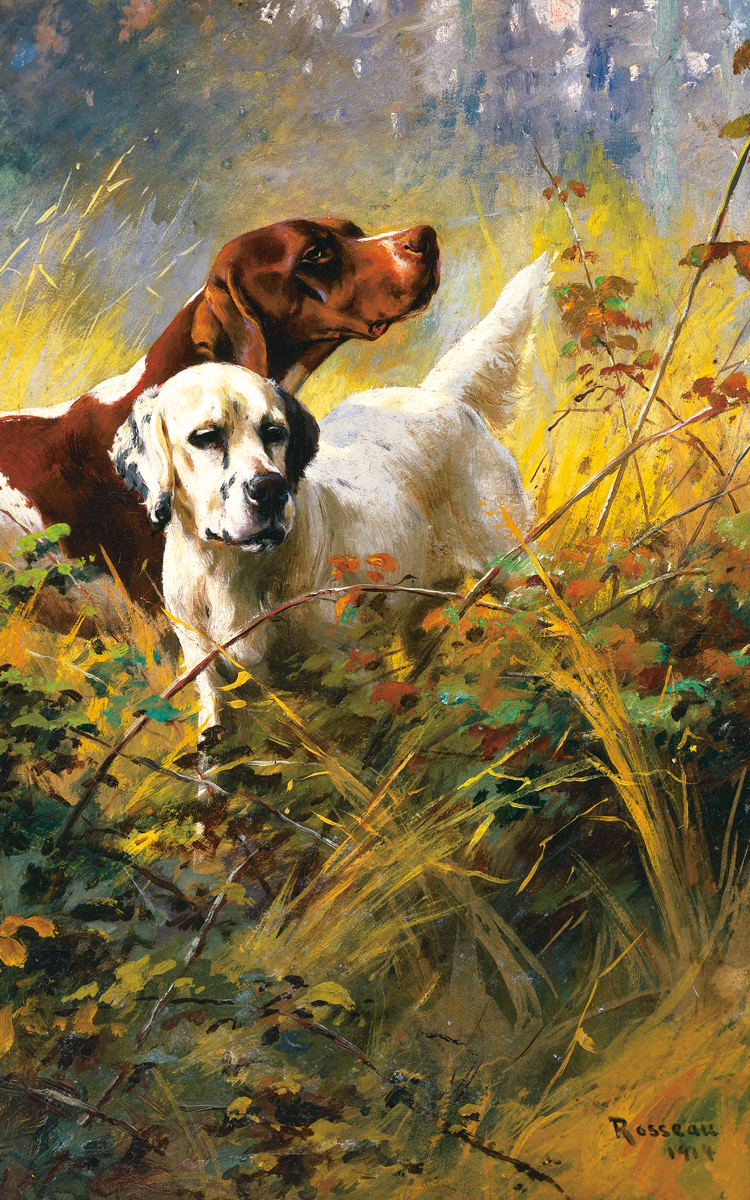
Setter and Pointer In the Field by Percival Rosseau – Courtesy of William Secord Gallery.
We soon struck off up a winding road. “I know right where them birds lit,” he remarked. I said I did, too. “I ain’ see Mist’ Pomp in quite a spell,” he went on. “Him an’ Papa was in th’ Confederate Army t’gether – th’ ol’ gent’man is mighty queer an’ his health ain’t none too good.”
Leo and Tom, sensing, as dogs have a way of doing, that the hunt had suddenly taken an odd turn, were at heel. Charley told me more of Mister Eddins as the red road circled uphill. Retired now, he used to keep a store in town – president of the bank once upon a time. Knew some of my kinfolks in the city. “If he lets us shoot we can get cleaned up all-fired quick,” concluded Charley.
The twists and turns of our way mounted higher among coniferous knobs.
“Great folks, them Eddinses,” puffed Charley, “th’ Civil War ’bout cleaned them up – th’ clan’s seeded down t’ ol’ man Pomp; but he kep’ things together – don’t owe no man –
an’ had a sight o’ cash money an’ eight hunnerd acres – yep – daughter-in-law an’ grandson – always bin’ fine folks an’ still are – them Eddinses.”
We walked out on top and into a clearing. Deeply set among holly and cedar squatted an antebellum, white-brick cottage. Its wide chimneys gave off squills of woodsmoke into the keen sunshine.
It was young Mrs. Eddins who ushered us cordially into the cozy vastness of a low-ceilinged chamber filled with crowded bookshelves, hair sofas, armchairs and a grandfather clock that would have made a collector’s acquisitive hair stand on end. She spoke gently to a tall, gray-haired, angular old gentleman who unwound from a deep rocker. “Daddy, here’s some company come t’ see you.”
Cousin Charley stepped forward. “Mist’ Eddins, this is Charley Johnson. Good afternoon, suh.”
“Yes,” he acknowledged, bowing gravely, his direct, steely eyes measuring us both in rapid appraisal. “I know you well, Charley, but it’s been some time since we met howsomever. Yo’ folks all coming’ along all right, I hope?”
“Yes, suh, Mist’ Pomp – uh – Mist’ Pomp – this – uh – this is – uh – Mist’ Buckin’ham – from down in th’ city – comes out bird huntin’ with me once in a while. Ou’h dogs got into a covey down yonder on th’ bushy side o’ yo’ place, but we seen yo’ posted sign an’ come on up t’ast if you’d mind us shootin’ a little if we run into another bunch on ou’h way home – we’ve ’bout got our limits an’ we’re headin’ thataway.”
Mister Pomp’s deeply recessed eyes, ’neath shaggy brows, swept me from head to foot. He slowly extended a leathery, toil-scarred hand. “Buckingham – is it?”
“Yes, suh.”
“Gran’son o’ ol’ man Henry’s?”
I nodded.
“He was from th’ North – an’ sided that way.”
“Yes, suh.”
“But his brother, yo’ great-uncle Fred – he went out fust with Walker an’ got set with th’ Federals – crossed under a flag o’ truce at midnight when his expired secon’ day o’ th’ Battle o’ Fredericksburg – an’ reenlisted under Gin’l Lee – transferred later to th’ Louisiana Wildcats – they blowed him up on th’ Queen o’ th’ West.”
I listened in amazement. We had quickly gotten down to rock bottom on party platforms. A moment of hesitant recapitulation by Mister Pomp.
“Which one o’ ol’ man Henry’s boys is yo’ Daddy?”
“Miles!” And I said it proudly.
“Uummmmm! in th’ bank?”
“Yes, suh.”
“Th’ two younger boys – Gunn an’ Hugh – in th’ dry-foods business – they’re yo’ uncles, o’cose?”
“Yes, suh.”
“Well, I didn’t hav’ no better friends than them boys – all o’ them – back in th’ hard-times panic o’ ninety-three – they carried me – took care o’ me an’ mine an’ a lot o’ others in these parts.”
His brilliant eyes turned from piercing scrutiny of me off through the window toward the basin’s distant rim. A resurgent sun poured over it.
He quizzed rapidly. Another line of evidence must be established. He said: “Yo’ wife’s folks were th’ ol’ Cap’n Joneses, warn’t they?”
“Yes, suh.”
“Uuummmmm – tho’t I heard tell. Jones was my captain – fought all over his own land, too. Rich Yankees from up North own it all now – an’ mighty fine folks they are, too, I’m told.” He spat explosively into the fireplace.
If I rec’lect, rightly, yo’ wife’s a gran’niece o’ ol’ man John Jarratt’s, ain’t she?”
“Yes, suh.” No use to elaborate. Best to stand hitched and come clean.
“John an’ me done some tall ridin’ an’ shootin t’gether. We rode with Forrest. Once in a while we had som’ all-fired runnin’ t’ do – too.” An aquiline nose wrinkled into a grim snicker at the recollection. Half-reverie apparently swept us from his thoughts. Then – “You boys take chairs, git warm. You’re welcome t’ shoot on my land whenever you choose – I’ll jes’ go along a piece with you – I ain’t shot at a bird in fifteen years. John – John Yancey – aw – John Yancey.”
A rough-and-tumble specimen of shaver hardihood, with clear gray eyes and mop of tousled red hair, darted in from the hallway. The grandfather’s eyes blazed with pride. “Say ‘howdy’ to th’ gentlemen – say ‘Howdy,’ John Yancey – then run an’ fetch Granpa’s gun.”
With a whoop of joy the little fellow sprang away and soon returned lugging an old but beautiful muzzle-loading shotgun. It was in superb condition. Muzzles paper thin. Locks that sang like harp strings. Stock fit and balance that made shoulder-spot and eyes all one. With it was handed up belt, powder horn and shot pouch. I examined it avidly. A genuine Manton.
“Git yo’ hat, John Yancey. You an’ Grandpa’s goin’ bird huntin’. I want you t’ watch these good shots an’ learn how t’ hit ’em, boy – you’ll be needin’ some knowledge one o’ these days.”
There was a method in Charley’s madness as we retraced that quarter of a mile to the vicinity of our scattered bevy. They had moved around an orchard’s hem just outside some slash pine. Tom nailed them tightly. I believe to this good day he and Leo had an idea what was up.
How I wish more of today’s “sports” with magazine guns could have watched that old gentlemen hustle his percussion Manton into action. In my own boyhood I had, of necessity, performed a like manual, but with nothing remotely comparable to his exhibition of rapid and orderly precision. Nipples capped, he stepped forward and to the left. Charley spun one victim from the rise. But old man Pomp Eddins laid down a bang-up right and left that served notice how he played the game. Congratulations over, we followed the singles across a gully and into a patch of low broomsedge where we found both Leo and Tom on individual points.
“Do you boys mind,” queried our host, “if I let this little chap try t’ see kin he hit a quail on th’ wing – he’s shot a few rabbits an’ some squirrels, settin’ – but this’ll be his first chance flyin’ – an’ over a dog?”
He turned and smiled at the grandson, “Come on – boy.” The Manton, recapped and hammers drawn, was thrust into the lad’s eager hands. All must go well with Grandpa there to see it well done. Gun below the elbow, keen for contact with a long-awaited moment, John Yancey Eddins braced for his first rise. In every gunner’s life, in every father’s heart, there should be, at least, one such undying memory.
“Walk on in – walk right on pas’ th’ dog – when th’ bird gits up – take yo’ time.” Step by step the child obeyed leadership that held his every faith.
“Both eyes open, John Yancey, pick yo’ bird if there’s mo’ n’ one – an’ keep both eyes jes’ on it.”
Singles began taking leave on every hand. I can still see that broth of a boy, stockinged legs and butternut knee pants spraddled into a resolute stance among the sedge clutter. Determined arms hefting the burled stock – a long pause as the child leveled and swung.
B-o-o-o-m – B-o-o-o-m!
A boy on his knees peering beneath a smoke-screen; an old man’s shrill cry, “You got ’im, son, you got ’im.” A race through the stems as youth and old age both shot for the retrieve. Oh! The radiance on their faces. Pomp’s aglow with pride, the boy’s alight with the greatest thrill any possessor of game heritage treasures as no other in life. For the next half-hour neither Charley nor I fired a shot. Then, borrowing the Manton, we took turns at finishing our limits with the tool of a vanished field gentility.
Gulch bottoms were beginning to darken. Shadows thrust claws across the basin. The crest of a steep ridge split away cleanly, dropping almost a hundred feet sheer to the railway’s gash. Behind Mister Pomp, we followed a well-defined trail across the hump. It ended in a spacious alcove, swung like a dirtdauber’s nest above the brink. I looked about me in wonder. Some grim business hereabouts.
Pomp Eddins slackened pace and looked about him.
“I thought maybe you’d like to see this place.” He placed the Manton carefully aside and seated himself on a lichened boulder. “There was big doins’ went on here – bloody doins’ back in Shiloh times.” Mister Pomp smiled reflectively. “I’ll bet Charley ain’t ever bin in this spot befo’ in his life – y’ see – from he’ah this height commands th’ railroad plumb across th’ basin – from whur th’ ol’ M. and C. come outa th’ fur gap.”
Somehow, he seemed to kindle and take a fresh grip on himself. He lapsed into the speech of ancient action; words of almost broad patois leaped from him. “This he’ah’ wuz an’ ol’ fo’te – I hepp’d build it – look yonder at them timbered bastions still stickin’ outa th’ groun.’ ”
He glanced ruminatively at worn, angled earthworks and crumbling casemate. Lethargic burrows in their aged blanket of peaceful silt and grasses. “We wuz dismounted an’ ordered on detail t’ mount two pieces – told t’hold this position at any an’ all cost. H’it warn’t no easy job, young man, gittin’ them guns so high. But h’it wuz wuth th’ sweat an’ labor.”
His eyes snapped fire. He was back at work again. “We come in from behin’-aroun’ yonderways – lak we com’ awhile ago – with an infantry company in suppote fuh ambush.”
I visualized that scene. Gaunt, dog-tired gunners in ragged gray. Slobbery, lathered horses, sputtery whiplashes, straining traces, laborious heaving through steamy morass and unwaxed swamp. What a beehive of slapdash, slaughterous activity and toxic hate.
A steady voice continued. “I ’member how we stopped ’em th’ fus’ time – a supply train with guard – we wuz hid out an’ ready when their locomotive come th’u th’ gap an’ pulled jes’ onto th’ trussle y’ see down yonder.” His eyes narrowed. “But we had it blocked with logs, they seen ’em jes’ in time as they run outa th’ curve. We let ’em get out an’ start unloadin’. Then we cut that injin’ t’ ribbons – blowed h’it t’ Hell-an’-Gone.”
He leaped to his feet and almost swarmed to a counterattack. “Ou’h boys swung ov’ah th’ hill an’ flanked ’em – som’ tried t’ make h’it away th’u yon valley.” He chuckled. “But h’it warn’t no use – we – we – had ’em – them hillsides yonder wuz strewn with dead.” He was telling it to High Heaven. “We sho’ raised Cain in these parts f’ mo’ n two months – but finally th’ Yanks com’ in fo’ce with heavy guns an’ shelled th’ livin’ hide offn’ us – we – we had t’ abandon th’ position an’ fall back – damn it.”
I looked about me carefully. Through worn embrasures grinned two dummy cannons, fashioned from peeled pine logs painted black and mounted upon hewn wooden gun carriages. About them, in orderly stacks, were piles of round shot – mud balls. As I half-grasped all their significance, the flaming realism of this old man’s passion and adoration gripped me. I saw sweating, unshaven half-mad men lashing back on lanyards; blistering hands fumbling at red-hot gun muzzles, hell-and-damnation curses turning peaceful quail country into a sudden shambles of thudding smoothbores.
Mister Pomp caught my look and smiled grimly. “This he’ah,” he injected half-fancifully, “is what me an’ John Yancey calls ou’h Play House. He dropped a comradely arm about his grandchild’s shoulder. The child cuddled lovingly against him.
“Y’see,” he went on, a sort of proud wistfulness creeping into his tone, “y’see, I had t’ raise this child – me an’ his ma – that is – we come t’ this ol’ fo’te when he wuz jes’ er toddler – almos’ a babe in m’ arms – h’it come t’ me one day t’ fix things up like you see ’em he’ah – I jes’ built it all in mem’ry o’ them times – an’ – an’ – as John Yancey growed up, we jes’ kep’ comin’ an addin’ t’ things.”
His jaw suddenly tightened. He spoke proudly. “Anyhow, this he’ah ain’ no bad play house t’bring a boy up in.”
John Yancey spoke up softly. “Gran’pa, we hav’ a lot o’fun he’ah – don’t we?”
The old man turned to me. “I fought – we all o’ us – fought,” he cried passionately, “f’ ou’h conception o’ homes an’ rights jes’ like th’ side saw theirs. My father fought in Mexico – I fought with Forrest – an’ – an’ – this chile’s daddy – th’ only son God Himself could ever give me – was killed at San Juan Hill – he couldn’ no mo’ o’ stayed at home when th’ call come than John Jarratt coulda’ hepped ridin’ off with us boys.”
We shook hands and exchanged “good-byes” and “come agains.” He said simply, “Tell all yo’ folks y’ met ol’ man Pomp Eddins – yo’ Daddy’ll remember me – an’ – send me a bird-dog puppy sometime – I’ll raise an’ train him an’ John Yancey t’gether – John’s gittin’ too big f’ th’ Play House anyhow.”
So, leaving them to turn back across their darkening trail through the hills, Charley and I slid down a precipitous path to the railroad ties and a starlit trek to home.
Fifteen or 20 years is a long, long time. Again, however, Cousin Charley and I munched cat-head biscuits and meaty hog ribs at Fish Trap dam. The bottomlands still challenged change, but it was there, however furtive. The drone of an airplane might impeach the years, or some distant, raucous motor change the face of things.
“Charley,” I asked, “whatever became of the old gentleman way back over yonder across the Tubba – Mister Eddins – who knew my folks an’ let us hunt on his land – and – showed us his Rebel Play House. I sent him a pointer puppy, afterward?”
“Daid,” responded Charley, laconically. “He lived t’ be past eighty but he passed on aroun’ Christmas time – didn’ last long after th’ Worl’ War.”
“And the boy,” I went on, “I suppose he turned out to be a bum bird hunter like us – and runs the old home place now?”
“Yep,” replied Charley, and something in the way he spoke it made me look up. “There was sure one fine, mighty fine, hones’-t’-God boy, too.”
“He’s – –!”
“Yep!” Cousin Charley was a direct narrator. “They hadn’ no sooner started talkin’ war with Mexico, back in ’sixteen, but that John Yancey an’ his gran’pa showed up in town with John’s gripsack all packed. That youngster signed up an’ went on out with th’ National Guard – an’ I mean he lef’ out right then.”
I might have guessed as much. Cousin Charley gnawed at a rib’s end and caught up with his story.
“Then, y’know, come sho’ nuff war – with Germany. By that time John Yancey had turned out t’ be a natural-born soldier – his grandad damn near passed out, he was so proud when th’ boy went to an officers’ trainin’ school an’ come out with a commission. I never seen anyone quite so happy. Why – why – there wuz times he’d talk about h’it an’ tears com’ to his eyes. John Yancey’s wuz a first unit overseas, too.”
Charley paused. Tossed a welcome shred of fat meat to a dog. The pair we were using were doing their best but they weren’t Tom Cotton and Leo by a hell of a sight. “Ol’ man Pomp Eddins come t’ town a lot mo’ in those days – wanted news ’bout th’ war – an’ that boy – mebbe. He’d sit aroun’ in a big swivet till he got his mawnin Commercial Appeal off th’ newsboy. Talked ’bout how he wish’d he coulda been along with John Yancey. Whut’s mo’, that ol’ man meant ev’y word he said. He’d say, ‘This he’ah makes fo’ wars f’ us Eddinses – fo’ wars – an’ th’ Lord only knows how many mo’. John Yancey – he’ll be comin’ home befo’ long – an’ – an’ marryin’ up.’ ”
A flock of ducks suddenly dipped through the chute and whizzed across the spillway. Cousin Charley grabbed his gun and sorrowfully watched them dwindle into specks. The old codger loved to sneak mallards and jump them around bends. He went back to his story.
“I happened t’ be at th’ sto’ th’ night th’ telegraph operator brought up th’ message ’bout John Yancey. Somebody jus’ had t’ ride out an’ git th’ news t’ his folks. So I run out in m’ Fode. They’d done gone t’ bed long ago. But ol’ man Pomp he come t’ th’ do’h with a lamp in one han’ an’ that ol’ muzzle-loader o’ hisn’ in t’ other. He seen h’it wuz me an’ says – ‘Why – com’in, Charles. Glad t’ see you – my daughter’ll be right down in a minute. Whut you got – a message fo’ us ’bout John Yancey winnin’ another medal o’ honor? ‘How many Germans is that boy done kilt this time?’
“Bout that time his ma – Miz Eddins – come into th’ hallway – I guess I musta looked – an’ I sho’ felt kinda queasy – maybe h’it wuz whut they call mother’s intuition, I don’t know, guess she jus’ sorter suspicioned, you know? All I could do wuz jes’ hand her th’ War Department’s telegram – you remember how they wuz’ worded.”
Charley looked at me, and remembering, turned quickly away. He hadn’t meant to put it that way – good old scout!
He clucked softly and sorrowfully. “Never s’long as I live, Buck, will I ever fergit th’ look that com’ over his ma’s face. She handed Mister Pomp th’ wire – but he didn’ hav’ his specs, so she had read it to him – an’ – man – her voice wuz as steady as – as –”
Charley clucked softly into his cheek. “Seemed at first lak Mist’ Pomp couldn’ understand. Then, all of a sudden lak’ – it seemed t’ com’ t’ him. I wuz lookin’ t’ see th’ ol’ gent’man bust out – but not a single tear com’ hoppin’ down his face. He warn’t th’ cryin’ kind. Naw – he jes’ sorta clutched out f’ Miz Eddins – clasped her in his arms and sorta drawed himself up lak he wuz comin’ t’ attention – an’ – an’ half-listenin’ f’ sump’n. They both jes’ stood there an’ shivered. I tried t’ say sump’n comfortin’ lak – but th’ ol’ man interrupted me.
“I’m obliged t’ you, Charles,’ he says, ‘f’ bringin’ th’ word – h’its sho’ bad news,’ he says. ‘But ’on th’ other hand,’ he says, ‘John Yancey Eddins has won th’ highes’ an’ mos’ distinguished honor that can befall a gallant soldier of Our Country! When he drawed hisse’f up still straighter an’ said Our Country like he did – I cried.”
Charley wiped his greasy fingers on his stained and tattered hunting coat and turned to me again – reflectively. “Do you ‘member whut an unreconstructed Confederate ol’ man Pomp Eddins wuz? But in th’ end he wuz sold jes’ as strong on Uncle Sam.”
Charley had the threat of matters toward the knot. “Bout that time,” he concluded, “ol’ man Pomp raised his face t’odes th’ ceilin’, an’ his whole heart jes’ seemed t’ break out in one great cry. ‘Aw – Gawd,’ he says, ‘You know,’ he says, ‘H’it ain’t right!’
Miz Eddins seen he wuz fixin’ t’ giv’ down. She held him tighter in her arms an’ says, soothing like, ‘There – there – Daddy,’ she says. ‘Th’ Lord giveth an’ th’ Lord taketh away, blessed be th’ name o’th’ Lord.’
“Buck, there warn’t one single tear evah com’ t’ ol’ man Pomp’s eyes. ‘I know,’ he wailed, ‘I take it all back – Gawd – but – oh!’ He says, ‘John Yancey’s th’ last one o’ us – no mo’ John Yancey – Oh! Christ!’ he says. ‘No mo’ Eddinses fo’ th’ wars – no mo’ Eddinses f’ th’ wars.”
Editor’s note: “Play House” is taken from De Shootinest Gent’man, 1934, Thomas Nelson & Sons. It originally appeared in Field & Stream in January 1929.