

“That’s gone. It sold right away. Sorry.”
I had phoned on an ad for a rebarreled Mauser. He did sound genuinely sorry. My reply—“Oh,”—must have had an authentic ring, too. I truly was crushed. “You wouldn’t want a Springfield, would you?” As if he owed me something. He spooled out details that set the hook. The chambering was 30-06 Improved. I’d not yet used an Ackley Improved cartridge. “I’ll take $300 apiece,” he concluded.
“Apiece?”
“I have two. A lot alike. The barrel length differs.”
The sting of missing the 6mm was still fresh. I deserved a couple more 30-06s. “Shipping?”
“It’s on me if you take ’em both.”
At that time, signing a check for $600 made my fingers tremble. I let them.
The rifles were re-stocked and much modified, mostly for the better—though on one the holes for the Buehler base didn’t march in line with the receiver. My 3x Leupold peered side-eyed over the muzzle. Charitably, its windage adjustment was generous.
A year later, padding toward a conifer thicket in Wyoming wilderness, I heard an elk bellow from its depths. Clutching the Springfield, I slipped ahead. The bull was a shadow-dance against dawn’s light. The crosswire steadied as he entered a slot 40 yards off. My Nosler Partition staggered him. A second hit brought the 6-point to earth.
Since that long-ago shot, I’ve taken game with several other cartridges developed by P.O. Ackley.
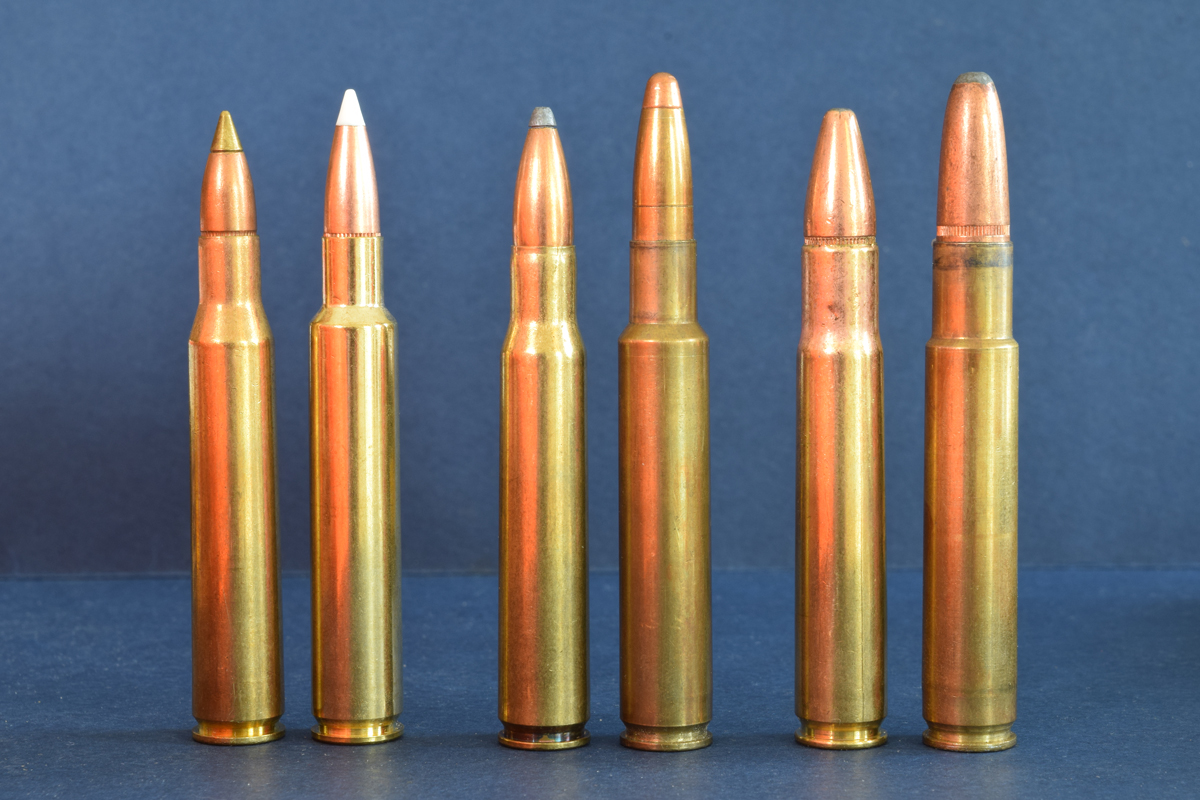
Ackley gave popular rifle cartridges more capacity by reducing body taper and giving the shoulders a steeper angle. From left, standard and Ackley Improved: 280 Rem., 30-06 and 35 Whelen.
Celebrated for his gunsmithing and his writing that helped amateurs pretend to be gunsmiths, he’s best known for his wildcatting—designing new rifle cartridges. He increased powder capacity in commercial cases by “blowing them out” in chambers cut with less taper and sharper shoulder angles. With no other changes, the resulting cartridges became known as “Improved.” To hunters and handloaders, “A.I.” is still shorthand for Ackley Improved.
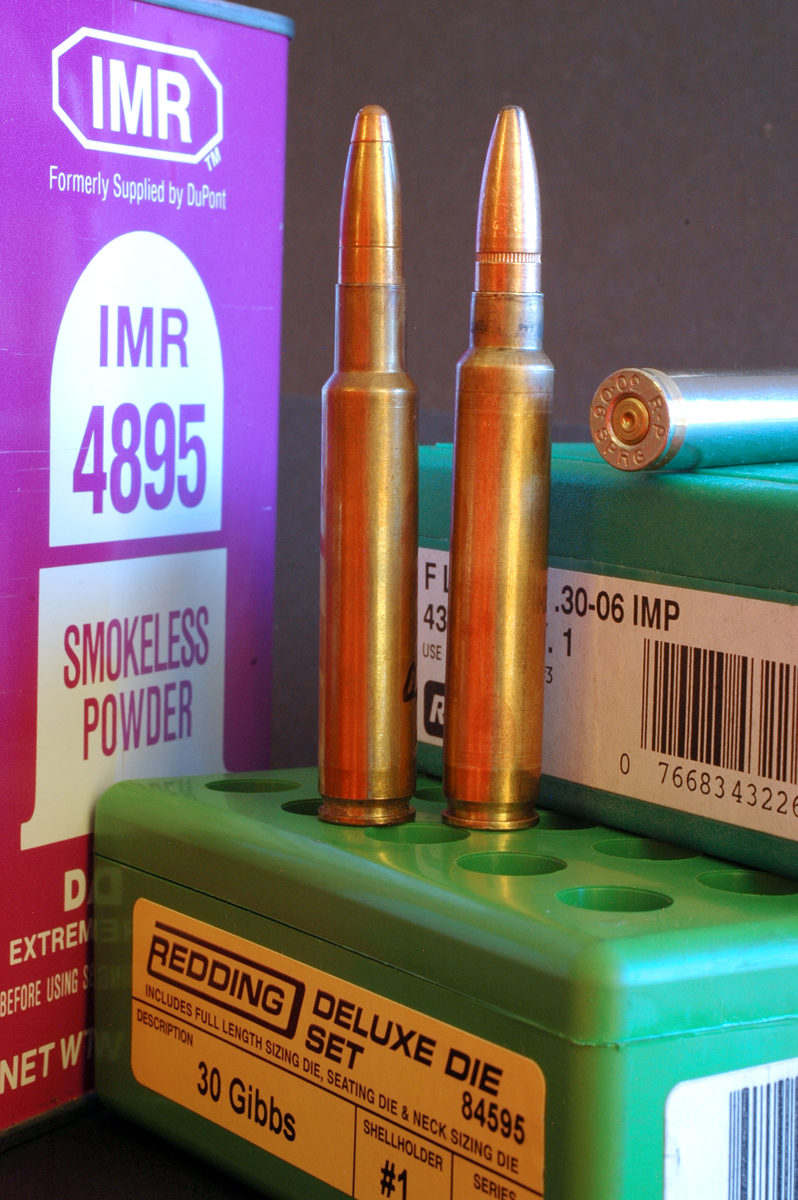
The 30-06 Improved (left) headspaces the same as its parent, the 30-06. The 30 Gibbs (right) requires more work in case-forming to move the shoulder (and headspace datum line) forward.
That label credits the man and identifies the case-forming method. It also implies a shoulder angle of 40 degrees, though Ackley tested, used and recommended other slopes. He had an open mind, drawing conclusions and changing them as evidence prompted.
Ackley began experimenting with the 219 Zipper Improved in 1938, just a year after Winchester announced the Zipper. Not until his third rendition was he pleased. In 1945, his focus still on small-bores, he wrote that most of his 22-caliber cases, including the 228 Ackley Magnum and the Improved Zipper, had 28-degree shoulders. “We have tried the 45-degree shoulder but do not like the results…. Ashurst, Gipson and Lovell [prefer] 28-degree and 30-degree shoulder slopes ….”
Still, Ackley liked the 40-degree slant well enough to adopt it for most of the Improved cartridges that bear his name. They found favor with hunters not only because they added ballistic sizzle—as much as 15 percent, depending on the case—but because the brass could be easily and inexpensively made and handloaded. A barrel bored for the parent cartridge would serve the Improved offspring. It had only to be removed and its chamber reamed. No need for a new barrel or to cut, re-thread or re-bed the original.
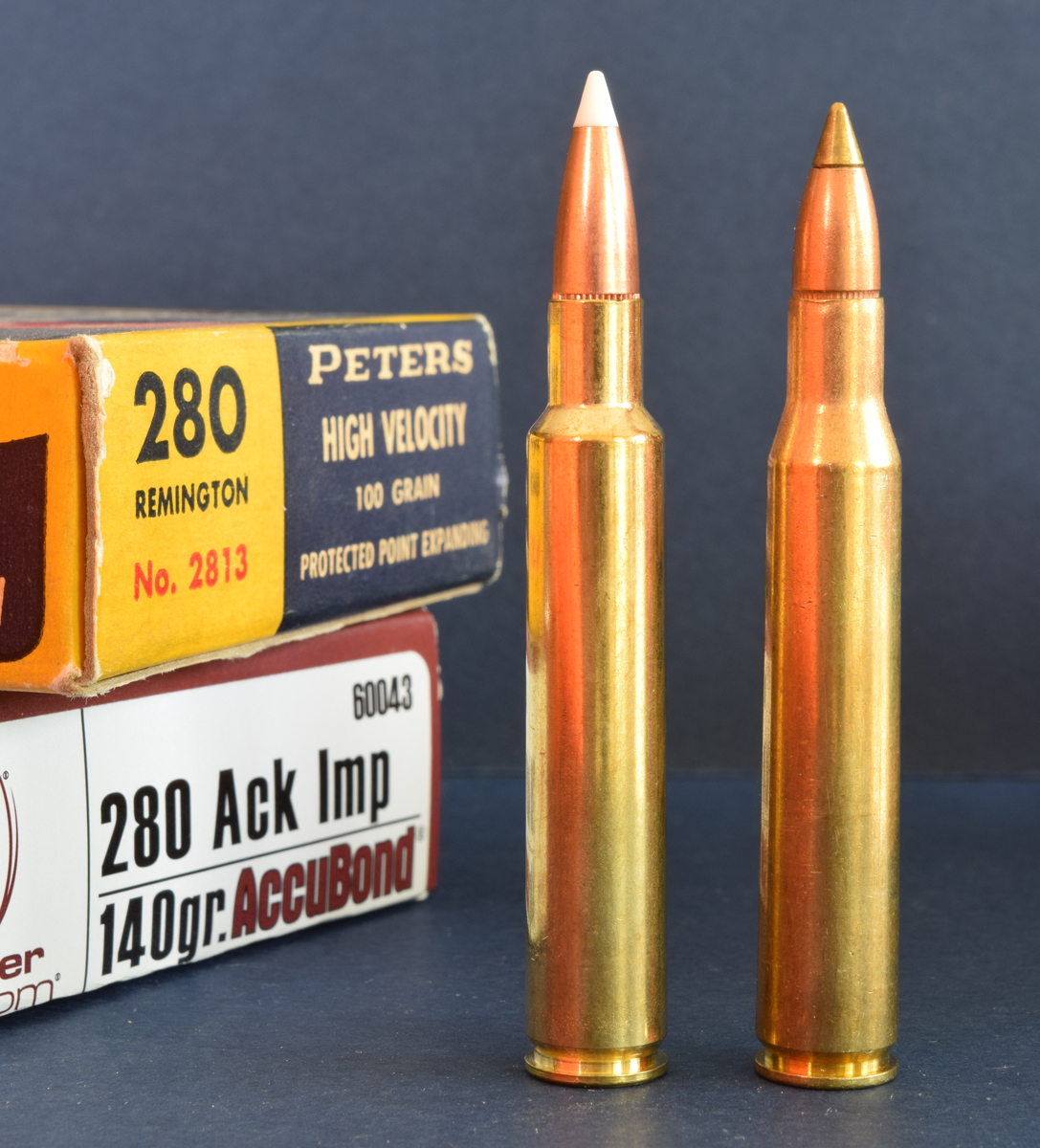
The 280 Ackley Improved (left) was among John Nosler’s favorite cartridges. In 2006, Nosler was first to give the cartridge a commercial home.
P.O. Ackley’s ancestors had deep roots in what became the United States. Nicholas Ackley and his bride-to-be, Hannah Mitchell, had arrived from the Old World by 1655, when their names appear in the property records of Hartford, Connecticut. Nicholas was a chimney viewer. On a ladder required of every homeowner, he ensured that each chimney was clean and no trees grew within two feet of its top.
In 1667, Nicholas moved his family onto 14 acres he had acquired earlier on 30-Mile Island, later re-named Haddam. Nicholas died without a will in 1695. His eldest son, John, got a big share of the estate. He married Rebecca Spencer in 1699. Seven children and 37 years later, he died. Son Nathaniel wed Sarah Saxton. The union of their son, Joseph, with Hanna Archer also produced seven children. Joseph Jr. moved to Granville, New York. Another son, Jonathan, went to Vermont after marrying Sally Bigsby. Their only son was christened Joseph, after his grandfather. With wife Lucy (Green), this Joseph sired nine children. One, Lorenzo, or Zach, wed Emily Matthewson. William Ackley was born to them in 1877. Zach died in 1900, his family now to Granville. There, in 1901, William married Ida Parker. He earned a modest living running a potato farm and a gravel pit. Ida bore one son, Parker Otto, on May 25, 1903.
Parker grew up disliking his first name, and preferred to go by P.O. “Now and then,” he declared later, “someone [says] he knows Parker Ackley personally, to which I can only reply: ‘Not very well!’”
From his youth, P.O. was fascinated by firearms. At age eight he was pestering woodchucks with a single-shot Stevens/Maynard 22. It gave way to a new Stevens Favorite. An 1886 Winchester in 38-56 introduced him to centerfire rifles. Crawling within shotshell range of ’chucks with a 12-bore double left him indifferent to shotguns.
In 1927, Ackley earned a B.S. degree from Syracuse University, graduating magna cum laude in Agriculture. University records show him as a member of the ROTC (Reserve Officers’ Training Corps), in which he attained the rank of 2nd Lieutenant. He also joined the Agricultural Club and the Grange, and shot with the school’s rifle team. He was a member of two agricultural fraternities.
A year after finishing at Syracuse, Ackley married Winifred Elizabeth Ross. Together they would raise four daughters: Jeanne (born 1929), Virginia (1930), Ann (1933) and Jacqueline (1936). “Winn” got a break from teaching as she tended the growing family while P.O. helped his father on the farm and ran a business selling and delivering gravel. A gifted mechanic, he kept his Model T trucks on the road until the Depression snuffed that enterprise in 1932. He continued to farm, but bumper crops gave the Ackleys little cheer when potatoes fetched 10 cents a bushel.
Then, a classified ad in American Rifleman caught his attention. Ross C. King, an ex-cavalryman and now a gunsmith, was selling his Roseburg, Oregon, shop. Asking price: $2,000 for everything, half in cash right away. He’d trust the buyer for the rest. Beginning in 1888, King had apprenticed in the trade at Fort Dodge, Kansas, and followed his stint in the Army with more gunsmithing. From 1910 to 1915, he worked for famous rifle-stock designer Ludwig Wundhammer in Los Angeles. When Wunhammer died in 1919, King bought his shop. His move to Oregon followed.
A spring freeze that claimed his 1936 potato crop pushed P.O. Ackley out of Granville. With his family in an aging Oldsmobile, he left for Roseburg to start a new career. Ross King would move back to L.A. to carry on gunsmithing. He died in 1954.
Keen and capable as he was around guns, Ackley knew little about rifle barrels. Concerned that this void in his background would limit his work, he jumped at the chance to learn barrel-making from Cincinnati friend Ben Hawkins. For most of a year after leaving New York, P.O. was tutored by an ace German machinist in Ben’s shop, a fellow who’d begun his Old World apprenticeship at age 12. Back in Roseburg in 1937, Ackley tooled up to make barrels. As he couldn’t afford multiple drills, he ordered one to bore 22-caliber blanks and fashioned his own reamers to produce larger holes.
His first barrels didn’t please him, least of all one in 257 Roberts for a crusty Wyoming client who wanted it for a ’98 Mauser. “I never saw a barrel warp so badly,” Ackley recalled. Unwilling to send it or start over, he shelved the job until a pointed letter “got me off the dime.” Ackley expressed the barrel and awaited the brutal response. Instead the customer mailed a target with a cloverleaf group and a sunny note on Ackley barrels to Fred Ness, then “Dope Bag” editor at American Rifleman. Suddenly, Ackley’s shop was busy.
That episode taught Ackley the value of favorable press, and thereafter he made a concerted effort to stay in touch with writers and editors. He also contributed editorial to shooting-industry magazines.
By 1942, P.O. had enough orders that he hired help for some tasks. But war-time production was ramping up, and his focus would turn elsewhere. General Julian S. Hatcher had been impressed by Ackley as both a gun mechanic and an experimenter. When Hatcher was given charge of the Army’s Ordnance Department, he asked P.O. to head the Small Arms Division at the Ogden Arsenal. Ackley accepted that appointment, but he knew his absence in Roseburg would affect future business. He wrote later that “the shop was moved to Ogden in 1942 and operated on spare time [to keep its products] before the public….”
During his Ogden tenure, Ackley worked with barrel-makers Ward Koozer and Bliss Titus, and also with bullet-maker Fred Barnes. In 1944, his Army assignment completed, Ackley partnered with Koozer and New Mexico gunsmith George Turner to operate Turner’s Cimarron shop, in which he manufactured a detachable scope mount. After moving his family to Cimarron, however, Ackley decided the location was too remote. The Turner connection soon dissolved.
P.O. moved north in 1945, finding Trinidad, Colorado, a more promising place to grow a business. With colleagues, he formed “Ackley, Koozer and DeMiller Engineering Co.” Two years later, it became “P.O. Ackley, Inc.” in a 4,000-square-foot shop at 160 Elm St. Within a few years, its payroll grew to 25. Besides producing barrels and custom rifles, it built the Turner Mount and offered general gunsmithing.
At the same time, Ackley taught gun-making theory and metallurgy at Trinidad State Junior College. His classes were the germ of what’s been called the country’s first gunsmithing school.
“We had only on-the-job training at our shop,” recalled a former Ackley employee, who’d started working there as a 17-year-old lass. “But G.I.s returning from the war got wind of it as a school. In 1945 and ’46 we were sent 4,000 applications from would-be gunsmiths. The Trinidad Chamber of Commerce received another 1,000. The staff in charge of vocational programs at the College quickly approved a new gunsmithing curriculum and put P.O. Ackley in charge of instruction. The first classes were held in 1947.
Ackley was, by most reports, an able teacher. Over the next four years, he earned for the program a reputation that still serves it. Many outstanding rifle- and barrel-makers trained there. During his tenure, P.O. corresponded with firearms buffs world-wide. In 1951 he left the College to focus on P.O. Ackley, Inc. After a stockholder-prompted sale to Easton Engineering, the company moved to Easton’s Salt Lake City headquarters. Ackley followed and worked there for a time. But Easton couldn’t hold a man used to running his own shop. Ackley’s staff for his revived enterprise included several women. They were quick learners with sound business sense. They worked hard. One soon turned out barrels that met P.O.’s high standards. Meanwhile, Winn opened a branch of Tandy Leather Co. She would become the first woman in that company’s management, retiring in 1968.
In 1949, Ackley set out to design a better hunting bullet. The Ackley Controlled Expansion (ACE) bullet resulted. Its base and shank, comprising half its length, was machined or drawn from copper—more ductile than gilding metal and thus less likely to fragment. It extended forward around a cavity holding an ovoid lead nose core whose tip protruded a quarter of its length.
Of semi-spitzer profile, this bullet was designed to expand but retain almost all its weight in tough going. It was very costly to produce, however, and it never got to market. Easton couldn’t make it profitable either. Much later, the ACE design would be resurrected by North Fork Technologies, founded by Mike Brady in Glenrock, Wyoming, and later sold.
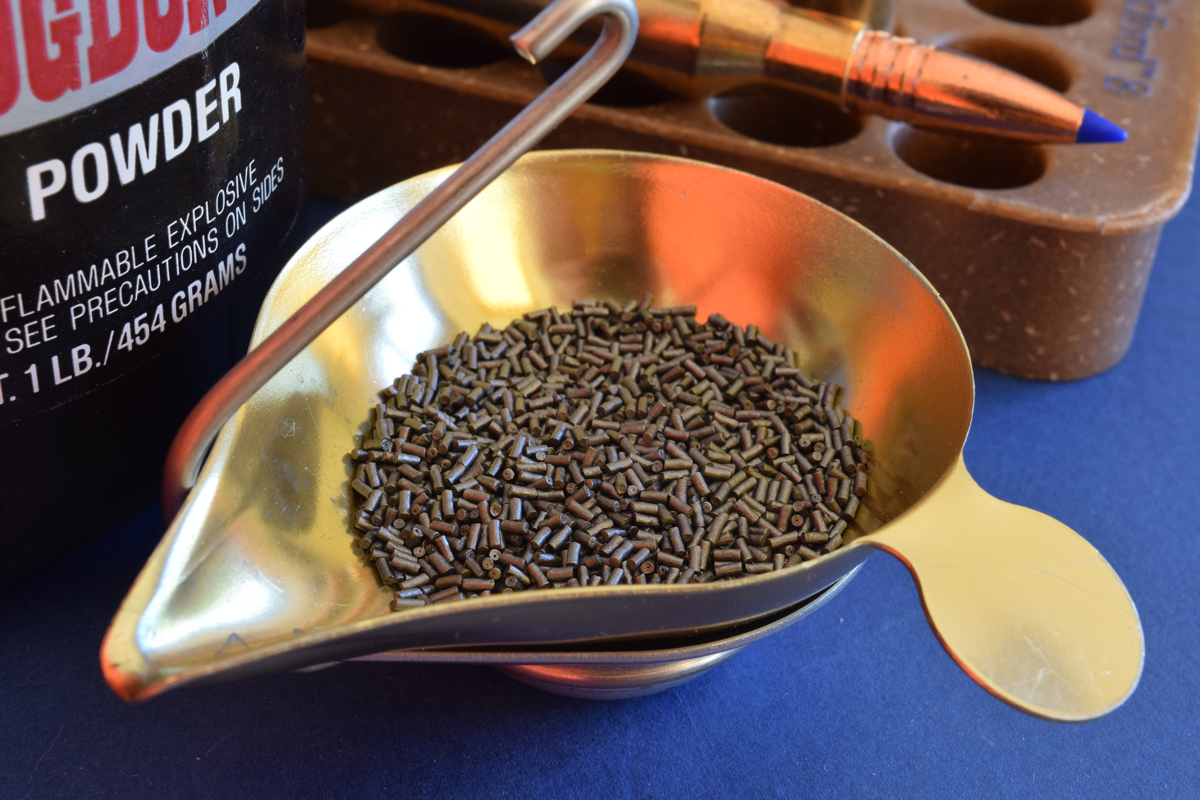
Ackley liked efficient cartridges, preferring the 7×57 Improved to over-bore-capacity 7mm magnums because it drove bullets “nearly as fast [using] considerably less powder.”
From Utah, Ackley boosted his public profile with columns in Guns & Ammo and Shooting Times magazines. His vast knowledge of firearms drew readers. And, gun writer Sam Fadala observed, “Ackley was honest. His wildcats were not his children.” If a cartridge he developed disappointed him, he said so, then discussed better options. His 7mm Ackley Magnum fore-shadowed the 7mm Remington Magnum, a ballistic twin that became hugely popular. But Ackley denied big belted sevens his blessing. He pointed out that the 7×57 Improved “drives the various weights of bullets nearly as fast [using] considerably less powder.” He added that “it is more flexible, and barrel life is much better. [Also,] the 7mm Improved with the right bullet is sufficiently powerful for almost any type of big game.”
P.O. could report without advocating. His extensive work with 17-caliber wildcats was a big investment in their success. One autumn it led him to try the 17 Javelina on deer—in Texas because the state allowed any centerfire cartridge on deer hunts, no matter the bullet’s size. “I shot a running deer at … 125 to 150 yards,” he wrote, “the shot entering … just ahead of the pelvis.” The deer tumbled. Conceding surprise, Ackley added, “I am not unequivocally recommending the .17s for big game.”
His open-minded approach to testing rifle actions and cartridge components set Ackley apart. His carefully documented work could challenge longstanding assumptions. He found, for example, that one of the strongest military bolt actions of the early 20th century (he tested 18!) was the crude Japanese Arisaka. His work with Savage Model 99 and Winchester Model 94 actions showed both to be strong. The slab sides of the 94, he confirmed, do flex. But they spring back. Testing the effect of changing headspace in barrels, he found that even unsupported cases bottle significant pressure. Trials with cases of various tapers showed steep taper does not by itself increase thrust on the bolt, as pressure released upon firing still irons the front of the case to the chamber wall. But taper does limit the rebounding of the case to original shape after firing. He demonstrated that oil on cases and in chambers increases bolt thrust.
Notable Wildcats
Ackley explored many 17-caliber cartridges, but poor barrels early on reflected the difficulty of drilling and rifling such tiny bores. His first 17-caliber wildcat, the Pee Wee on the 30 Carbine case, burned just 9 grains of 2400 powder to send 25-grain bullets more than 3,200 fps. He called the sharp-shouldered version of the 250/3000 “one of the best” Improved cartridges, with “a greater percentage of increase in velocity than almost any other.” The 257 Roberts Improved, he said, had “about the maximum [case] capacity for the .25 bore.” He liked his Improved version of the 7×57, also the .270 wildcat on that case.
P.O. praised the 30-30 Improved, as it “can be loaded relatively hot and still work fine in lever-action rifles.” He lamented the dearth of actions suitable for the 30-40 Krag Improved, “one of the best [.30s].” The 300 Savage he approved “as is,” noting Savage Model 99s aren’t readily converted to fire the later, more potent, 308. Heavy bullets in 30-06 rifles, he said, make good use of the 30-06 Improved case. In a break from sharp shoulders, he hailed Charles Newton’s 256, a frisky 6.5mm ahead of its time in 1913.

Wayne killed this bull with a 300 Savage handload. Ackley liked even its factory loads.
He noted that Savage Model 99 rifles so chambered could not be readily converted to fire
the later, more powerful 308.
Only a few belted magnums impressed Ackley, and these were of at least 30 caliber. The 30/338, 308 Norma and Mashburn’s Short 300 made that roster. He liked Germany’s 8×57 and the 8mm/06 in standard and Improved form. He spoke well of the 338 Win. Mag., also the 35 Whelen and 35 Whelen Improved. He noted that Winchester’s Model 71 lever rifle gets noticeably more punch from the 348 Improved.
Beyond his easily fashioned Improved cases, Ackley experimented with small-bore cartridges of little practical benefit to weekend handloaders. His 228 Ackley Magnum, or 228 Belted Express, used a shortened 30-06 hull with a belt swaged into its head. It sent 70-grain .227-inch diameter bullets (not common .224s) at more than 3,600 fps. Fadala noted that P.O. developed a 230-caliber with 75-grain bullets at 3,500, because many states disallowed hunting deer with 22-caliber rifles.
How Improved Are They?
The ballistic edge delivered by an Improved cartridge over its parent depends on many variables, chiefly the parent’s shape. Cases with lots of taper and long shoulders benefit most when given minimum body taper and sharp shoulders. The 219 Zipper, 250 Savage, 30-40 Krag and 300 H&H Magnum are examples. Ackley found with his handloads that Improved versions of these cartridges bumped velocities by 10.9, 11.0, 12.1 and 10.5 percent, respectively. Significant! The less-tapered 30-06 added about 7 percent. Hiking the speed of 250-grain 35 Whelen bullets from the factory claim of 2,400 fps to 2,575 fps in an Improved case, Ackley registered about what I wring from my 35 Whelen Improved. That 7-percent leap surprised me, as this cartridge has very little shoulder to “improve!” Of course, the measure of any increase hinges heavily on how ambitiously both the commercial cartridge and the Improved version are loaded!
He worked with big cartridges, too—though he evidently saw little application for the likes of his 475 Ackley Magnum, which thrust 600-grain bullets from a blown-out 375 H&H hull at 2,250 fps.
Ackley briefly imported riflescopes built in Japan and labeled with his name. In the mid 1960s he also ordered 150 all-steel commercial Mauser actions from Japan. Fifty of those were true left-hand ’98s. All had 3.55-inch magazine boxes. P.O. planned to barrel them to 22-250, 243, 6mm, 25-06, 270, 7mm Rem. Mag., 308, 30-06 and 300 Win. Mag. He priced them at $77.50. Alas, this venture flopped when the company producing the actions went bankrupt after the first shipment to Ackley.
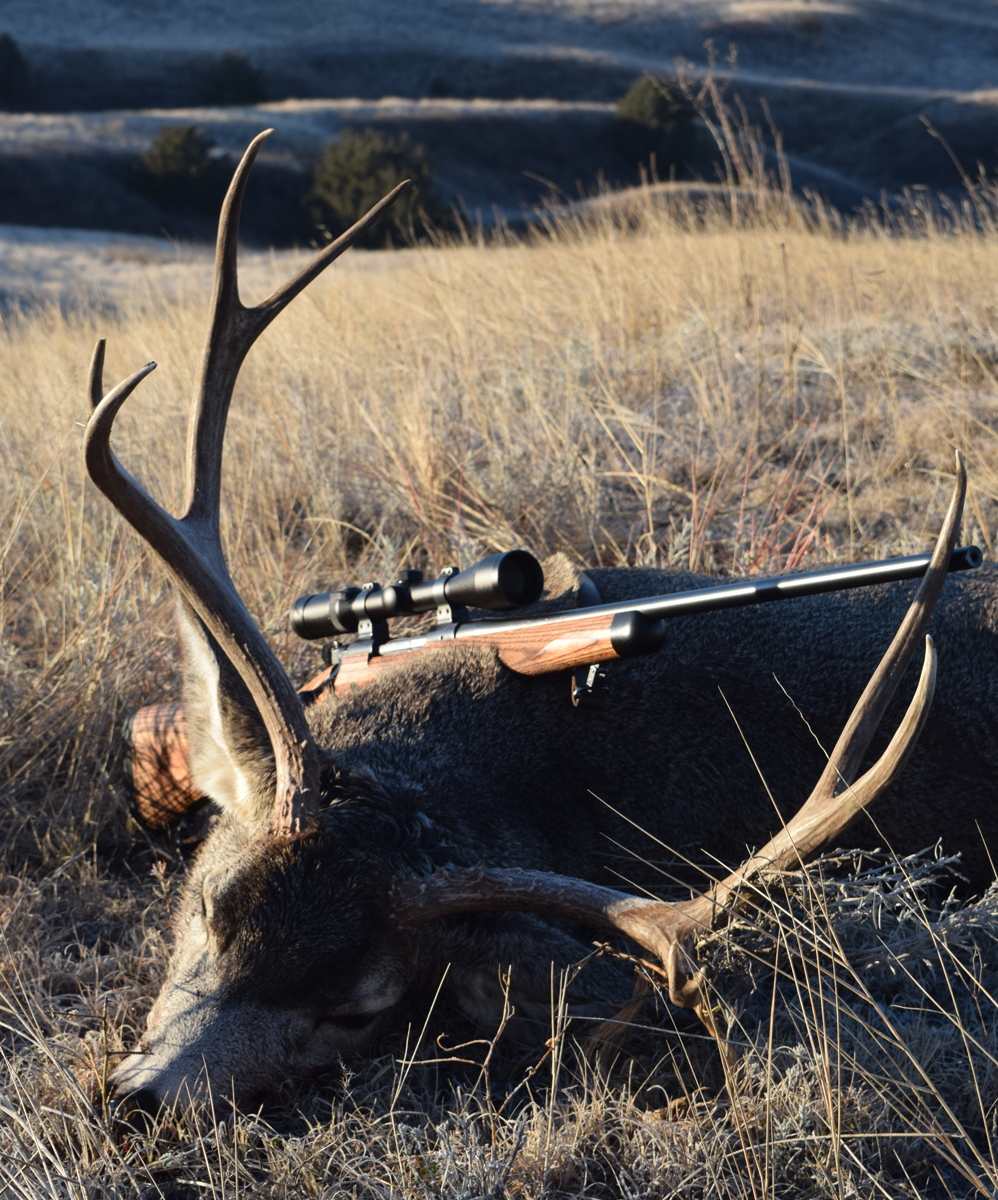
Popular wildcats can earn factory loading. The 25-06, credited to A.O. Neidner, was handloaded well before WWII. Remington adopted it in 1969. Wayne shot this Dakota buck with a Holehan-built 25-06.
In 1968, Ackley joined Arthur Swanson in an effort, financed by Salt Lake-based EMDEKO, to re-engineer the single-shot Sharps-Borchardt action and build rifles on it. The few rifles that resulted wore Ackley barrels. Then EMDEKO offered to buy P.O.’s company and name, also to employ him while he peddled barrels to the industry under his label. The deal was done and Ackley’s tooling moved when Colt bought EMDEKO—minus the Ackley name. Colt later abandoned the Sharps project, but EMDEKO sold 5,000 Ackley-labeled rifles on Interarms Mark X actions, most barreled to 25-06, 270 and 30-06.
Not long after the EMDEKO projects, Ackley was seriously injured when he walked in front of a Buick left with the transmission in neutral. It rolled forward, crushing both of his legs against the concrete wall of his shop. As tragic as this episode was, it lost nothing in the telling. A decade later, P.O. recalled: “The bones were all broken and were sticking out of a seven-inch hole … full of sand.”
Early in 1978, Ackley peddled his barrel-making business to Max Graff, of American Fork, Utah. That deal would trigger the retirement he’d long threatened. A year later, Graff sold out to Dennis Bellm, who listed barrels bored from .204- to .475-inch.
In his teaching, books and magazine columns, and letters to myriad disciples, P.O. Ackley left a treasure of information for hunters, shooters and handloaders. He died on August 23, 1989, having mined and shared the truth as best he could.
Where Credit Is Due
No rifle enthusiast’s library is complete without Ackley’s two-volume Handbook for Shooters & Reloaders (1962 and 1966). Most of what’s worth knowing about his life’s efforts is there. Beyond that, author, wildcatter and ace rifle-maker Fred Zeglin has made an impressive study of the man and his work. Both are detailed in his well illustrated 2017 book, P.O. Ackley, America’s Gunsmith. Read, too, Fred’s Wildcat Cartridges (2005) and Reloader’s Handbook of Wildcat Cartridge Design (2nd Ed., 2024).
Zeglin counts 62 wildcats as having come from Ackley’s bench, more than 40 of them Improved cartridges. Despite his earned celebrity, however, P.O. openly acknowledged efforts of other wildcatters of his day—Harvey Donaldson, Vernon Gipson, Lyle Kilbourn, Harvey Lovell, Art Mashburn and others. He was ever a student and respected others of the same bent.