

During the past millennium, I was fortunate to spend time in northern Texas as a wildlife biologist and hunting in south-central Oklahoma a few miles north of the Red River, the border between our two states. Drawing from my experience as a biologist and as well as a hunter of whitetails, I knew there was a really good deer population both north and south of the Red River just west of Lake Texoma.
On previous hunts at Brett Addison’s ranch years ago just north of the Red River, I had taken two bucks, both grossing over 170 B&C. I also conducted deer census surveys in Texas just south of Oklahoma and had seen some outstanding whitetails. Ever since, I yearned to hunt adjacent to the Red River on our Texas side of the border.
My opportunity finally came this fall when Luke Clayton, co-host of our weekly A Sportsman’s Life CarbonTV.com TV show, introduced me to one of his rancher friends who had decided to lease his land for deer hunting. It took but a couple of calls with Matt Brown to reach an agreement.
Others on our lease include father and son, Paul and Colin Moore, Ricky Ballenger and additional members of the Moore family. Paul is the primary owner and innovator of Vineyard Max, the fabulous deer bait made of hammer-milled dried grape skins, rice bran and chopped corn, which attracts deer but is also nutritionally good for them. Colin designs deer feeders for Vineyard Max, which also markets a variety of quality wildlife products. Ricky Ballenger, along with Kurt English is a partner in the Vineyard Max company (www.vineyardmax.net).
Originally from New Mexico. Matt spent years on the professional rodeo circuit, then set about establishing an extremely successful bird hunting operation while training some of the best bird dogs in North America. Deer hunting on his property had for many years been restricted to family and a couple of close friends. His decision to lease his land to whitetail hunters was not an easy one.
Needless to say, I was thrilled that he leased his property to our group of hunters.
The northern boundary of the property is the Red River. Being in the cattle business, Matt plants his fields for hay and forage, which deer absolutely love. He continually works at improving the wildlife habitat by planting native grasses and forbs. This combination results in a large population of whitetails.
Paul and his crew also saw the lease as an opportunity to continue field-testing their products, developing new products and proving the worth of using their Vineyard Max attractant in areas where there are no grapes, rice or for that matter corn.
I started putting Vineyard Max in places where there were no existing or established deer stands, what a friend of mine from New Mexico refers to as “outhouses in the sky.” My goal was to draw does and bucks into areas I wanted to hunt, while not affecting those who hunted from deer blinds over automatic corn feeders, which are legal in Texas and Oklahoma.
Paul and crew moved several existing deer blinds and feeders to the Red River from their previous lease in the Texas Hill Country. Colin did a stellar job of placing those blinds in key areas, but also with a safe distance between them.
The ranch is essentially divided into pastures on the east and west side of the lease. Blinds were set up in the extreme corners of the pasture next to the river, which is where I put spread Vineyard Max as soon as I arrived on the ranch. My intention was to bait the area for a day or so, then rattle. The same technique had served me well in the past.
I spent part of my time learning all I could about the property, asking the owner about where deer moved and the trails they took to the forage fields. Matt was gracious in answering my questions.
On a Friday, I spent almost all of the day hunting. I returned to camp only to make a couple of business phone calls because there was no cell service where I was hunting.
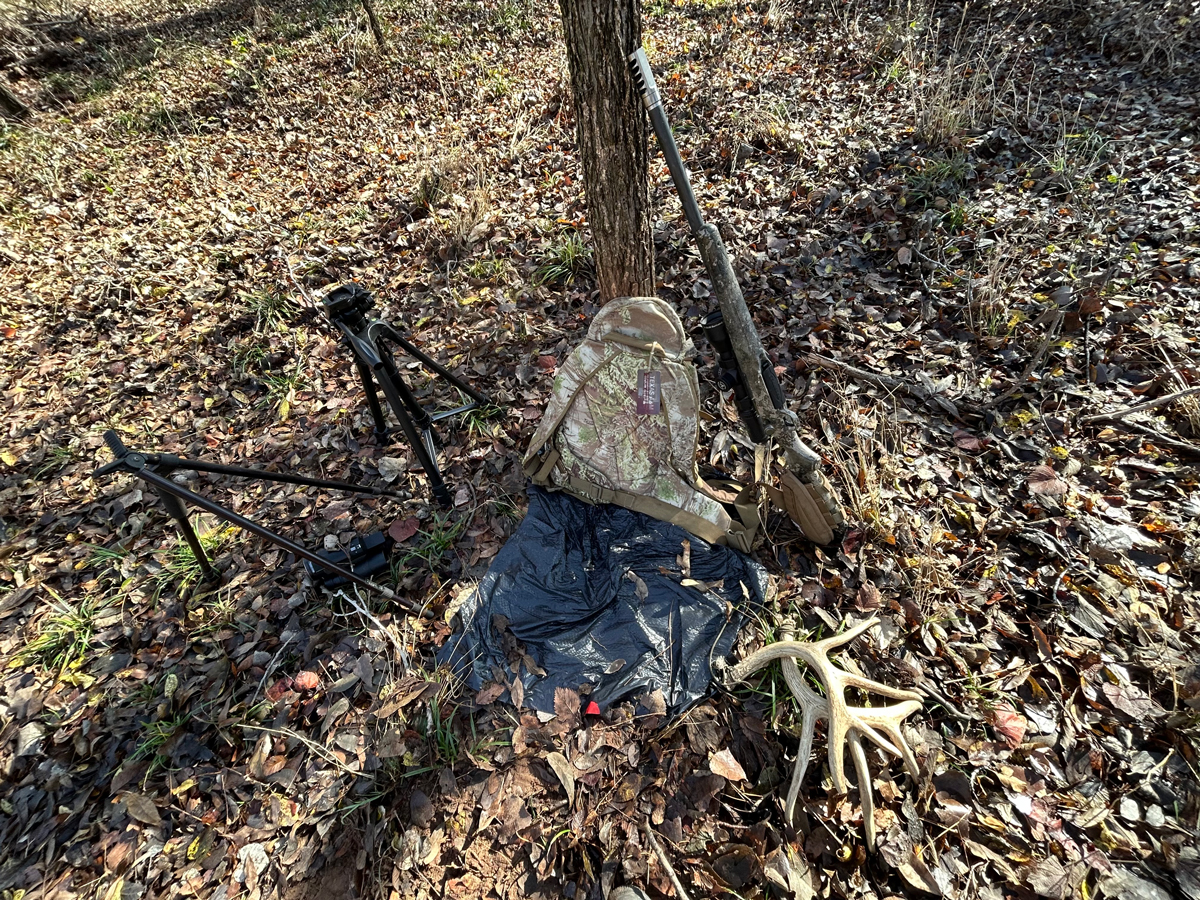
My set-up rattling horns, rifle tripod, camera and podcast, 7mm PRC rifle, trash bag to sit on because of wet ground, and my back pack to make sitting against a tree easier.
Before first light on Saturday morning, November 22nd, I was set up on the ground, my back against a huge pecan tree close to where I had been putting out Vineyard Max. I managed to ratttle in five bucks, including the one that was missing his entire right antler and most of his left; no doubt a serious fighter. Another buck was a really nice 8-point that looked to be a year away from greatness. The other three were relatively young. All had approached to within ten yards.
About 11:00, I briefly saw a 10-point buck chasing a doe. I watched him just long enough to determine he was likely a young buck. I settled back against my tree, my tripod holding my Mossberg Patriot with its custom Thunder Valley Precision (www.thundervalleyprecision.com) Avient Rapid Heat Releasing Barrel Technology system barrel, topped with a Stealth Vision 3-18×44 SVT scope. Chambered in 7mm PRC and shooting Hornady’s Precision Hunter 175-grain ELD-X, the combination is superbly accurate from 100 to 1,200 yards. With it, I have shot three-inch outside five-shot groups at 1,200, as well as essentially same hole accuracy at 100 out to 500 yards.
I have shot that rifle/scope/ammo combination a fair amount and knew that I could kill a deer at 1,000 yards. But that is not what I am about when it comes to hunting. I shoot at those long ranges, so I am confident that I can precisely place my Hornady bullet into the vitals and quickly and humanely put down the animal. Don’t get me wrong. I truly enjoy shooting steel at long range, but when it comes to hunting, I want to get a close as earthly possible before pulling the trigger.
It was almost exactly noon when I picked up my horns to rattle. I said a short prayer, then crashed my antlers together as loud as possible. Immediately, I spotted movement in the river bottom where a lot of briars formed a wall. The buck stopped behind the briars, where I could see enough of him to tell he was mature buck. He had a thick neck and I could see dark hocks, sure signs that he was at least four years of age. And, I could smell his musky odor.
The buck was staring at me through the maze of briars while I raised my rifle and looked at him through my SVT scope. He turned to walk away just as I grunted, causing him to turn and walk back to almost the same spot. I could see he had both antlers, good mass and a 20-inch outside spread. I wanted him! Now, if I could get a clear shot.
Thanks to the quality of my scope, I was able to find a small window in the wall of briars where I could place a bullet. I took a deep breath, released it, then squeezed the trigger. The buck shuddered, turned and staggered off to my left. I cycled the bolt and sent another round his way through the briars, then bolted in a third round. I was prepared to shoot, but he was now behind an impenetrable wall of vegetation. I watched as he ran about 20 steps farther into the river bottom, then fell.

Larry with his Red River buck, rattled in at 12:03 pm.
I had been filming all the bucks that came in during my hunt for our weekly A Sportsman’s Life show on CarbonTV.com. Unfortunately, taking this buck had happened so quickly I could not get the camera set up to record the moment.
I was tremendously pleased that I decided to take the buck. His teeth revealed he was a six-year old, a basic nine-point with an interesting extra point near his brow tine, plus two basal points with a 20 inch outside spread. He weighed 187 pounds. A great “real” whitetail buck!
I have long been a firm believer in hunting during mid-day. That said, I know recent research in several states shows deer are diurnal, meaning they move almost exclusively at first and last light and are not affected in any way by the moon. Indeed, they do move early and late in the day. However, I must tell you that I have taken most of my biggest antlered bucks during the hours of 10 a.m. till about 2 p.m.
Our lease is in a Texas county where the bag limit is a one buck that must have a 13-inch inside spread, plus a spike buck. Two does may also be taken. I plan on returning to the Red River lease to take two does during the late antlerless season in January. When I return, I will be hunting with my Taurus Raging Hunter handguns loaded with Hornady ammo. While there, I’ll spend considerable time doing more scouting, trying to find areas where I can hunt without disturbing others on the lease who hunt from established blinds.
I can hardly wait to return to the lease for the 2026 Texas whitetail hunting season!