
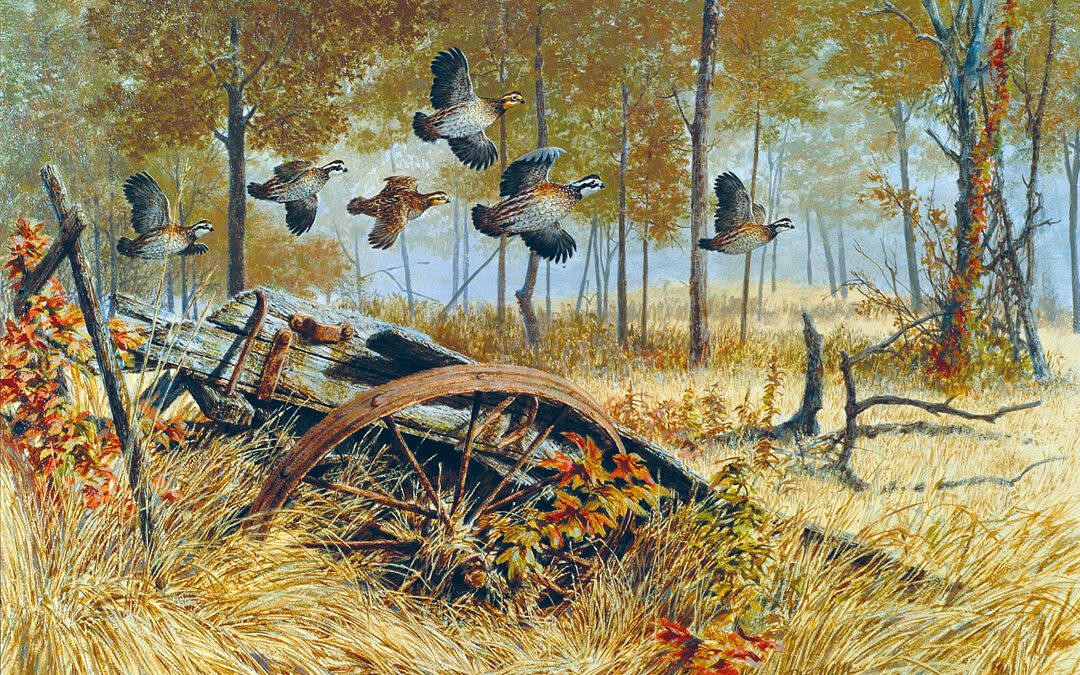
“I like November best,” the Old Man used to say, “because it reminds me of me.” A heartwarming remembrance from Ruark’s classic, The Old Man and the Boy.
A lot of people figure November to be a middling sad kind of month, with the trees showing naked against the leaden skies late in the afternoon, and the grass all crisp and brown from frost and the threat of winter turning your ears red in the morning, and the evening cold making your nose run. The year has only one more month to live, and that is sad too, to some people.
But November was the month I aimed my whole year at, for the very simple reason that the bird season opened round about Thanksgiving, and if you lived in my neck of the woods, “birds” didn’t mean canaries or parrots or bluejays. Birds meant quail. The Old Man was with me all the way on that one, but he liked to fuzz it up with a little philosophy. Like most pipe smokers, he needed some extras to hang on it to make it dignified.
We were talking about the seasons one time, and the Old Man said that if he had to, he could do without summer and all of spring except maybe May, and he would be just as happy to settle for October through January and give the rest away. He said he would pick November as the best one, because it wasn’t too hot and wasn’t too cold, and you could do practically anything in it better than any other time of the year, except maybe get sunburnt or fall in love.
“Although,” he said, “there ain’t nothing wrong with November, or any other month, for falling in love if the moon’s right. But mainly the reason I like November best is that it reminds me of me.”
He stopped and struck another kitchen match to his pipe.
“Look at me,” he went on. “Here you see a monument to use. I’m too old to fall in love, but I ain’t old enough to die. I’m too old to run, but I can outwalk you because I know how to pace myself. I know when to work and when to rest. I know what to eat and what sits heavy on my stomach. I know there ain’t any point in trying to drink all the licker in the world, because they’ll keep on making it. I know I’ll never be rich, but I’ll never be stone-poor, neither, and there ain’t much I can buy with money that I ain’t already got.
“A man don’t start to learn until he’s about forty; and when he hits fifty, he’s learned all he’s going to learn. After that he can sort of lay back and enjoy what he’s learned, and maybe pass a little bit of it on. His appetites have thinned down, and he’s done most of his suffering, and yet he’s still got plenty of time to pleasure himself before he peters out entirely. That’s why I like November. November is a man past fifty who reckons he’ll live to be seventy or so, which is old enough for anybody – which means he’ll make it through November and December, with a better-than-average chance of seeing New Year’s. Do you see what I’m driving at?”
I said, “Yessir,” because I didn’t want him explain it all over again, and because I was worrying about a young pointer puppy who was going to have his first chance at being a working dog, and I was worrying over whether those late rains hadn’t drowned off the whole second clutch of quail, and I was worrying over my shooting eye, which had fallen off alarmingly the final two weeks of the last season.
“What’s your idea of November?” he asked, his eyes half-closed.
I wanted to tell him that it was mostly the opening of the bird season, and the Thanksgiving holidays, the persimmons wrinkled and ripe on the trees, when the weather was real nice, and it was hog-killing time in the country, and the punkins looked yellow and jolly in the fields, and the sun set good and red, and a lot of other things, but I couldn’t manage to squeeze it all out because I had no way with words.
“The bird season,” I said.
The Old Man looked at me and sighed. “I reckon I ain’t ever going to make no philosopher out of you. Let’s us go look at the guns and figger out where we’ll best go tomorrow, when she opens.”
The day and night before the opening of bird season lasts longer than anything, including the week before Christmas holidays. Awful, horrible thoughts keep you awake, such as will it be raining, or what if the dogs get hot noses or the quail have all moved? And then the next morning dawns clear and bright with just the right breeze, and it is another ten years until afternoon. I used to beg and coax to start in the morning, but the Old Man was stone-set against it.
“There ain’t no point to hunting in the morning. Not quail,” he said. “They don’t feed out until nine or ten o’clock, and later if it’s cold, and maybe not at all if it’s too hot or raining. And if they come out at all, they don’t go far away from the branches, and they head back before you can get the dogs calmed down. You’ll find you’ll kill all of your quail in two hours – between three and five o’clock – with very few exceptions. All-day hunting just tires you and the dogs, and if you do get lucky and find birds in the morning, you’ve got your limit and there ain’t nothing to do in the afternoon. No, morning is the time for deer and ducks and turkeys, but the bob-white’s a late-sleeping bird.”
So we would mess around all morning, and then have us a light lunch about noon. By two o’clock we’d be where we had headed, with the dogs shivering and nipping from excitement and slobbering at the mouth, and me wishing I could. We had a lot of places where we hunted, but we usually started off at a place called Spring Hill, which we had a lucky feeling for, after trying for three or four coveys closer in, just to let the dogs wet down all the bushes and get the damfoolishness out of their systems.
It is difficult, very hard, to try to explain what a boy feels when he sees the dogs sweeping the browned peafields, or skirting the edges of the gallberry bays, or crisscrossing the fields of yellow, withered corn shocks, running like race horses with their heads high and their tails whipping. And then that moment, after nearly a year, of the first dog striking the first scent, and the excitement communicating to the other dogs, and all hands crowding in on the act – the trailers trailing, the winders sniffing high, but slow now, and the final eggshell-creeping, the tails going feverishly and the bellies low to the ground, presaging a point.
Then the sudden freeze, then the slight uncertainty, then a minor change of course, and then the swift, dead-sure cock of head, which says plainly the bird is here, boss, right under my nose, and now it’s all up to you.
The backstanders edge closer, especially the puppy, and the Old Man says sharply, “Whoa!” You walk past the backstanders and then up to the pointer, who is still stamped out of iron, like an animal on a lawn. And you walk past him and kick, but nothing happens.
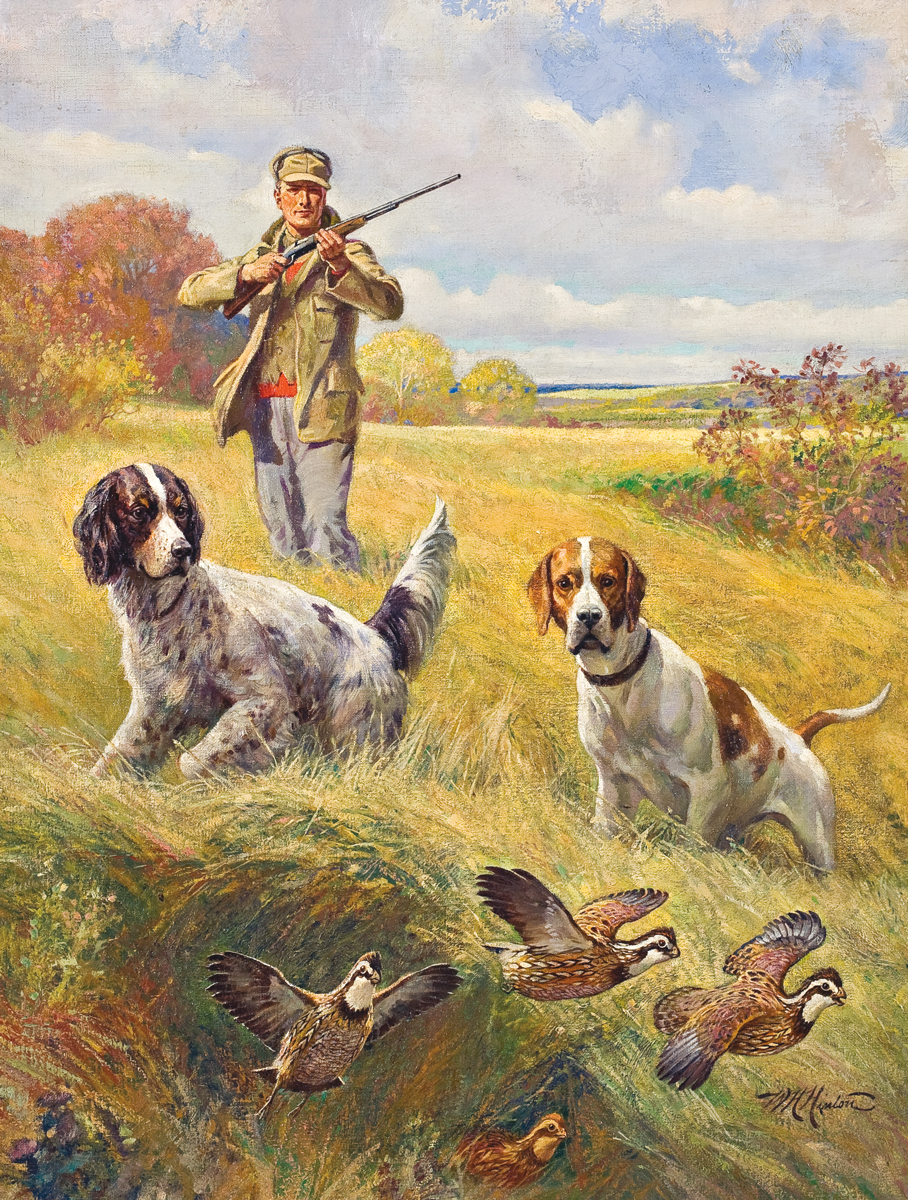
Painting by W.H. Hinton – Courtesy Robert Sakuta
At this moment a blood-pressure estimate would bust the machine that takes it. Your heart is so loud it sounds like a pile-driver. There is something in your throat about the size of a football, and your lips are dry from the temperature you’re running, which is maybe just under 110 degrees Fahrenheit.
You are looking straight ahead of the dog – never down at the ground – and you are carrying your shotgun slanted across your chest, the stock slightly cocked under your elbow. Nothing happens. The dog creeps forward another six yards, and you come up behind him when he freezes again. This time he’s looking right down at his forefeet, and when you walk past him he jumps and the world blows up.
The world explodes, and a billion bits of it fly out in front of you, tiny brown bits with the thunder of love in each wing. They go in all directions – right, left, behind you, over your head, sometimes straight at you, sometimes straight up before they level. Then a miracle happens.
Out of these billion bits you choose one bit and fire, and if the bit explodes in a cloud of feathers you choose another bit and fire again, and if this bit also explodes you break your gun swiftly and load, figuring maybe there’s a lay bird and you can turn to the Old Man with a grin, and when he says, “How many?” you can answer, “Three.” More likely you’ll answer, “One” or “None.”
But the tension is over now, and you find you have broken out into a heavy sweat. If there’s a crick nearby, you go and plunge your face in it, or at least you take a long drink from the water bottle. The dogs fetch, and there in your hand is the first bird of the year – the neat, speckled, cockaded little brown fellow with a white chin strap if he’s a cock, a yellow necklace if she’s a hen. He weighs less than half a pound, but has just induced nervous prostration in a man, a boy and two dogs.
This is when you first sniff the wonderful smell of gunpowder in an autumn wood, and notice that all save the evergreens have crumpled into red and golden and crinkly brown leaves, that the broomgrass has gone sere and dusty yellow, and that the sparkleberries are ready to eat, the chinquapins ready to pick. The persimmon tree that always sits lonely at the edge of the cornfield is bare except for the wrinkled yellow balls that the possums love, soft and liver-brown-splotched now, and free of the alum that ties your tongue in knots and turns your mouth inside out.
The dogs are roving out ahead, and the Old Man says, “Well, we didn’t do so bad for beginners. Anybody here notice where the singles went?”
“I thought about six went over there by that patch of scrub oak, just at the end of the broom,” I say.
“Let’s go have us a good look,” the Old Man suggests. “The dogs seem to think you may be right. Old Frank has either found a friend or turned into a stump.”
At the edge of the broom, with the scattered scrub oaks making a screen before the swamp, is old Frank, nailed to something. And over there, like a lemon-spotted statue, is Sandy, nailed to something else.
“You take this ’un, I’ll take that ’un,” the Old Man says. “We’ll walk up together.”
Two birds get up under my dog’s nose, and I miss both clean, blim-blam! I hear the Old Man shoot once, and then the rest of the group explodes in my face, and me with the gun broke and both barrels empty. I load and another bird, a sneaker, gets up behind me, and I whirl and watch him drop off the end of my gun barrel.
“That’s enough,” the Old Man says. “We got three apiece.
Let’s go find another covey. There used to be one hell of a big one over the top of that rise that we never had no luck with last year. I was beginning to think they was bewitched when the season ended. Unless the cats and the foxes been at ’em, we could take the rest of the limit out of that ’un and not even make a dent in ’em.”
The Old Man lights his pipe and I break an apple out of my pocket. I think I never really appreciated an apple until I ate it in the November woods, after the first covey of the first day of the year. We follow the dogs over the hill, and when we top the brow, there is the white dog stiff, the black dog backing, and the puppy sort of sitting back on his haunches, wondering what to do next.
This didn’t happen every day, or even every year, but once in a while it happened like that, and I mean to say that the walk up to where the dogs were painted against the side of a hill was the longest, happiest journey I ever took in my life.