

As agreed, I turned on my cell phone, an item that was relatively new at the time, at 10:15 to let my guide know whether I was ready or not to leave the deer woods after my morning hunt. Admittedly, I had not even seen a bird. I was tempted to go back to camp, have a hot meal, visit with others in camp before returning to the woods that afternoon.
“Come getcha?” read the guide’s message.
I really wanted to reply, “Negative Red Ryder!” but again avoided temptation. Instead, I replied: “Thank you no, gonna hang here till dark.”
He responded with a “thumbs-up.” I again turned off my phone.
The morning had been slow. The only happenings were leaves falling the shrubs, all coming straight down. I checked my watch, 11 o’clock. What had started out as a very cool though windless morning had warmed to the low 70s and finally, a slight west breeze.
There had been a full moon all night. Straight-up noon, it should be directly below. Experience as a professional wildlife biologist and a lifetime hunter told me mature deer would start moving at noon.
Five minutes before high noon, I spotted a deer slowly feeding my way. A quick look through my 10x binos confirmed it was a big-bodied, wide and massive ten, nay nine-point. I could see where he had very recently broken off his right brow tine. The break still showed brightly white. His impressive rack, even with the missing tine, was near Boone & Crockett record book quality.
Though momentarily hidden, the buck was obviously heading my way. At the time, I was hunting with outfitter Steve Shoop in far northern Missouri near the Iowa border, using a then new Marlin in-line .50 muzzleloader loaded with Hodgdon’s Pyrodex and a Hornady’s 250-grain SST MZ sabot bullet. I was on assignment to do an article about the hunt for SHOOTING TIMES while serving on the magazine’s staff.
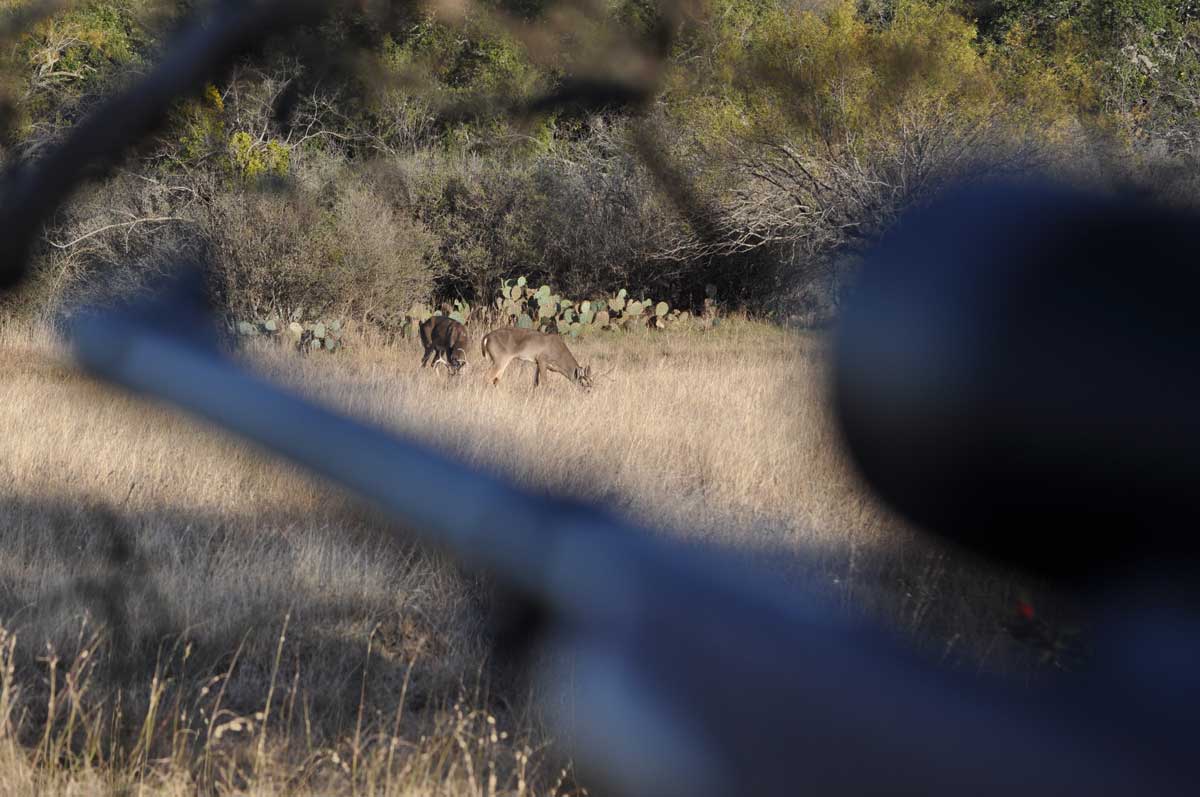
The buck was behind the narrow screening of brush as I raised the muzzleloader, cocked it and got ready. The distance when the buck stepped in the clear was near 50 yards. I grunted loudly. The buck stopped, slightly quartering to me. I pulled the trigger, then momentarily lost sight of him as the cloud of smoke hung exactly between the buck and me.
Then, to the left of the smoke, I saw the buck walk slowly away, pumping blood from both sides. He disappeared into a dry creek bottom.
Before following, I reloaded with 150 grains of Hodgdon’s Pyrodex, then seated a 250-grain Hornady Sabot, replaced the spent 209 shotgun primer with a fresh one. In so doing, I happened to glance at my watch. It was 12:02 pm.
I followed the obvious blood trail and found my buck 20 steps from where I’d last seen him. His body was huge, and his antlers were impressive. Later, I learned that had his missing brow tine been intact, he would have made the all-time Boone and Crockett record book.
A fluke occurrence of mid-day deer movement? “Me thinks not!”
For years I had been, as I am today, a proponent of hunting mid-day, between the hours of 10 a.m. and 3 p.m., when most hunters are back at camp eating lunch, watching football, telling stories or complaining about not seeing deer.
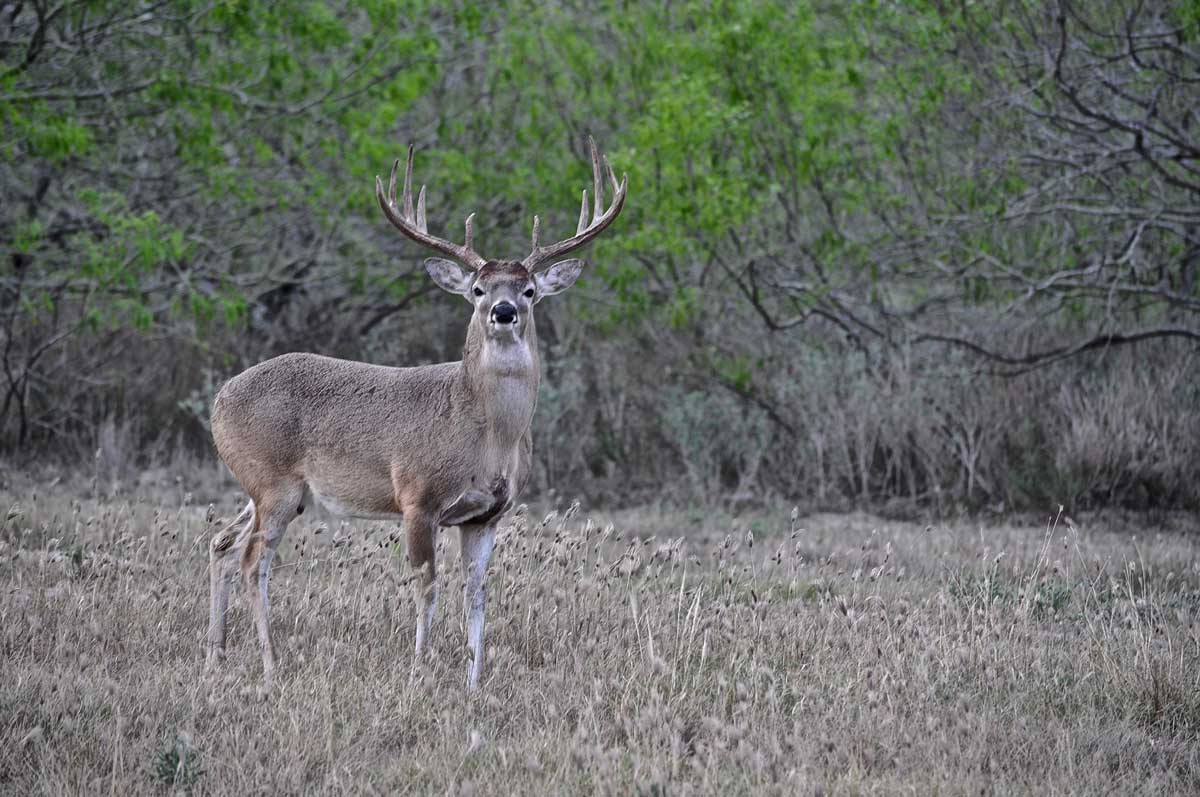
As a professional wildlife biologist and hunter who has spent time on some the best deer properties throughout much of North America, I have seen some of my biggest antlered bucks during mid-day, particularly starting a couple days prior to full moon, during full moon and through a couple of days past. Same experiences as with a new moon. I’m not sure if this is a natural occurrence, or something deer have adapted to, “knowing” there are very few if any hunters in the woods during the middle part of the day.
That said, I have recently read scientific research papers that debunk what I just said, and, what I have experienced in over 70 years of hunting whitetails. Be that as it may, I simply know what I have seen having spent many, many hours each year in varied terrain and deer habitat.
One of my favorite whitetails I shot several years ago between Pearsall and Uvalde, Texas on a friend’s property. It was a buck both he and I hunted; not the biggest antlered buck on the ranch, but an ancient, wary and challenging nine-point.
The only time we saw the buck was after dark when we were headed back to camp. This was long before trail cameras. He was always in the same area. I tried rattling, grunting, still-hunting and sitting near feed areas and water sources. Nothing worked. It was like he was reading my daily schedule. However, I had not at that point hunted mid-day. This was because of my duties with our Los Cazadores Hunting Headquarters and Deer Contest, which at the time I co-owned with a couple of friends. During the hunting season, when not traveling, I was generally at “the store” during midday hours, scoring other hunters’ bucks for our contest and visiting with customers.
Out on the ranch for a morning’s hunt, I returned to my pickup to find a flat tire. I hate flat tires but then, I looked at it as a blessing. I called the store, told our manager I had a flat, and it would be later that afternoon before I could get to the store. Finally, I could hunt through the noon hour, then later change tires.
I headed toward the area where, on the previous night, I’d seen the big nine. I soon found an area deep in a blackbrush thicket where there was a small opening; with three trails coming into it. I sat down against a gnarly mesquite, my .270 Win. resting on shooting sticks.
I glanced at my watch, 11:45. As I looked up, I spotted a big-bodied deer walking toward me on the trail to my left. I could see it was a buck, but not “just a buck.” It was the big, wide nine. I quickly found him in my scope and pushed the safety to fire. When the buck paused 20 steps away I pulled the trigger. He dropped in his tracks. I bolted in a fresh Hornady load and kept my crosshairs on him. He kicked twice then lay still. Mid-day hunting had provided me another mature buck. one that I had long pursued.
I can relate many such stories about noon-time bucks, all taken well before anyone even dreamed of trail cameras.
On another occasion, I was down in Texas’ “The Wild Horse Desert,” so called because of the many wild Spanish horses that once roamed there. On a ranch I managed, I had found a shed antler with 26-inch main beam, short brow, 12-inch back tine, 14-inch third tine, and a-3-inch front point. Impressive! I looked for that buck at every opportunity for most of the Texas whitetail season. First, I looked for him for the guests who hunted the ranch. Could not find him. After all guests had hunted, I started looking for the buck for myself.
It was late December. A frigid cold spell was headed to far southern Texas. I headed to the ranch’s camp to turn off the water and drain all the pipes. Forecasters called for several days of single-digit temperatures, truly a rarity for that part of Texas.
I got to the ranch at 9 in the morning. By 11:30, I had drained all the pipes and secured the windows and doors to keep out uninvited guests. Before heading home, a five-hour drive, I decided to make one sweep through the property. The whitetail hunting season was still open, so of course I had my .270 Win. rifle loaded with Hornady ammo.
I drove just south of camp, then got out of my pickup to walk to a remote food plot. I was about halfway there when I spotted the long-tined 10-point whose shed I had found earlier that spring. He was 50 yards away and had no idea I was there. I rested my rifle on a nearby mesquite, then shot the buck. He dropped in his tracks. It was straight up 12 noon.
Walking up to my downed buck, I realized I had picked up that buck’s shed within mere steps of where he had dropped in his tracks. I took this to heart as well. I know of other hunters who have shot older mature bucks during midday, less than a hundred yards of where they had found their cast antlers from the previous fall.
Coincidence? I do not think so. It has happened far too often.
I usually get to hunt a lot during the fall deer seasons, but never as often as I really want to. That is one of the reasons I tend to hunt all day. The other is that many a time I have shot big, mature bucks between 10 in the morning and 3 in the afternoon, often at “high noon,” while other hunters are back in camp.
Again, I know. Research says it does not happen the way I describe. But over 50 years of experience as a professional wildlife biologist and 70 years of hunting, I have come to know not all whitetails read professional research papers as to how they are supposed to act and when they are supposed to move. Bottom line, I dearly love “Nooners!”