
Responses vary greatly when someone hears the unexpected. There may be a blank stare or emphatic sigh or even a look of mild alarm. There may be the sudden gasp accentuated with a rhetorical, “Really?” This is not so much a question as it is spontaneous disbelief. Or there may be ill-placed laughter erupting from the dumfounded hearer who is so taken aback that there seems nothing more appropriate than inappropriate hysterics. Regardless of which emotion-driven reverberation silently presents or virtually explodes, some form of recognizable reaction is a near certainty.
All the above refers to hunting. Birds, in this case. Potentially, this will open eyes and interests to consider neglected opportunities that could possibly appear frivolous and inconsequential to the unknowing, or open eyes and interests among the knowing.
The title of this piece contains the word neglected. These birds are not neglected at all by those who hunt them. Still, these birds, in my less-than-worldwide acquaintance with all things hunting, seem a poor lot in popularity when weighed against other fowl. They pale as favorite when compared to pheasants or doves or mallards or geese. They fail to trigger immediate mental portraits when they are mentioned. That all said, let’s get on with the business of hunting these neglected birds.
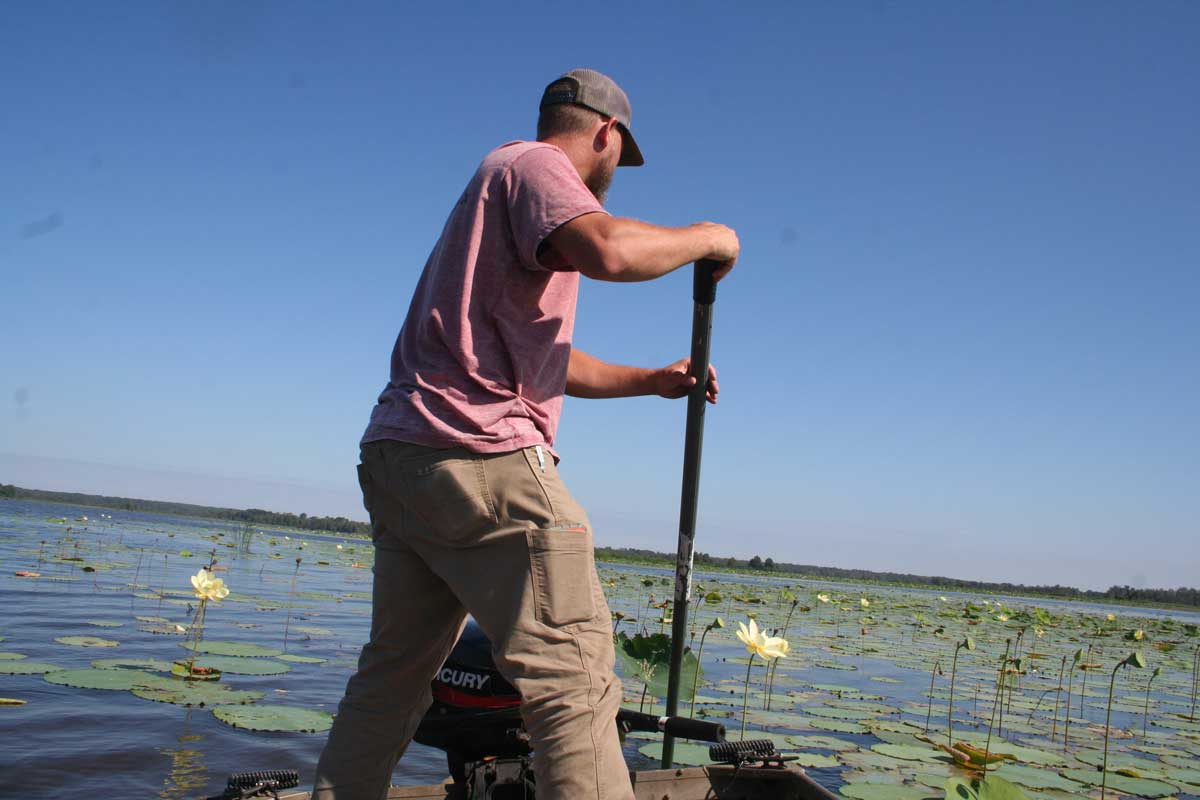
Dustin Cushman handled the push pole in fine fashion. Such stealth is a solid boost while moving about the tangles.
I met Phillip Greer and Dustin Cushman at a launch shortly after daylight one bright September morning. The launch afforded access to miles of marshy shores and diminutive islands and assorted channels that proffered great tufts of grasses and water lilies and water hyacinth and other vegetation. The muddle was complex and uninviting. Still, it was what we sought.
I knew this setting was there, for as a college student in search of paychecks I worked summers measuring flooded channels with the assist of a lead weight on the end of a long rope. Channel banks, smothered by overflow but demanding delineation, were marked with buoys left and right to provide boaters a clear path up- or downstream.
Phillip had been the instigator of this hunt. One Sunday morning on the porch of our country church, he mentioned something he and Dustin had come to enjoy. “They walk around on the lily pads down there at the reservoir.” My ears perked. I don’t know why it was preserved, but I found a name lying dormant in my aging brain. “Gallinules?” I was pleased with my recall. “Yeah, that’s it. We have hunted them for the past three years, and they are good to eat.” Phillip brought me a frozen half-dozen a few days later. They are indeed good to eat.
Dustin guided us through the labyrinth in deft fashion, the motor chuckling softly at low speed. Around a bend, its edges choked with tall grasses, a more defined and open channel waited. The motor exerted a higher dose of propulsion as my comrade twisted the throttle and, spread in every direction, were more paths of water similar to that one we had navigated near the launch; all appendages of that larger flow we had just entered.
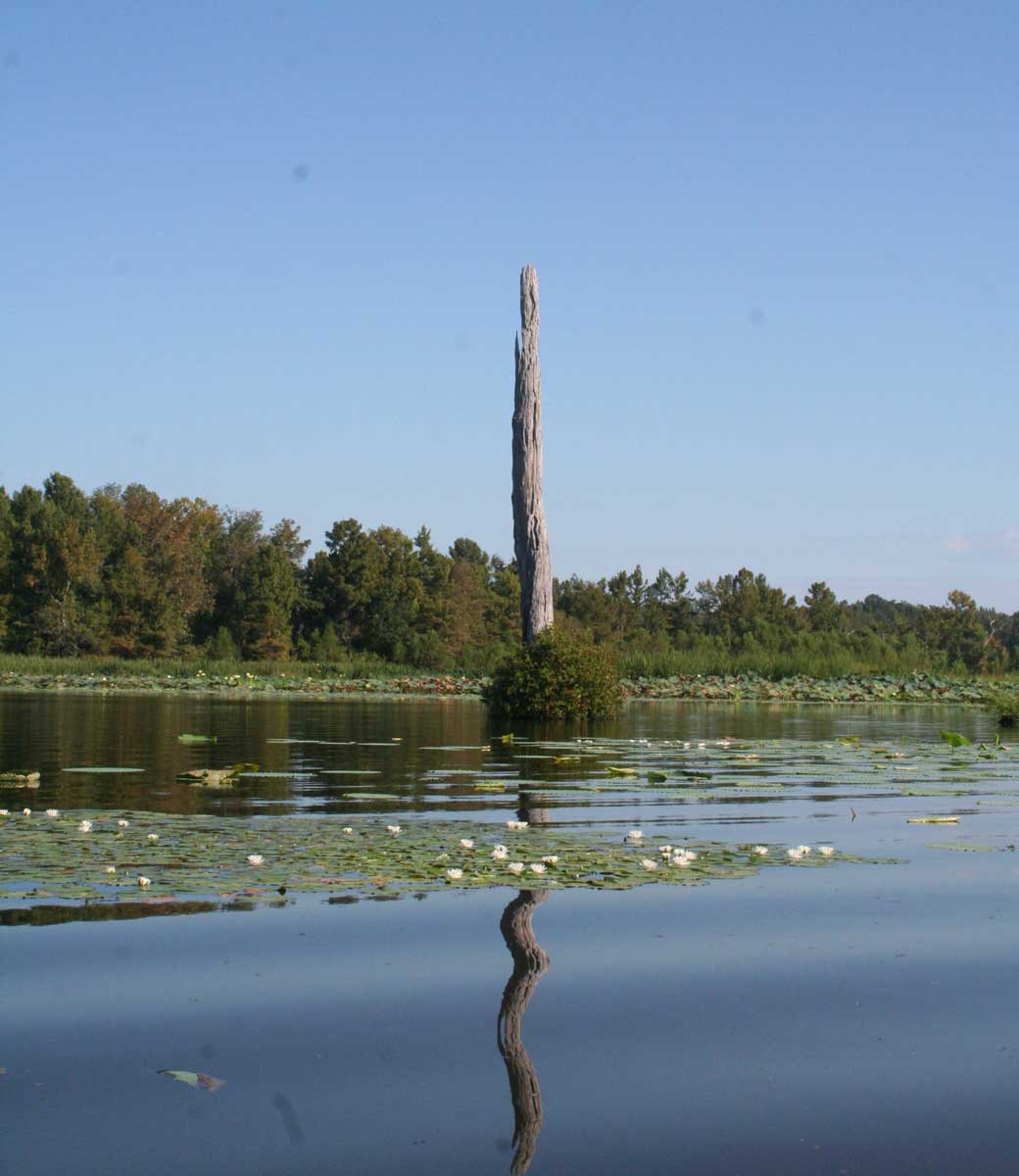
Skeletal remains of cypresses that had once stood majestic but since lost their crowns now bowed in homage; mere trunks or portions of trunks cowering at the threat of thunderstorm or lightning strike that, if unleashed, would within seconds render those trunks substantially shorter or splash them completely into the murky waters. Their roots optimistically grappled to support remnants of what those roots had sustained, but the last chapter had been written. The hook of a sad song by Hank Williams came to mind: “I’m so lonesome I could cry.” But melancholy slipped away when Phillip spotted what he surmised to be our game de jour on a distant lily pad, north and across the main channel.
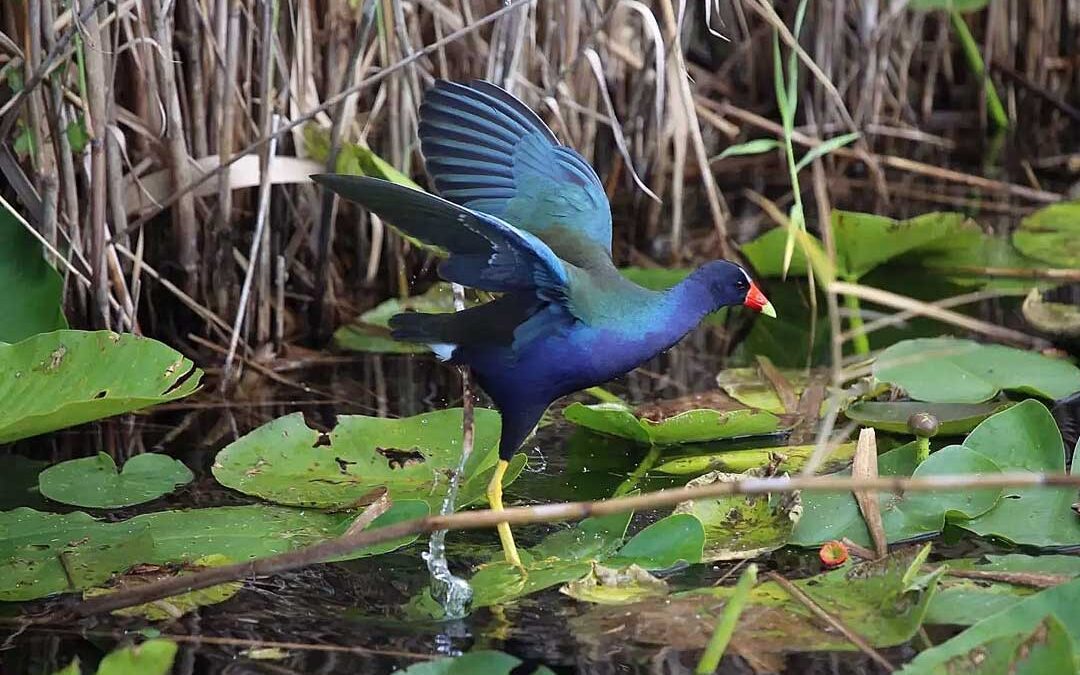
Phillip’s pointing and Dustin’s binocular confirmed what we suspected. There, piddling atop lily pads and stooping over, bill forward and head low to pick up a morsel, feet splayed and long legs accommodating his gymnastics, was what we were looking for. A purple gallinule. Others of his kin were chattering and squawking from deeper within the cloistered snarl of vegetation that blocked even a brief peep of their whereabouts. We were definitely on track. Dustin hushed the motor after crossing the channel and retrieved a push pole. No sound of human intrusion remained.
Propelling via push pole served two purposes. One was stealth, the other a legal matter. Where we were hunting and the game we were pursuing, any movement generated by a motor was disallowed when shooting. And the stealth factor was a complete necessity. A rumbling motor will most certainly push birds from the edges and into heavy cover. While not as spooky as a turkey coming to a call or a duck strafing decoys, gallinules are not immune to disturbance. A sturdy push pole with a foot that helps prevent the pole’s sinking into mud is a viable tool.
In range now, 30 yards perhaps, I stuffed the little 28-gauge O/U with No. 6 shot. The gallinule weaved and bobbed and threatened to make his short flight or jerky rush into cover. Those 6’s slipped through the modified choke constriction and the bird lay still on a lily pad. This was my first. Not my first to see, but my first to intentionally pursue and collect. The day was now taking on its autumn essence and boasting an azure sky and gentle breeze and comforting feel of wellness.
Gallinules are curious creatures. They come in two configurations throughout most of their range—common and purple. That latter is more a southerner, but the common—once known as the common moorhen—is found throughout the continent, some breeding as far north as southeastern Canada. Gallinules tend toward what might be considered short migrations, leaving the North to move southward when ice begins to infringe. Southern and coastal populations are pretty much considered residents of those regions.
The common is not quite the looker as the purple, but whatever iridescence is missing in the former is mitigated by a bold head shield of red plunging down the bill before ending in a yellow tip. There is also a white stripe down each side and white outer tail feathers.
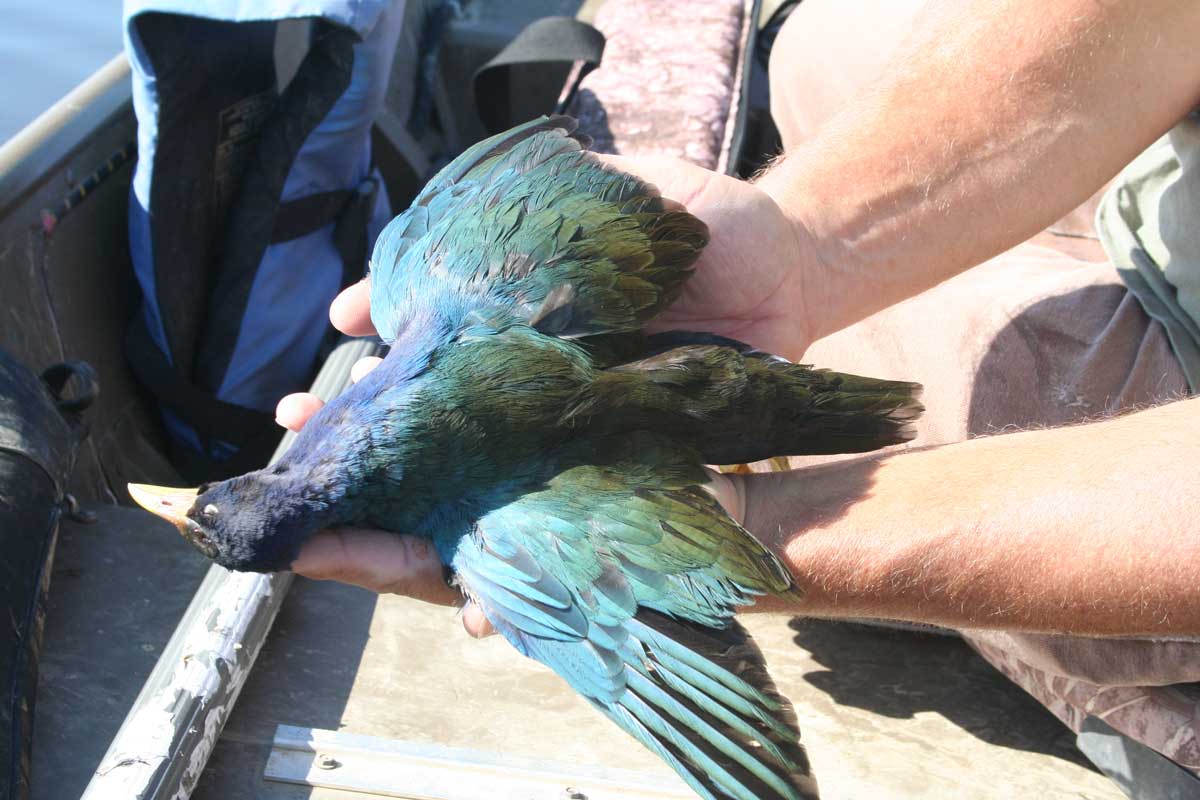
The purple can be described as downright handsome—quite striking. The forehead and portions of the neck and chest are a soft baby blue. The wings and back have alternating hues of purple as per the light’s angle. The bill is red with a yellow tip. Both varieties are pleasant to look at if disproportionate legs and big feet are not a turnoff.
The talk of both is abundant—it’s communication for the birds, but a signal and precursor of success for the hunter. That chattering and chicken-like clucking serve notice and the audible may be more important than the visual when it comes to initially locating gallinules. Wise hunters should go on high alert.
That visual is obviously essential. The bird must be seen before it can be brought to bag. And it is seen on the near side of tangles, flirting with edge vegetation and strolling along on lily pads. They, individually and collectively, are also seen, though ghost-like, scooting here and there behind a porous curtain of stems and leaves and grasses. Additionally, they are seen bouncing from such platforms and into the air briefly, that brevity exhibited in both time and height. Seems they’d rather walk than ride. As a result, shooting is not terribly demanding. If distance is not stretched past the shotgun’s comfort zone, shots at stationary or slow-moving targets are quite elementary.
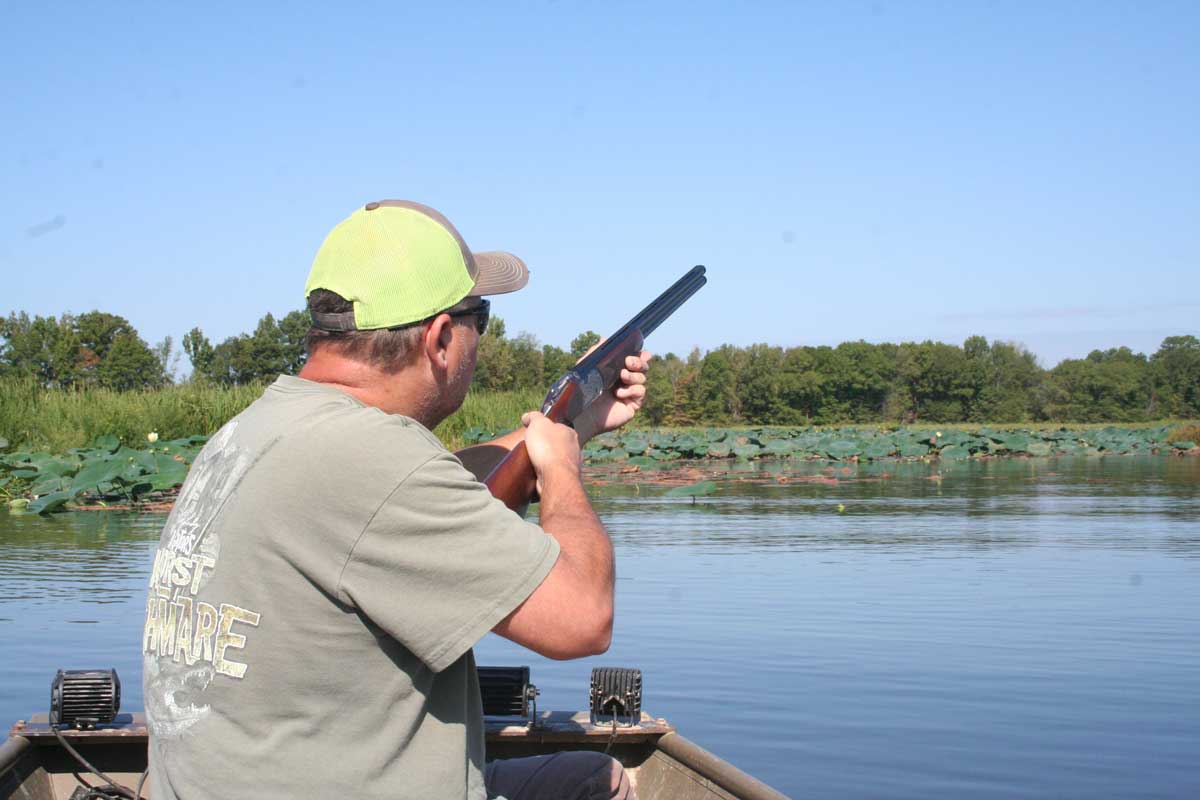
That delightful September morning of the hunt cited earlier ended with a self-imposed limit of eight birds; this agreed upon by all three participants. Those eight cost nine shells. Phillip and I alternated tending the little 28-gauge and unloading after each shot, changing positions in the boat to put the shooter up front. Dustin handled the push pole. All ended well, with hunters planning another pleasant morning in the company of gallinules.
And then the snipe.
In those youthful days of blissful ignorance and woeful apathy, we boys hunted “snipe.” But we didn’t actually hunt snipe. What we were hunting—more appropriately stated, what we encountered—were woodcock, not snipe. But we didn’t care. We bumped them while quail hunting and shot them when the opportunity arose. We took them home and fried them with the quail. Not a culinary delight, those woodcock, in that form and certainly not something that should be served in genteel company.
After time and ample coaxing by those who knew and, after some elementary studies of zoology, perhaps even after a library book on ornithology, we gradually began to get the names right. There were woodcock and there were snipe. And while they have similar demeanors, the two are certainly not the same. This at times rowdy and near permanently crude collection of individuals I called friends, had morphed into some level of sophistication. We knew a woodcock when we saw one. And we saw quite a few. And we knew there were snipe. Didn’t see many of those in our poor-dirt surroundings of undulating broomsedge and weak pasture lands and low-grade cotton patches and lonely fallow fields, all backdropped by oak-strewn hill sides, but we came to know the difference between snipe and woodcock.
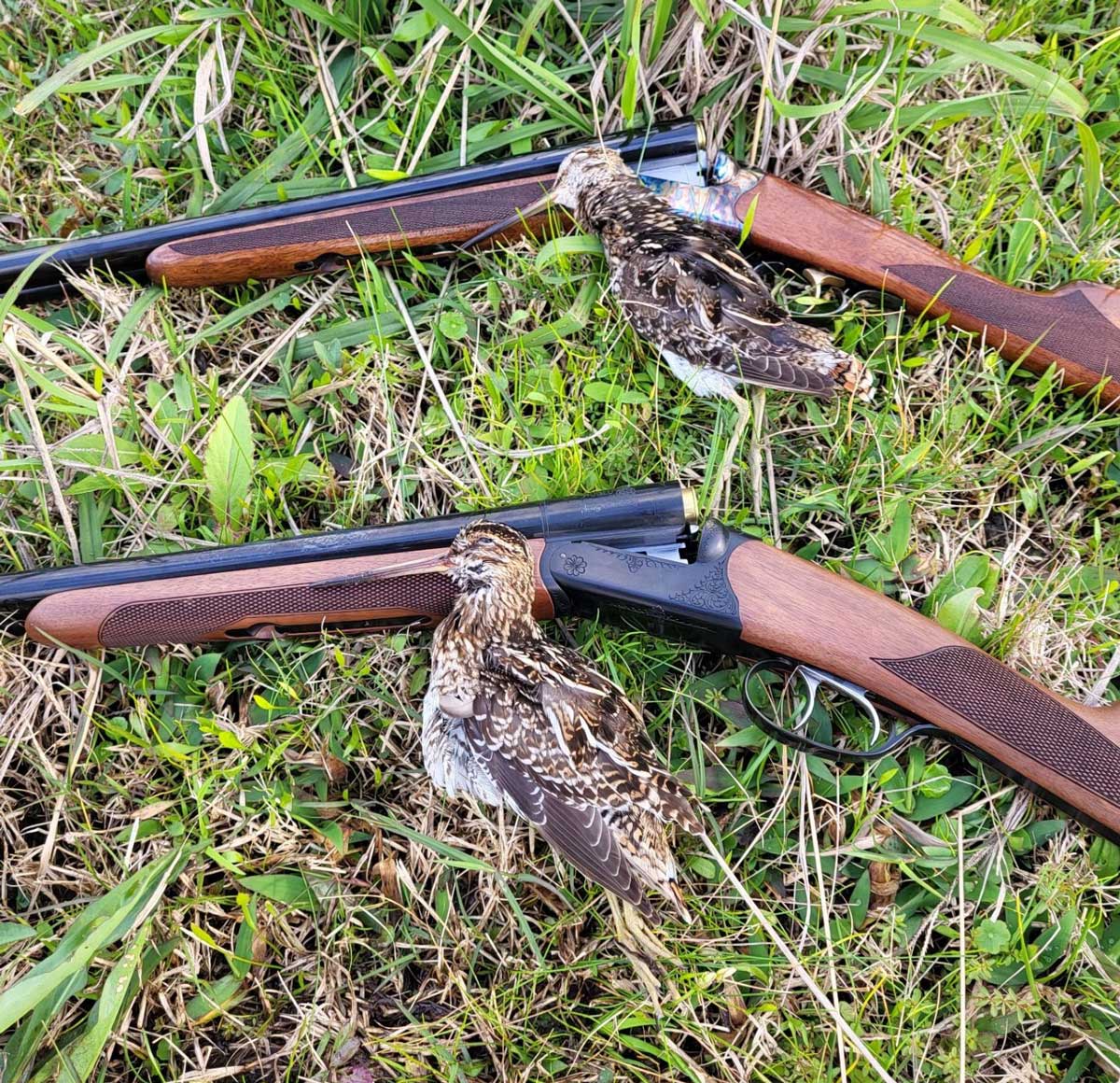
Twin-tubed 20-gauges are perfect for snipe hunting.
Snipe are crafty little speedsters, a touch smaller than a dove. Coloration is similar to a woodcock and the bill is, as with the woodcock, a prehensile appendage. It wonderfully performs the chore of seeking out and plucking sustenance from damp soil. But the snipe opts for more open real estate than does his lookalike, while woodcock tend to lounge and feed in areas of reasonably serious overstory. Moist, maybe even boggy farmland that is winter dormant, impoundment edges with little or no grasses along the water and borders adjoining brushy woods or fields entice them, for it is from such locales that the birds find food and seem to feel more comfortable.
And they can be terribly nervous and flighty. The first bird up is a signal for comrades to do the same—if comrades are present—and they are more often than not. They, the first or the last bird, are prone to rush away at small disturbance and create a mesmerizing blur of twisting and lane changing in the initial flurry, only to settle into a more organized and advantageous pattern—advantageous for the hunter—after a few seconds of gathering their faculties. But don’t be misled by false hope that this more acceptable flight will save the day. It probably won’t, for what appears as beneficence is usually too far out for sane shotgunning. It’s a scaled-down facsimile of sky busting on ducks or geese.
But do take heart. Pass on those out-of-range shots and stand still. There is a curious habit of gathered snipe that have been rousted from where they were to circle and come back to where they still want to be. Two, maybe three circles in some instances. If that occurs, some viable shooting can ensue. Other than the odd flush, a dog is of little import before the shooting but is instrumental afterward. Downed birds can virtually vanish in short grasses or weeds into which they fall, so take a dog if you have one. Mere companionship is worth the price of admission.
I am reticent to give specifics on locales when writing about hunting or fishing adventures. That is, reticent regarding destinations other than commercial entities. Other than that, I insist on generalities. That said, I have heard that if hunters want to work probable hot spots for winter snipe, the delta of Arkansas, Louisiana and Mississippi are the places to go. Habitat and food sources are there. And likely some public lands as well, as is the potential of gaining access to private land if a courteous request is made.
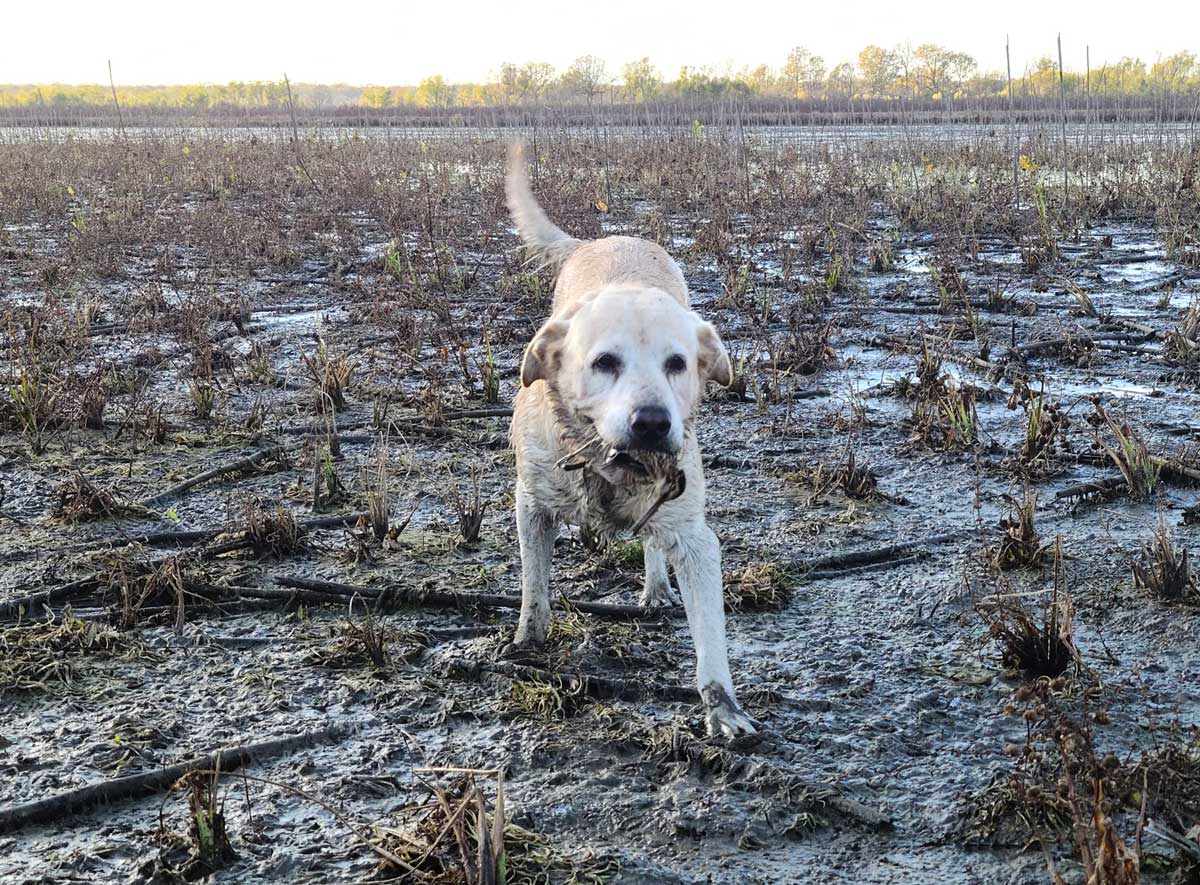
My friend, Jonathan Boone, is an enthusiastic snipe hunter. He, his two daughters, and his dog, Wrigley, frequent agricultural fields to which he has access. Dad, daughters and dog are all true devotees to the pursuit. Jonathan keeps a journal of each hunt, and I have been privileged to read some of his entries. Dates, weather conditions, specifics about shooting and bird availability—all there. He omits nothing. In one entry I recently read that Jonathan had titled, “Girls and a Snipe Limit,” the last few sentences read:
“Less than 50 yards in, a couple of snipe flushed and one fell to my shot. This caused 15 or 20 snipe to flush in singles and pairs. We took the easy shots and marveled at what was happening. What a day! Jonathan – 8; Wrigley – 8 retrieves.”
As it turns out, neglected birds hold promise for some grand experiences and, perhaps, should not be neglected after all.