
From the March/April 2015 Issue of Sporting Classics
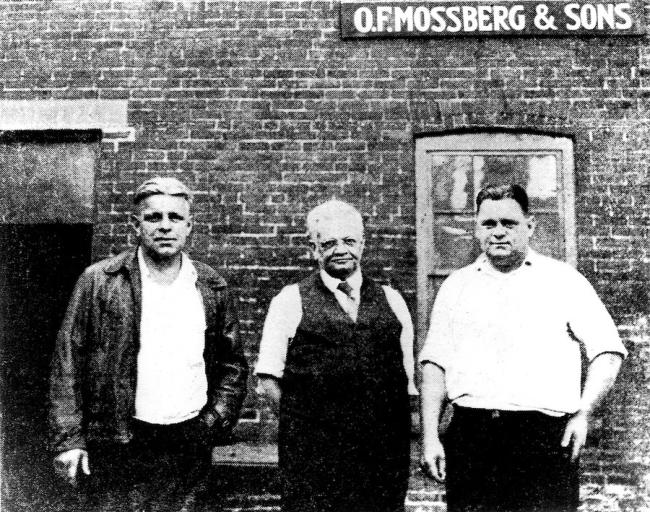
The Selous Game Reserve in southern Tanzania comprises more than 21,000 square miles and is one of the largest faunal reserves in the world. It’s named after the legendary English big-game hunter, explorer, and early conservationist, Sir Frederick Selous, and was officially established in 1922. That same year, O.F. Mossberg & Sons, a fledgling firearm manufacturer in New Haven, Connecticut, introduced its first rifle. ?
An unrelated coincidence or was there something in the heavens, some cosmic connection, between the two? Mossberg’s first rifle was a .22 pump — hardly the stuff of African legend. A connection seems unlikely. But then again . . .
Like Samuel Colt, Oscar F. Mossberg was a born tinkerer with an innate fascination for mechanical devices — how they were assembled, worked, and could be improved. His passion, ingenuity, and skill in design and engineering later put an indelible stamp on the firearm company he launched.
Joining the great wave of immigrants of the era, Mossberg traveled to the United States in 1886 from his native Sweden and found work in New England’s burgeoning firearm industry with the firm of Iver-Johnson Arms and Cycle Works in Fitchburg, Massachusetts. In 1893, Mossberg earned (jointly with Iver Johnson) a firearm patent, his first, for a barrel strap catch — a spring-loaded lever-and-arm catch for the Iver-Johnson top-break pistols.
Coincidentally, Sir Frederick Courteney Selous was awarded the Royal Geographical Society’s Founder’s Medal that same year for exploring and surveying vast stretches of previously uncharted Africa. These events, in a sense, marked the start of one career and gave due recognition to the life-long accomplishments of another.
Oscar Mossberg continued his broad and varied education in the firearms industry with stints at the Shattuck Arms Company and the J. Stevens Arms & Tool Company (later purchased by Savage Arms), which gave him hands-on experience in the design and manufacture of rifles and telescopic sights. In 1916, as World War I raged in Europe, Mossberg accepted a position with the Marlin-Rockwell Corporation (later the Marlin Firearms Company), which focused on the deployment of a Colt machine gun for use on aircraft. The company assigned Oscar the challenging task of synchronizing the firing sequence of the machine gun with the rotation of the front-mounted propeller. Oscar developed a mechanism with both hydraulic and mechanical systems that allowed machine-gun use without firing bullets into the blades of the propeller.
Completed in 1917 and critically acclaimed by U.S. and Allied forces, some 40,000 Marlin Model 1917 aircraft machine guns were produced before the end of the war. No small feat for a designer whose previous experience had been with pocket pistols and sporting rifles. ?
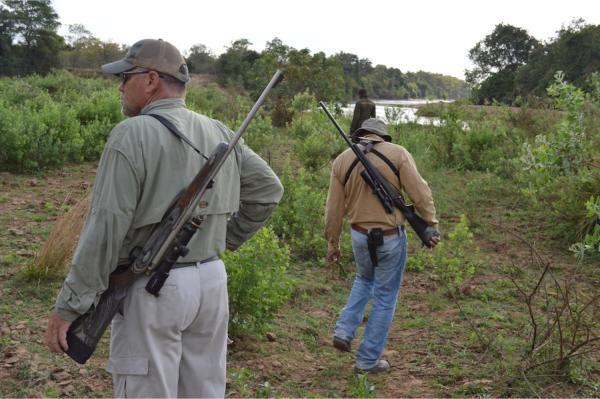
On their safari, the hunters carried Patriot rifles stocked in walnut or in various styles of composite.
On our second to last day, we finally spotted a herd of some 50 buffalo, but they had seen or winded us first. We began our stalk, but the buffalo outmaneuvered us, simply moving downwind and out of range irrespective of our angle of approach.
While the buffalo had the odds in their favor, we had an ace up our sleeve. This was Paul’s first trip to Africa and as every veteran hunter knows, there’s no luck like beginner’s luck. On the second day of the hunt, after a long stalk on a herd led by PH Werner Van Noordwy, they were able to isolate a good bull, but had to keep their distance to some 125 yards. Paul stayed steady and dropped the buffalo with one shot.
What a series of firsts! First African safari, first Cape buffalo, and the first hunter ever to kill one of the Big Five with Mossberg’s first dangerous-game rifle. Whatever hunts lie ahead for him, I’m sure Paul knows this is a trifecta that will be hard to top.
In between our stalks on buffalo, Tom Taylor had the opportunity to hunt plains game, making one-shot kills on impala, wildebeest, hartebeest, and more with a Patriot prototype chambered in .308 Winchester. It was game we all enjoyed for dinner back at camp, a traditional and most luxurious tent set-up run by legendary African PH Peter Chipman of Palahala Safaris.
On our last day Tom and I made a final try for buffalo, but to no avail. We had pushed hard through late afternoon and were happy to finally get back to the Land Cruiser. In the clear and crisp African evening it felt good to stand up in the truck, holding on to the roll-bar, our Patriot rifles cradled in racks below.
At some point I looked down at the rifles. No frills, but purpose-built to take on the world’s toughest game. A far cry, I mused, from the youth-model .22s and training rifles of Mossberg’s early years. It had been more than 90 years since the first Mossberg rifle rolled off the assembly line. A long time, but slung beneath me was one that could now rightfully take its place in African legend and lore.
When I looked up in the night sky, I saw that the Southern Cross was pointing our way back to camp. A coincidence? Or, had it been written in the stars all along?
For more information on Mossberg’s line of Patriot rifles, visit mossberg.com.