
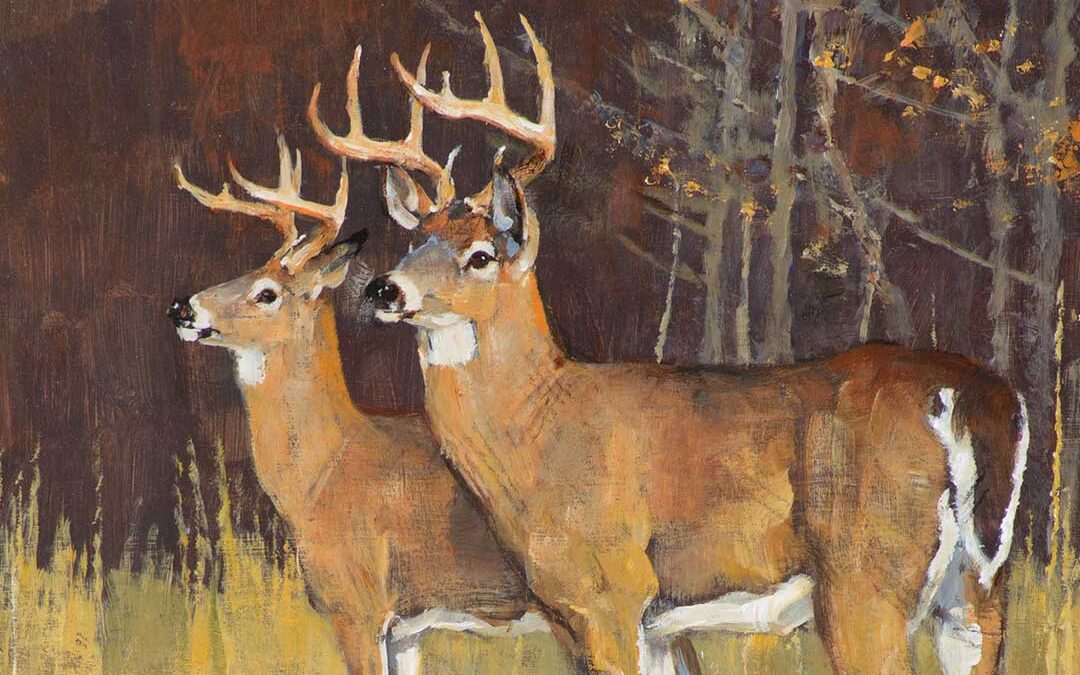
The week before Thanksgiving that year, one of the Old Man’s best buddies came down from Maryland to spend a piece with the family, and I liked him a whole lot right from the start. Probably it was because he looked like the Old Man—ragged mustache, smoked a pipe, built sort of solid, and he treated me like I was grown up too. He was interested in ’most everything I was doing. He admired my shotgun and told me a whole lot about the dogs and horses he had up on his big farm outside of Baltimore.
He and the Old Man had been friends for a whole lot of years; they had been all over the world, and they were always sitting out on the front porch, smoking and laughing quietly together over some devilment they’d been up to before I was born. I noticed they always shut up pretty quick when Miss Lottie, who was my grandma, showed up on the scene. Sometimes, when they’d come back from walking down by the river, I could smell a little ripe aroma around them that smelled an awful lot like the stuff that the Old Man kept in his room to keep the chills off him. The Old Man’s friend was named Mister Howard.
They were planning to pack up the dogs and guns and a tent and go off on a camping trip for a whole week, ’way into the woods behind Allen’s Creek, about 15 miles from town. They talked about it for days, fussing around with cooking gear, and going to the store to pick up this and that, and laying out clothes. They never said a word to me; they acted as if I wasn’t there at all. I was very good all the time. I never spoke at the table unless I was spoken to, and I never asked for more than I ate, and I kept pretty clean and neat, for me. My tongue was hanging out, like a thirsty hound dog’s. One day I couldn’t stand it any longer.
“I want to go, too,” I said. “You promised last summer you’d take me camping if I behaved myself and quit stealing your cigars and didn’t get drowned and—”
“What do you think, Ned?” Mister Howard asked the Old Man. “Think we could use him around the camp to do the chores and go for water and such as that?”
“I dunno,” the Old Man said. “He’d probably be an awful nuisance. Probably get lost and we’d have to go look for him, or shoot one of us thinking we were a deer, or get sick or bust a leg or something. He’s always breaking something. Man can’t read his paper around here for the sound of snapping bones.”
“Oh, hell, Ned,” Mister Howard said, “let’s take him. Maybe we can teach him a couple of things. We can always get Tom or Pete to run him back in the flivver, if he don’t behave.”
“Well,” the Old Man said grinning, “I’d sort of planned to fetch him along all along, but I was waiting to see how long it’d take him to ask.”
We crowded a lot of stuff into that old tin Liz. Mister Howard and the Old Man and me and two bird dogs and two hound dogs and a sort of fice dog who was death on squirrels and a big springer spaniel who was death on ducks. Then there were Tom and Pete, two kind of half-Indian backwoods boys who divided their year into four parts. They fished in the summer and hunted in the fall. They made corn liquor in the winter and drank it up in the spring. They were big, dark, lean men, very quiet and strong. Both of them always wore hip boots, in the town and in the woods, on the water or in their own back yards. Both of them worked for the Old Man when the fishing season was on and the pogies were running in big, red, fat-backed schools. They knew just about everything about dogs and woods and water and game that I wanted to know.
The back seat was full of dogs and people and cooking stuff and guns. There were a couple of tents strapped on top of the Liz, a big one and a small one. That old tin can sounded like a boiler factory when we ran over the bumps in the corduroy clay road. I didn’t say anything as we rode along. I was much too excited; and anyhow, I figured they might decide to send me back home.
It took us a couple of hours of bumping through the long, yellow, savanna-land hills before we came to a big pond, about 500 yards from a swamp, or branch, with a clear creek running through it. We drove the flivver up under a group of three big water oaks and parked her. The Old Man had camped there lots before, he said. There was a cleared-out space of clean ground about 50 yards square between the trees and the branch. And there was a small fireplace, or what had been a small fireplace, of big stones. They were scattered around now, all over the place. A flock of tin cans and some old bottles and such had been tossed off in the bush.
“Damned tourists,” the Old Man muttered, unloading some tin pots and pans from the back of the car. “Come in here to a man’s best place and leave it looking like a hog wallow. You, son, go pick up those cans and bury them some place out of my sight. Then come back here and help with the tents.”
By the time I finished collecting the mess and burying it, the men had the tents laid out flat on the ground, the flaps fronting south, because there was a pretty stiff northerly wind working, and facing in the direction of the pond. Tom crawled under the canvas with one pole and a rope, and Pete lifted the front end with another pole and the other end of the rope. Mister Howard was behind with the end of Tom’s rope and a peg and a maul. The Old Man was at the front with the end of Pete’s rope and another stake and maul. The boys in the tent gave a heave, set the posts, and the two old men hauled taut on the ropes and took a couple of turns around the pegs.
The tent hung there like a blanket on a clothesline until Tom and Pete scuttled out and pegged her out stiff and taut from the sides. They pounded the pegs deep into the dirt, so that the lines around the notches were clean into the earth. It was a simple tent, just a canvas V with flaps fore and aft, but enough to keep the wet out. The other one went up the same way.
We didn’t have any bedrolls in those days, or cots either. The Old Man gave me a hatchet and sent me off to chop the branches of the longleaf pine saplings that grew all around—big green needles a foot and a half long. While I was gone he cut eight pine stakes off an old stump, getting a two-foot stake every time he slivered off the stump, and then he cut four long oak saplings. He hammered the stakes into the ground inside the tent until he had a wide rectangle about six by eight feet. Then he split the tops of the stakes. He wedged two saplings into the stakes lengthwise, jamming them with the flat of the ax, and then he jammed two shorter saplings into the others, crosswise. He took four short lengths of heavy fishing cord and tied the saplings to the stakes, at each of the four corners, until he had a framework, six inches off the ground.
“Gimme those pine boughs,” he said to me, “and go fetch more until I tell you to stop.”
The Old Man took the fresh-cut pine branches, the resin still oozing stickily off the bright yellow slashes, and started shingling them, butt to the ground. He overlapped the needles like shingles on a house, always with the leaf end up and the branch end down to the ground. It took him about 15 minutes, but when he finished he had a six-by-eight mattress of the spicy-smelling pine boughs. Then he took a length of canvas tarpaulin and arranged it neatly over the top. There were little grommet holes in each of the four comers, and he pegged the canvas tight over the tops of the saplings that confined the pine boughs. When he was through, you could hit it with your hand and it was springy but firm.
“That’s a better mattress than your grandma’s got,” the Old Man said, grinning over his shoulder as he hit the last lick with the ax. “All it needs is one blanket under you and one over you. You’re off the ground, and dry as a bone, with pine needles to smell while you dream. It’s just big enough for two men and a boy. The boy gets to sleep in the middle, and he better not thrash around and snore.”
By the time he was through and I had spread the blankets, and Tom and Pete had made themselves a bed in the other tent, just the same way. The whole operation didn’t take half an hour from stopping the car until both tents and beds were ready.
While we were building the beds, Mister Howard had strung a line between a couple of trees and had tied a loop in the long leash of each dog, running the loop around the rope between the trees and jamming it with a square knot. The dogs had plenty of room to move in, but not enough to tangle up with each other, and not enough to start to fight when they got fed. They had just room enough between each dog to be sociable and growl at each other without starting a big rumpus. Pretty soon they quit growling and lay down quietly.
We had two big canvas water bags tied to the front of the flivver, and the Old Man gestured at them.
“Boys have to handle the water detail in a man’s camp,” he said. “Go on down to the branch and fill ’em up at that little spillway. Don’t roil up the water. Just stretch the necks and let the water run into the bags.”
I walked down through the short yellow grass and the sparkleberry bushes to the branch, where you could hear the stream making little chuckling noises as it burbled over the rocks in its sandy bed. It was clear, brown water, and smelled a little like the crushed ferns and the wet brown leaves around it and in it. When I got back, I could hear the sound of axes off in a scrub-oak thicket, where Tom and Pete had gone to gather wood. Mister Howard was sorting out the guns, and the Old Man was puttering around with the stones where the fire marks were. He didn’t look up.
“Take the hatchet and go chop me some kindling off that lightered-knot stump,” he said. “Cut ’em small, and try not to hit a knot and chop off a foot. Won’t need much, ’bout an armful.”
When I got back with kindling, Tom and Pete were coming out of the oak thicket with huge, heaping armfuls of old dead branches and little logs as big as your leg. They stacked them neatly at a respectable distance from where the Old Man had just about finished his oven. It wasn’t much of an oven—just three sides of stones, with one end open and a few stones at intervals in the middle. I dumped the kindling down by him, and he scruffed up an old newspaper and rigged the fat pine on top in a little sharp-pointed tepee over the crumpled paper.
He put some small sticks of scrubby oak crisscross over the fat pine, and then laid four small logs, their ends pointing in to each other until they made a cross, over the stones and over the little wigwam of kindling he had erected. Then he touched a match to the paper, and it went up in a poof. The blaze licked into the resiny lighterwood, which roared and crackled into flame, soaring in yellow spurts up to the other, stouter kindling and running eager tongues around the lips of the logs. In five minutes it was roaring, reflecting bright red against the stones.
The Old Man got up and kicked his feet out to get the cramp out of his knees. It was just on late dusk. The sun had gone down, red over the hill, and the night chill was coming. You could see the fog rising in snaking wreaths out of the branch. The frogs were beginning to talk, and the night birds were stirring down at the edge of the swamp. A whippoorwill tuned up.
“ ’Bout time we had a little snort, Howard,” the Old Man said. “It’s going to be chilly. Pete! Fetch the jug!”
Pete ducked into his tent and came out with a half-gallon jug of brown corn liquor. Tom produced four tin cups from the nest of cooking utensils at the foot of the tree on which they had hung the water bags, and each man poured a half-measure of the whisky into his cup. I reckoned there must have been at least half a pint in each cup. Tom got one of the water bags and tipped it into the whisky until each man said, “Whoa.” They drank and sighed.
The Old Man cocked an eye at me and said, “This is for when you’re bigger.”
They had another drink before the fire had burned down to coals, with either Tom or Pete getting up to push the burning ends of the logs closer together. When they had a solid bed of coals glowing in the center of the stones, the Old Man heaved himself up and busied himself with a frying pan and some paper packages. He stuck a coffee pot off to one side, laid out five tin plates, dribbled coffee into the pot, hollered for me to fetch some water to pour into the pot, started carving up a loaf of bread, and slapped some big thick slices of ham into the frying pan.
When the ham was done, he put the slices, one by one, into the tin plates, which had warmed through from the fire, and laid slices of bread into the bubbling ham grease. Then he broke egg after egg onto the bread, stirred the whole mess into a thick, bread-egg-and-ham-grease omelet, chopped the omelet into sections, and plopped each section onto a slice of ham. He poured the steaming coffee into cups, jerked his thumb at a can of condensed milk and a paper bag of sugar, and announced that dinner was served.
He had to cook the same mess three more times and refill the coffee pot before we quit eating. It was black dark, with no moon, when we lay back in front of the fire. The owls were talking over the whippoorwills, and the frogs were making an awful fuss.
The Old Man gestured at me. “Take the dirty dishes and the pans down to the branch and wash ’em,” he said. “Do it now, before the grease sets. You won’t need soap. Use sand. Better take a flashlight, and look out for snakes.”
I was scared to go down there by myself, through that long stretch of grass and trees leading to the swamp, but I would have died before admitting it. The trees made all sorts of funny, ghostly figures, and the noises were louder. When I got back, Mister Howard was feeding the dogs and the Old Man had pushed more logs on the fire.
“You better go to bed, son,” the Old Man said. “Turn in in the middle. We’ll be up early in the morning and maybe get us a turkey.”
I pulled off my shoes and crawled under the blanket. I heard the owl hoot again and the low mutter from the men, giant black shapes sitting before the fire. The pine-needle mattress smelled wonderful under me, and the blankets were warm. The fire pushed its heat into the tent, and I was as full of food as a tick. Just before I died, I figured that tomorrow had to be heaven.
It was awful cold when the Old Man hit me a lick in the ribs with his elbow and said, “Get up, boy, and fix that fire.
The stars were still up, frosty in the sky, and a wind was whistling round the corners of the tent. You could see the fire flicker just a mite against the black background of the swamp. Mister Howard was still snoring on his side of the pine-needle-canvas bed, and I remember that his mustache was riffling, like marsh grass in the wind. Over in Tom and Pete’s tent you could hear two breeds of snores. One was squeaky, and the other sounded like a bull caught in a bob-wire fence. I crawled out from under the covers, shivering, and jumped into my hunting boots, which were stiff and very cold. Everything else I owned I’d slept in.
The fire was pretty feeble. It had simmered down into gray ash, which was swirling loosely in the morning breeze. There was just a little red eye blinking underneath the ashes. After kicking some of the ashes aside with my boot, I put a couple of lighter-wood knots on top of the little chunk of glowing coal, and then I dragged some live oak logs over the top of the lighter-wood and waited for her to catch. She caught, and the tiny teeth of flame opened wide to eat the oak. In five minutes I had a blaze going, and I was practically in it. It was mean cold that morning.
When the Old Man saw the fire dancing, he woke up Mister Howard and reached for his pipe first and his boots next. Then he reached for the bottle and poured himself a dram in a tin cup. He shuddered some when the dram went down.
“I heartily disapprove of drinking in the morning,” he said. “Except some mornings. It takes a man past sixty to know whether he can handle his liquor good enough to take a nip in the morning. Howard?”
“I’m past sixty too,” Mister Howard said. “Pass the jug.” Tom and Pete were coming out of the other tent, digging their knuckles into sleepy eyes. Pete went down to the branch and fetched a bucket of water, and everybody washed their faces out of the bucket. Then Pete went to the fire and slapped some ham into the pan and some eggs into the skillet, set some bread to toasting, and put the coffee pot on. Breakfast didn’t take long. We had things to do that day.
After the second cup of coffee—I can still taste that coffee, with the condensed milk sweet and curdled on the top and the coffee itself tasting of branch water and wood smoke—we got up and started sorting out the guns.
“This is a buckshot day,” the Old Man said, squinting down the barrel of his pump gun. “I think we better get us a deer today. Need meat in the camp, and maybe we can blood the boy. Tom, Pete, you all drive the branch. Howard, we’ll put the boy on a stand where a buck is apt to amble by, and then you and I will kind of drift around according to where the noise seems headed. One, t’other of us ought to get a buck. This crick is populous with deer.”
The Old Man paused to light his pipe, and then he turned around and pointed the stem at me.
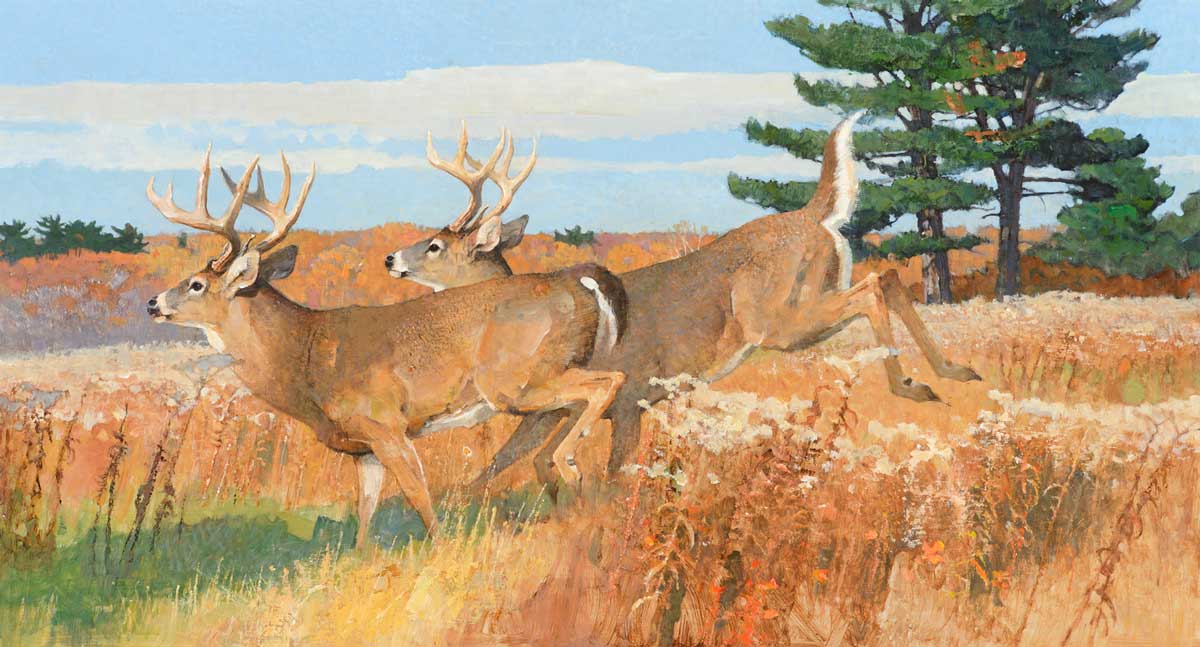
October Prime by Bob Kuhn
“You, boy,” he said. “By this time you know a lot about guns, but you don’t know a lot about guns and deer together. Many a man loses his wits when he sees a big ol’ buck bust out of the bushes with a rockin’ chair on his head. Trained hunters shoot each other. They get overexcited and just bang away into the bushes. Mind what I say. A deer ain’t a deer unless it’s got horns on its head and you can see all of it at once. We don’t shoot does and we don’t shoot spike bucks and we don’t shoot each other. There ain’t no sense to shootin’ a doe or a young’un. One buck can service hundreds of does, and one doe will breed you a mess of deer. If you shoot a young’un, you haven’t got much meat, and no horns at all, and you’ve kept him from breedin’ to make more deer for you to shoot. If you shoot a man, they’ll likely hang you, and if the man is me I will be awful gol-damned annoyed and come back to ha’nt you. You mind that gun, and don’t pull a trigger until you can see what it is and where it is. Mind, I say.”
Tom and Pete picked up their pump guns and loaded them. They pushed the load lever down so there’d be no shell in the chamber, but only in the magazine. The Old Man looked at my little gun and said, “Don’t bother to load it until you get on the stand. You ain’t likely to see anything to shoot for an hour or so.”
Tom and Pete went over to where we had the dogs tethered on a line strung between two trees, and he unleashed the two hounds, Bell and Blue. Bell was black-and-tan and all hound. Blue was a kind of a sort of dog. He had some plain hound, some Walker hound, and some bulldog and a little beagle and a smidgen of pointer in him. He was ticked blue and brown and black and yellow and white. He looked as if somebody spilled the eggs on the checkered tablecloth. But he was a mighty dandy deer dog, or so they said. Old Sam Watts, across the street, used to say there wasn’t no use trying to tell Blue anything, because Blue had done forgot more than you knew and just got annoyed when you tried to tell him his business.
Tom snapped a short lead on Blue, and Pete snapped another one on Bell. They shouldered their guns and headed up the branch, against the wind. We let ’em walk, while the Old Man and Mister Howard puttered around, like old people and most women will. Drives a boy crazy. What I wanted to do was go and shoot myself a deer. Now.
After about ten minutes the Old Man picked up his gun and said, “Let’s go.” We walked about half a mile down the swamp’s edge. The light had come now, lemon-colored, and the fox squirrels were beginning to chase each other through the gum trees. We spied one old possum in a persimmon tree, hunched into a ball and making out like nobody knew he was there. We heard a turkey gobble away over yonder somewheres, and we could hear the doves beginning to moan—oooh—oohoo —oooooh.
All the little birds started to squeak and chirp and twitter at each other. The dew was staunchly stiff on the grass and on the sparkleberry and gallberry bushes. It was still cold, but getting warmer, and breakfast had settled down real sturdy in my stomach. Rabbits jumped out from under our feet. We stepped smack onto a covey of quail just working its way out of the swamp, and they like to have scared me to death when they busted up under our feet. There was a lot going on in that swamp that morning.
We turned into the branch finally, and came up to a track that the Old Man said was a deer run. He looked around and spied a stump off to one side, hidden by a tangle of dead brush. From the stump you could see clear for about fifty yards in a sort of accidental arena.
“Go sit on that stump, boy,” the Old Man said. “You’ll hear the dogs after a while, and if a deer comes down this branch he’ll probably bust out there, where that trail comes into the open, because there ain’t any other way he can cross it without leaving the swamp. Don’t let the dogs fool you into not paying attention. When you hear ’em a mile away, the chances are that deer will be right in your lap. Sometimes they travel as much as two miles ahead of the dogs, just slipping along, not running; just slipping and sneaking on their little old quiet toes. And stay still. A deer’ll run right over you if you stay still and the smell is away from him. But if you wink an eye, he can see it two hundred yards off, and will go the other way.”
I sat down on the stump. The Old Man and Mister Howard went off, and I could hear them chatting quietly as they disappeared. I looked all around me. Nothing much was going on now, except a couple of he-squirrels were having a whale of a fight over my head, racing across branches and snarling squirrel cuss words at each other. A chickadee was standing on its head in a bush and making chickadee noises. A redheaded woodpecker was trying to cut a live oak trunk in half with his bill. A rain crow—a kind of cuckoo, it is—was making dismal noises off behind me in the swamp, and a big old yellowhammer was swooping and dipping from tree to tree.
There were some robins hopping around on a patch of burnt ground, making conversation with each other. Crows were cawing, and two doves looped in to sit in a tree and chuckle at each other. A towhee was scratching and making more noise than a herd of turkeys, and some catbirds were meowing in the low bush while a big, sassy old mocker was imitating them kind of sarcastically. Anybody who says woods are quiet is crazy. You learn how to listen. The Tower of Babel was a study period alongside of woods in the early morning.
It is wonderful to smell the morning. Anybody who’s been around the woods knows that morning smells one way, high noon another, dusk still another, and night most different of all, if only because the skunks smell louder at night. Morning smells fresh and flowery, a little breezy and dewy and spanking new. Noon smells hot and a little dusty and sort of sleepy, when the breeze has died and the heads begin to droop and anything with any sense goes off into the shade to take a nap. Dusk smells scary. It is getting colder and everybody is going home tired for the day, and you can smell the turpentine scars on the trees and the burnt-off ground and the bruised ferns and the rising wind. You can hear the folding-up, I’m-finished-for-the-day sounds all around, including the colored boys whistling to prove they ain’t scared when they drive the cows home. And in the night you can smell the fire and the warm blankets and the coffee a-boil, and you can even smell the stars. I know that sounds silly, but on a cool, clear, frosty night the stars have a smell, or so it seems when you are young and acutely conscious of everything bigger than a chigger.
This was as nice a smelling morning as I can remember. It smelled like it was going to work into a real fine-smelling day. The sun was up pretty high now and was beginning to warm the world. The dew was starting to dry, because the grass wasn’t clear wet any more but just had little drops on top, like a kid with a runny nose. I sat on the stump for about a half-hour, and then I heard the dogs start, a mile or more down the swamp. Bell picked up the trail first, and she sounded as if church had opened for business. Then Blue came in behind her, loud as an organ, their two voices blending—fading sometimes, getting stronger, changing direction always.
Maybe you never heard a hound in the woods on a frosty fall morning, with the breeze light, the sun heating up in the sky, and the “aweful” expectancy that something big was going to happen to you. There aren’t many things like it. When the baying gets closer and closer and still closer to you, you feel as if maybe you’re going to explode if something doesn’t happen quick. And when the direction changes and the dogs begin to fade, you feel so sick you want to throw up.
But Bell and Blue held the scent firmly now, and the belling was clear and steady. The deer was moving steady and straight, not trying to circle and fool the dogs, but honestly running. And the noise was coming straight down the branch, with me on the other end of it.
The dogs had come so close that you could hear them panting between their bays, and once or twice one of them quit sounding and broke into a yip-yap of barks. I could hear a little tippety-tappety noise ahead of them, in between the belling and the barking, like mice running through paper or a rabbit hopping through dry leaves. I kept my eyes pinned onto where the deer path opened into the clearing. The dogs were so close that I could hear them crash.
All of a sudden there was a flash of brown and two does, flop-eared, with two half-grown fawns skipped out of the brush, stopped dead in front of me, looked me smack in the face, and then gave a tremendous leap that carried them halfway across the clearing. They bounced again, white tails carried high, and disappeared into the branch behind me. As I turned to watch them go there was another crash ahead and the buck tore through the clearing like a racehorse. He wasn’t jumping. This boy was running like the wind, with his horns laid back against his spine and his ears pinned by the breeze he was making. The dogs were right behind him. He had held back to tease the dogs into letting his family get a start, and now that they were out of the way he was pouring on the coal and heading for home.
I had a gun with me and the gun was loaded. I suppose it would have fired if the thought had occurred to me to pull the trigger. The thought never occurred. I just watched that big buck deer run, with my mouth open and my eyes popped out of my head.
The dogs tore out of the bush behind the buck, baying out their brains and covering the ground in leaps. Old Blue looked at me as he flashed past and curled his lip. He looked as if he were saying, “This is man’s work, and what is a boy doing here, spoiling my labor?” Then he dived into the bush behind the buck.
I sat there on the stump and began to shake and tremble. About five minutes later there was one shot, a quarter-mile down the swamp. I sat on the stump. In about half an hour Tom and Pete came up to my clearing.
“What happened to the buck?” Pete said. “Didn’t he come past here? I thought I was going to run him right over you.” “He came past, all right,” I said, feeling sick-mean, “but I never shot. I never even thought about it until he was gone. I reckon you all ain’t ever going to take me along any more.” My lip was shaking and now I was about to cry.
Tom walked over and hit me on top of the head with the flat of his hand. “Happens to everybody,” he said. “Grown men and boys, both, they all get buck fever. Got to do it once before you get over it. Forget it. I seen Pete here shoot five times at a buck big as a horse last year, and missed him with all five.”
There were some footsteps in the branch where the deer had disappeared, and in a minute Mister Howard and the Old Man came out, with the dogs leashed and panting.
“Missed him clean,” the Old Man said cheerfully. “Had one whack at him no farther’n thirty yards and missed him slick as a whistle. That’s the way it is, but there’s always tomorrow. Let’s us go shoot some squirrels for the pot, and we’ll rest the dogs and try again this evenin’. You see him, boy?”
“I saw him,” I said. “And I ain’t ever going to forget him.”
We went back to camp and tied up the hounds. We unleashed the fice dog, Jackie, the little sort of yellow fox terrier kind of nothing dog with prick ears and a sharp fox’s face and a thick tail that curved up over his back. I was going with Pete to shoot some squirrels while the old gentlemen policed up the camp, rested, took a couple of drinks, and started to prepare lunch. It was pretty late in the morning for squirrel hunting, but this swamp wasn’t hunted much. While I had been on the deer stand that morning the swamp was alive with them—mostly big fox squirrels, huge old fellers with a lot of black on their gray- and-white hides.
“See you don’t get squirrel fever,” the Old Man hollered over his shoulder as Pete and I went down to the swamp. “Else we’ll all starve to death. I’m about fresh out of ham and eggs.” “Don’t pay no ’tention to him, son,” Pete told me. “He’s a great kidder.”
“Hell with him,” I said. “He missed the deer, didn’t he? At least I didn’t miss him.”
“That’s right,” Pete agreed genially. “You got to shoot at ’em to miss ’em.”
I looked quick and sharp at Pete. He didn’t seem to be teasing me. A cigarette was hanging off the corner of his lip, and his lean, brown, Injun-looking face was completely straight. Then we heard Jackie, yip-yapping in a querulous bark, as if somebody had just insulted him by calling him a dog.
“Jackie done treed hisself a squirrel,” Pete said. “Advantage of a dog like Jackie is that when the squirrels all come down to the ground to feed, ol’ Jackie rousts ’em up and makes ’em head for the trees. Then he makes so much noise he keeps the squirrel interested while we go up and wallop away at him. Takes two men to hunt squirrels this way. Jackie barks. I go around to the other side of the tree. Squirrel sees me and moves. That’s when you shoot him, when he slides around on your side. Gimme your gun.”
“Why?” I asked. “What’ll I use to shoot the—”
“Mine Pete answered. “You ain’t going to stand there and tell me you’re gonna use a shotgun on a squirrel? Anybody can hit a poor little squirrel with a shotgun. Besides, shotgun shells cost a nickel apiece.”
I noticed Pete’s gun for the first time. He had left his pump gun in camp and had a little bolt-action .22. He took my shotgun from me and handed me the .22 and a handful of cartridges.
“ ’Nother thing you ought to know,” Pete said as we walked up to the tree, a big blue gum under which Jackie seemed to be going mad, “is that when you’re hunting for the pot you don’t want to make much more noise with guns than is necessary. You go booming off a shotgun, blim-blam, and you spook ever’ thing in the neighborhood. A .22 don’t make no more noise than a stick crackin’, and agin the wind you can’t hear it more’n a hundred yards or thereabouts. Best meat gun in the world, a straight-shootin’ .22, because it don’t make no noise and don’t spoil the meat. Look up yonder, on the fourth fork. There’s your dinner. A big ol’ fox squirrel, near-about black all over.”
The squirrel was pasted to the side of the tree. Pete walked around, and the squirrel moved with him. When Pete was on the other side, making quite a lot of noise, the squirrel shifted back around to my side. He was peeping at Pete, but his shoulders and back and hind legs were on my side. I raised the little .22 and plugged him between the shoulders. He came down like a sack of rocks. Jackie made a dash for him, grabbed him by the back, shook him once and broke his spine, and sort of spit him out on the ground. The squirrel was dang near as big as Jackie.
Pete and I hunted squirrels for an hour or so, and altogether we shot ten. Pete said that was enough for five people for a couple of meals, and there wasn’t no sense to shootin’ if the meat had to spoil. “We’ll have us some venison by tomorrow, anyways,” he said. “One of us is bound to git one. You shot real nice with that little bitty gun,” he said. “She’ll go where you hold her, won’t she?”
I felt pretty good when we went into camp and the Old Man, Mister Howard, and Tom looked up inquiringly. Pete and I started dragging fox squirrels out of our hunting coats, and the ten of them made quite a sizable pile.
“Who shot the squirrels?” the Old Man asked genially. “The dog?”
“Sure,” Pete grinned. “Dog’s so good we’ve taught him to shoot, too. We jest set down on a log, give Jackie the gun, and sent him off into the branch on his lonesome. We’re planning to teach him to skin ’em and cook ’em, right after lunch. This is the best dog I ever see. Got more sense than people.”
“Got more sense than some people,” the Old Man grunted. “Come and git it, boy, and after lunch you and Jackie can skin the squirrels.”
The lunch was a lunch I loved then and still love, which is why I’m never going to be called one of those epicures. This was a country hunting lunch, Carolina style. We had Vienna sausages and sardines, rat cheese, gingersnaps and dill pickles and oysterettes and canned salmon, all cold except the coffee that went with it, and that was hot enough to scald clean down to your shoes. It sounds horrible, but I don’t know anything that tastes so good together as Vienna sausages and sardines and rat cheese and gingersnaps. Especially if you’ve been up since before dawn and walked ten miles in the fresh air.
After lunch we stretched out in the shade and took a little nap. Along about two I woke up, and so did Pete and Tom, and the three of us started to skin the squirrels. It’s not much trouble, if you know how. Pete and I skinned ’em and Tom cleaned and dressed ’em. I’d pick up a squirrel by the head, and Pete would take his hind feet. We’d stretch him tight, and Pete would slit him down the stomach and along the legs as far as the feet. Then he’d shuck him like an ear of corn, pulling the hide toward the head until it hung over his head like a cape and the squirrel was naked. Then he’d just chop off the head, skin and all, and toss the carcass to Tom.
Tom made a particular point about cutting the little castor glands. Squirrel with the musk glands out is as tasty as any meat I know, but unless you take out those glands an old he- squirrel is as musky as a billy goat, and tastes like a billy goat smells. Tom cut up the carcasses and washed them clean, and I proceeded to bury the heads, hides, and guts.
The whole job didn’t take 45 minutes with the three of us working. We put the pieces of clean red meat in a covered pot, and then woke up the Old Man and Mister Howard. We were going deer hunting again.
The dogs had rested too; they’d eaten half-a-can of salmon each and had a three hours’ snooze. It was beginning to cool off when Tom and Pete put Blue and Bell on walking leashes and we struck off for another part of the swamp, which made a Y from the main swamp and had a lot of water in it. It was a cool swamp, and Tom and Pete figured that the deer would be lying up there from the heat of the day, and about ready to start stirring out to feed a little around dusk.
I was in the process of trying to think about just how long forever was when the hounds started to holler real close. They seemed to be coming straight down the crick off to my right, and the crick’s banks were very open and clear, apart from some sparkleberry and gallberry bushes. The whoo-whooing got louder and louder. The dogs started to growl and bark, just letting off a woo-woo once in a while, and I could hear a steady swishing in the bushes.
Then I could see what made the swishing. It was a buck, a big one. He was running steadily and seriously through the low bush. He had horns—my Lord, but did he have horns! It looked to me like he had a dead tree lashed to his head. I slipped off the safety catch and didn’t move. The buck came straight at me, the dogs going crazy behind him.
The buck came down the water’s edge, and when he got to about 50 yards I stood up and threw the gun up to my face. He kept coming and I let him come. At about 25 yards he suddenly saw me, snorted, and leaped to his left as if somebody had unsnapped a spring in him. I forgot he was a deer. I shot at him as you’d lead a duck or a quail on a quartering shot—plenty of lead ahead of his shoulder.
I pulled the trigger—for some odd reason shooting the choke barrel—right in the middle of a spring that had him six feet off the ground and must have been wound up to send him 20 yards, into the bush and out of my life. The gun said boom! but I didn’t hear it. The gun kicked but I didn’t feel it. All I saw was that this monster came down out of the sky like I’d shot me an airplane. He came down flat, turning completely over and landing on his back, and he never wiggled.
The dogs came up ferociously and started to grab him, but they had sense and knew he didn’t need any extra grabbing. I’d grabbed him real good, with about three ounces of No. 1 buckshot in a choke barrel. I had busted his shoulder and busted his neck and dead-centered his heart. I had let him get so close that you could practically pick the wads out of his shoulder. This was my buck. Nobody else had shot at him. Nobody else had seen him but me. Nobody had advised or helped. This monster was mine.
And monster was right. He was huge, they told me later, for a Carolina whitetail. He had 14 points on his rack, and must have weighed nearly 150 pounds undressed. He was beautiful gold on his top and dazzling white on his underneath, and his little black hoofs were clean. The circular tufts of hair on his legs, where the scent glands are, were bright russet and stiff and spiky. His horns were as clean as if they’d been scrubbed with a wire brush, gnarled and evenly forked and the color of planking on a good boat that’s just been holystoned to where the decks sparkle.
I had him all to myself as he lay there in the aromatic, crushed ferns—all by myself, like a boy alone in a big cathedral of oaks and cypress in a vast swamp where the doves made sobbing sounds and the late birds walked and talked in the sparkleberry bush. The dogs came up and lay down. Old Blue laid his muzzle on the big buck’s back. Bell came over and licked my face and wagged her tail, like she was saying, “You did real good, boy.” Then she lay down and put her face right on the deer’s rump.
This was our deer, and no damn bear or anything else was going to take it away from us. We were a team, all right, me and Bell and Blue.
I couldn’t know then that I was going to grow up and shoot elephants and lions and rhinos and things. All I knew then was that I was the richest boy in the world as I sat there in the crushed ferns and stroked the silky hide of my first buck deer, patting his horns and smelling how sweet he smelled and admiring how pretty he looked. I cried a little bit inside about how lovely he was and how I felt about him. I guess that was just reaction, like being sick twenty-five years later when I shot my first African buffalo.
I was still patting him and patting the dogs when Tom and Pete came up one way and the Old Man and Mister Howard came up from another way. What a wonderful thing it was. When you are a kid, to have four huge, grown men—everything is bigger when you are a boy—come roaring up out of the woods to see you sitting by your first big triumph. “Smug” is a word I learned a lot later. Smug was modest for what I felt then.
“Well,” the Old Man said, trying not to grin.
“Well,” Mister Howard said.
“Boy done shot hisself a horse with horns,” Pete said, as proud for me as if I had just learned how to make bootleg liquor.
“Shot him pretty good, too,” Tom said. “Deer musta been standing still, boy musta been asleep, woke up, and shot him in self-defense.”
“Was not, either,” I started off to say, and then saw that all four men were laughing.
They had already checked the sharp scars where the buck had jumped, and they knew I had shot him on the fly. Then Pete turned the buck over and cut open his belly. He tore out the paunch and ripped it open. It was full of green stuff and awful smelly gunk. All four men let out a whoop and grabbed me. Pete held the paunch and the other men stuck my head right into—blood, guts, green gunk, and all. It smelled worse than anything I ever smelled. I was bloody and full of partly digested deer fodder from my head to my belt.
“That,” the Old Man said as I swabbed the awful mess off me and dived away to stick my head in the crick, “makes you a grown man. You have been blooded, boy, and any time you miss a deer from now on we cut off your shirt tail. It’s a very good buck, son,” he said softly, “one of which you can be very, very proud.”
Tom and Pete cut a long sapling, made slits in the deer’s legs behind the cartilage of his knees, stuck the sapling through the slits, and slung the deer up on their backs. They were sweating him through the swamp when suddenly the Old Man turned to Mister Howard and said, “Howard, if you feel up to it, we might just as well go get our deer and lug him into camp. He ain’t but a quarter-mile over yonder, and I don’t want the wildcats working on him in that tree.”
“What deer?” I demanded. “You didn’t shoot this afternoon, and you missed the one you . . . ”
The Old Man grinned and made a show of lighting his pipe. “I didn’t miss him, son,” he said. “I just didn’t want to give you an inferiority complex on your first deer. If you hadn’t of shot this one—and he’s a lot better’n mine—I was just going to leave him in the tree and say nothing about him at all. Shame to waste a deer, but it’s a shame to waste a boy, too.”
I reckon that’s when I quit being a man. I just opened my mouth and bawled. Nobody laughed at me, either.
Editor’s Note: “Mister Howard was a Real Gent,” ©1957 by Robert Ruark, © renewed 1984 by the Estate of Robert Ruark. Reprinted by permission of the Harold Matson Co., Inc. All Rights Reserved.
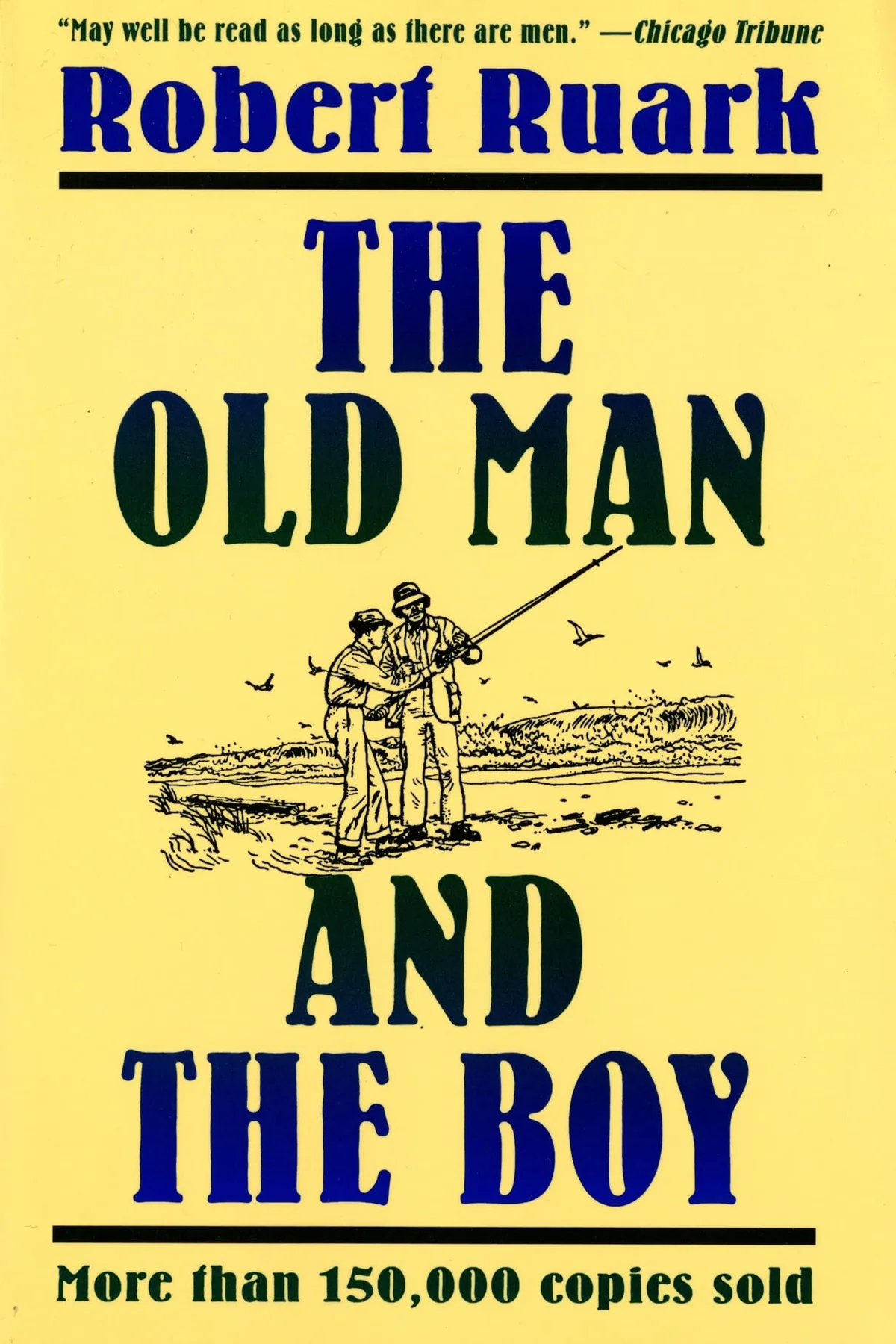 This timeless classic, originally published in 1957 and never out of print, tells the story of a remarkable friendship between a young boy and his grandfather. The Old Man and the boy hunt the woods and fields of North Carolina together; they fish the lakes, ponds, and sea. All the while the Old Man acts as teacher and guide, passing on his wisdom and life experiences to his grandson, who listens in rapt fascination. Buy Now