
The following is Chapter 1 from Jim Spencer’s latest book A Life Well Misspent. With a keen eye for detail and a deep connection to the natural world, Spencer invites you to walk in his footsteps, feel the thrill (and disappointments) of the hunt, the serenity of quiet streams and the satisfaction of a life well-lived. Order your copy today!
Seven hours and 22 minutes before I sat down to write this… this… whatever this thing I’m writing is going to be, I pulled the trigger on a fine gobbler. Seven hours, 21 minutes and 59 seconds before I sat down here, I watched that gobbler fly away through the greening April woods. I don’t usually write about my hunts so soon after they happen (except of course in my turkey journal,) but I wanted to commit this to print while the remorse and recrimination still weigh heavy on my shoulders. I tend to be more truthful – and thus harder on myself – when tragedy is still fresh.
Today’s was a late-morning hunt. After eight straight mornings of early alarm clocks and long hours walking the hills and hollers of the north Arkansas Ozarks (two days scouting and six days hunting,) Jill and I decided to take a day off to catch up, both on sleep and on the inevitable accumulation of dreck and detritus that piles up around you when you cease tending to it. My plan was to not hunt at all today, but that good intention became yet another paving stone on the proverbial road. I tried, I really did, but by 9 a.m. the gentle breeze and sunny skies wore me down. The text message that dinged my phone at 8:45 from a friend (the single all caps word BOOM!!!, complete with the three scare points) also had a little to do with it. I apologized to Jill, grabbed my truck keys and went to check out one of my old near-the-house sweet spots.
I was in the woods by 9:30 and sitting in the honey hole by 10. My tree was familiar; I’d used it as a backrest on two previous kills and several other close encounters over the past 15 years. I’d been there a half-hour, calling a little but mostly just watching and listening, when a turkey gobbled not far away. His direction was favorable to my set-up’s swing radius, so I just put my gun on my knee and waited. It didn’t take long. He gobbled three more times over the next 15 minutes, closer each time. Then I heard him drum.
When I can hear a turkey drumming, that turkey is killable. I tightened down on my shotgun, my eyes tracking back and forth like windshield wipers. I remember thinking, as I always do in situations this tight: Stay calm. You’ve got this. Don’t screw it up.
A wasted thought, that. I caught movement to the right of my gun barrel, and in seconds the movement became a strutting gobbler. He obligingly went behind a tree and I made the slight necessary adjustment of the gun. When he reappeared and ran his neck up, I did what I did.
Whatever that was. Shot overneath him, I suppose, as a friend of mine used to say. What most likely happened was that I failed to get my head down on the stock and therefore launched my shot charge over his head. I do that more often than I care to admit, wanting so badly to see the turkey go down. But it could have also been because he was less than 20 steps off the barrel, and at that range there’s little room for error with a tightly-choked shotgun. There’s also the not insignificant fact that when a gobbler is that close, I tend to get a little yippy.
Whatever the reason, I missed him. The turkey got airborne after the shot, and it seemed to me he was laboring to stay in the air. Taking that as a sign he was wounded, I quickly stood up and watched him until he was out of sight below the slope of the ridge, committing his flight path to memory. I gathered my stuff and set off down the slope to look for him. I looked for two hours, checking every brush pile, limb, log, rock and anywhere else a crippled turkey might hide.
Then I climbed back to the scene of the crime, went back to my set-up tree and re-created in my mind his flight path. Then I searched again, concentrating this time along a line slightly uphill from my original search zone. After an hour, I returned to the set-up tree, re-imagined the flight line, and invested another hour searching slightly farther downslope.
I gave up at 3 p.m., went to the spot where he’d been standing and searched it like DiNozzo, Ziva and McGee working an NCIS crime scene. When a gobbler is wounded by a shotgun, there is almost always evidence in the form of feathers or blood, often both. I found nothing, and I think now I missed him clean.
As has already been mentioned in this…this…whatever this is, this morning was not the first time I have missed a turkey. Thanks to my turkey logbooks, I know exactly how many times I’ve done it. But it’s an embarrassingly large number and I’m not about to reveal it.
I know turkey hunters, and a few of them are veterans of decades in the turkey wars, who claim straight-faced to have never missed or wounded a turkey gobbler. Whenever they make these claims in my presence, I try my best to keep my face as straight as theirs, but what I’m thinking is How can you look me in the eye and feed me this load of horseshit?
If the person making the claim is a relative newcomer to the game, I can accept it at face value and give them the benefit of the doubt. They might not have yet stacked the amount of woods time that makes misses and/or cripples inevitable. But it will happen, if they stick with it.
Guaranteed. Make no mistake, missing/crippling turkeys is inevitable if you hunt them long enough. Nobody gets out of living alive, and nobody bats a thousand shooting at turkeys.
There are simply too many ways you can miss. You can misjudge the distance between yourself and the turkey. If you think your gobbler is 40 yards out but he’s 46, that makes a significant difference in pattern density. When an excited hunter is concentrating on a gobbler’s head and neck, it’s possible – maybe even likely – for him to fail to notice the thin screen of fine brush between gun muzzle and turkey head. If you use an aftermarket red dot or crosshair sighting device, it’s easy to knock those things off center and not know it. Raising your head off the stock and looking over the barrel rather than along it (which is what I think I did this morning) will make you shoot high. Nervous anticipation of the punishing recoil of a large-bore shotgun pushing a heavy payload can cause flinching and/or trigger jerking, neither of which is conducive to hitting your target. And the list goes on…
Even if none of these bad things come to pass, you’re left with the unavoidable fact that any time a firing pin dents the primer of a shotgun shell, it sets in motion a random act. When that swarm of metal projectiles inside the shot cup exits the barrel, each one begins its own journey, and none of them have the spin that keeps a rifle bullet on a straight course. Imagine several hundred tiny knuckleballs heading downrange all at once, spreading farther and farther apart as they go. No two patterns are alike, and all of them, even the best, have thin spots. Relatively speaking, of course, but thin spots nonetheless. Considering that the target you have to hit to instantly kill a turkey (the cranium and the six or so inches of vertebrae immediately below it) is roughly the size and shape of a briar pipe, it doesn’t take much of a thin spot to cause a miss.
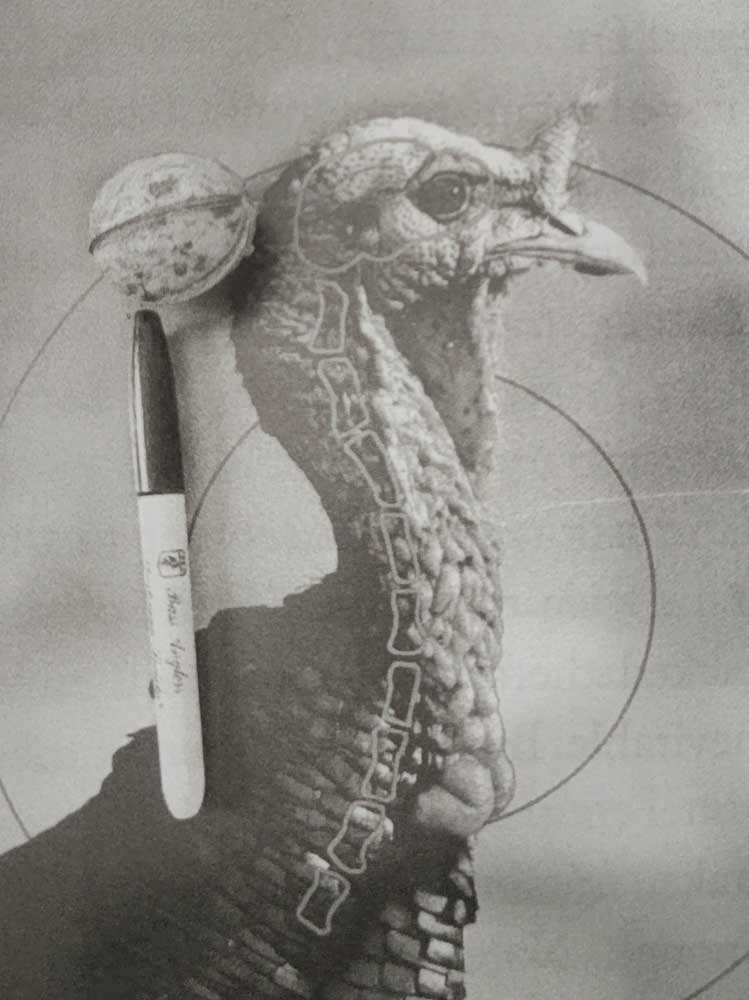
I don’t smoke any more so I didn’t have a pipe to illustrate this, but a hickory nut and a Sharpie pen illustrate the point just as well. This is the size of the target you must hit to kill a turkey quickly and cleanly.
The thing is, though, when a gobbler runs or flies away after the shot instead of falling, flopping and dying like good turkeys should do, you have to go look for him. Every time, no exceptions. A wild turkey gobbler is a magnificent beast, every bit as strong and tough as he looks. Sometimes misses aren’t misses, but crippling shots instead. I have killed quite a few turkeys that carried other hunters’ lead pellets, and some of them had recovered from obviously horrendous wounds.
The fourth gobbler I ever killed, more than 40 years ago, was the first example of this I ever saw. The gobbler had his left side to me when I killed him, but when I took him apart a couple hours later, his right breast and leg carried more than 30 number 6 shot, and all the meat on that side of his body was bruised a gangrenous green. Yet, he was trailing a bevy of six hens, strutting and drumming like he’d never had a bad day in his life.
Years later, I killed a Kansas bird that had its left thighbone shattered by a number 2 shot. The shot was still imbedded in the meat, behind a grotesque but fully fused femur that was shorter but probably stronger than its counterpart. And just a few years ago, after I shot a big Missouri strutter three times, my wife killed him in the same field less than 24 hours later, but not before we watched him thrash a 22-pound, 3-year-old gobbler that came into the field and challenged him. His left side (the side toward me when I hit him with three 12-gauge loads) was shot up like Clyde Barrow, but he never showed it. In case you’re wondering how I know so much about the turkey he whipped, I killed that bird a few seconds after Jill killed The Iron Gobbler. (You can read about that hunt in Bad Birds 2.)
Obviously, sometimes they recover after being seriously wounded. But you can’t hang your hat on it. If you think you’ve put shot in a gobbler, you owe it to him to make a diligent search. That’s not written down anywhere, but it ought to be.
So, how long does it take to forget missing a gobbler? In 1982, a few days after I’d missed my first one, I put that question to an old friend who’d missed his own first one in the 1950s. “I don’t know yet,” he said. Thirty-nine years later, a few weeks before Tommy succumbed to cancer, I asked him the same question, trying to lighten the mood in the hospital room. He gave me a weak grin and the identical answer.
I don’t know yet, either, but I’m beginning to think the correct answer to the question is “Never.”
 Jim Spencer’s A Life Well Misspent is not just a collection of stories. It’s a rich and unforgettable journey through a life that has been anything but ordinary. With a keen eye for detail and a deep connection to the natural world, Spencer invites you to walk in his footsteps, feel the thrill (and disappointments) of the hunt, the serenity of quiet streams and the satisfaction of a life well-lived. Buy Now