
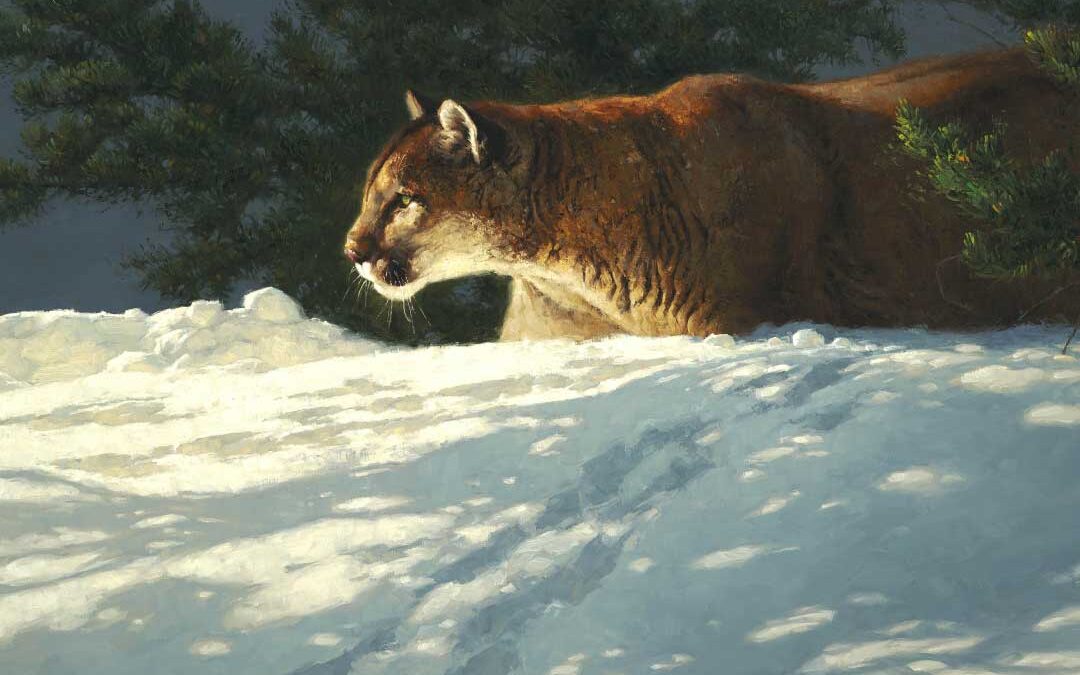
It was a cold, dull and dreary day, the 17th of December 1924, with the thermometer hovering around zero in the foothills of the Cascade Mountains of Okanogan County, Washington, when a man-eating cougar killed and devoured a 13-year-old boy. Reports from all over the northwest show that attacks on mankind, while not frequent, have happened at various times, but this was the first fatal tragedy to have occurred through the attack of the so-called cowardly beast.
Little Jimmy Fehlhaber had been sent by R. B. Nash, with whom he was making his home, to a neighbor’s ranch to procure a team of mules. The Kelly Ranch, located one mile south of the Nash home, has a public road passing the place, and also a trail through a dark, gloomy and dangerous canyon, cutting off a quarter of a mile. Jimmy had been warned not to take this cut-off owing to the perpendicular walls on the west side which, when wet or covered with snow, would loosen the earth allowing great boulders to come crashing down without warning. Yet, this cut-off Jimmy chose to take as he started, whistling in his little happy-go-lucky way, and as he passed along the great shadow walls or through the thickets, now and then stopping under the stunted jack pines, nothing else could be heard, not even the chatter of a pine squirrel.
With cap pulled well down and little gloved hands inside his mackinaw he continued to push on and on through the deepening shadows of the canyon. Suddenly the lad stopped. Ahead some 200 feet on a ledge stood a cougar. He had been enjoying a little warmth on the south side of a large boulder. Jimmy, being used to the habits of cougars, at first (the little tracks in the snow indicated) was not much afraid. He had swung but a little to the right and then continued on his course. The snow shows that the cougar at the same time left his place of rest. Jimmy, on coming out at the mouth or bottom of the canyon met the cougar in a thicket of jack pines face to face.
The big cat, no doubt, intended heading the lad off or, more probably, making for safety. Be that as it may, here the lad became frightened and alarmed at its second appearance and did exactly the wrong thing. He turned his back to the lion and started to run. His tracks measured three to four feet apart in the snow. The animal immediately started after him, bounding along on the left side and a little behind. They raced along for 50 yards when the cougar sprang 50 feet landing on the boy’s back with cruel claws, ripping and tearing through his mackinaw and into the tender flesh from shoulder to waist.
The boy fell, but somehow regained his feet and again ran on. His little brown jersey gloves found pressed close together show they had been removed, without a doubt, in order that he could get out his pocketknife which was found unopened a few feet farther on. The big male cat, springing the second time, crumpled its victim to the ground with a blow from its paw: a quick bite at the base of the skull and the unequal fight was ended.
A spray of bright blood on the right, a larger one on the left in the pure white snow gave ample proof of what occurred, yet no pen can describe the thoughts and anguish, or the heart-rending screams for help in that lonely canyon by little Jimmy as that great brute with blood-shot eyes, deep-sounding growls, ripping claws, cruel fangs and foaming mouth bore him to the ground. Here the brute dragged the boy back into the shelter of the small pines. At this place he tore off almost the entire scalp and devoured it. From here he carried the body over to the mountain side into a much darker and secluded thicket where the prized portions were eaten at his leisure.
As evening drew near, Mr. Nash became worried. On his visit to the Kelly Ranch he discovered that the lad had not reached there. A search began that lasted several hours. Taking the back track in the winding canyon trail, by lantern light they came upon the body, or what was left of little Jimmy, 150 feet off the trail. Word was wired at once to Okanogan, the county seat a few miles away.
Bernard MacCauley, one of the most noted young Chief Deputy Sheriffs in the northwest, who fears neither man nor beast and who is noted as a demon for speed, stepped in his big six-cylinder car and started on a wild ride of 100 miles north in the face of an oncoming blizzard with the thermometer dropping to 20 degrees below zero. On and on, beyond the Okanogan Falls, returning with Dave Suttleworth, a noted Canadian cougar hunter and his famous bloodhound. The round trip of 200 miles over frozen ground and snow-drifted roads was made from after dark to daylight. Here Suttleworth was joined by Charles Haley and Boyd Hildebrandt, noted veteran hunters, and the big hunt was on.
The bitter cold weather continued, causing the hunters much suffering night and day. The snow became so crusted that the lion left no tracks for the noble hound to work on. The search went on north, east and west, yet hopes ran high that the capture in time would be made by Suttleworth who had a record for the past five years of 85 cougars; but crusted snow leaving no scent and bitter cold winds at 15 degrees below zero, on two occasions, froze the nose of the noble, willing, ever-working hound and it was called off twice to thaw out.
The state of Washington sent in veteran hunters with well-trained dogs, but also failed. Four weeks later, after the weather became milder, a rancher in the Methow Valley, with his own hounds, trailed down and killed an old half-starved female cougar. Word went out that this probably was the killer, but on examination the stomach was found practically empty. The fact that she had been killed 30 miles from the scene of the tragedy and her tracks coming in from an opposite direction caused the Biological Survey men to disagree. A few days later a cougar was captured within eight miles of the scene, caught in a coyote trap and killed by a rancher.
The animal was taken to Brewster, Washington, and F. J. Clifford, before a large gathering of people, opened the stomach. A tight mass of brown silky hair, four or five inches long, came into view. Those who witnessed the operation were satisfied it was human hair. Samples of the hair and bones found in the stomach were sent to the University of California and some were sent to the State College. The balance, including the stomach, was forwarded to the Smithsonian Institute. They all agreed on the subject. The great Smithsonian Institute pronounced it human hair and bones of a human being. A rifle cartridge and a piece of overalls were also found within the stomach.
They became satisfied with the reports and asked that the hide and bones of the cougar be sent to them, as they would mount and make a permanent historical exhibit of same. Today the animal is on display at the State Historical Society Building, Tacoma, Washington, as the only known man-eating cougar in history.
Old cougars, true to nature, are afraid of guns, dogs and mankind, while the younger ones have much to learn and are more apt to attack human beings, especially at the approach of a blizzard when they are likely to go hungry for weeks. In the American Magazine, March issue of 1925, Dr. Nelson of Washington, D. C., in his article on the subject says: “Our experts at the Smithsonian Institute banished the last doubt, on their examination of the stomach, that the capture of the only man-eating cougar on record had been accomplished.”
Editor’s Note: Since this was reported in 1928, there have been more incidents of cougar attacks and suspected killings of humans.
This article originally appeared in the January 1928 issue of Forest and Stream.