

Beware of over-concern for money, or position, or glory. Someday you will meet a man who cares for none of these things. Then you will know how poor you are.— Rudyard Kipling
There was once a land with no people and no animals, just forested mountains and cold, clear rivers tumbling to the sea. New Zealand, the outermost place, was the last country to be inhabited by man.
A thousand years ago, Polynesian people arrived by sea, followed two centuries ago by European settlers who viewed deer, trout and game birds as basic necessities. Those pioneers fought every obstacle to bring those species to the end of the world. Their vision was to create a sporting paradise.
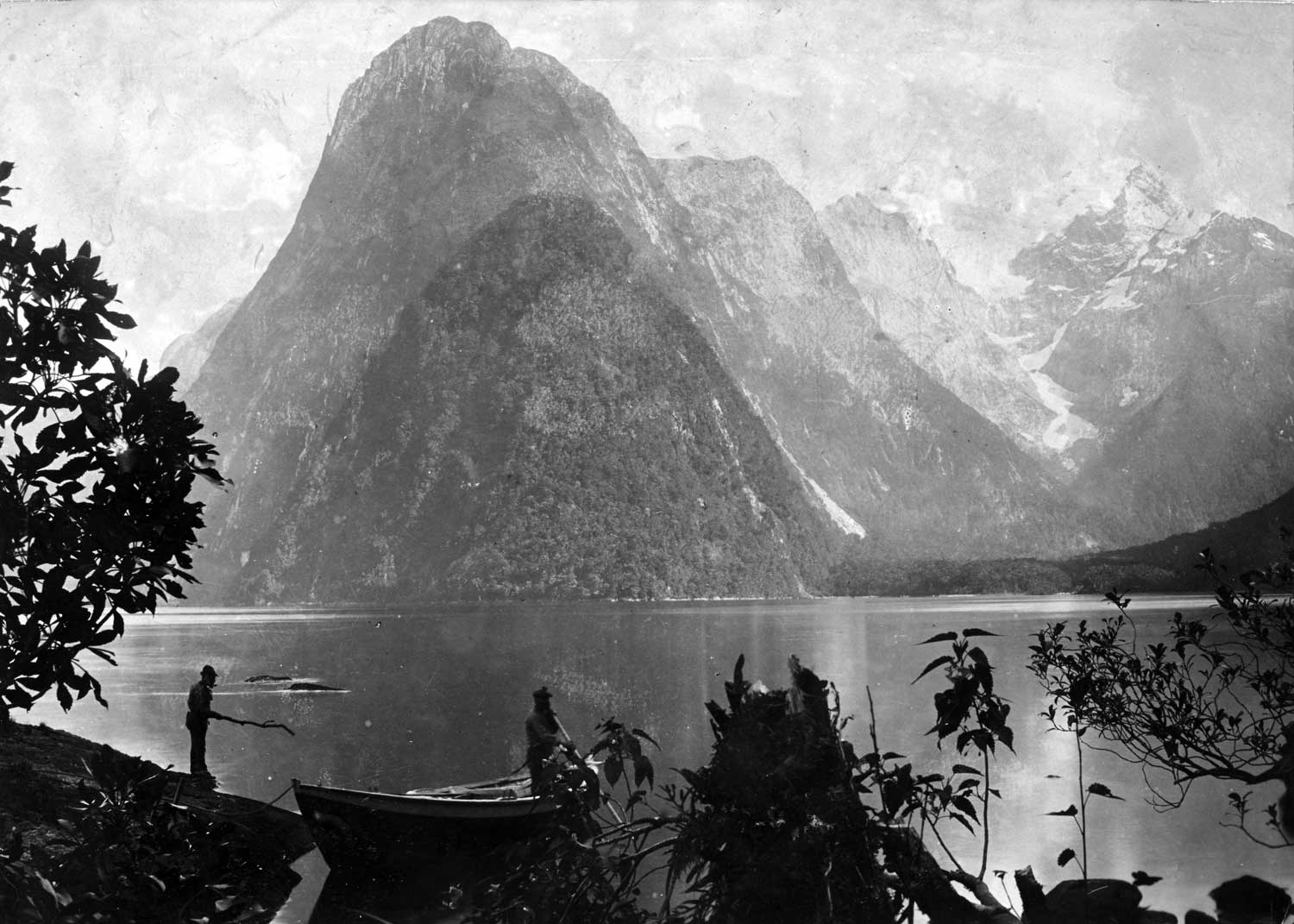
Fiordland landscape, 1880s.
Many red deer were released, mostly mixed genetics from English estates, but one place was unique in releasing pure wild Scottish bloodlines. Those deer came by steamship to the South Island of New Zealand, and then carted by bullock wagon to be released into the sweeping valleys of the Lindis Pass in 1871.
Those youngsters found themselves free in an empty landscape that had never been browsed by any mammal—rich valleys and endless alpine grassland with no predators. Some simply followed the prevailing wind and walked into new territory every year. It was soon noticed that they were growing to sizes seldom seen back in the hard granite valleys of Scotland, where overpopulation and starvation were common.
They found their echo in the new settlers. Jim Muir was born deep in the heart of wild country, the son of a Scottish immigrant farmer. Out of a large family of outdoorsmen, quiet young Jim was always the least comfortable in civilization. He spent his early years hunting deer, packing horses, learning marksmanship and alpine survival.
Even in the opening years of the 20th century, many of the rugged South Island ranges had hardly been explored by Europeans. One would later write of the Wills Valley that “the country there is steep and rough and we had some trying times of it, for the rainfall at times is terrific, about 17 inches falling one day…we were the first to cross into this valley.”

Jim took his first solo trophy from the remote Hunter Valley, a wonderful 12-point royal. Bob Wilson, a visiting sportsman, decided to trust his judgement on the quietly spoken young man. His youth did not make him cautious.
In pursuit of stags, Jim took his client through his old stomping grounds, over the ridge through snow and down a steep face into the next valley. They were travelling light and fast with no tent. It was a calculated risk and soon the gamble began to turn sour—the weather quickly turned, and a bitter snowstorm came snapping at their heels.
They climbed into another valley, with wind and rain gathering, clearing the ridgeline and then looking down into jagged glacier country. At 6,000 feet, they followed stag tracks to safety in a hurricane wind. There were no real maps, no locator beacons, no safety nets of any kind.
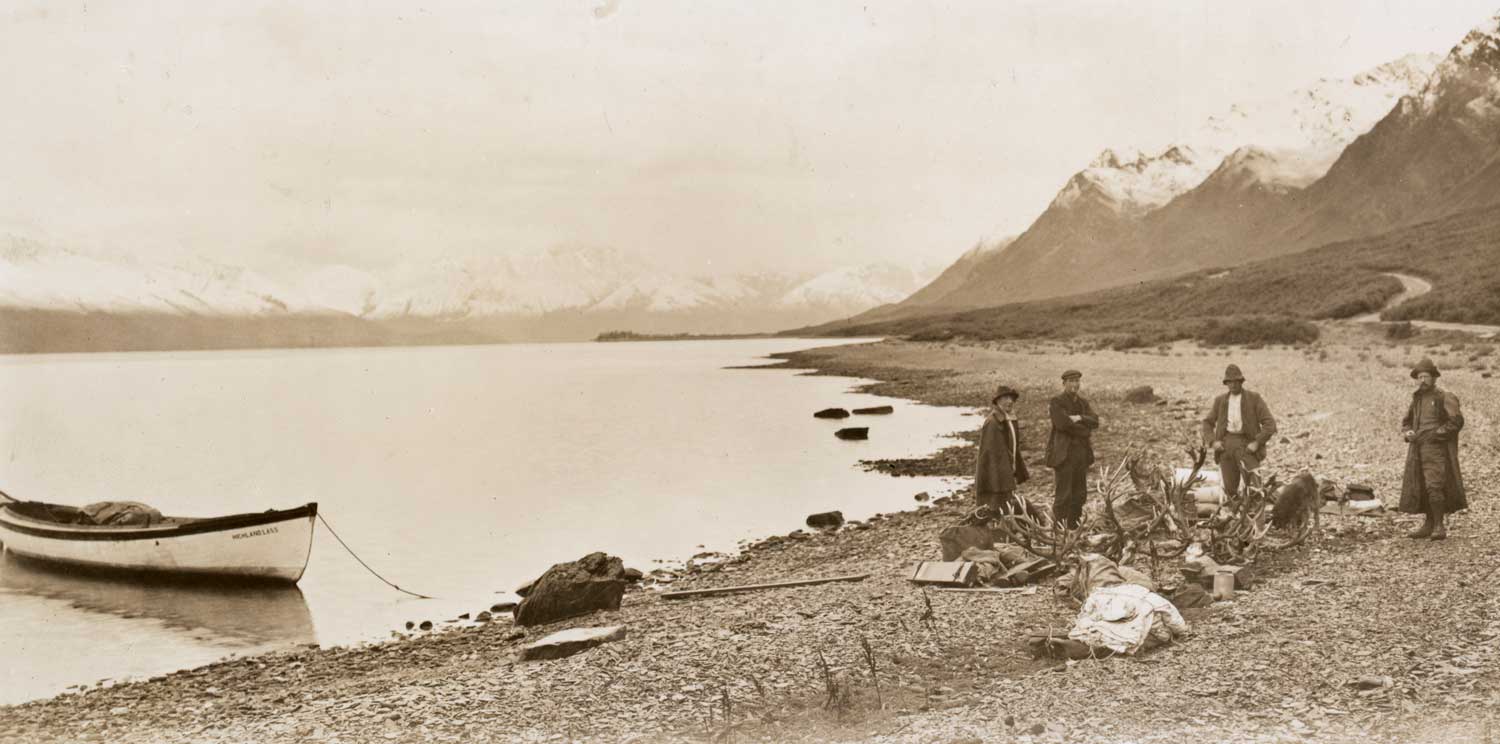
Deerstalkers on Lake Hãwea.
The pair eventually made the shelter of a hut, but not before watching the glacier country above them completely disappear into a wild storm. Had they not made it down safely, they would have died up there and both men knew it. The route was spectacularly aggressive, but Jim had remained calm at every stage.
In all, the young guide took his client over 25 miles of hostile alpine terrain in just two days, much of it under threat of killing weather. For both men it was the foundation of a friendship that would last for decades.
Jim Muir, professional guide on a raw frontier, was on his way. He was 18 years old.
Wilson returned the following March, crossing Lake Hãwea in the tiny Highland Lass to rendezvous with Jim. The rut opened to cold and wet conditions—deer often pass where men cannot, but the party watched as a stag descending on ice tumbled to its death.
WWI: Ambulance Man
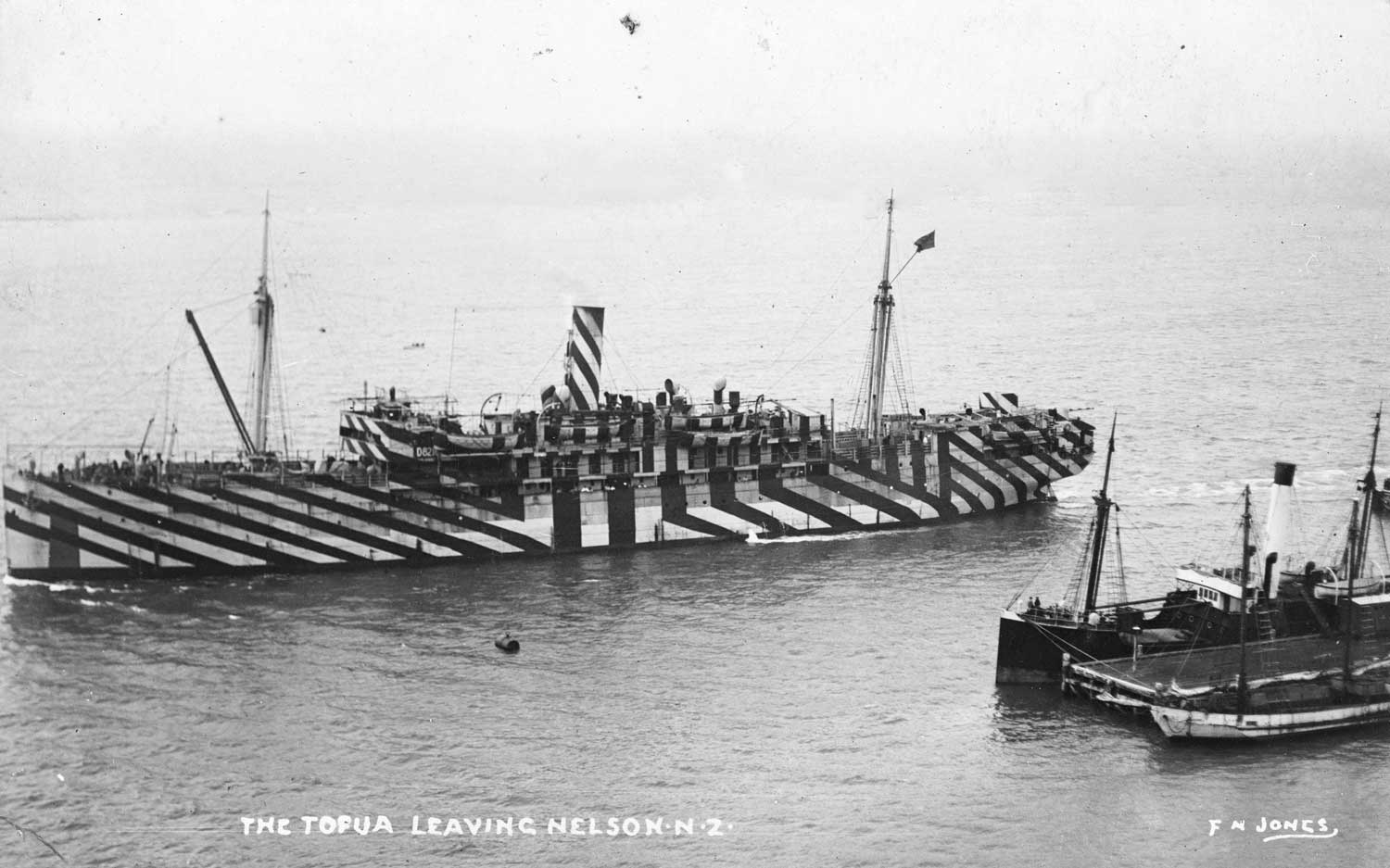
Seemingly out of nowhere, the Great War erupted onto the world stage and New Zealanders turned out to fight. Jim sailed for Suez on August 14, 1915, aboard the SS Tofua, the converted troop ship decked out in full dazzle camouflage.
Like many farm boys who had grown up hunting, Jim had been attached as mounted infantry but instead found himself in Europe as part of the No. 2 New Zealand Field Ambulance. The armies on the Western Front were facing the horrors of modern artillery, machine gun fire and poison gas for the first time. Casualties among the medical staff were high and fresh replacements with a high level of initiative were constantly needed.
Jim was at the Ypres Salient in October 1917. On the evening of the 11th, the weather broke over the 2nd New Zealand Rifle Brigade, with freezing rain pouring for much of the night. The next day they were to attack the German front line. They already knew that they would be confronting a mass of wire, and the ground was overlooked by a score of machine guns on Bellevue Spur. Zero hour was 05:25 the next day.
In cold rain the artillery barrage to soften the German lines was weak with many shells failing to explode in the deep mud. The troops groped their way through a swamp against the murderous fire of the Bellevue fortress, until they were forced to lie down in front of a deep zone of standing wire. It was clear that the Allied Command had made yet another shocking mistake to be paid for in colonial blood.
One ambulance squad leader lost his entire unit. Shells rained down on the medical posts and most were raked by machine gun fire, and many medical staff were gassed or exhausted. The message book is littered with names that Jim must have remembered for the rest of his life, now lost words on forgotten maps—Kansas Farm, Waterloo, Spree Farm, Dump House, Somme Post.
By the end of that day, almost 900 New Zealanders were dead and hundreds of wounded were pulled from the mud by the field ambulance teams. Today, the descendants of those survivors would fill a town.
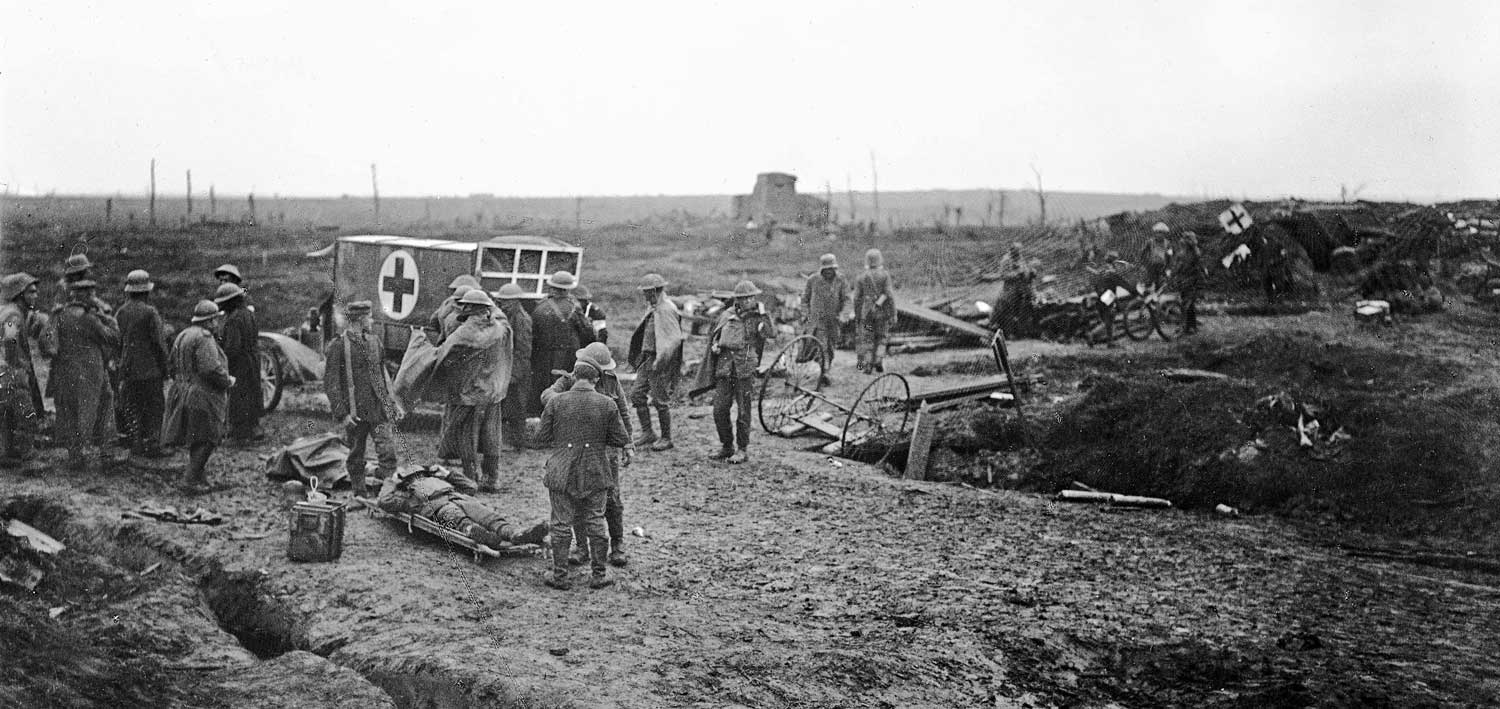
Somme Farm field ambulance station, October, 1917.
Field ambulance work in the Great War was a ridiculously dangerous job. Ernest Hemingway did it on the Italian Front and lasted barely a month before a mortar tagged him. Jim pulled hundreds, perhaps thousands of wounded out of the front line at the Somme, Messines and other names that made an entire generation catch their breath.
Jim enlisted on June 9, 1915, and was discharged on June 6, 1919. Military records show just one extended leave—a fortnight in England—during his service. He never spoke of his wartime life with his family.
Guiding in the Fiordlands
Jim plunged back into guiding, but in the off season roamed far and wide—high country fencing, deer culling with his 303 Lee Enfield when needed. Where introduced, rabbits had exploded to pest proportions, lonely “rabbiters” like Jim worked in all weathers with any means at hand—traps, dogs and guns—but it was not where his heart truly lay.
In 1921, Jim met a new client, Eddy Herrick, and then begins almost 20 years as the number one expedition guide in New Zealand. Again and again, the softly-spoken young man would take Eddy—and sometimes Eddy’s wife, Ethne, herself an accomplished hunter—deep into the last of the remote mountains and primordial forests, for some of the rarest trophies on earth.
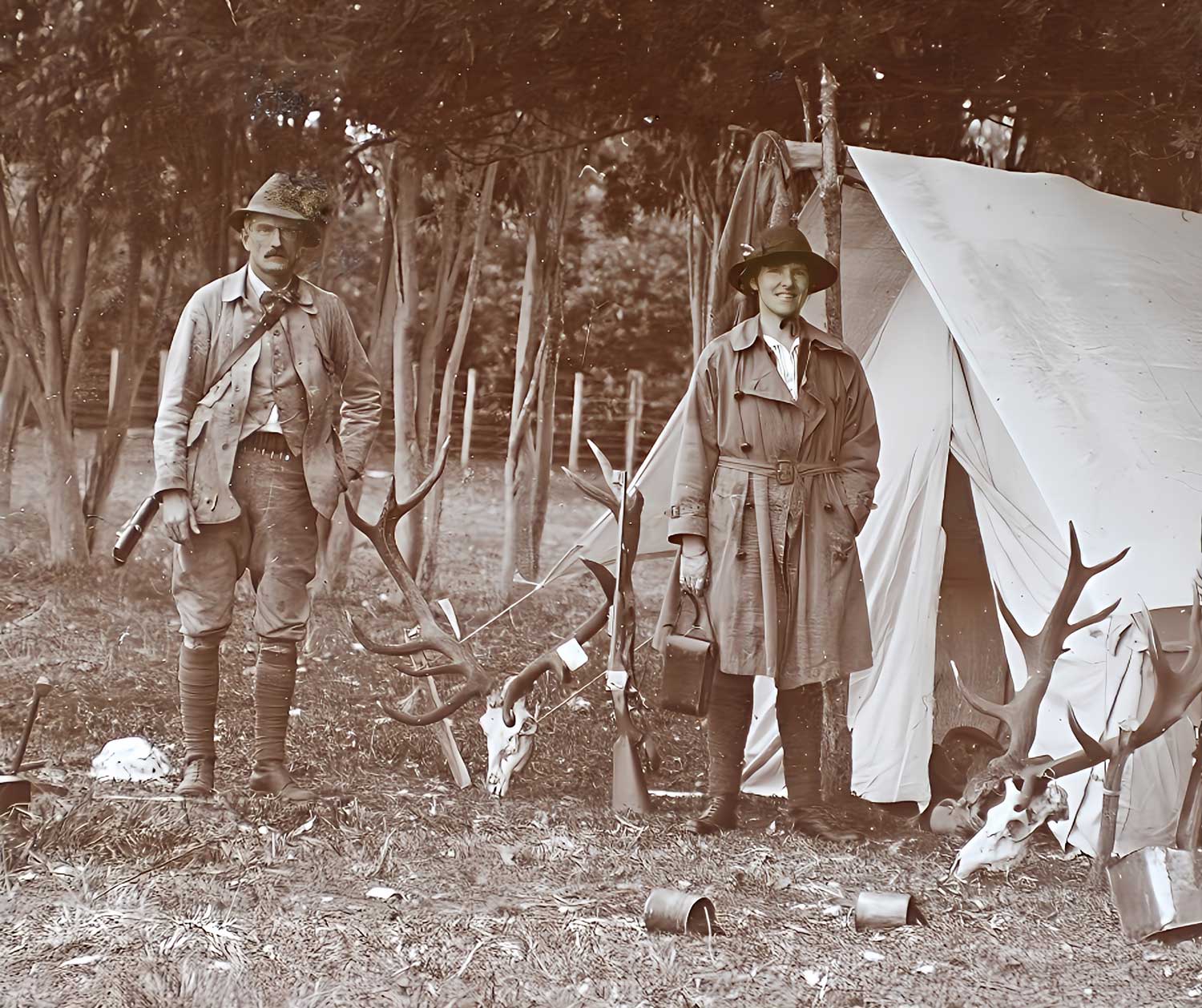
Eddy and Ethne Herrick with the single-shot Farquharson.
That year, the party hunted the Blue River wilderness during the rut, chasing the pure Scottish stags. After setting up a tented camp, fog lowered visibility, but Jim positioned his clients and advised them to be patient. It paid off with a world class 14-point stag stepping out of the gloom at close range, 45 inches in both length and spread. (It should be remembered that these were natural wild stags, not preserve animals.) Later, Jim would guide Ethne into a high basin, threading the needle through watchful old hinds, to take a magnificent royal stag of the same length with her Farquharson single-shot.
There was so much more to come. Fiordland is a wilderness of three million acres, a land of sweeping glacial valleys and cold, mossy rainforests, where tall waterfalls plunge hundreds of feet down steep rock faces. Back then, vast swathes of Fiordland were blank on maps, simply marked “unexplored.” Rainfall runs up to a ridiculous 400 inches a year and biting insects are fierce. There are no ranches, no settlements, no roads.
And it was there, deep in the heart of the lost world, that Yellowstone elk gifted by Teddy Roosevelt had been released years before.
At that time, the Fiordland elk were as big as anything that walks the Rockies—a cast antler of 64 inches was found on a high saddle, the area so remote that the bull may never have been seen by human eyes.

In 1924, Jim took Eddy and Ethne into Dusky Sound. Jim worked his clients hard but any doubts about her ability to handle the terrain were lost when she made a successful stalk on an old elk, dropping the bull with a single shot.
Days later, Jim and Eddy spied another bull in the last glow of twilight. Rather than leave a promising opportunity so far from camp, they decided to spend the night in the open without food or shelter, heads down as the rain soaked both guide and client. At first light they looked for their quarry and must have been delighted to pick him up again not far away. Jim positioned his weary client to shoot across a small stream. The bull proved to be one of the great ones—a spectacular 14-point, length 58 1/2 inches.
The elk season of 1927 was the worst in a generation, with torrential storms and rain falling for weeks. Many hunters abandoned the blocks they had drawn. Jim and Herrick were pinned for a week, but the foul weather brought animals down from the high passes. On the Wapiti River, Jim led his client through thick bush, travelling quietly. They struck two spectacular bulls, neither holding cows, and both fell to Herrick’s Westley Richards. The quality of the herd was becoming clear—the larger of the two went 17 points.
Moose
Years before, Canadian moose had been released in Fiordland but reports from such a remote location had been almost non-existent. In cooperation with the government, Jim surveyed the herd to assess whether a strictly limited season could be declared. He went into Dusky Sound, Supper Cove and the Seaforth River, where the release of ten young moose from Saskatchewan, Canada, had taken place in 1910.
Dusky Sound runs deep in the history of New Zealand. A century and a half before Jim went in, Captain James Cook anchored Resolution there, having taken his little ship far beyond the edge of the known world. He had been at sea for 117 days, had sailed 11,000 miles without sight of land. Resolution is widely credited as the first ship to cross the Antarctic Circle.

As to his long voyage of discovery, Cook wrote that it was his ambition to go “further than any one had been before…” which may sound familiar. He is often credited as part of the inspiration for the character Captain James Kirk, and his other ship Endevour may have inspired Enterprise.
Yet, even Cook was shocked by the savage Fiordland landscape, its waterfalls plunging hundreds of meters from grim mountainsides into mossy forest. The ship’s journal records the atmosphere of the place with awe. “A prospect more rude and craggy is rarely to be met with, for inland appears nothing but the summits of mountains of a stupendous height…the almost continual rains may be reckoned another evil…in this bay, we were all strangers.”
One hundred and fifty years later, not much had changed. In his survey, Jim Muir found and noted at least 20 moose. On March 14, 1929, he and Herrick left civilization on Britannia, a small coastal schooner, tracking west through the Roaring Forties, then they took a rowboat into the mouth of the Seaforth River. While coastal Fiordland was well-known to indigenous Maori people, the areas the hunters were searching lie far from any traditional routes. It is likely that Jim and Herrick were the first to set foot in that unexplored country.
They sighted a cow with calf and three young males, as well as recovering eight cast antlers from different bulls. One night they woke to a moose outside the tent, but by the time they roused up it had disappeared into pitch black pouring rain. After five weeks of this, they had secured nothing.
On the second to last day, after fording the icy Seaforth, the team entered a swampy area. Jim’s uncanny deer sense suggested a careful stalk in, and he signalled Herrick to be ready. Within a few moments the first legal moose taken in the Southern Hemisphere fell to a single shot from Herrick’s 350 Rigby.
In the 1934 expedition, Herrick and Jim were chasing moose again under hostile conditions. Heavy rain fell for weeks, and there were frustratingly brief contacts. They found themselves out of food and surrounded by rising rivers. Their camp flooded and they were forced to wade out through water up to their armpits, then it grew cold, and snow began to build.
They dropped a tree to cross a swollen stream, crossing fields of moss-covered boulders, separated by deep crevasses. They heard a red stag roar and took it for food, warming their frozen hands in the steaming guts and fat. Packing all the meat they could carry, they moved on.
After a month and hunting down to the wire they found moose tracks but could not locate a shootable bull. By now their time was up, but they convinced the ship’s captain to linger for two more days. They relocated to a small stream leading into Wet Jacket Arm, one of the many deep sounds that gave Fiordland its name.
Stalking heavy bush, they heard an animal grunting as it moved, and the bull was theirs. Jim carried the 80-pound head out. Three times the party dropped over steep cliffs using rope, the last descent directly through a waterfall.
In 1936, the two partners hitched a ride on HMS Wellington, out on survey patrol, to the Wild Natives River, looking to hunt across a high saddle and rendezvous with the ship in George Sound. They had five days to do it, but a series of howling storms ruined the plan. The hunt was over before it had begun; they were now improvising an escape on the run.
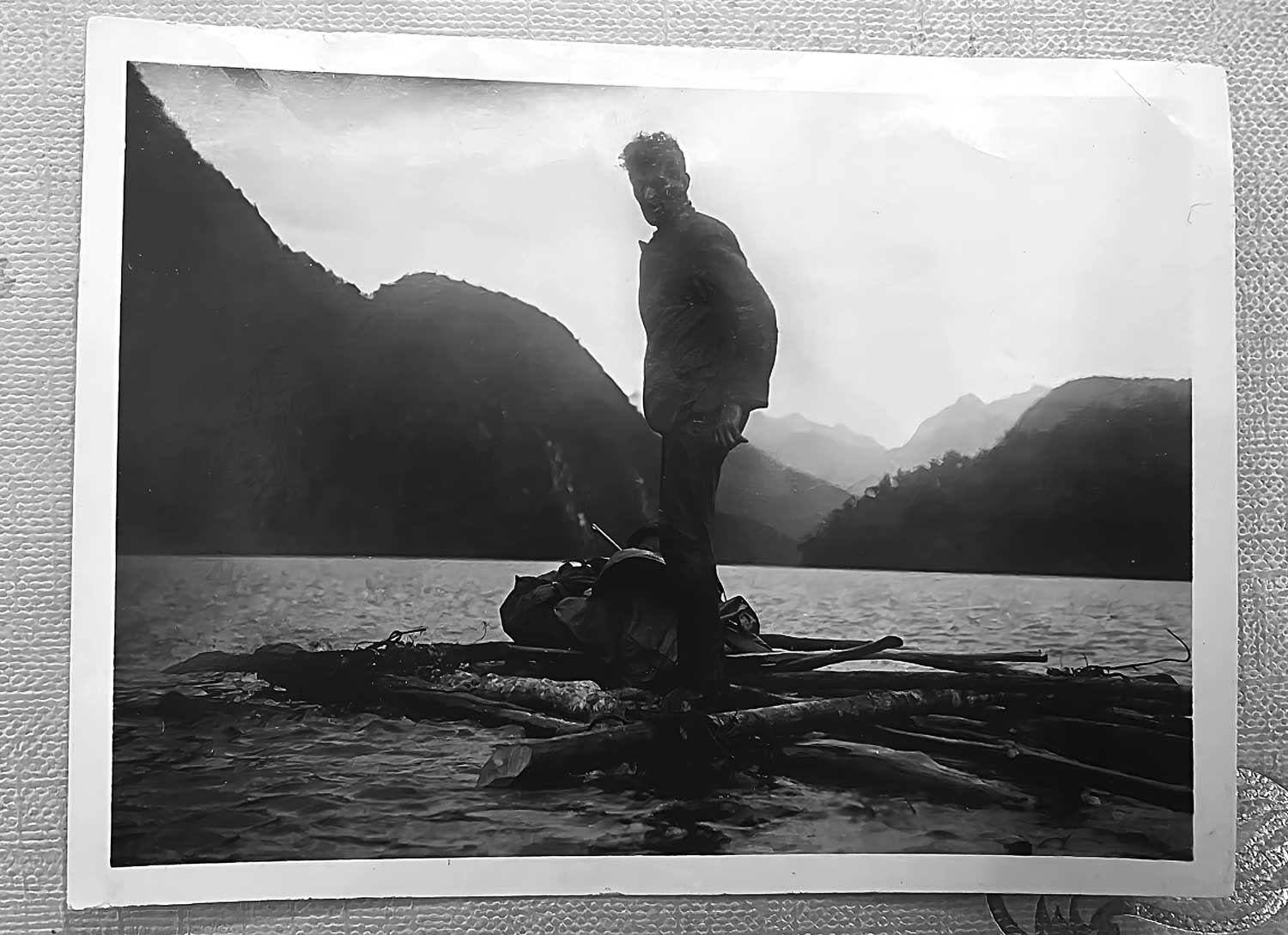
Escape raft, Lake Alice, 1936.
They dropped altitude and quickly built an 8×4-foot raft of beech logs lashed with supplejack vine to cross four miles of lake. Using improvised oars, they covered the journey in seven hours, flayed by bitter gales all the way. The wet logs took on water and the raft rode low, but it held. From there it was a weary tramp to the pickup. The misadventure took five days, but their survival made national news.
In 1939, Jim took Herrick back into Bligh Sound but had no luck. They crossed over into a new valley where they found two antlered elk skulls locked together, both fighters having long since perished. It was there that Herrick took a magnificent 14-point bull elk, and one of the most iconic photos in New Zealand hunting history was taken.
But within a few short years, Herrick would be hit hard. Heading in to stalk Fiordland with Jim, his Westley Richards was lost overboard. The moose, never really at home in the steep Fiordland habitat and never producing antlers as they did in North America, were in decline. The elk were being swamped by the arrival of red deer, who competed for food but also bred with the elk to produce low quality offspring.
Later that same year, Jim began to lose weight. He managed the shearing season of 1946-’47 but within months was diagnosed with cancer. When his condition got especially bad, the local doctor would be summoned and gravely ask the Muirs to put the kettle on. An ex-solider himself, the doctor stayed and talked with Jim for hours.

Jim Muir died on the March 18, 1948, four days after his 56th birthday. The house was still full of presents, and all of them were the kind that are chosen to last a lifetime. Two hundred cars made the four-hour journey to Hãwea Flat for the burial.
He had long since moved past guiding and into a class of his own, one that doesn’t have a name. Herrick was devastated—his son once said that he “was really never the same man again.” Herrick, one of the greatest sportsmen of his day, never hunted again.
If you look at the surviving photos of Jim Muir, his personality is clear. His ability to haul huge loads through hostile country was miraculous. That he stood up to weeks of endless rain, wind and cold in nothing more than an old jacket seems incredible until you recall his years spent in the mud of Flanders, in freezing rain or dodging gas and high explosives. Fiordland was an easy second home after that.
He is always off to one side, uninterested in the camera and obviously looking to finish the job. During his life, he sought no fame, no attention and wrote nothing about himself. He was softly spoken but would cheerfully chance his arm at damn near anything.
Jim’s life is like so many of that generation—not much money, but rich in a quiet heroism and hard as nails. The trick is to look past the tape measurements to find a humble man of cheerful wit and endless quiet courage.
I spoke to his daughter, Jeanie, still very active for someone of her years, and to her goes the final word. It is a fitting epitaph for all those quiet men now lost to history.
“For a shy man, he had a dry sense of humour that came out all the time. Of all the family, he was the one for leadership and advice. He did things for people, little everyday things. That’s what the ambulance years and guiding was about. He liked the people he worked with, and he liked helping people do what they love to do.
“When he was around, everyone was happy.”
Peter Ryan has hunted across the globe. This is an excerpt from his fourth hunting book Riding the Echo Down (Bateman Ltd) released October 2025.