

It started simple enough, a long time ago. Even now, after the passage of several decades, I am still caught in its clutches. And I love it!
My lifelong addiction to hunting desert mule deer began even before I could read the high desert tales of hunting great stags by the popular outdoor writers in the 1950s. I hung on Jack O’Connor’s every word, especially about hunting desert mulies in the brushy, cactus covered valleys of Sonora, Mexico and Byron Dalrymple’s annual forays to Hell’s Half Acre, the magical Catto-Gage Ranch in western Texas. I imagined being at each hunter’s side, stalking regally bedecked mule deer bucks.
Tales told by kinfolk who hunted “black-tail deer” in the rugged desert terrain west of the Pecos River deepened my yearning and resolve to someday hunt the mule-eared deer.
After graduating from Texas A&M University with degree in Wildlife Science degree and on the Texas’ Wildlife Disease Project, my desire to hunt desert mule deer grew even greater. At last, an opportunity to fulfill my dream arrived when I was invited by fellow biologists to join a lease for mule deer in western Texas.
I sent a check to pay for my share of the hunting lease from our family account. Married and with a young daughter, I barely had enough funds to cover it. As the mule deer hunting season, approached I borrowed a sleeping bag from my father-in-law, a tarp from my dad and a pair of binoculars from a friend. From my younger brother, Glenn, I borrowed his Model 99 Savage .300 Savage topped with a 4K Weaver scope and tens rounds of Hornady ammo.
After driving several hours to our West Texas hunting lease, I quickly set up my “dry” camp, then started scouting. I found deer tracks, but no deer. Walking back to camp, I flushed a three-by-three buck and two does after nearly stepping on them. I watched the trio pogo stick into a brushy draw. At least there was one buck around, though certainly not a monster.
That night I slept on rocky ground, my sleeping bag wrapped in the tarp.
Long before the slightest hint of pink in the eastern horizon, I was sitting on a rock, anxiously awaiting first light. Finally, the sun rose, bringing light and warmth, but no deer. At ten o’clock, I crawled onto a tall ridge facing an expanse of brushy low country. Years earlier, I had read that mule deer bucks often bed just below rimrock.
I had walked a hundred yards, heard rocks rolling above and behind me. Just below the rimrock walked a mule deer . . . a buck! Up came my rifle. Weaver K4 crosshairs settled on his vitals. I pulled the trigger and down he went. I levered in a fresh round and got the crosshairs on the buck, now lying on its back only 75 yards away.
Excitement and buck fever set in and I was shaking so hard that I nearly dropped my rifle! Luckily, there had been no time for such before my shot.
I do not remember my feet touching the ground while getting to his side. He had four long points on his left and five on this right, counting brow tines. I was beside myself with excitement and had dreamed of this very moment since I was four years old.
I offered up a prayer of thanks, followed by a “whoop” likely heard all the way back in Aggieland some 500 miles away!
Packing him off the mountain, I started planning my next desert mule deer adventure.

To me, there has always been something “special” about desert mule deer, Odocoileus hemionus crooki, and where they live. To the uninformed, their homeland looks like it should be occupied only by rattlesnakes, jackrabbits, coyotes and scorpions. But in the thirsty southwestern desert, mule deer flourish.
Over my many years as a professional wildlife biologist, I learned much about desert mule deer and their habitat. I have studied and pursued their kind in Texas’ Trans Pecos and Lower Panhandle, southern New Mexico and northwestern Mexico.
While researching mule deer nutrition and reproduction, I collected numerous does on selected ranches. Beyond basic information, we wanted to determine if we could manage mule deer the same as whitetails; i.e. harvesting does to increase fawn survival rates by increasing available nutrition for those remaining.
We noted a drastic decrease in deer density when we started removing any number of does. Analyzing reproduction data from the does we collected, we quickly learned that few if any mule deer does breed before they are two and a half years old. Whitetail does, however, often start to breed while only six-months of age.
During our research, we quit taking mule deer does and the deer population started to increase. It was a hard though good lesson learned.

Desert mule deer are brownish in color compared to the grayish coats of the Rocky Mountain mule deer subspecies. Rocky Mountain deer often range to upwards of 300 miles over the course of the year, but desert mule deer are not migratory, at least not to any great extent. In parts of western Texas, desert muley does tend to live in the mountains. The older bucks tend to stay low, until the breeding season. Then, they go to where the does live, though the total distance is rarely more than a mile or two.
Interestingly, desert mule deer in Sonora, Mexico tend to live year-round in broad valleys between mountain ranges.
For years, I have occasionally hunted desert mule deer with Greg Simon’s Wildlife Systems (www.wildlifesystems.com). Greg is a professional wildlife biologist who has access to numerous mule deer properties throughout western Texas. He also has a personal lease, which is intensively managed for nutrition, water and year-round habitat. It is here that he experiments with various management techniques, which can later be employed on the properties hunted by clients.
Bucks on his personal lease rival those taken in the deserts of Sonora. His personal biggest buck, produced on his free-range property, gross-scored more than 300 B&C points. It is the largest non-typical mule deer of the desert subspecies ever scored for the record book.
On one of my hunts with Greg, we spotted several bucks, including some very nice five-by-fives. Stalking closer, Greg would proclaim, “Too young!” or “Too small!” I accepted his judgment, hoping to take a good mature desert buck.
Nearing the end of my hunt, we spotted a handsome five-by-five bedded down more than a mile away. We decided to go after him, despite knowing that we would have to belly-crawl most of the distance and somehow slip past several smaller bucks and does. At one point we crawled within less than 20 steps of a monstrous 30-inch-wide forkhorn. I glanced at Greg and he mouthed “No!” Minutes later, we cautiously crept past an amorous whitetail buck tending two does.
We continued to belly-crawl, snaking our way through barely knee-high grass and weeds, for another hour until we assumed we were close to where we had last seen the bedded buck. Greg cautiously raised his head to peer over the top of the grass. He immediately ducked down, pointing to me where the buck was bedded only ten yards away. Greg waved me crawl to his side and then get into a sitting position.
Moments later, I pushed off my .280 Remington’s safety after finding the buck’s antlers and a sliver of his back in my scope.
I uttered a guttural “errrrrrkkkkk!,” and the buck immediately stood up. I pulled the trigger and down he went!
I accepted Greg’s congratulatory hand as we admired my massive, long-tined, six-by-five buck. Dusk was rapidly approaching, so we quickly caped and quartered my buck for the four-mile pack back to camp. The last three miles were in total darkness. Not fun!
The following fall, I was back hunting with Greg, this time on a ranch where the vaqueros had recently seen a large cougar, which explains why I had a Burnham Brother C-3 Long Range Predator Call in my pocket. On the first morning of the hunt, I was sitting where two canyons converged. I spotted movement in the canyon off to my left, so I started mimicking the sound of a distressed rabbit, hoping to call in a mountain lion.
I noticed more animals moving below me, running through brush and cactus in my direction. My heart skipped a few beats.
I expected a cougar. But out of the brushy canyon ran a mule deer doe. Behind her came a nice buck followed by a smaller buck. They continued in my direction until they were less than five steps away! The doe was excited, agitated and perturbed. I sat slack-jawed in awe. After a minute or so, the deer turned to walk away. I blew my call and immediately the trio turned and charged back.
Just then, I saw more movement, this time in the canyon to my right. I watched three does, three fawns and a two-year-old forkhorn charging toward where I was sitting. I could scarcely believe what was happening. I continued blowing the call, and moments later, four more does, two fawns and a buck that sorely tempted me raced in my direction. Had it not been the first morning of my hunt, I might have taken him. But Greg had told me about a couple of really nice five-by-fives he had seen right before my arrival. I hoped to take one of them.
Hunting later that afternoon in another area, I sat where could overlook three converging canyons. Once again, I started blowing my predator call. Within less than 30 seconds, eight mule deer does and fawns were staring at me, less than 20 yards away. When they walked off, I started calling again. Four hundred yards away, out stepped a mature 5×5. He looked my way and immediately started running toward me. I kept blowing on the predator call, while readying my rifle on the shooting sticks. The buck disappeared behind some brush and rocks, then reappeared, coming right at me. When he stopped 15 steps away, I pulled the trigger.
With the temperatures promising to get cooler each of the next few days, I decided to extend my stay and try to call in more mule deer.
Back in the 1980s, I had called Murray Burnham with Burnham Brothers Game Calls. I had read stories by John Wootters about a mule deer hunt he had done with Murray and his brother, Winston, where they had called in mule deer. I wanted Murray’s advice.
“The main reason mule deer likely respond to calls is they are a herd animal,” he said. “And when they hear the distress sounds, the does think a fawn or one of their family group is in peril. They almost always come at a run. I also think as the rut approaches and a doe weans her fawn, that maternal instinct remains. When she hears what sounds like a fawn in distress, she comes to the rescue. If she’s being tended by a buck. he will usually follow her. I think some bucks come to the call because they know if there is a distressed fawn, there will likely be does nearby.”
His explanation made good sense to me.
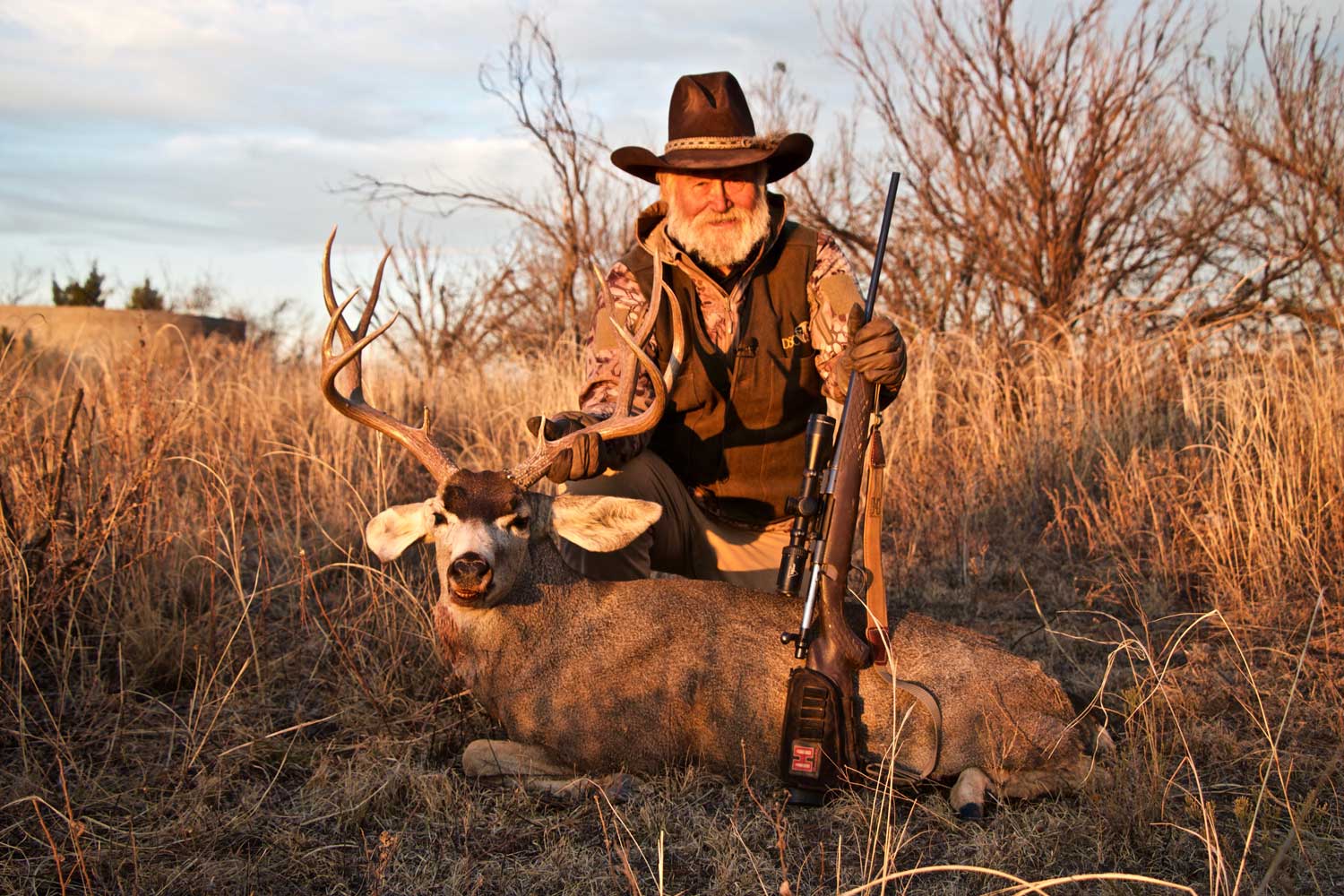
Since those first successful calling attempts, it has become one of my favorite ways to hunt desert mule deer. I have successfully called in bucks everywhere I’ve hunted the iconic deer of the Southwest.
My desert mule deer addiction continues and is an ever-learning challenge. If you do not wish to catch this incurable malady, do not ever go hunt them, and forget you read this!