
Most turkey hunters who are serious students of the sport and its rich literary heritage will be familiar with the name Henry Edwards Davis. His landmark book, The American Wild Turkey, is widely acclaimed as the definitive treatment of hunting America’s grand bird. Although first published almost three quarters of a century ago, it remains the gold standard, the sine qua non, for anyone anxious to delve deeply into the sport’s myriad secrets and subtleties and represents the cornerstone of any representative library on turkey hunting.
Meticulously written and researched, graced by deep practical experience and comprehensive in coverage even though written in an era when fall turkey hunting was standard, it is a masterpiece, a classic in every sense of the word. It is not the only highly estimable work Davis left for posterity. Although unpublished until decades after his death, his memoir, A Southern Sportsman, skillfully edited by Ben Moise, is delightful. Only two of its 18 chapters deal with turkey hunting, and they are devoted primarily to guns. Otherwise, the work deals with several predictable subjects (deer, dove, quail, duck and squirrel hunting), shooting proficiency and three topics you assuredly won’t find in a modern book—“Wildcat Hunting,” “Hawk Shooting” and “Hunting the Hooters.”
These quarries are protected seven ways from Friday by both state and federal laws, but Davis’s work reminds us how easy it is to fall into the trap of viewing the past through the lens of the present. The chapters dealing with bobcats and birds of prey come from a time when folks lived close to the land and when chickens were a prized part of daily existence. They were hunted with a vengeance. During my boyhood every raptor was a “chicken hawk,” and if one happened to come within range while I had a gun in hand, I had to explain to Grandpa Joe any failure to “have at it.” A miss was forgivable; failure to shoot a cardinal sin. Davis takes us back to those times in telling fashion.
Born and raised in South Carolina’s Pee Dee region, the vast majority of Davis’s hunting experiences focused on that region. He was an astute student of the game he pursued as well as sport hunting paraphernalia. A master craftsman, Davis made fine furniture, designed tools, did a fair amount of gunsmithing and shaped turkey calls in which function followed form in exemplary fashion. Some indication of his skill and status is provided by the fact that a suction yelper he made sold a few years back for $55,000, the largest sum ever for any item of turkey-hunting memorabilia. While a man of many talents and diverse interests, the quest for gobblers was unquestionably Davis’s grand passion. He devoted much of his leisure time to America’s big game bird.
This quintessential Southern gentleman/sportsman endowed with the qualities of a Renaissance man was born on October 4, 1879, in Williamsburg County, South Carolina. From early boyhood he was a keen outdoorsman. Swamps and occasional patches of higher ground along the nearby Santee and Black rivers formed his playground. By the tender age of 14 young Henry had completed his secondary education, but for reasons that are unclear, there was an interval of five years before his enrollment at Presbyterian College. In the interim he worked on the family farm, and it may well be that the family’s financial circumstances were such that his presence was needed. During those halcyon years of his teens Davis had ample time to hunt the game animals available within walking distance or a horseback ride.
Davis finished his studies at Presbyterian, graduating with highest honors, and straightaway entered the University of South Carolina Law School. There he again proved to be an exceptional student. After completing law studies he briefly served as clerk to a state Supreme Court justice and then launched his own legal career. This came more or less simultaneously with his 1906 marriage, and from that point until his death Davis was qualified to practice law in all South Carolina state and federal courts, in the Fourth Federal Judicial District and before the U. S. Supreme Court. He was an eminent and eminently qualified lawyer.
Although he worked hard and with great success, a portion of Davis’s soul always harkened to the call of the wild. Davis and his wife settled in Florence, South Carolina, where they raised two daughters and made their home. Years ago one of those daughters, Virginia, told me: “I never tasted a bite of ‘tame turkey’ until I went off to college, but we ate wild turkey regularly.”
Davis brought painstaking care to everything he did. Like many avid sportsmen, he treasured fine guns and enjoyed both trading and tinkering. Among the guns he owned at one time or another were classic shotguns made by the likes of Purdey, W. & C. Scott and Greener. These were tools of his turkey-hunting trade, but he also hunted a lot with rifles. This was a time when rimfires for turkeys were not only legal; they were in the eyes of many the weapon of choice. Davis was a master at fitting stocks and the intricacies of gunsmithing, and he even made some of his own telescopic sights for rifles, no mean feat when performed in a home workshop.
During those times of the year when the hunting season was closed, Davis spent happy hours absorbed in his hobbies. Of course he had far more time to hunt turkeys than is the case today. South Carolina had a long season in the running through much of fall and winter and extending on into early spring. Davis, though a hard hunter and a turkey killer of great repute, would have no part of spring hunting. He wrote:
“I feel compelled to say I am unalterably opposed to shooting old gobblers in the mating season. It is neither good sport nor good conservation. Any tyro can call and kill a lovelorn old gobbler in the gobbling season, but I will wager that 95 percent of these spring gobbler shooters could not call and kill the same gobbler in the fall and winter seasons if their life depended on it. His ability to call and kill an old gobbler in these two seasons is the acid test of a man’s ability as a turkey hunter.”
Those are strong thoughts, strongly expressed and we now know he was wrong in the sense of a springtime gobblers-only mentality being unethical or unwise. However, no one who has had much experience with mature gobblers outside the mating season will likely reckon his thoughts on difficulty in any way wide of the mark.
The circumstances surrounding Davis’s venture into the writing and publication of a full-length book on turkey hunting involve two other men, also South Carolinians, who are of considerable note in the annals of American sporting letters. Roughly a decade before Davis wrote The American Wild Turkey, Thomas Garvine Samworth moved his Small-Arms Technical Publishing Company to Exchange Plantation and later Dirleton Plantation, both located near Georgetown, South Carolina. While most of the approximately 50 books published by salty “Mr. Sam” dealt with technical aspects of guns, cartridges and gunsmithing, he recognized the need for a detailed work on turkey hunting.
With that in mind, Samworth commissioned Archibald Rutledge, a prolific writer who had produced scores of articles on turkey hunting, to write a book on the subject. Rutledge seemed, at least on the surface, the ideal man for the task. He and Samworth agreed to terms, and Rutledge took a handsome monetary advance on the book. However, when the completed manuscript reached the publisher, there was an explosion reminiscent of a dog scattering a huge flock of turkeys.
Samworth accused Rutledge of providing him with “dirty linen” in the form of previously published tales and avowed he was not going to “wash any writer’s laundry.” Mr. Sam, who had a fierce temper accompanied by the language of a widely traveled sailor, made it clear that he wanted no part of what Rutledge offered. He probably should have known better, because almost all of Rutledge’s outdoor-related books are anthologies comprised of material previously published in article form. But apparently the contract made no precise stipulations as to the nature of the book’s contents. Rutledge, who could vent his own feelings when aggrieved, albeit in less bombastic fashion than Samworth, politely but pointedly noted that the agreement did not in any sense run contrary to what he had provided.
The upshot of the matter was that Rutledge retained the advance he had been paid and Samworth scrapped the project. It was at that juncture Mr. Sam turned to Davis. He likely already knew of him and had possibly met him in person, thanks to Davis having published pieces in The American Rifleman, a magazine Samworth once edited. In fact he was the individual responsible for changing the NRA’s flagship publication to that title replacing the earlier Arms and the Man. Whatever the exact nature of their initial contact, the Samworth-Davis linkage was a publishing venture made in heaven.
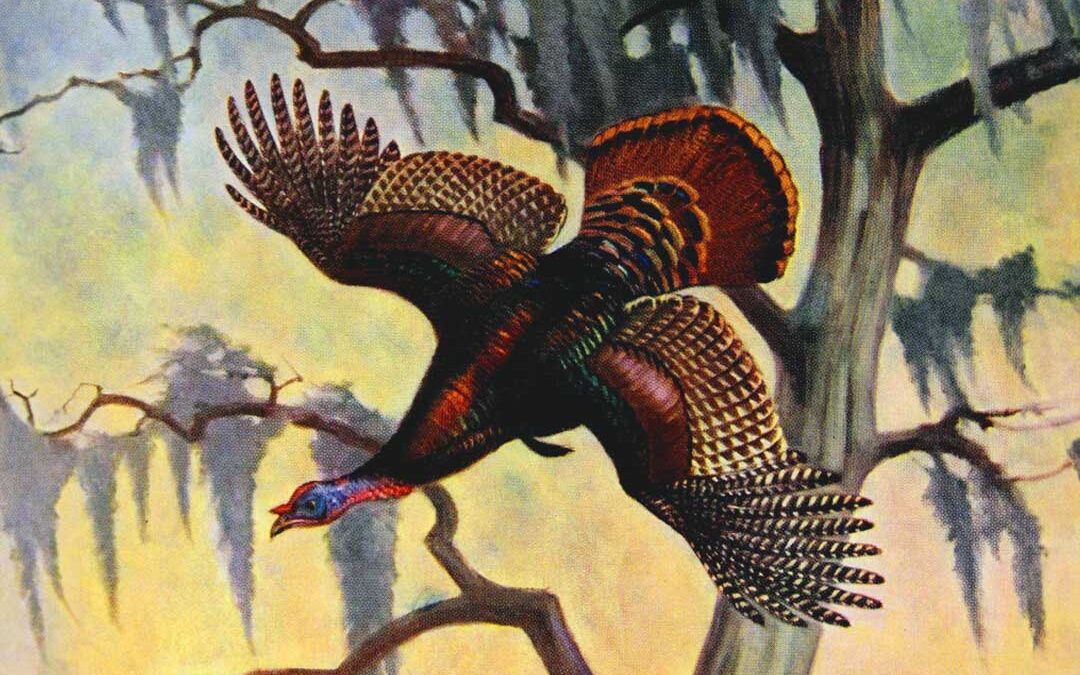
The American Wild Turkey is everything a sporting book should be. It has a beautiful color frontispiece of a gobbler in flight rendered by Walter Weber, a noted wildlife artist whose work graced the federal duck stamp for 1944-45. The same image was used for the striking dust jacket. Internally there are dozens of fine gravures by E. Stanley Smith, better known to the sporting world as Ned Smith. Knowingly or not I suspect many readers have tipped a convivial glass decorated with his art work. Photographs from Davis’s personal collection add to the book’s visual appeal, but its narrative content is what makes the volume of lasting importance. In the course of 300-plus tightly written pages, Davis touches on just about every aspect of turkey hunting—habits and habitat, guns and gunning, calls and callers—with clarity and common sense. His knowledge represented state of the art for the era when the book was written, and even today the portions of the book dealing with calling and hunting methods are instructive for tyros and seasoned sportsmen alike. It is a book every turkey hunter should read, a valuable collector’s treasure in the original edition (and even the two reprinted versions fetch north of three figures) and a work some studious turkey hunters read annually. If you delve into it, I strongly suspect you’ll want to read A Southern Sportsman as well.
Davis continued to be vigorous and active right up until his death in 1966 at the age of 87. He was a man of many facets and someone who lived his life with a fullness most of us can only envy. Turkeys and turkey hunting were integral parts of that fullness. Every sportsman who loves what he often styled “the great American bird” owes him an incalculable debt. He left the sport far richer, and to walk in his literary footsteps is to tread paths of turkey-hunting wonder.
Jim Casada, a longtime student of hunting the American wild turkey, has written extensively on the subject. Both his book Remembering the Greats (which includes coverage of Davis) and A Southern Sportsman are available through his website, jimcasadaoutdoors.com, and the Sporting Classics Store.