

In September, the summer folks trade their beach lives to head home. The public boat ramp near my home, the one that once was clogged with all sorts of recreational craft, is deserted. It’s a busy process to haul and winterize boats tied up in slips just as it is to haul the dock fingers and gangplanks. Saltwater freezes at 28 degrees Fahrenheit, and the floats get stacked in the parking lot beyond the weathered cedar shakes of the shuttered harbormaster’s office. When I arrive for the second duck season in December, I see only two boats in the water. They’re draggers tied up to dock pilings, and they set sail around the low water marks and drop their gear when they think they’ll get a good haul of hard-shell clams. When I’m hunting in a gale wind, I can smell the burned diesel that drifts on the wind. The low drone of their motors is comforting, especially because the number of fellow duckers heading out is few and far between.
My 4 a.m. launches are usually quiet, sleepy affairs, but on a pre-Christmas hunt that wasn’t the case. Word of the enormous flocks of fresh arrivals—eider, old squaw, surf scoter and brant—got out, and holy mackerel was the ramp jumping. Hunters launched pretty much anything that would float. There were 21-foot duck boats powered with 140 HP outboards that carried five hunters and dogs, and custom blinds built on Carolina skiffs that were roomy enough to hold a Saturday night dance. One, a shellfish barge, was converted into a blind big enough to resemble a small house. The launch line was as long as it was during fishing season; the tempers were just as short.
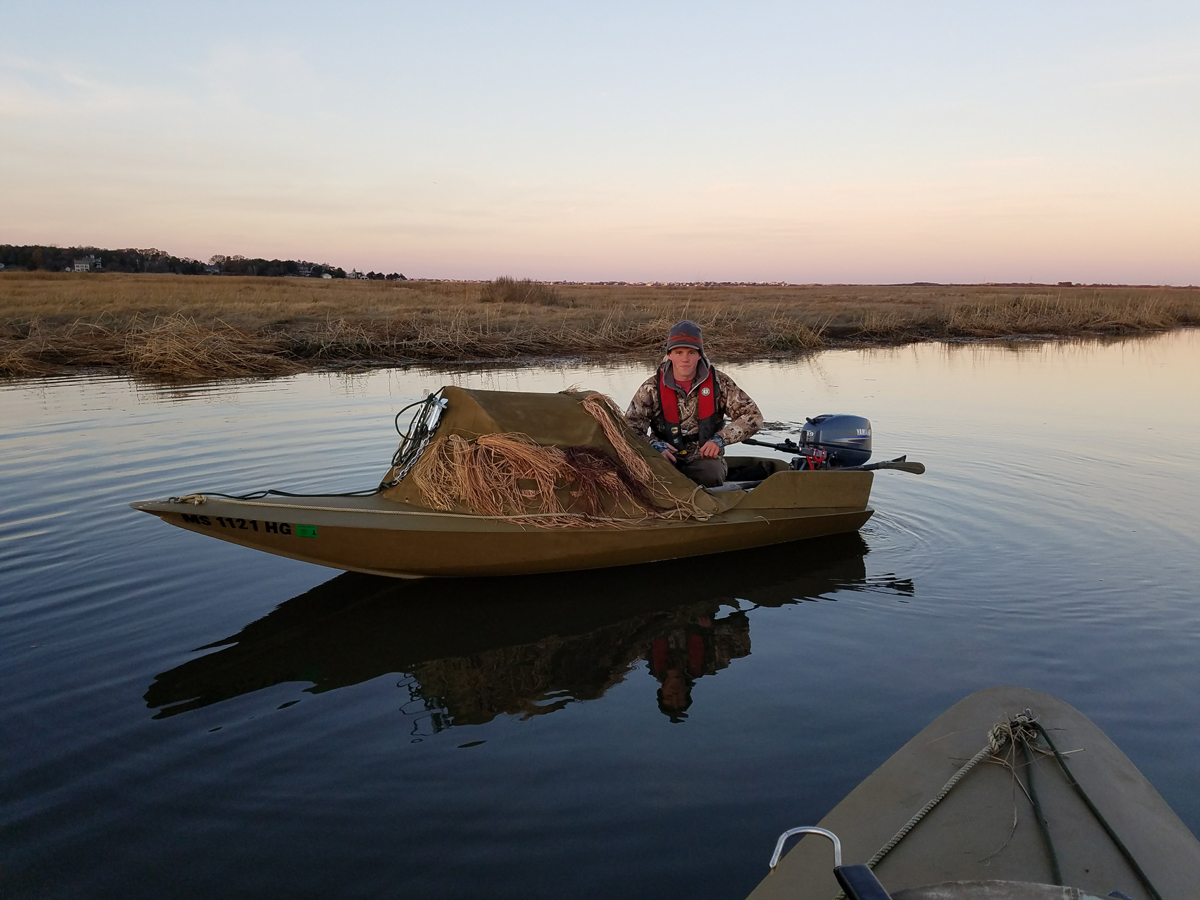
Hank Garvey Barnegat Bay sneakbox.
I waited in my truck for my turn. It was as if a checkered flag at a B.A.S.S. tournament dropped, and throttles were hammered. The boats left surfable wakes that splashed the shoreline as they sped into the night, but their destinations were revealed. Red and green running lights indicated that two boats headed set up for eiders and oldsquaw on the west rip. Three went north to where the freshwater estuary meets the bay. There they’d have a wider variety of divers, black ducks and brant. Four vessels headed east to hammer eiders and surf scoters along the rocks, but no one headed south. The structure is super shallow and flat, the tide seams are soft, and it’s a subpar spot at best. By the time I got to launch, the armada would have anchored up in every decent gunning spot except for the south. No one went south because no one ever goes south.
No one ever goes south.
No one goes down there because it’s super skinny and there isn’t a hard current to be found. I went there one time and dug more clams at low tide than I shot birds. It’s a gorgeous spot for sure, and it fishes well in the summer. But when I’m in a mood to kill ducks it’s the worst choice of all.
Opportunity knocks. Blessed are those who wait. I waited in line long enough to realize that the southern marsh would be the ideal secondary spot in this straight northerly wind. Ducks, geese and brant spooked by the barrage along the other compass points would fly downwind. The boat hitched to my truck couldn’t be in there, but if I headed home, swapped boats and picked up my sneakbox, I could tuck up high in the reeds and set a raft of dekes on the edge. The ducks would pour right into the shallow cover.
I could trailer it to the town landing 50 yards from my house. I’d launch from the beach that smelled sweetly of coconut oil in the summer but was void of life in the winter. There would be no pounding in the open ocean, I’d glide with the tide, and gunkhole through the skinny water. There’d be enough dried cordgrass and bladderwort above the high tide mark, and I could grass my boat in minutes. I’d be there alone, drinking a hot coffee while listening to the waves slap the shoreline in peace. All I’d have to do is to listen for some shots to be fired, wait a bit and then clean house.
Gunkholing for ducks is best done with what many folks call primitive craft. Sneakboxes, scull boats and the like, were designed for a life lived in the shallows. They draw mere inches of water when fully loaded. Boats built before the days of outboards featured innovative hull designs that made for easy rowing, poling or sailing. Watermen favored beamy, stable boats that could be used for a wide variety of work throughout the year. The boats’ simplicity connects us with the rich fabric of our waterfowl heritage.
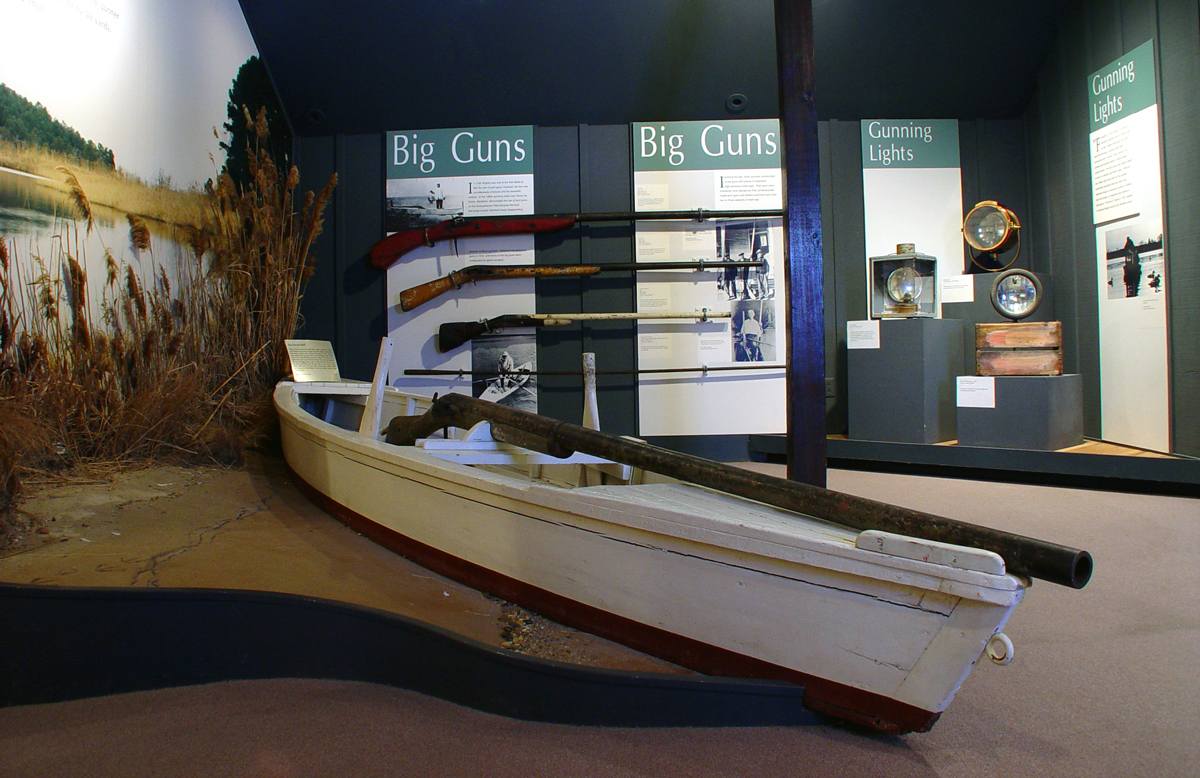
A 16-foot sneak skiff is exhibited in the Waterfowling Exhibition at Chesapeake Bay Maritime Museum. Photo courtesy of Chesapeake Bay Maritime Museum.
Ask Pete Lesher. Lesher is the chief curator at the Chesapeake Bay Maritime Museum in Saint Michael’s, Maryland, and he’s surrounded by such boats. He’s worked on some, captained others and has a 360-degree view of a waterfowling fleet. His work at the museum keeps that history and tradition alive.
“A number of the boats used by watermen are still used today,” he said. “I think it’s because those boats were purposefully designed and built to handle the conditions. Most of the boats were not designed specifically for waterfowling. As watermen made a living doing a variety of seasonal jobs, their practical, functional and durable boats were used for a wide variety of activities. Some watermen ran pound net fisheries for striped bass and shad, while others oystered in the winter and crabbed in the summer. After the market gunning days ended, watermen still provided ducks and geese for commercial sale. As their hunting wasn’t a principal occupation, it did fill a seasonal niche. So boat design was important, and it largely came from their handling and maintenance skills with an eye toward making their already hard work easier. The commonality was that they all needed to get into shallow water be it for ducks, geese, crabs or oysters.”
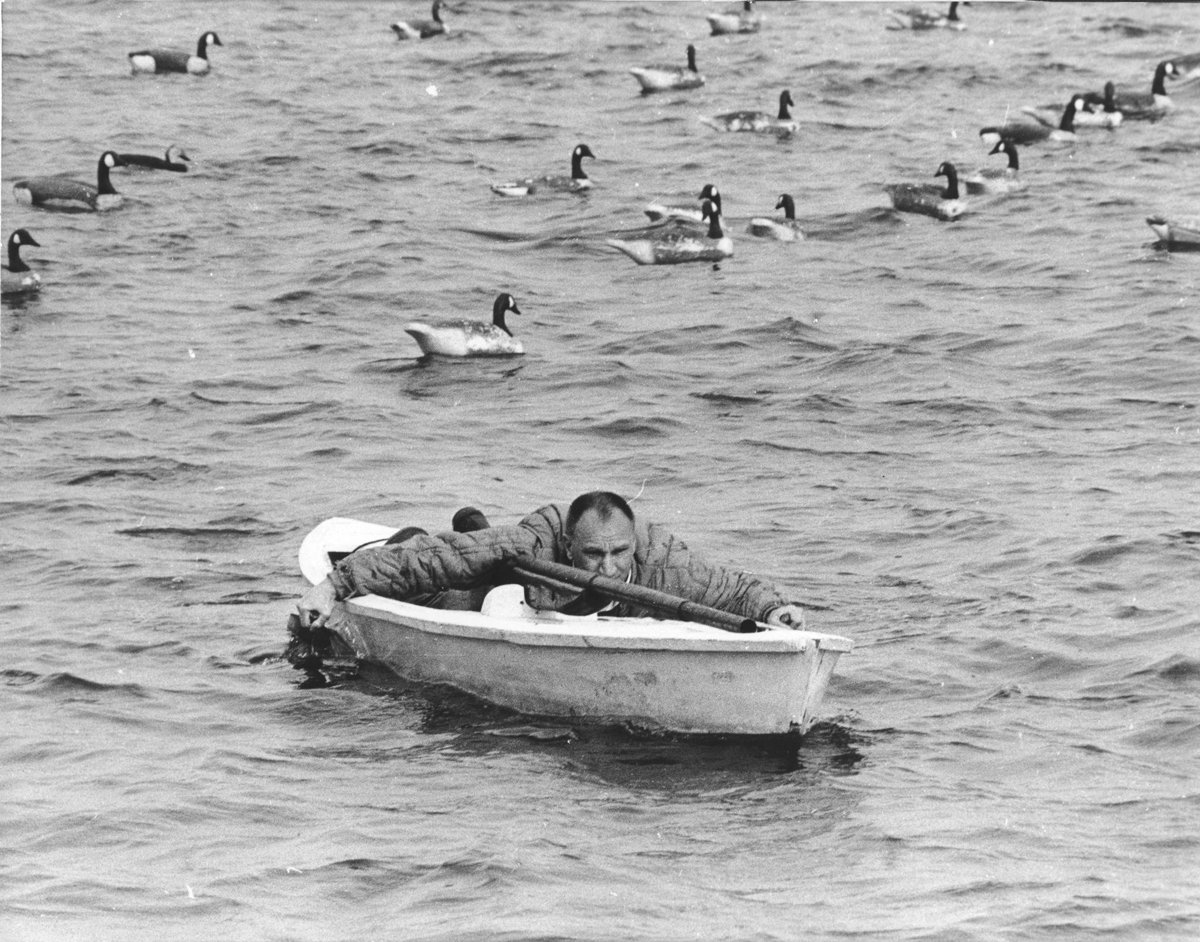
Photo courtesy of Chesapeake Bay Maritime Museum.
Several examples that were once stored in the museum’s corn crib in St. Michaels, Maryland, are on display in the Waterfowling Exhibition Building and the Small Boat Shed. What’s better is that a number of these hull designs are still used by hunters today. “The Bushwack boat is a native of the Chesapeake Bay,” Lesher said. “They are similar to a dory in that they are flat, have narrow bottoms and have high-raked transoms with wide-flaring sides. These boats are very dry, and they present a low-profile. The canvas curtains around the bow make them stealthy.
“Watermen used oars to row their Bushwacks into an upwind position above their decoys. Bear in mind that shotgun loads weren’t what they are today, so if a flock of birds landed out of shooting range the hunter would scull down, flush them, and take them as they flared off the water. It was common for two hunters to be in one Bushwack; one was the shooter and the second was the paddler. A single sculling oar was used, and even that design was well conceived. The oarsman placed leather around the oar shaft which silenced the chafe and kept the sculling noise to a minimum. We have two Bushwack boats made by watermen who are best known as decoy carvers. One boat was built by James T. Holly from Havre de Grace. Holly made boat molds in his workshop and passed along his skills—and later his patterns—to his apprentice, Paul Gibson. We also have Gibson’s Bushwack. Both of those boats were used for waterfowling and, when the season ended, they were used for gill netting shad in the spring.”
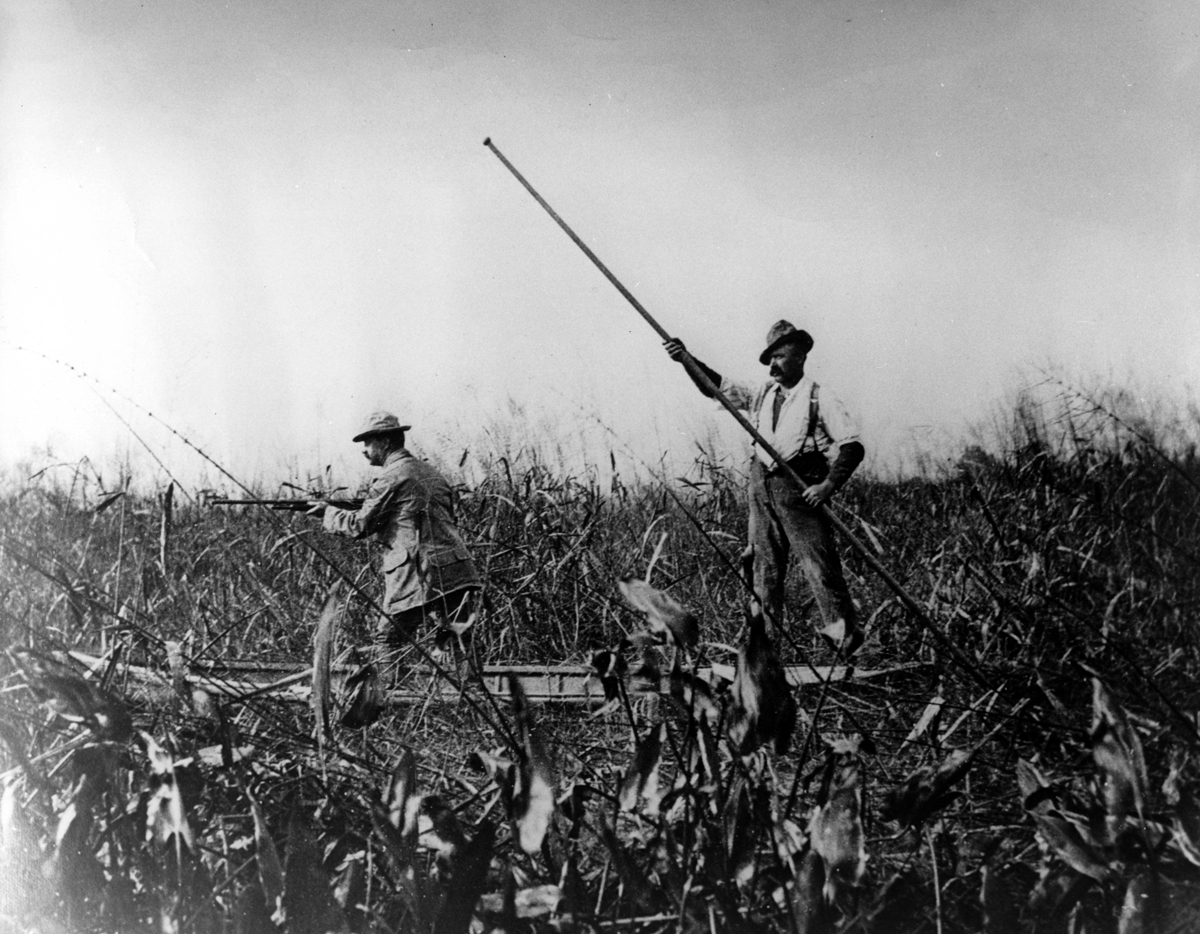
Capt. Joseph Heisler pushes a railbird skiff for sportsman Otto Eisenlohr, circa 1909. Gift of Nelson H. McCall, Chesapeake Bay Maritime Museum.
Though they hail from the Garden State of New Jersey; Barnegat Bay sneakboxes were heavily used in the Chesapeake. “Boat building is sometimes a theme and variation,” Lesher said. “Watermen in Maryland built theirs differently than the New Jersey boatbuilders. The original New Jersey model had a rounded crown that connected to a rounded hull. That design created a shallow draft boat that combined stealth, maneuverability and seaworthiness. Chesapeake builders borrowed that clever design but added a 3-inch connection between the crown and the hull. The model we have here reflects that change, but I’m not sure if that was by design or if the boatbuilder lacked the understanding of how to fit the hull with the crown.”
Another shallow draft boat is the Delaware Ducker. The 15-foot, lapstrake, double-ended boat could be rowed, poled or sailed. “The Delaware Ducker was a cross-purpose hunting boat,” Lasher said. “It certainly would be used for waterfowl, but its main purpose was for hunting sora rails high up in estuaries. Each Ducker had three methods of power. A sail was used for longer distance travel to the mouth of an estuary. Once there, oars rowed the boat into the river. As the hunters got high up in the river system, the poler would stand up and use a clawfoot push pole to get to the birds. The hunter sat in the bow, but the Duckers were stable enough to stand to shoot. We have two Delaware Duckers in our collection, and they were made by Josef Liener, the head of a small boat shop in Philadelphia. Liener retired to the Eastern Shore, which is how we acquired his boat. His boat has a single mast with a sprit rig sail. That one sheet makes the boat as simple as can be, especially because hunting was his primary activity.”
The Patuxent Railbird Skiff’s nice, simple design was used primarily for shooting rails high up in the marsh. “The Patuxent Railbird Skiffs were double ended, with a sharp, balanced stern,” Lesher said. “The sides were nearly straight but had a slight flare at the fore and aft decks. A platform was in both the bow and the stern, with one for the gunner and one for the pusher. These boats had a lot of rocker toward the bow, which was an interesting design. If the boat was stuck on a mud bank, the pusher and hunter could rock their way off to get back in the water without having to get out of the boat. It’s a nice, simple design.”
If you can’t find a traditional skiff, then why not build your own? That’s what Newburyport, Massachusetts,’ Hank Garvey did. Garvey needed a low-profile, lightweight and seaworthy blind to hunt the guzzles, estuaries, salt pannes and tidal rivers around his coastal home. And because the 12-foot tides push ducks all around, his blind had to be mobile. His solution was a hand-made Barnegat Bay sneakbox that can be rowed, paddled or motored to where the ducks are that day.
“I built mine to be representative of the original New Jersey design,” he said. “So far, I have built five in total. I built four with my hunting buddies and, when my son Hank, Jr. was old enough to learn to use power tools, we built one together. The best part is when we all splash our sneakboxes on a hunt. It’s rewarding to hunt from a boat we’ve built from scratch.
Each of the sneakboxes is 12 feet long with a 4-foot beam. “In keeping with the original design, I used cedar planks and mahogany ribs,” Garvey said. “The rocker and traditional featheredge provide a smooth and stable ride in stiff seas. There is one coat of fiberglass and multiple coats of epoxy so they’re watertight. I went with a canvas dodger because when it gets wet, the saltwater shrinks the fabric and keeps it tight. Then I’ll add in some spartina grass along and fill it in with natural cordgrass from our marsh. That combination makes the sneakboxes blend right in.
One would think that laying in a boat that sits in cold, December water would be bone chilling. But it’s not. “You wouldn’t think a sneakbox would be warm but when my Lab, Brizzo, and I are tucked in under the dodger, it’s comfortable enough to take a nap,” Garvey said. “The boats are light, and weigh between 125 and 140 pounds. They’re easy to pull up a bank and position near a salt panne. I use an outboard on mine and, while a 9.9 horsepower outboard pushes the sneakbox just fine, I prefer a 15-horsepower engine. That extra power comes in handy on a dropping tide. When I bought my outboard, I went with a two-stroke because they were lighter than four-strokes. These days the weights are pretty close to the same.”
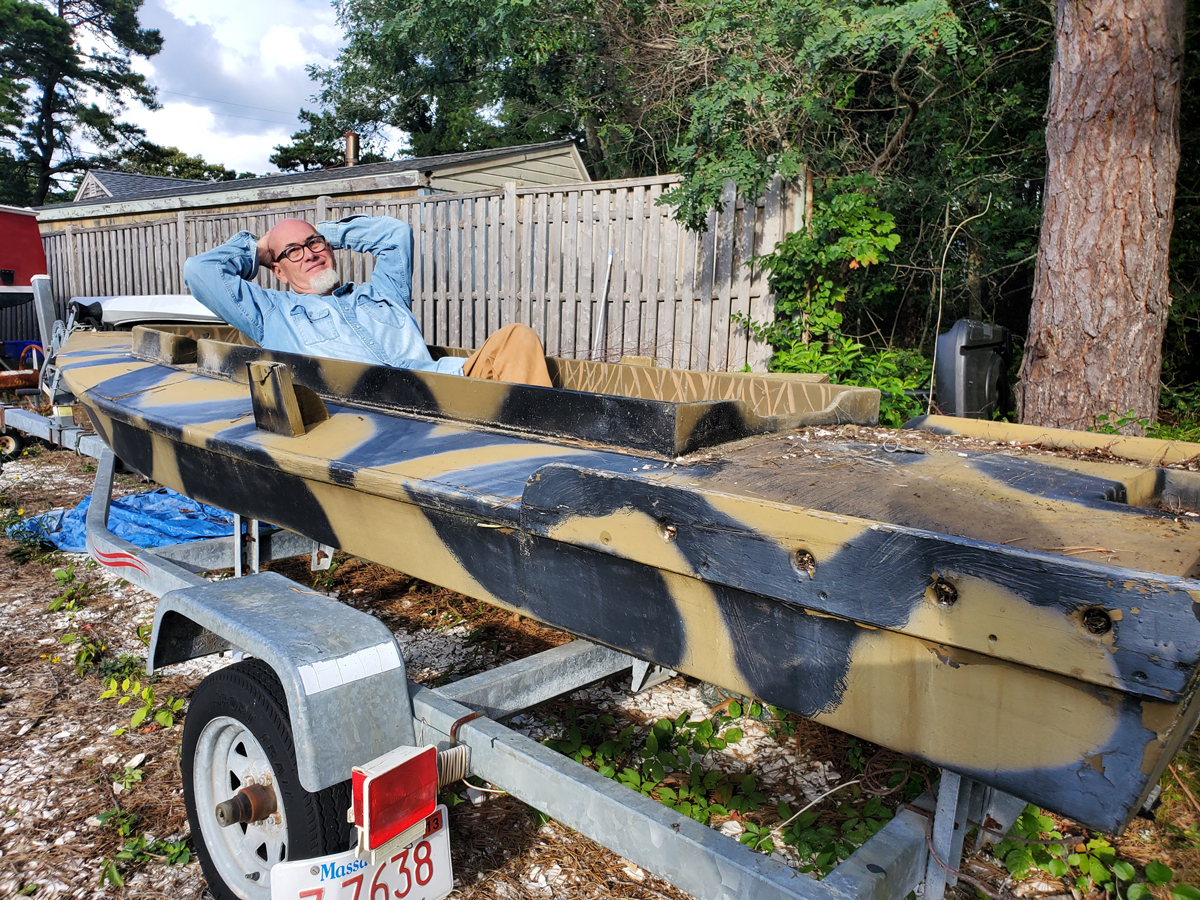
Capt. Kevin Coakley of Wellfleet, Massachusetts,’ Wellfleet Charters thinking about duck season in a layout boat he built himself.
Don’t overlook the classic layout, especially if it’s one built by Capt. Kevin Coakley. One winter, the Cape Cod charter captain built two layouts for hunting in the waters near his home. “Late winter and early spring are slow times for me,” he said. “Waterfowl season is over, and fishing season hasn’t started. I got bored one winter, so to pass the time I built a few layout boats. They require a bit more maintenance than my fiberglass duck boats, but it’s regular and preventative for sure.
“I built layouts because they position me low-to-the-water, which is a similar plane as my decoys and incoming ducks. I like the low profile because it offers me unparalleled stealth in a marsh, a cove or a river estuary. The boats are easy to move and, since they only draw a few inches of water, I can get into spots bigger draft vessels can’t reach. Sometimes I’ll crank up a 5-horsepower outboard, but most of the time I’ll row or scull. It’s an open cockpit, which is roomy enough for all of my gear, and I built a hole for my dog in the bow. With him riding up front, the weight balances perfectly. Though 12 feet long they weigh only about 80 pounds. That makes them easy to launch and simple to drag off a bar when the tide runs out. The best part is that they’re beamy and stable. On a bluebird day, I’ve been known to take a nap.”
Sometimes, bigger really is better. A bigger gun cabinet means you’ve got all bases covered. The same holds true with more dog power that comes from a bigger kennel. A bigger wallet helps make those things happen. But when it comes to duck boats in the marsh, bigger might not always be better. Many times, slow and low is the only way to go.