

On January 23, 1990 Kevin Thacher, my wife Marge, and I made our way a mile over rolling sand dunes from the English village of Wells-next-the-Sea. There was a very strong wind, alternating with ice, rain and heavy snow. We were there for the goose flight. Wells-next-the-Sea is a very famous wildfowl location in the U.K. and gunners have shot there since muzzleloader days.
As Kevin kindly explained to us, the shooting at Wells was done just one way: The geese, almost all pink-footed, roost on sandbars off the main beach. It isn’t allowed to disturb them there. In fact, one cannot station oneself at the water’s edge. Instead, one is required to stand far back in the dunes. At dawn, the geese leave their roosting locations and fly inland to feed. From that point the day is entirely a crap shoot. If lucky, a flock, or flocks, will pass over you. If so, it is all important that they are low enough for a reasonable shot. Many times, they aren’t. That type of goose shooting is termed “flighting,” and was by and large the only way geese were shot in about all regions of the U.K. until recent times when decoy hunting in fields saw a noticeable switch of methods. Flighting proved to be a very mixed bag of success. I have read accounts of goose hunters spending a full week without firing a shot.
On my day at Wells things turned out very well indeed. As the first rays of light appeared, a low flock of seven pink-footed struggled my way against the strong wind. One was blown off course and came directly overhead. I crumped it.
I was using the classic U.K. goose gun—an 8-bore with 3 ¼-inch, 2-ounce lead No. 2s in an old shell made by Eley. The gun was a single-barrel hammer by Trulock & Harris of Dublin. The gun was loaned to me by Kevin. In downing the goose, I was able to accomplish something that at one time was highly regarded by U.K. wildfowlers, that being bagging a pink at Wells with an 8-bore. It goes without saying I was more than happy to do that.
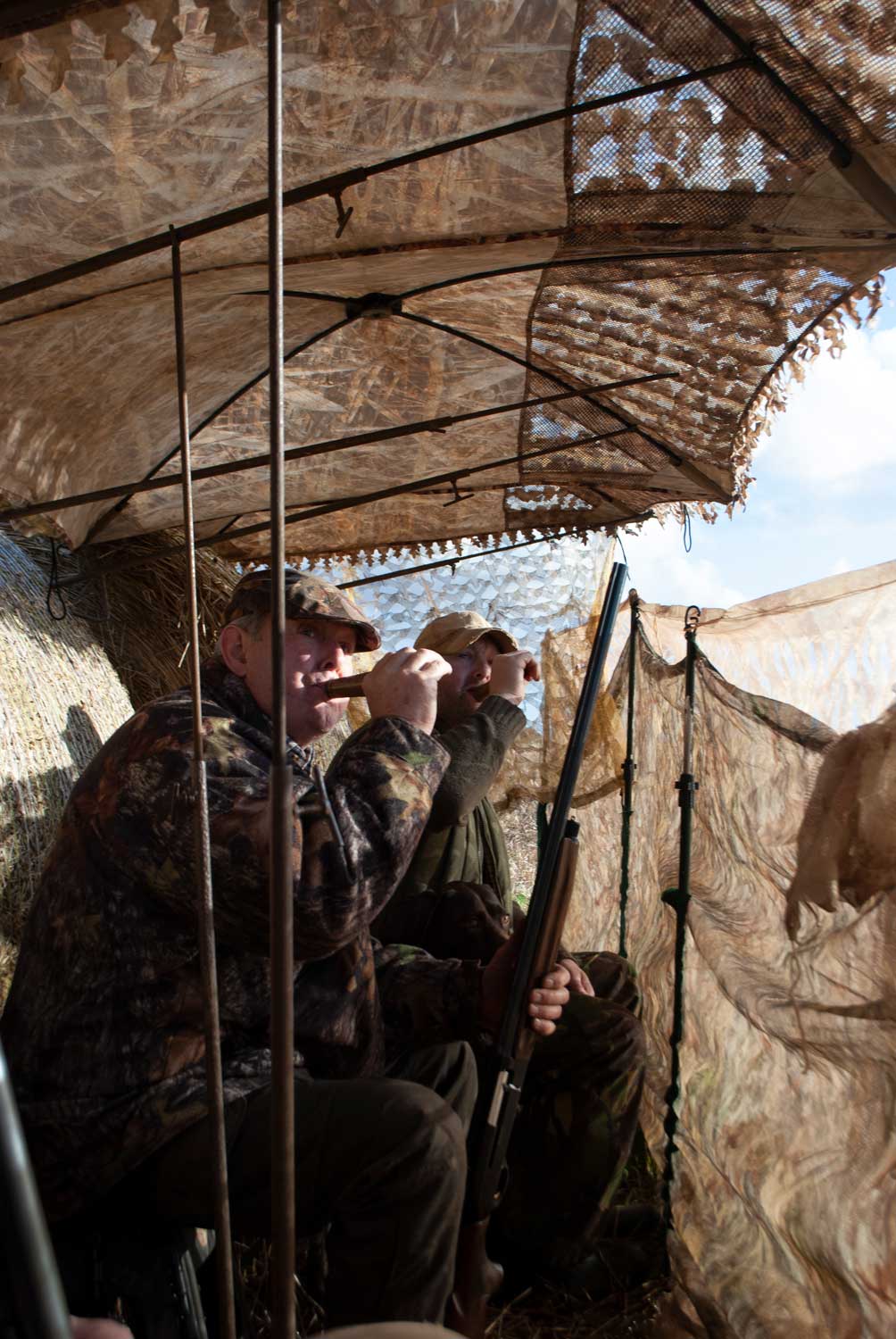
Fast forward to November 4, 2019. My wife, Marge, along with two Scottish fowlers and I, finished setting out 125 decoys in a cut barley field. Then we tucked ourselves into a hedgerow bordering the field to await the arrival of the pink-feet.
With first light they came; a whole bunch of them in big flocks.
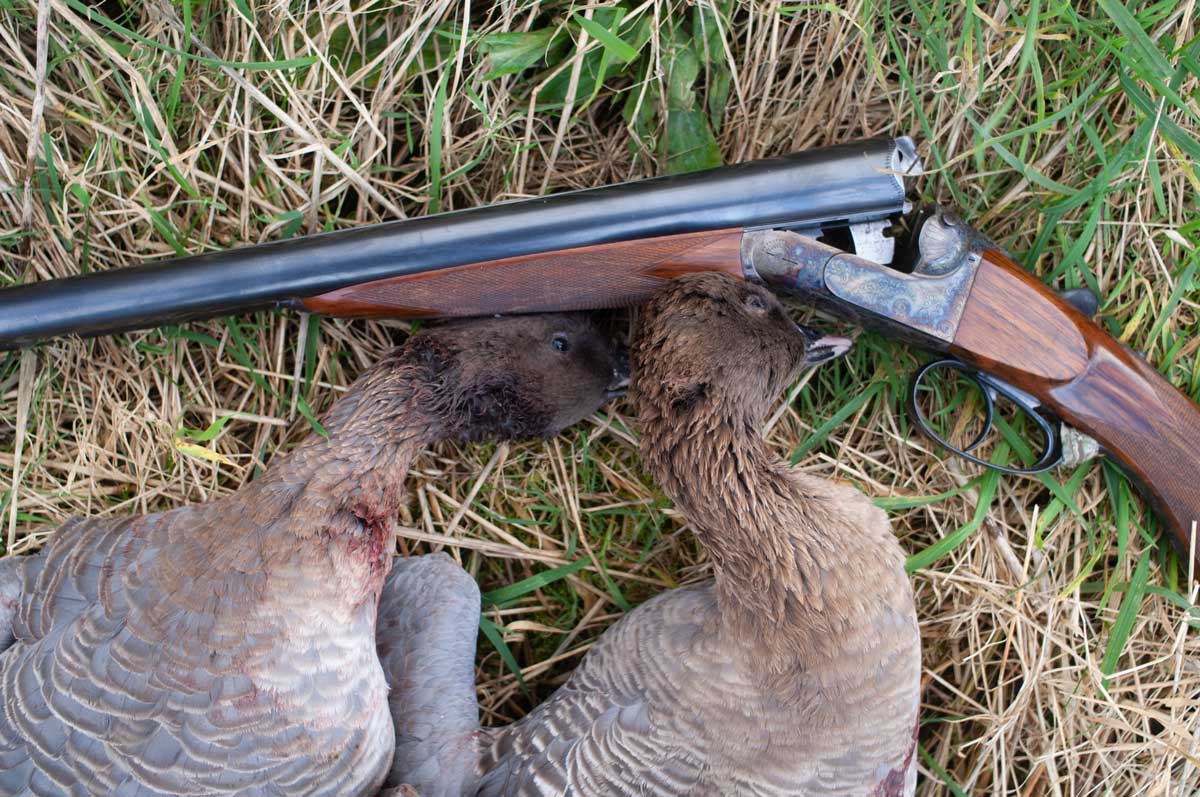
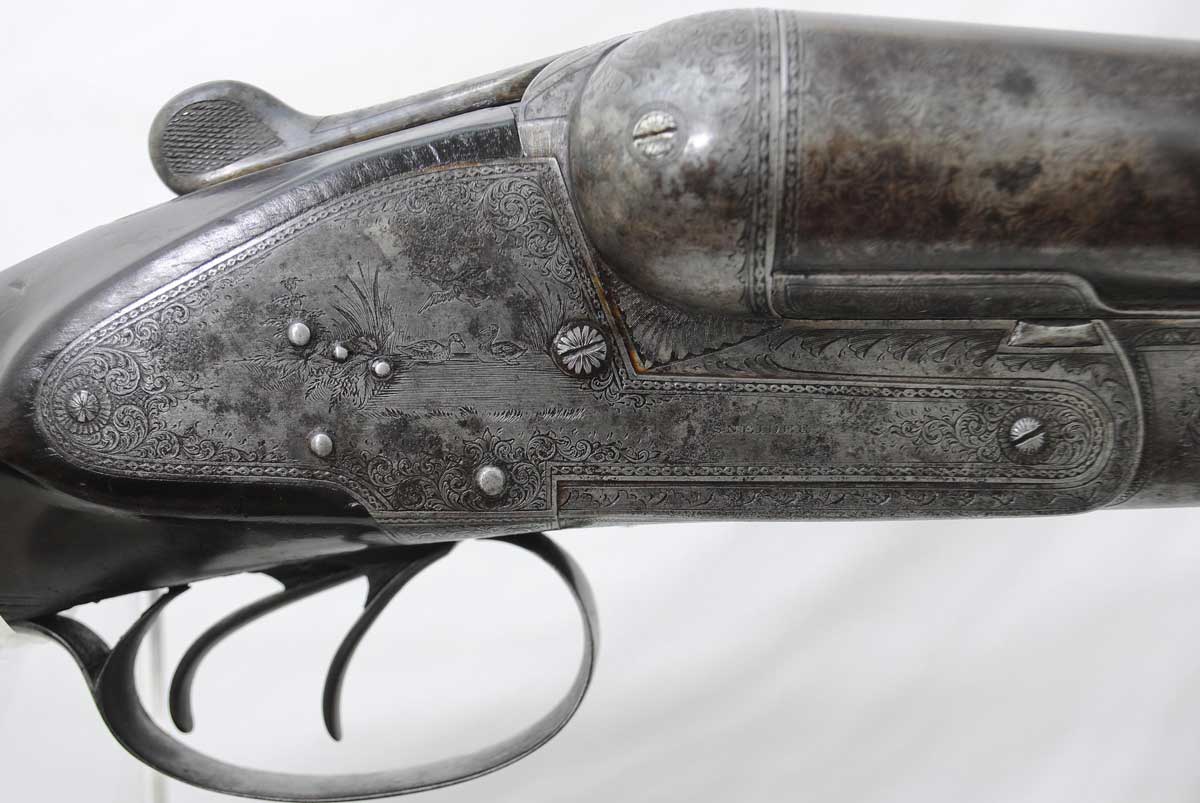
The powerful gun I was using wasn’t really needed that morning as the geese came over the decoys at about 40 yards high. With some low-flying flocks, a 20-bore would have been totally adequate. However, I had a hammerless double 8-bore made by Francotte that weighed 13 pounds and was proofed for 2 ounces of shot. I had 3 ¼-inch shells with the 2 ounces of lead No. 2s.
I enjoyed shooting it and the big 8 did accomplish a couple of good things. With one flock, up about 50 yards, I killed two geese with one barrel, then I took a single that our guide declared was at least 100 yards high. It was high, but I think it was more like 65 or 70 yards.
Even larger than the 8-bore, the 4-bore was used in the past and it was shot off the shoulder. Far fewer 4s were made and used in the U.K. than the 8s. These massive guns fired 3 ounces of shot. During one trip to Scotland, I was extremely fortunate to have a day for graylag geese with a 4-bore. It was a magnificent old single-barrel hammer gun made by Holland & Holland. It weighed 17 pounds with a 38-inch barrel. I was using blackpowder loads and once, briefly after firing it, was encompassed in a thick cloud of smoke such that I had to call to my wife to find out if I had hit a goose or not. It turned out that I didn’t hit anything, and Dave Hagerbaumer, who was with us, found that very funny.
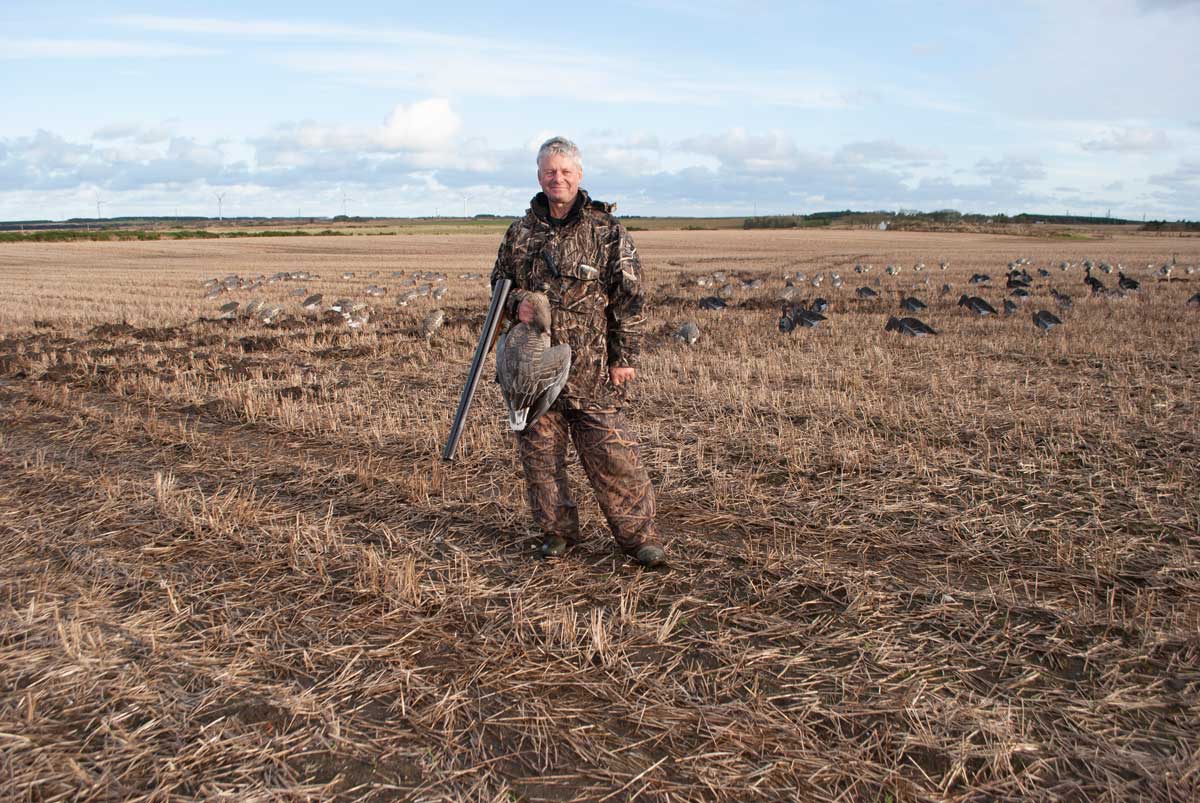
This hammerless double 8-bore made by Francotte weighs 13 pounds and is proofed for
2 ounces of shot. The author had 3 ¼-inch shells with the 2 ounces of lead No. 2s.
In comparison to the 4-bore, the 8-bore was somewhat common in the U.K. for many years. A famous British wildfowler, John S. Barrington, termed the 8 as “The prince of fowling pieces.” Many English gun makers made 8s, with some specializing in them. These include Greener, Scott, Bland and Tolley.
The 8-bores were very interesting guns as they were available in many chamber lengths. The standard length was 3 ¼ inches, but some were made with 3 ½-, 3 ¾-, 4- or 4 ¼-inch chambers. The 4- and 4 ¼-inch-chambered guns fired 3 ounces of shot, which was the standard 4-bore load.
Without question, likely the rarest gun I ever encountered was a Parker double 4-inch 8-bore made in 1916. That gun weighed 16 pounds. I saw it several years ago when it was owned by a surgeon and gun collector in Oregon. He has now passed, and I have often wondered what became of that gun.
Certainly, the most amazing and comical 8 I have heard of was one owned by the famous English fowler D.J. Watkins Pitchford, who wrote under the pen name of “BB,” as that was his favorite size shot for geese. He wrote often of his single-barrel hammer 8 with a 39-inch barrel made by a Birmingham maker. The weight was an unbelievable 7 pounds! Many standard 12 bores weigh more than that. He wrote that it commonly made his nose bleed after firing it!

Leaving The Grass At Dawn, Solway by Hugh Monahan (1914-1970), oil on canvas,18 x 24 inches.
Most of the 8s were made in the 1800s. Far fewer were made after the turn of the century. Most were hammer guns, and almost all had Damascus barrels proofed for blackpowder and 8s with fluid steel barrels are not common. Many have since been sent back to the proof house and re-proofed for nitro powder. I had a single-barrel hammer Damascus made by Midland that had been re-proofed, and my current 8-bore double made by Francotte has fluid steel barrels, but it is a very late 8 made in the 1930s.
In the U.S., far fewer 8-bores were used. Those that were came mainly from Greener or Scott and most of those were purchased and used by wealthy members of waterfowl clubs, especially along the Atlantic coast. Some American gunmakers made 8s. Parker made the most, L.C. Smith and Lefever a few.
Nash Buckingham wrote that in the late 1800s several members of the Wapanoca Club had 8s made by Scott and that as a young hunter he sometimes used one.
The belief that market hunters used 8s to a great extent is very likely false. Of course a few did, if they could afford them, but the 10-bore was by far the most common. And of great importance, once pump and auto guns were available, they became the market hunters’ first choice.
The use of 8-bores and larger guns was banned in the U.S. on July 1, 1918, as part of the Migratory Bird Treaty Act. The ban was by and large aimed at taking away big guns from market hunters. In the case of the 8-bore, the ban wasn’t really needed as market hunters hadn’t used them since the turn of the century. The ban rightfully eliminated the punt guns, but the 8s got dragged along.
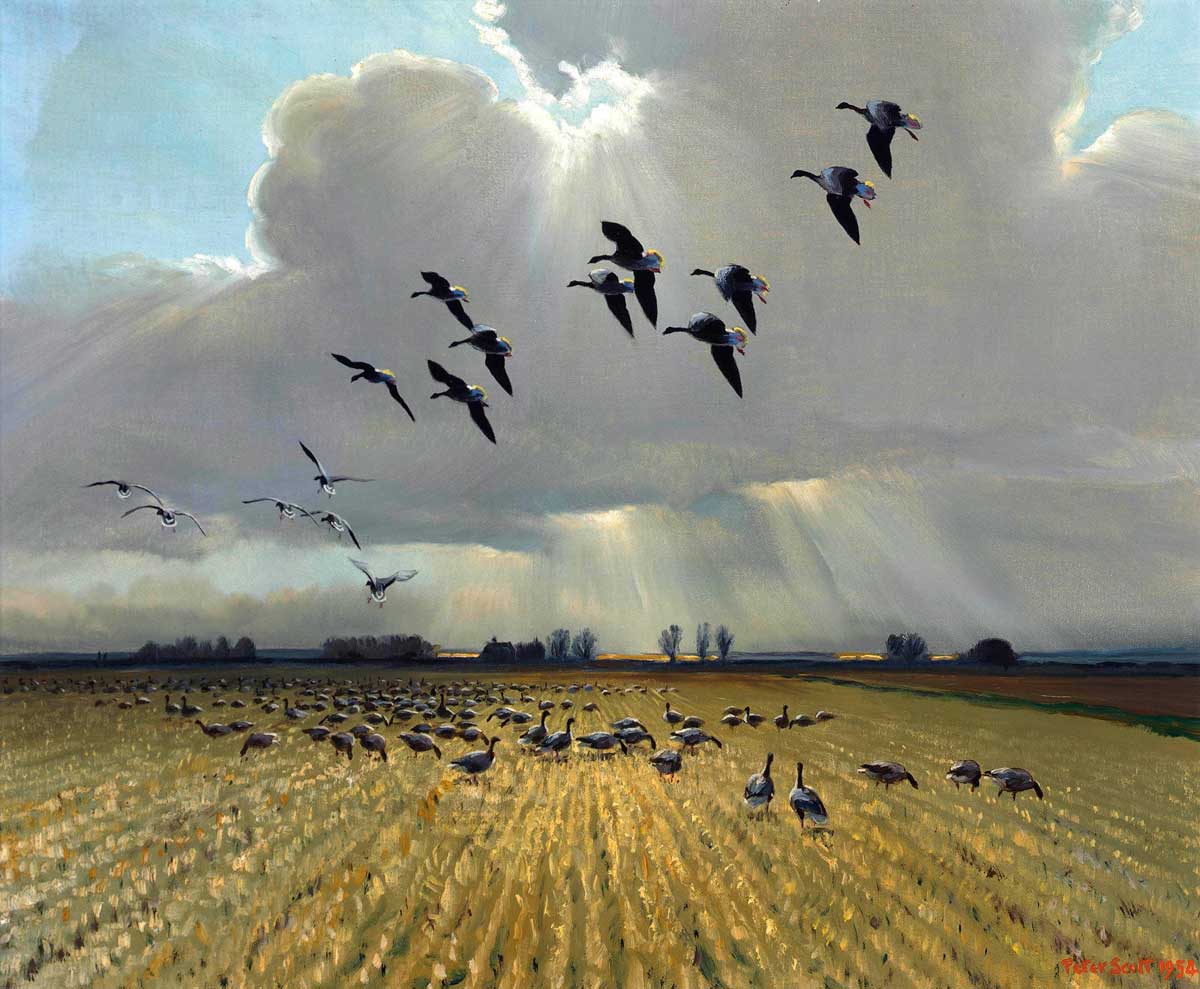
Pink-footed Geese Coming In by Sir Peter Markham Scott (1909-1989), oil on canvas, 20 x 24 in.
Early on, especially in the U.S., the 8-bore had a marked advantage for goose hunting. For many years the standard 12-bore load was 1 ounce and, at 1 ¼-ounce, the 10-bore’s standard payload wasn’t much larger. The 8-bore’s standard load was 2 ounces. One of the sharpest outcries over the ban on 8s came from Charles Askins, then-gun editor for Outdoor Life. He wanted a 2-ounce load for geese and wrote, “The big 8 bore, rightly used, is not a duck killer, and I have never agreed with the Bureau of Biological Survey in their forbidding its use. Over decoys, a repeating shotgun will kill twice as many ducks as an 8 bore double.”
During the 1920s, Askins campaigned to have the ban on 8s lifted. He was unsuccessful, but along with his campaign came a very interesting chapter in gun making. Askins was close friends with Lou Smith at Ithaca, and Spencer Olin at Western Cartridge. He discussed with Olin the possibility of making a 10-bore 2-ounce load. Olin said it could be done and Lou Smith signed on the project and made the gun. It was a way around the ban on the 8 and, while not totally ideal, was the best that could be done. Askins got the first big 3 ½-inch-chambered 10-bore made. It later went to Elmer Keith.
It has been written that the range for an 8 to kill a bird dead, not just cripple it, is out to 80 yards. And that of a 4-bore is another 20 yards. Well, perhaps. But I would reduce the range for the 8 to 65 to 70 yards. And by that I mean certain killing shots, however, I haven’t had all that much field time with an 8 and have shot only lead. I would love to shoot some HEVI-Shot from an 8!
Steel 3 ½-inch 10 bore BB loads can result in some remarkable shots. I was once using a cow silhouette in Oregon to try to get close to a flock of the small cackler Canada geese in an open field. They were not afraid of the silhouette, but each time I moved closer they just walked away. Getting tired of that after a half hour I let the silhouette fall and shot into the flock with one barrel of my old Ithaca 3 ½-inch 10-bore as they rose. I killed one stone dead and had two cripples. After chasing down the cripples I went back to the dead goose. The farmer who owned the field had been watching from his barn and walked out to join me. He pointed down the field to where the silhouette was and remarked it was a long distance. So we both carefully paced it off. It was 104 yards!
Should I have tried that shot? Under normal conditions, of course not. But the geese were causing grave damage to the farmer’s young rye grass field and he wanted them shot off, not just taken for a walk. He had been keeping them out of the field with his rifle.
It needs to be stated that big guns and loads, which include the newer 12s and 10s can often only cripple birds when used for long range shots. And unfortunately, some hunters armed with such guns shoot at birds they shouldn’t, even if they get a few at times. Regarding that, it is interesting to note that somewhere near the turn of the century 4-bores were banned at Wells-next-the-Sea because those with such guns were shooting at geese that were too high.
Very likely the individual in the U.S. who knows the most about 8-bore guns and loads is Tom Armbrust. In 2006 he wrote the excellent book, 4 and 8 Bore Shotguns and Loads and among the guns he owns and takes to Scotland to shoot is a truly wonderful Westley Richards 8-bore with the very uncommon 4-inch chambers.
Armbrust took a page out of Askin’s playbook and wrote letters to the U.S. Fish and Wildlife Service about lifting the ban on 8s. His reasoning was more than valid:
“With non-toxic shot loads, 8 bores will not have much, if any, performance advantage over current magnum 10- and 12-gauge shotguns. They certainly will not match the fire power of unplugged magnum 10- and 12-gauge shotguns used during the spring conservation season on light geese. For those few waterfowl hunters who have the privilege of owning a fine 8 bore, the thrill of being able to harvest geese or even ducks with it would be immeasurable. I urge the U.S. Fish and Wildlife Service to allow the use of fine vintage 8 bores for waterfowling, at least during the spring conservation season.”
Like Askins, Armbrust was not successful in his persuasion.
I fall in close formation behind Armbrust; I would rather not have to take my 8-bore to Scotland in order to use it. And again, I would love to try 2 ounces of HEVI-Shot from an 8!
Note: This article was originally pubished in the 2020 Guns & Hunting issue of Sporting Classics Magazine.