
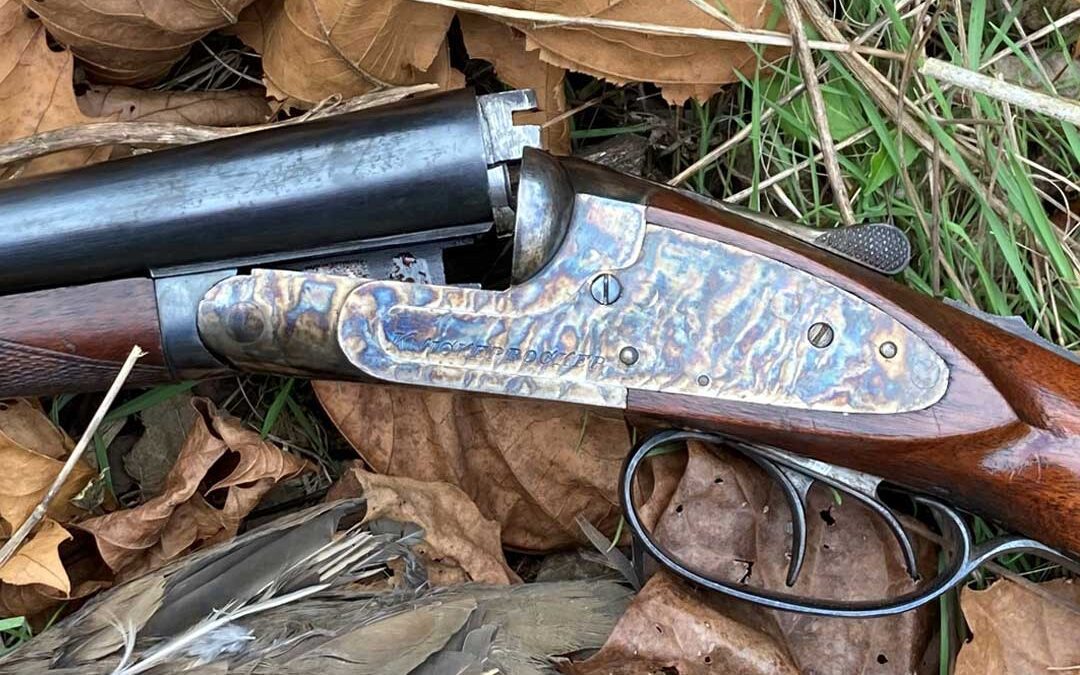
If a person wants to hunt with the same double barrel shotgun that his or her grandfather or great grandfather used in the early 20th century, the odds are ten-to-one it would not be one of the premium brands that today dominate side-by-side competitions and shotgun literature.
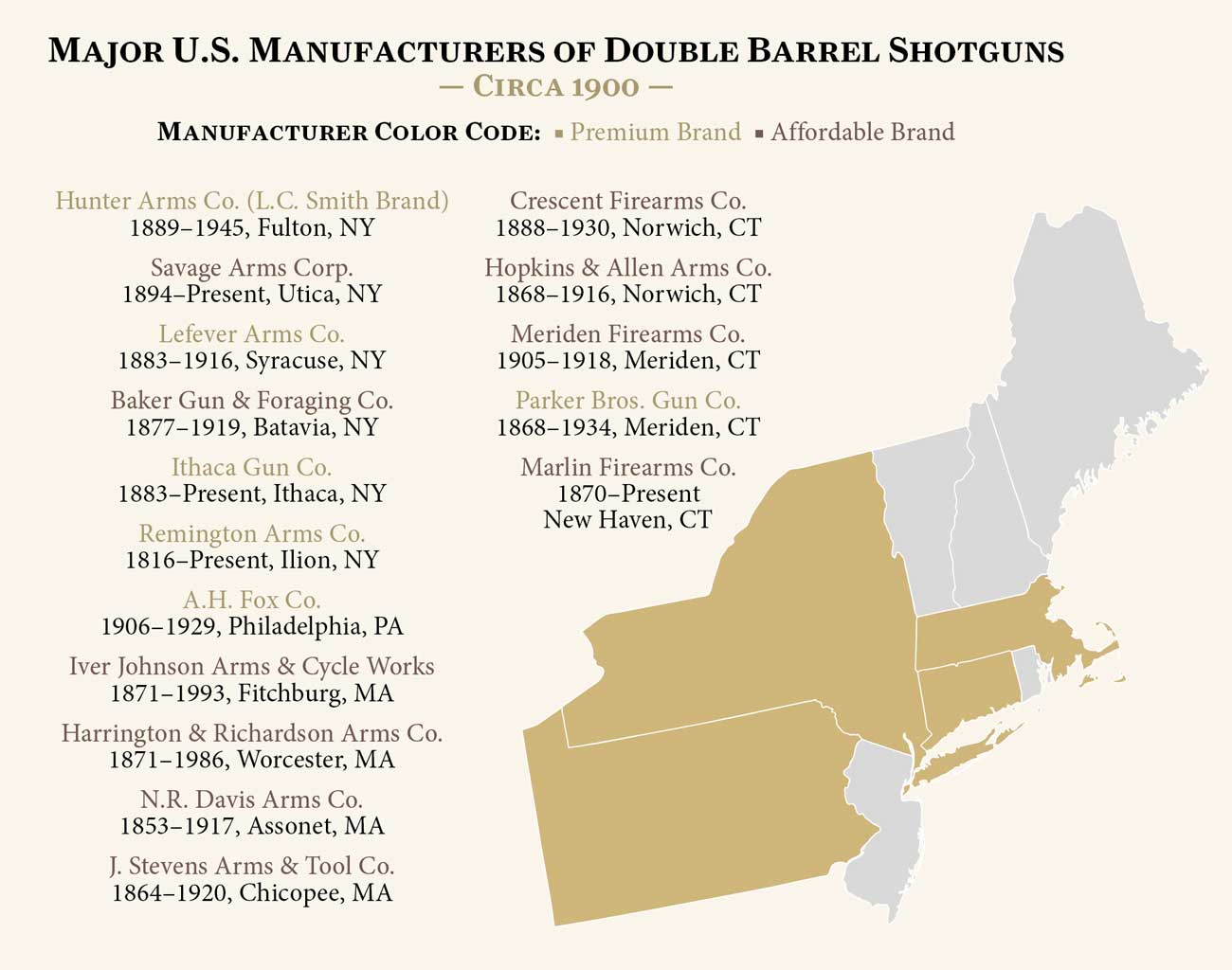
Out of approximately 17 million double shotguns sold in the United States between 1875 and 1925, only about 1.5 million were made by L.C. Smith, Parker Bros, Remington, Lefever, Ithaca, Colt and Baker. Another couple of hundred thousand were high-quality European guns. Most of the remaining 15 million shotguns were what Nicholas Niles characterized as the “affordables” in his definitive book on this class of shotgun. Niles described an “affordable” as:
“… an inexpensive, multi-purpose, durable, double barrel shotgun that looks and behaves like a much more expensive one but costs about half as much or even less. It is the ideal double shotgun for ‘Everyman’.”
My professional interest and knowledge of this class of gun have expanded in the past couple of years. Increasingly, the guns that come to me at Doublegun Preservation, LLC are fathers’, grandfathers’ and great-grandfathers’ shotguns that their owners want reconditioned in order to pass on to the next generation to shoot and hunt safely. As the value of these guns to the owners is independent of the original purchase price or current market value, they include many different makes and models.
As a collector, my appreciation of this class of guns has also come relatively recently. I collect the evolution of the side-by-side shotgun from 1865 to 1915. Like many, I started my collection of American shotguns with the iconic premium, or luxury, brands. While presenting an educational display at the Maryland Antique Arms Show in Baltimore in 2018, it dawned on me that I could not tell the story of the double barrel shotgun in America without addressing 90 percent of the guns sold here.
Any class of products that can meet the needs of multiple diverse sectors of the population is going to have a substantial variance in cost and quality. Almost all of the shotguns in the affordable class were safe, effective and reliable when made. However, as with all machines, their design, component parts and special features would have been dictated by what their targeted customers needed and could afford. Hence, many of the lowest priced affordables were designed for a limited useful lifespan, to be used up, discarded and replaced. Others, however, aspired to achieve the same quality and performance standards as the luxury shotguns, but at a lower production cost.
Historical Context
Although technology and industrialization have a role in the story of American affordables, the key factor explaining the 10:1 ratio mentioned above is the huge disparity in wealth and income as the country was coming out of the Gilded Age. The wealthiest 2 percent of American households owned more than a third of the nation’s wealth, while the top 10 percent owned roughly three-quarters of it. The bottom 40 percent had no wealth at all. In terms of property, the wealthiest 1 percent owned 51 percent, while the bottom 44 percent claimed 1.1percent.
Much of what we today refer to as the working class was on the edge of poverty. The average weekly income for men in all industries was $8.42 a week. For women in was $6.13. The wages for even highly skilled workers were low. The average median weekly wage of a metal machinist at that time was $12 for a 60-hour work week, or 20 cents an hour. A machinist circa 1900 milling the parts for L.C. Smith shotguns most likely would not have been able to afford to buy any of the guns he was making. It would have taken 185 hours of his wages to buy even a field grade hammerless shotgun, which listed for $37. It would be the equivalent today of a machinist earning the national average wage of $22 per hour spending $4,000 on a shotgun.
However, the relative expense was even more severe for the 60 percent of the population in 1900 living in rural areas of America. Average annual earnings of a farm family were $402, of which only $300 was in cash. Yet, a small farmer or rancher needed a shotgun to put food on the table, control predators and provide security. For most rural households, a shotgun was an essential tool. The western population expansion accentuated the demand for reliable, multi-purpose shotguns.
Niles explains the reasons for the “enormous popularity” of this “uniquely American type of utility double”:
“Americans at the lowest income levels could afford them. In fact, they could not afford not to own one…. A farmer could not be without a gun to kill the fox that was eating his hens or the crows that were molesting is valuable crops. A settler on the frontier could not afford to leave his family or his possession unprotected.”
The shotgun market in the first two decades of the 20th century paralleled the nation’s overall economic disparities. The super wealthy bought the most prestigious and expensive of the British shotguns such as Purdy, Boss and Holland & Holland. At the next economic level, affluent Americans bought the premier American brands and second-tier British guns such as W.& C. Scott and W.W. Greener and from the Continent brands such as Francotte, Sauer and Lindner. The Continental guns were often rebranded by prestigious New York firms such as Schoverling, Daly & Gales and Von Lengerke & Detmold.
The needs of the rest of the population in the last decades of the 19th century were met largely by Belgian-manufactured hammer sidelocks. By the late 1880s, trusted mail order houses with extensive reach into middle America, most prominently Sears, Roebuck, & Co. and Montgomery Ward, were importing and backing with guarantees large numbers of Belgian guns. Their catalogs, along with those of major sporting goods and hardware manufactures, served the same function then as the internet does for gun buyers today.
By 1900, a combination of the growth of American industrialization, global advances in metallurgy and machine tools and tariffs (30 percent on Belgian guns) gave U.S. manufactures a competitive advantage that they never yielded. They expanded their facilities, adapted designs of previously hand-made guns to mass-produce machine-made guns and captured the affordable shotgun market.
The companies that made the premium brands, with a couple of exceptions, were start-ups concentrated in Upstate New York. The companies that produced the affordables were predominantly established firms in New England, which had been the arsenal of the Union during the Civil War.
Accessing Quality and Value
The quality of a double shotgun of the period can objectively be assessed based on the quality of the wood and steel that were used to make it, and the design and workmanship of its mechanical components. Engraving and other embellishments were major factors in the grading and pricing of a particular model, but in most cases the mechanical components were identical in all grades and thus of limited interest in this analysis.
The type of the wood used in stocks and forends is a key indicator of the quality of a vintage double. Three types of wood were used in U.S.-manufactured affordable shotguns: various semi-hard wood species, American walnut and English walnut.
The least expensive American-made affordables used beech, cherry, maple or other semi-hard wood that was locally available and could be seasoned relatively quickly. The wood was strong, but not necessarily tough. Stocks dented and scratched easily. Most importantly, they tended to be very susceptible to their most lethal threat, petroleum-based oil that seeped into and rotted the wood. The use of semi-hard wood appears to be the primary reason why so few of the lower end affordables have survived.
The best of the affordables used American black walnut or English walnut. American black walnut was widely available, dependable and relatively inexpensive (with the exception of the highly figured wood taken from where the roots and trunk join). The term “English walnut” was a trade name for a species that was native to all of Central and Southern Europe. English walnut had been grown in America since Colonial times, but because of climate and soil the quality was lower than imported wood. An American black walnut stock tends to be more attractive than a similarly priced English walnut stock because of color and figure. English walnut, however, is denser, holds checkering better and is more resistant to damage of all types.
Before the invention of fluid steel, half the cost of a shotgun was in the barrels. The hierarchy was decarbonized steel (sometimes also advertised as “blued steel”), twist steel, laminated steel and Damascus steel. The latter had at least five quality levels from “good” to “finest.” All of the twist, laminated and Damascus steel barrels used for U.S.-made guns were imported from Europe “in the white.” The vast majority came from Belgium. Belgian barrels covered the quality spectrum, from the “good” two-bar (or blade) barrels used on field grade guns to the “finest” six-bar used on the most expensive guns.
Fluid steel barrels, which were in wide use in America by around 1905, tended to be lumped into two categories. American- and Belgian-made steel barrels with trade names such as Armory Steel and Armor Steel, were at the low end. They were considered less desirable than standard two-bar Damascus-steel barrels, which commanded a 20 percent premium. German Krupp steel and British Whitworth steel barrels were at the upper end and considered equal in quality to extra-fine four-bar Damascus-steel.
The case-hardening of steel is a labor intensive, and hence expensive, industrial process. Before circa 1900, case-hardening was essential. High-carbon steel could not be cut by the machine tools of the day. The steel used in shotgun frames had to be soft enough to be milled, but the exterior of the frame and other exposed parts had to be hard enough to resist wear and corrosion. Case-hardening accomplished that. The beautiful colors were just a by-product of the process.
Case-hardening shotgun receivers remained functionally desirable for another two decades. Because of improvements in steel and machine tools, by circa 1910 case-hardening was no longer essential, but manufacturers of the best of the affordable class continued case-hardening their steel. For manufacturers targeting the middle and lower end of the market, the new technologies gave them a means to reduce production costs while still providing a good, safe gun. In some cases, a chemical wash was used to create faux case colors, which did not add to the durability of the steel and also wore off easily. One way of telling the difference between real case-hardening and colored is that real case-hardened steel cannot be cut with a standard metal file.
With the introduction of the first commercially successful single-barrel repeating shotgun in 1897, manufactures of both premium and affordable double-barrel shotguns had to cut costs if they wanted to compete pricewise with the new class of everyman’s shotguns. One result was re-designed mechanical components. The transition from traditional tempered steel “V” springs to the less expensive and more durable coil springs reduced costs without any apparent loss of effectiveness. Sidelocks were redesigned to reduce complexity and number of parts, which when taken to extremes did reduce quality. That was also the case with trigger and safety mechanisms. Stamped parts became more common, although the better guns continued using nicely milled high carbon tool steel for crucial components. Good to have but not essential features, such as firing pin bushings and cocking indicators, were sometimes retained, but mostly not.
Determining best value is far more subjective than best quality. Affluent sportsmen, who were the prime market for American premium brands, were buying a lot of things when they purchased a gun, including prestige. The price-conscious working men, farmers and small ranchers, who were the primary market for the affordables, were buying effectiveness, durability and versatility. These men knew a lot about guns, and their purchasing decisions are some of the best indicators of bang-for-the-buck.
The Best-in-Class: Based on these criteria, eight hammer and hammerless shotguns, made by four different manufacturers, stand above the rest. These guns were in production between 1900 and 1920 and had a list price of $25 or less.
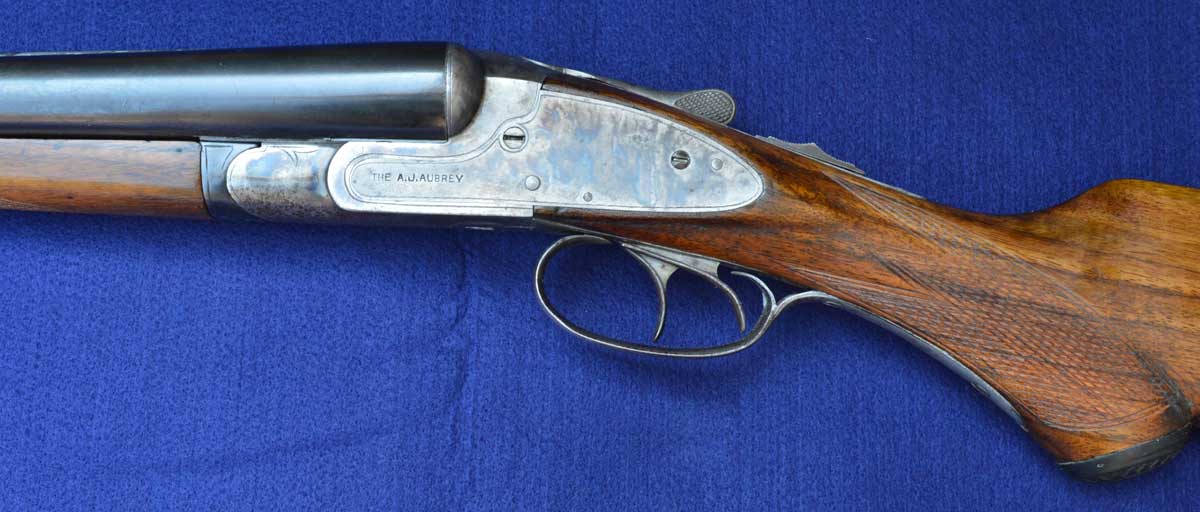
The A.J. Aubrey field grade hammerless shotgun above, s/n 5779, listed for $13.85 in 1908. It has 30-inch Armory fluid-steel barrel; the wood is nicely-grained English walnut. The frame is case-hardened. The gun’s mechanical features include traditional V-spring powered sidelocks, an innovative safety mechanism and cocking indicators.
Meriden Arms A. J. Aubrey Hammer and Hammerless Sidelocks
The creation of the Meriden Firearms Company in 1905 by Sears, Roebuck, & Co. was a personal initiative of Richard Warren Sears. The business rationale was both to ensure the supply of shotguns to the Sears & Roebuck mail-order business and “…to control the quality of materials, workmanship, style and finish…” of the top of the Sears & Roebuck line of house-brand guns. His vision was to make the highest-quality double shotgun possible at a cost that would appeal to Sears & Roebuck’s prime customer base—America’s expanding middle class.
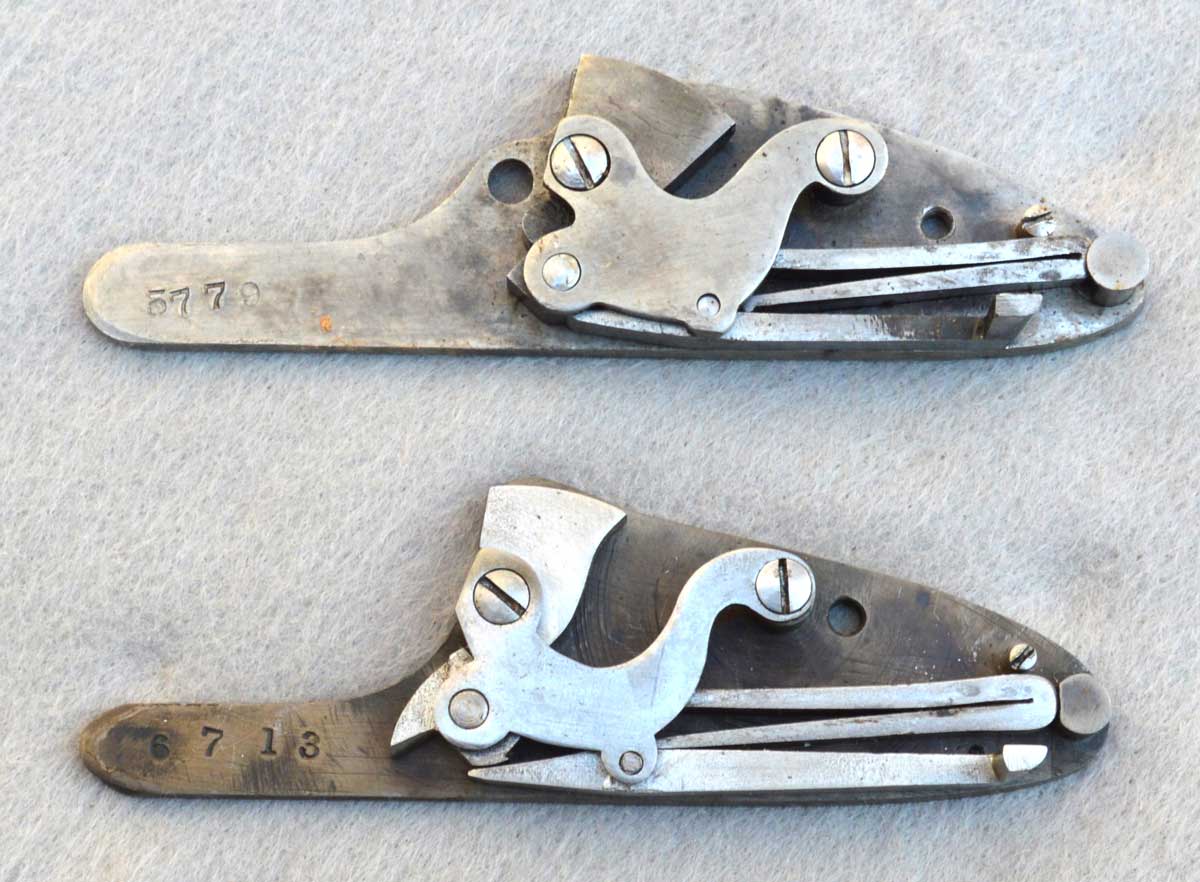
The A.J. Aubrey lock on the top is similar in materials and design to an L.C. Smith lock.
Richard Warren Sears selected a young, experienced firearms manager and designer who shared his vision, A.J. Aubrey, to be President and General Manager. In 1908, Richard Warren Sears resigned as President of Sears & Roebuck due to poor health, and in 1909 the new leadership replaced Aubrey and cancelled the A.J. Aubrey line of shotguns.
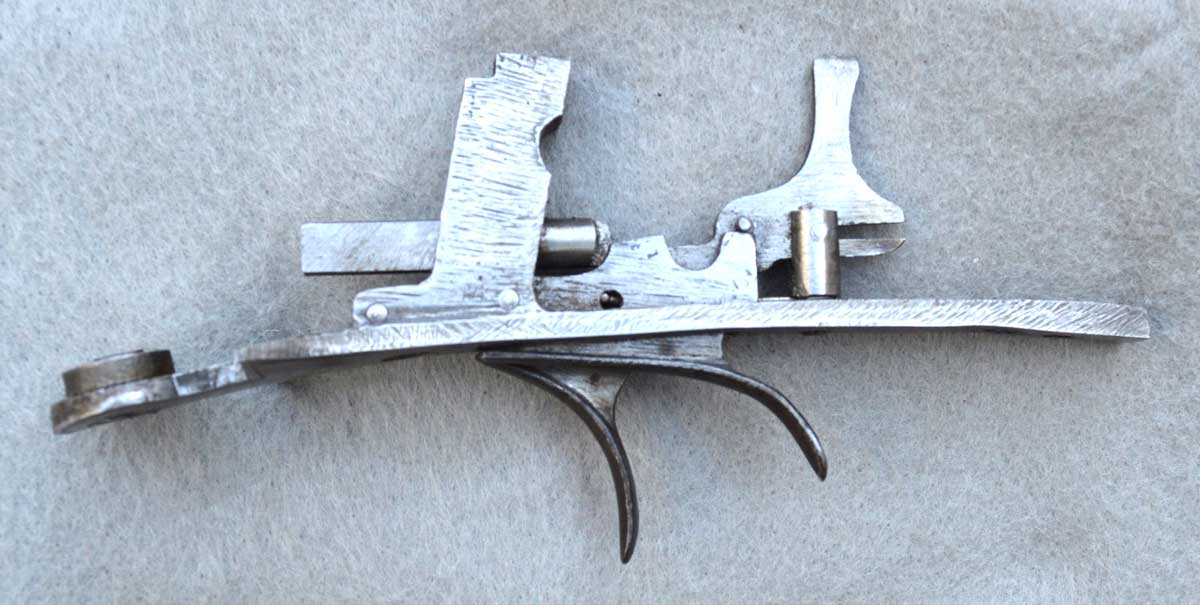
The innovative safety mechanism is strong and reliable.
Sears & Roebuck’s 1908 catalog devotes eight pages to the A.J. Aubrey hammerless gun. It gives us insight to what Sears & Roebuck thought was important to buyers, and also to how knowledgeable Americans circa 1900 were about guns. The catalog states that detailed descriptions and etchings were intended to give customers:
“… an idea of the individuality of this gun, how all essential parts have been cared for in the matter of strength, workmanship and finish, an opportunity for you to compare the general mechanical construction and design of the Aubrey hammerless with any other hammerless.”
One full page of detailed etchings focuses on the strength, mechanical design and safety aspects of the gun: steel quality; reinforced breech; double-bolt locking system; construction of the top rib; sidelock design; frame construction; three-point locking system and a unique safety mechanism.
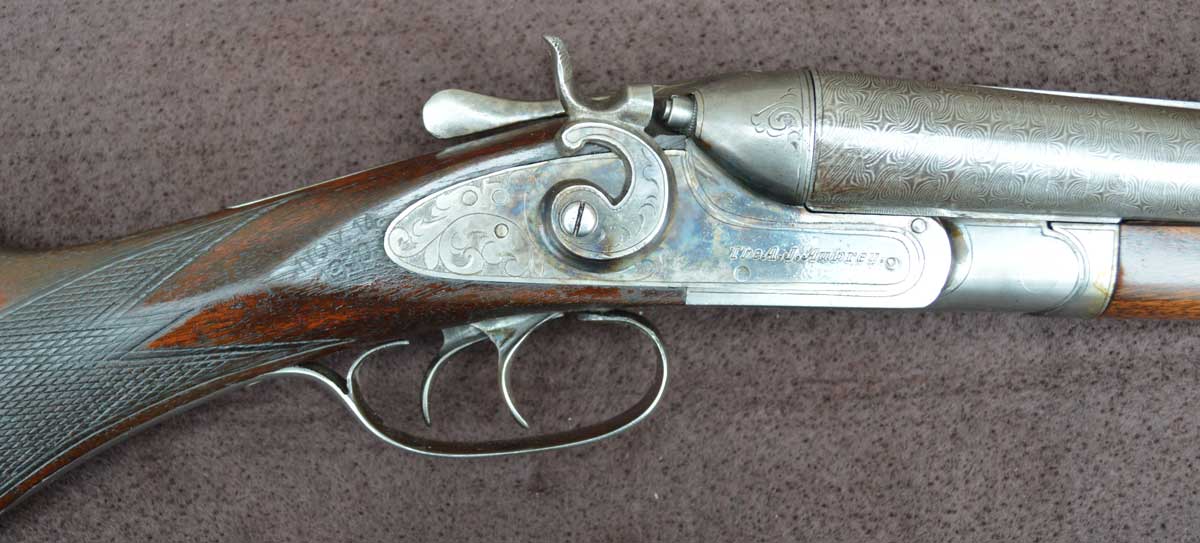
The A.J. Aubrey 12-gauge above, s/n 11408, is hand engraved in the leaf style. With tightly-choked 32-inch Damascus-steel barrels, and weighing in at 8 pounds 4 ounces, it was most likely used to hunt waterfowl—a role it still performs wonderfully.
The descriptions of these features are, in my opinion, basically factual, although the adjectives lean too far toward the superlative. As a minimum, these features matched those of premium brand shotguns. The locks, for example, are virtually identical to L.C. Smith locks. There is, however, one very innovative high-quality feature that deserves attention—the trigger and safety mechanism. It is the most sophisticated, strongest and least likely to fail that I have seen except in other guns made by Meriden Arms.
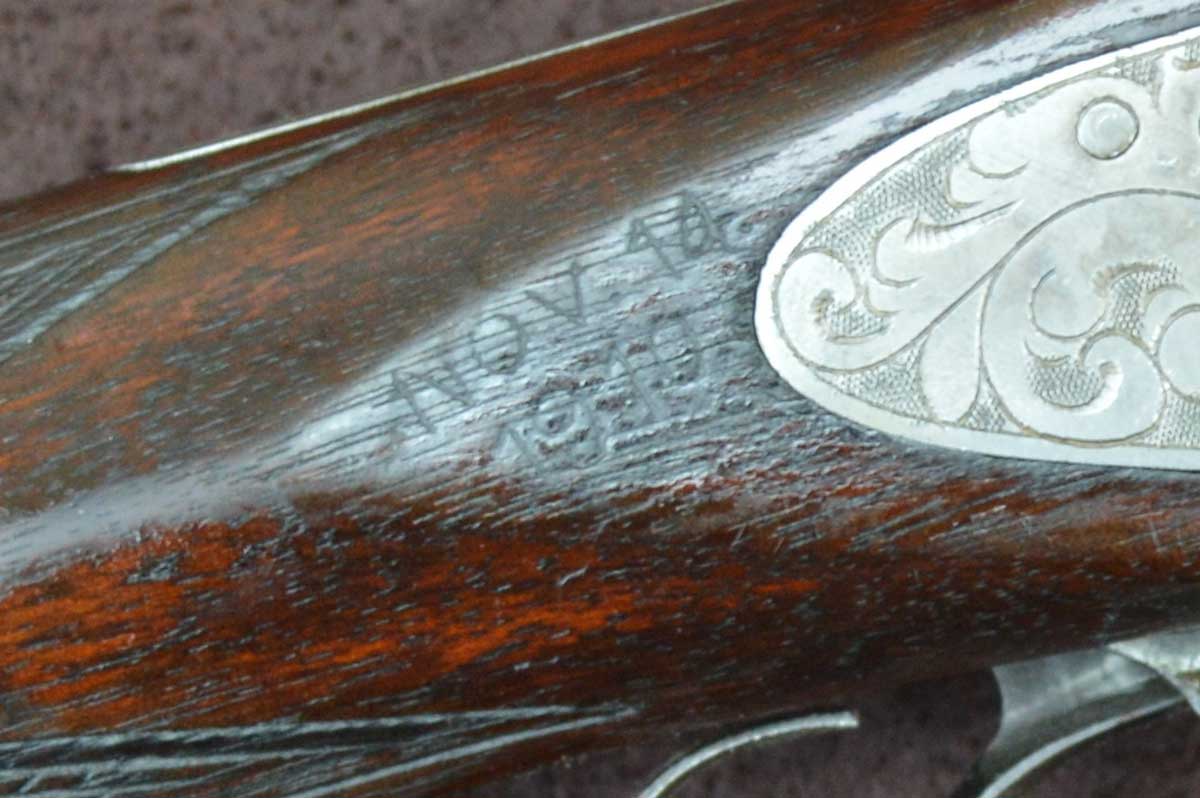
To its first owner, this inexpensive shotgun and some experience on Nov 14, 1910 were connected in a meaningful way, a reminder that the cost of an item does not determine its value.
Sears & Roebuck backed up its claims with a 20-year guarantee covering any defect in material or workmanship. It also allowed a 60-days free trial:
“If you are not satisfied that the gun is indeed the highest grade gun made in America, you can return the gun to us at our expense, and we will immediately return your money, together with any freight or express charges you have paid.”
The materials and workmanship of the A.J. Aubrey hammer shotguns parallel its hammerless guns. Hammer guns also carried the same 60-day free trial and 20-year guarantee. The field grade hammer gun listed at $12.59 with fluid steel barrels and $16.59 with Damascus-steel barrels. The well-engraved Damascus-barreled hammer gun listed at $19.50.
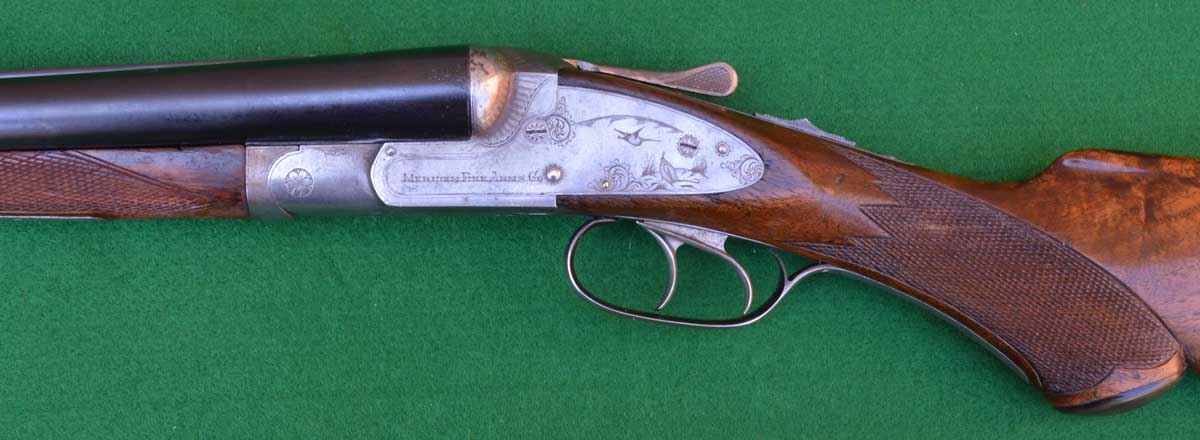
The Meriden Firearms 12-gauge above, s/n 68834, has 30-inch Krupp-steel barrels, game-scene engraving, and a figured English-walnut stock. It listed for $100, the price of a Parker Bros. D Grade.
After discontinuing production of the A.J. Aubrey gun for Sears & Roebuck, Meriden Firearms continued producing low priced shotguns under its own label. However, it appears to have shifted focus to more expensive hammerless shotguns. Its 1910 catalog list six grades ranging in price from $40 for its Grade G gun to $250 for its Grade A gun. All were offered with Krupp steel barrels. Grade G guns were stocked with “plain American walnut” and had “plain line engraving.” Grade A guns were stocked with “the most beautifully figured Circassian walnut” and engraving “not surpassed by anything in this country.” The frame and mechanical features were the same as those of the A. J. Aubrey.
Between 1905 and 1918 when it closed, the company produced around 70,000 A. J. Aubrey- and Meriden Arms-labeled shotguns. For perspective, that is just shy of the total shotguns produced by the Lefever Arms Company between 1880 and 1919.
Folsom Arms Knickerbocker and Baker Gun
The H&D Folsom Arms Company, which was headquartered in New York City, was the largest manufacturer and distributor of firearms in America circa 1900. Founded in 1884, its sporting goods catalogs offered a wide range of domestic and imported premium and affordable shotguns. In 1892, after acquiring the Crescent Fire Arms Manufacturing Company in Norwich, Connecticut, Folsom Arms became the largest manufacturer of shotguns in America. From 1892 to 1933 it made about 1,300,00 double-barrel shotguns. It also sold about 300,000 imported doubles.
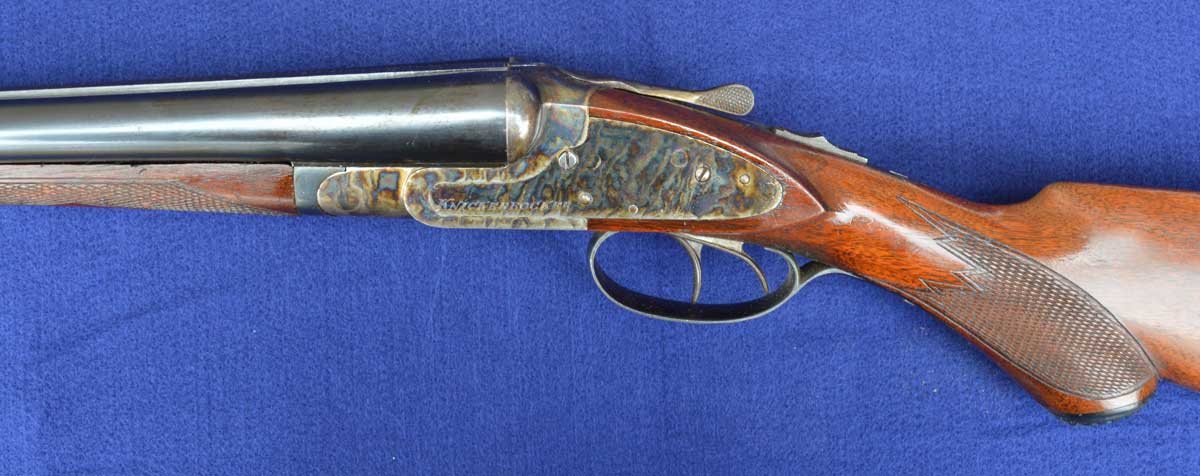
This No. 6 Model Knickerbocker 12-gauge, s/n 10453, has 30-inch fluid steel barrels and listed for $25. The price of a No. 7 with twist-steel barrels was $27 and a No. 8 with Damascus-steel barrels $30.
One of the reasons very few people today recognize the company’s significance or even its name is that Folsom Arms made private-label guns for more than 60 companies. Also, Folsom rarely used its name on its own house brands, which included American Gun Co., New York Arms, Crescent Firearms, New England Arms and Norwich Arms. Folsom dominated the low and middle of the affordables market. However, two of its brands, the Knickerbocker and the Baker Gun, competed successfully with the American premium brands.
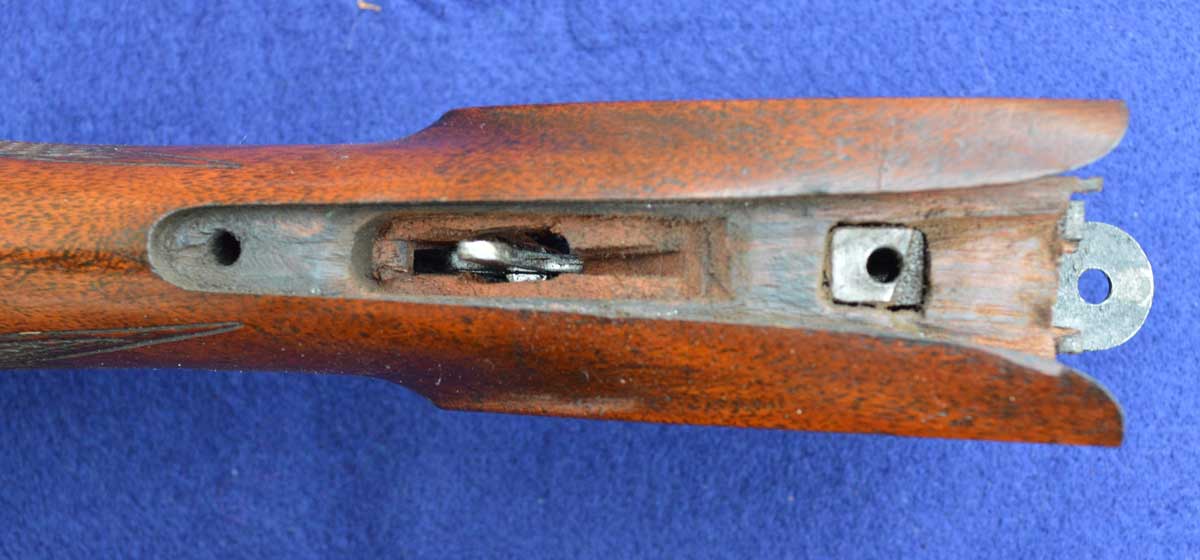
The steel column rising from the trigger plate to the tang reduces the potential for oil damage to the stock head.
The Folsom Arms 1905-1906 catalog introduces the Knickerbocker by stating Folsom’s intent in making it:
“We manufacture this line of Hammerless Guns and have spared no expense to obtain a gun equal to any of the American market. The symmetrical lines, balance, and beautiful finish of this gun are…superior to other guns of about the same price. Every part is drop forged, polished, and case-hardened. The cocking-mechanism is simple and strong…. The locking-mechanism consists of two bolts [that when] coupled with the ‘L’-shaped extension rib, are features of strength, and make it impossible for the gun to shoot loose. The automatic safety and Deeley & Edge patent fore-end are fitted to each gun.”
Folsom Arms’ assessment of what gun buyers were looking for in a quality double was apparently right on target given that it sold 220,000 Knickerbockers between 1905 and 1923. For perspective, the total number of doubles ever made by A.H. Fox was 170,000 and by Parker Bros 240,000.
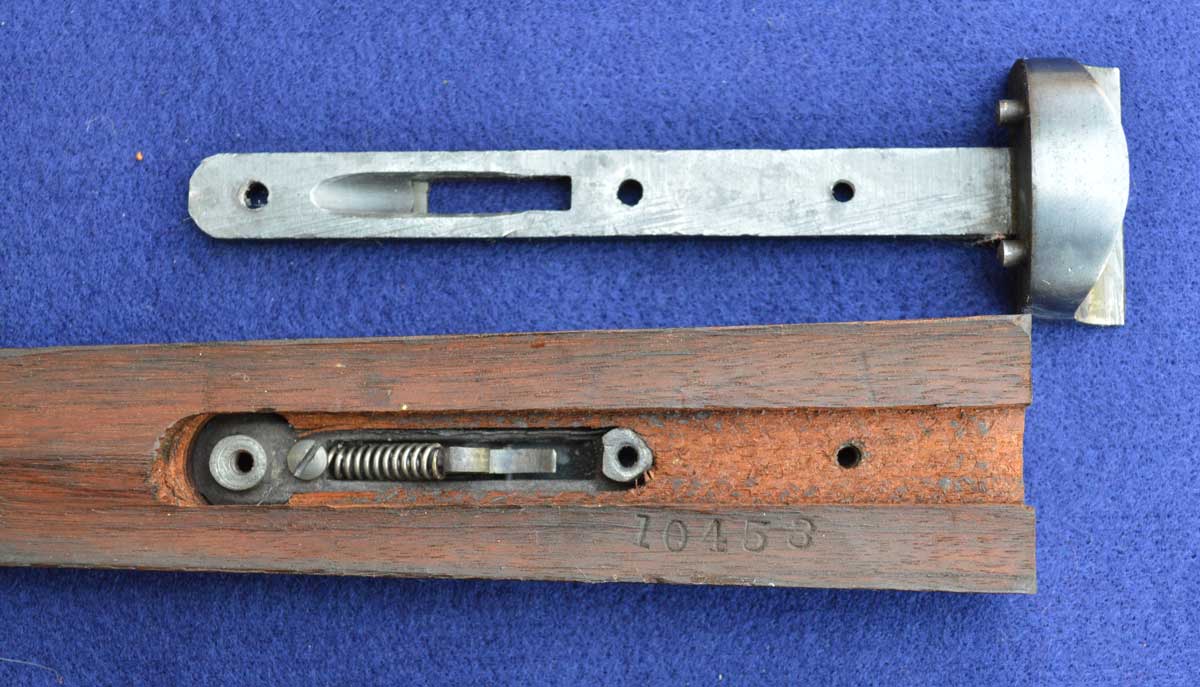
The design of the forend metal and latch limit pathways for oil to enter the wood.
Folsom outsourced the manufacture of the first 10,000 or so guns to Meriden Arms. The rest were made at its Norwich factory. The No. 6 Model Knickerbocker 12-gauge was among the last of the Meriden-made guns. Its sidelocks, cocking rods, trigger and safety mechanism are identical to those of the A.J. Aubrey. The later Norwich-made Knickerbockers differ in that they use Folsom’s coil spring-powered locks and do not have cocking indicators.
The Knickerbocker, like its A.J. Aubrey and Meriden Arms cousins, has two unique defenses against petroleum-based oil damage to the wood. The first is the design of the trigger plate, which closes the single most damaging path whereby oil can enter into the interior of the stock head. In most doubles, the tang and trigger plate are connected by a long tang screw that runs down through about 3/4 inch of wood. On the Knickerbocker, a steel column extends upward to meet with the bottom of the tang and is connected by a short machine screw. The forend metal and latch also have a metal-to-metal fit, thus inhibiting oil seeping from either part into the wood. Also, the back of the forend wood is supported by two steel rods welded to the forend metal. Most manufactures passed wood through holes drilled in the steel, creating a short, direct path for oil into enter the wood.
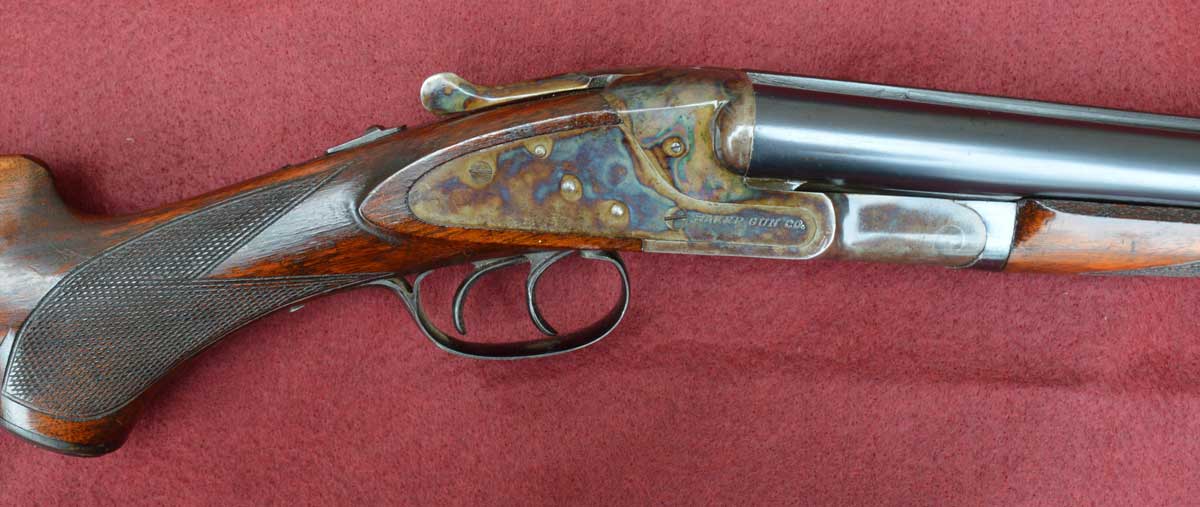
The 20-gauge Batavia Leader pictured above, s/n 3426F, is one of about 20,000 Baker Guns manufactured by Folsom Arms. It has 28-inch barrels and weighs 7 lbs. 4 oz.
In 1919 Folsom Arms bought the Baker Gun and Forging Company, which had operated in Batavia, New York, since 1888. As the successful run of the Knickerbocker was ending, the Baker Gun became Folsom’s high-quality brand. Folsom Norwich-made Bakers are almost indistinguishable from Batavia-Bakers. Their external appearance and names—the Batavia Leader, Black Beauty Special and Paragon—were similar. Folsom made some adjustments to the mechanical design that reduced costs without compromising quality and incorporated Stevens-type top ribs on its barrels. Folsom also added a 20-gauge gun to the product line. The best way to identify a Folsom Baker is that it has a letter “F” after the serial number. Folsom Arms made the Baker Gun until the company was acquired by Savage/Stevens in 1932.
Hopkins & Allen New Model Hammer and Hammerless Boxlocks
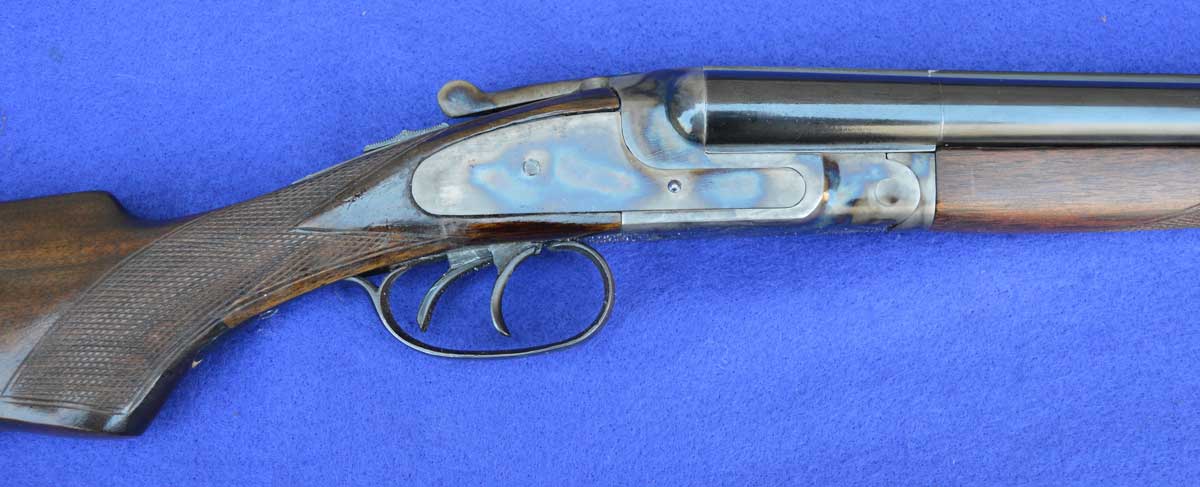
This restored H&A 20-gauge hammerless gun, s/n 1281, has 26-inch decarbonized-steel barrels and weighs 6 lb. 2 oz. It listed for $16 in 1908, which was about half of the price of a premium-brand hammerless sidelock.
The quality of the double barrel shotguns made by Hopkins & Allen Manufacturing Company (H&A) between 1908 and 1915 came as a surprise. Founded in Norwich, Connecticut, in 1868, the backbone of its business until 1900 was a line of inexpensive revolvers sold under various trade names. The company entered the growing affordable double-barrel shotgun market in 1902 by acquiring the Forehand Arms Company of Worchester, Massachusetts. After acquiring the W.H. Davenport Arms Company of Norwich in 1908, H&A launched its New Model line of hammerless and hammer doubles. It made about 60,000 New Model guns between 1908 and 1915.
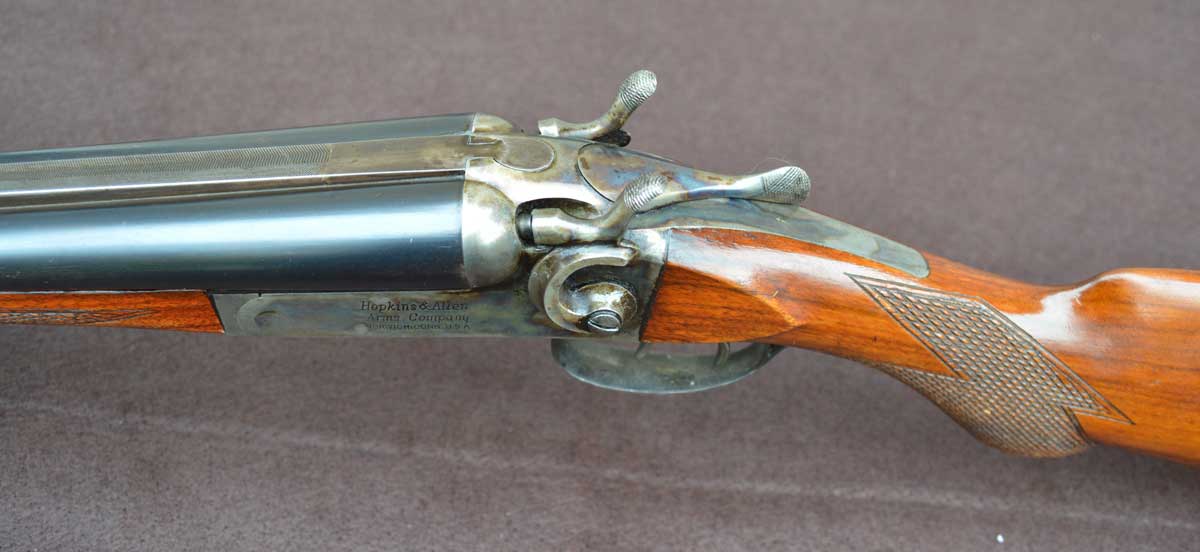
This H&A 16-gauge hammer gun, s/n 11706, has a color-case-hardened receiver, attractive English walnut stock, Deeley & Edge forend latch and low-circular hammers. It listed for $15.
Somehow, the three teams coming together sparked a wave of creativity. The New Model hammer and hammerless guns used innovative manufacturing methods. Most significant was the monobloc construction of barrels in which the breech and lumps are one piece, a concept pioneered by Henri Pieper in Belgium. Cost-cutting measures appear to have been well-thought out in most cases. The frame is nicely milled and case-hardened. Load bearing mechanical parts are made of tempered tool steel. Coil springs powered both the hammer and hammerless guns.
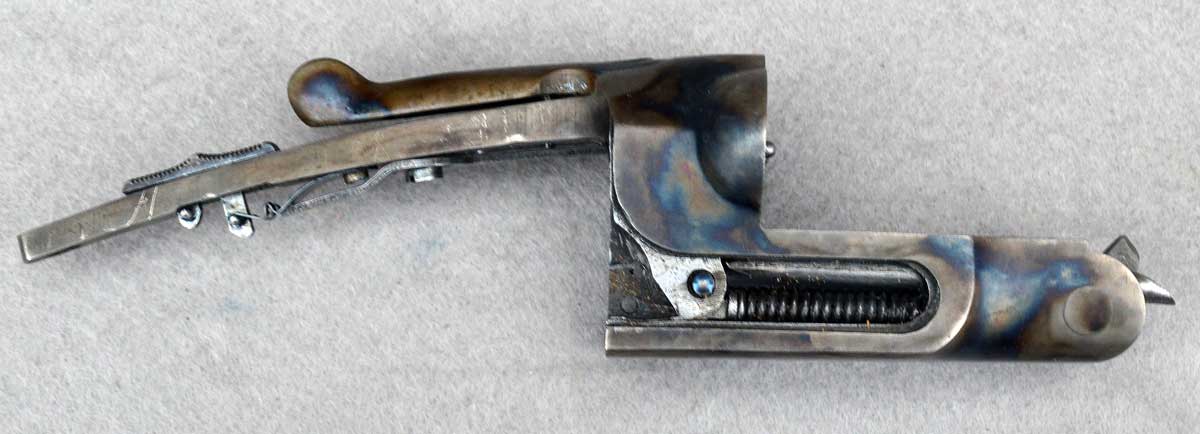
The H&A locks are coil-spring powered and incorporated into the frame.
H&A’s innovative Hammerless side-plated Box Lock (HLspBL) rival in appearance the premium Hammerless Side Locks (HLSL) made by L.C. Smith and the Baker Gun & Forging Co. H&A frames and mechanical parts were also similar in the quality of construction. The price of a H&A HLspBL started at $16.
J. Stevens Arms Model 325 Hammerless and Model 235 Hammergun
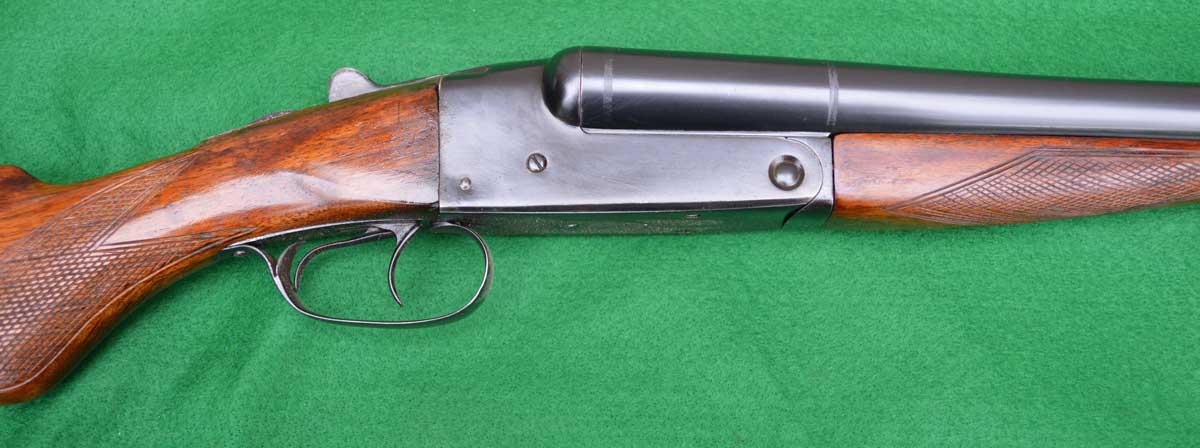
The reconditioned 12-gauge Model 325 pictured above, s/n 9495, has a one-piece cast-steel frame, high-pressure compressed steel barrels and an American walnut stock. It listed for $20.
The J. Stevens Arms and Tool Company of Chicopee Falls, Massachusetts, was not just an innovator, it was a game changer. Between 1902 and 1915, its visionary understanding of the implications of new metallurgical technologies, coupled with its mechanical innovations, allowed it to dominate the affordable utility-double shotgun market for the next three decades.
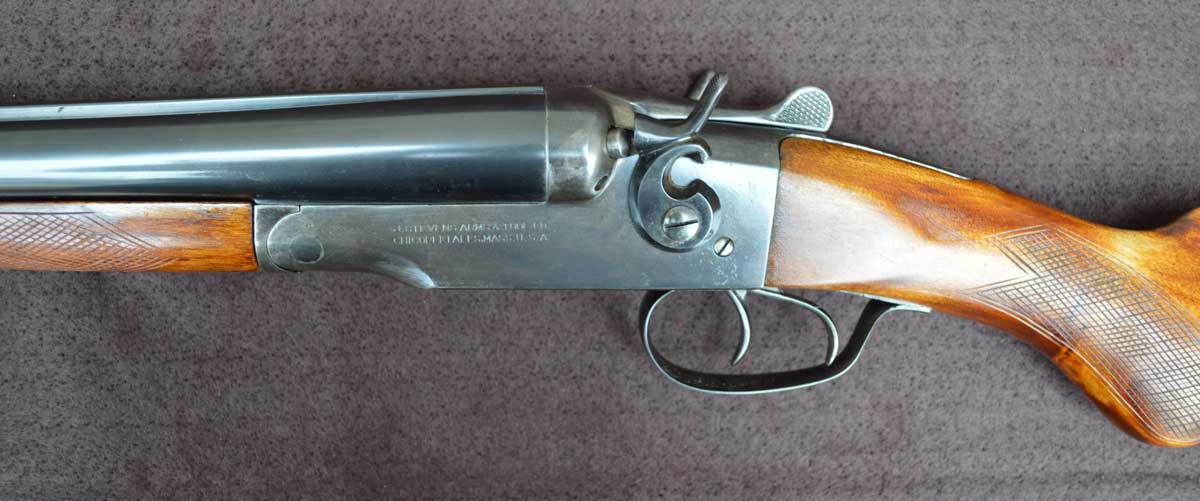
The 16-gauge Stevens Model 235 hammer gun shown above, s/n 11706, listed for $15.
In 1904, Stevens introduced a revolutionary hammerless boxlock, the Model 325, and sold 8,000 guns in its first four years. It was advertised in the 1906 firearms catalog of Philadelphia sporting goods company Edw. K. Tryon, as having “high pressure steel barrels, choke bored for nitro powder, matted extension rib, with reinforced breech, American walnut pistol grip stock and patent snap fore-arms, checkered.” Offered in 12 or 16 gauge, it listed for $20. By 1920, Stevens had sold 270,000 similar guns in various models based on its design.
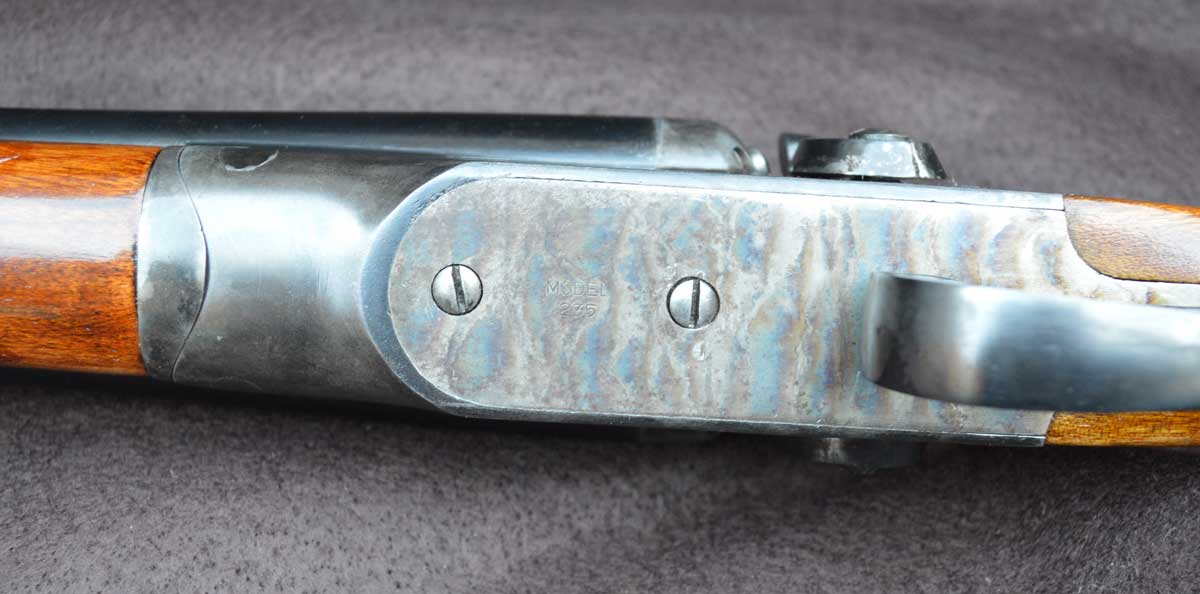
The case colors on Stevens doubles resulted from a chemical wash, which due to the toxic substances can no longer be replicated.
In 1907, Stevens introduced a similarly constructed hammer boxlock, the Model 235. It sold 75,000 copies by 1920. It is a relatively heavy gun; a 16-gauge with 28-inch barrels weighs 7 pounds, 8 ounces. The stock has modern shooting dimensions: 1 1/2-inch drop at comb, 2 1/2-inch drop at heel and 14 1/2-inch length of pull to the end of the hard rubber buttplate.
Stevens doubles were built on a one-piece cast-steel frame. Casting was less expensive than forging, and the finishing required less labor. Stevens did not invent the concept but advanced it significantly. Its patents allowed it to dominate the market well into the 1930s. The frame was secured to the stock with a long bolt running through the center of the stock. That dramatically simplified the process of fitting the metal and wood, put less stress on the stock head, and reduced potential for petroleum-based oil damage. Moreover, Stevens’ compressed fluid-steel barrels became the industry standard.
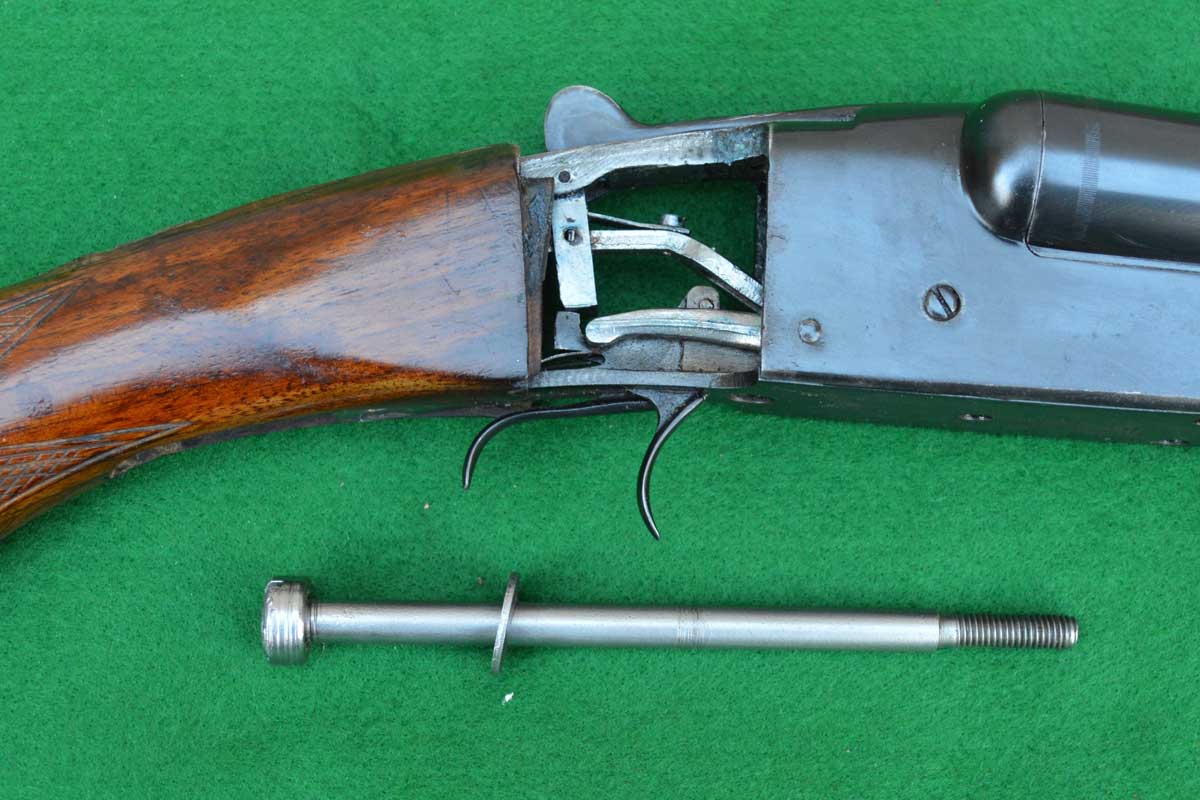
The stock and one-piece cast-steel frame of Stevens doubles are secured with a bolt running from the rear of the stock.
Affordable and Effective Today
The early 20th century affordables our grandfathers bought are still affordable. I acquired the guns featured in this article for an average cost of $725, with prices ranging from $350 for the 12-gauge Stevens Model 325 to $950 for the 20-gauge Folsom Baker Gun.
All were mechanically sound. Three of them—Knickerbocker, Baker and A.J. Aubrey hammer gun—were in high original condition. They only needed the preventive maintenance servicing I recommend to clients for all newly acquired vintage shotguns. For the other five, I refinished the barrels and reconditioned the wood, the latter being essential to the preservation of most guns more than 100 years old. Only the H&A 20-gauge required significant repairs, primarily because of petroleum-based oil damage.
All of these guns perform their original purpose well. The A.J. Aubrey hammer gun is a fine waterfowler, and with low-pressure RST bismuth shells can crumple a goose at 40 yards. It is also, in my judgment, the highest quality hammer sidelock ever made in America that sold for less than $15.
The A. J. Aubrey hammerless double was originally advertised for use in the field and for trap. It has good balance, shoulders smoothly and remains well-suited for hunting and today’s target-shooting sports. The fact that it was sold with a 20-year guarantee and 60-day free-trial is a pretty impressive subjective indicator of its quality and effectiveness. Based on objective measures of quality, I consider it the best hammerless double ever made in America that sold for less than $20.
The Knickerbocker, which is built on the Aubrey design, is also a high-quality gun. Based on the subjective judgment of gun buyers in the early 20th century, with 220,000 guns sold, the Knickerbocker has to be at the top of the “bang-for-the-buck” list.
A Folsom-made Baker may be one of the best values today to someone who wants to hunt quail or woodcock with a vintage 20-gauge, but who does not want to spend thousands of dollars for a premium brand gun. The same goes for the H&A 20-gauge.
The 16-gauge H&A is a sweet-handling hammer gun well suited for hunting upland game, squirrels or rabbits. A major caution regarding all H&A doubles, however, is that its “blued steel” barrels are made of decarbonized steel, not fluid steel. Thus, H&A doubles should only be shot with shells that produce 5,000 to 7,000 psi.
The Stevens Models 325 and 235 doubles were not designed for modern target shooting sports. They were designed to kill all manner of game and to be put next to the door in a farmhouse to be ready when needed. Rugged and reliable, if I had to survive alone in the wild, I would take a Stevens double.