
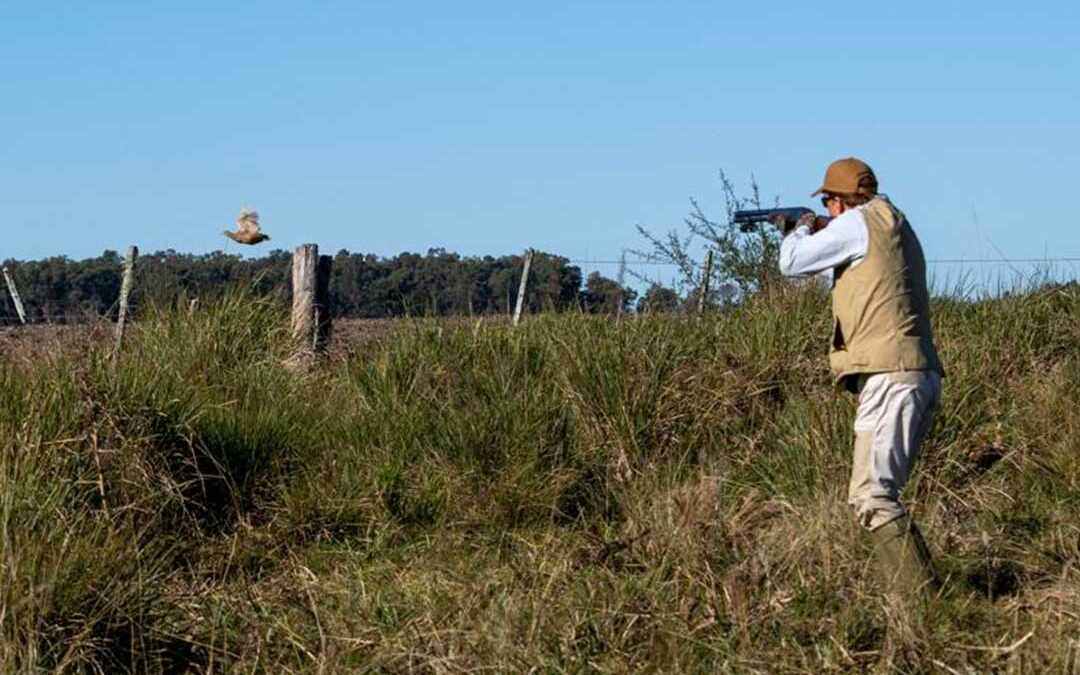
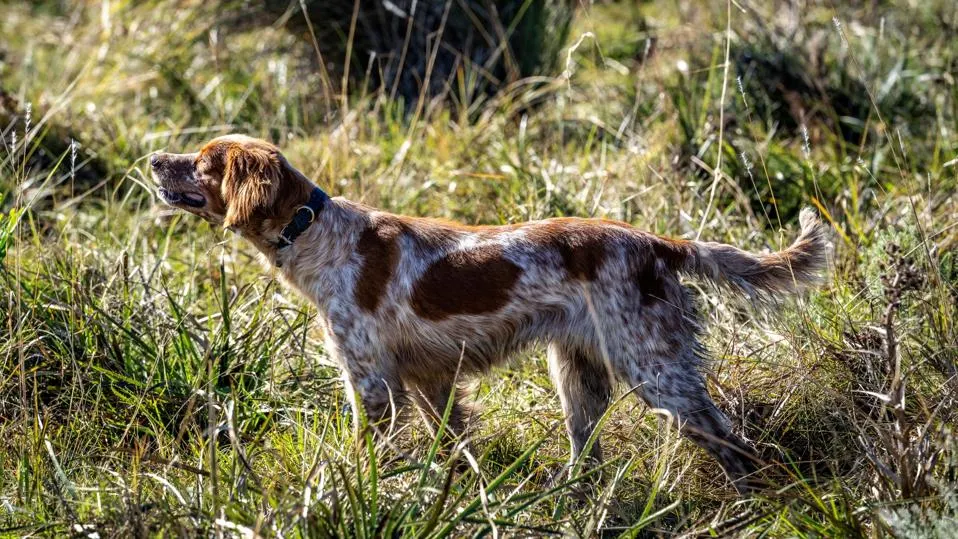
An orange and white Brittany named Mia slinks cheetah-like through cover, crouching motionless on her belly as she peers like a weathervane into the wind, nosing the scent of a partridge-sized bird known locally as a perdiz (partridge in English). The small game bird is, however, a spotted tinamou more closely related to ostrich than partridge.
The Brittany’s game of cat and mouse—point, creep and point again—lasts for more than 100 yards as these birds are constantly on the move. With each nerve-racking step, the anticipation of the flush builds. Then, suddenly, the perdiz takes flight in a whir of wings that sounds like a deck of cards being shuffled. For Italian ex-pat Domenico Orzi, this dog and hunter two-step is what has brought him to the South American nation of Uruguay. For Orzi, intercepting the fast-flying tinamou with the first barrel of his over-and-under 20 gauge is reminiscent of the quail hunting in his current home in South Carolina.
“These dogs and birds are just incredible,” he offers. “I don’t think you can find a better upland bird hunting experience anywhere.”
For global bird hunters and other travelers, Uruguay is a celebrated destination that is among the safest in the world with famously friendly people that boast a high literacy rate. The country retains a colonial charm owing to Spanish and Portuguese settlers. It is the second smallest country in South America—about the size of the state of Washington—with a population of merely 3.5 million people.
Some two million residents live in the capital city of Montevideo. The remaining countryside is sparsely populated, and the pastoral mix of farmlands, marshes and eucalyptus plantations creates an ideal blend of habit for several varieties of game birds to thrive including the tinamou, doves, pigeons and many species of ducks.
Of the roughly 20,000 foreign hunters who travel to South America each year, the majority visit Argentina and Uruguay. Orzi and I are part of a group of eight hunters visiting from South Carolina to sample the bird hunting offered in Uruguay. June, July and August are prime winter months for bird hunting in the reversed seasons south of the equator. It’s the ideal time for our troupe of bird-hunting aficionados to trade Carolina’s sweltering summer heat for the cool temps of winter in Uruguay—all the while enjoying opportunities for an extended bird season.
Our week-long foray includes two stops—the first being Estancia Santa Elena, a working ranch in the heart of some of the country’s best bird hunting. For Francisco ‘Pancho’ Cardoso, hosting traveling American bird hunters is a matter of converting the region’s surplus of game birds into currency. That an entire industry of lodges and outfitters catering to mostly U.S. bird hunters can exist in the country is testament to both the size of the American bird hunting market and their willingness to travel to enjoy the pastime.
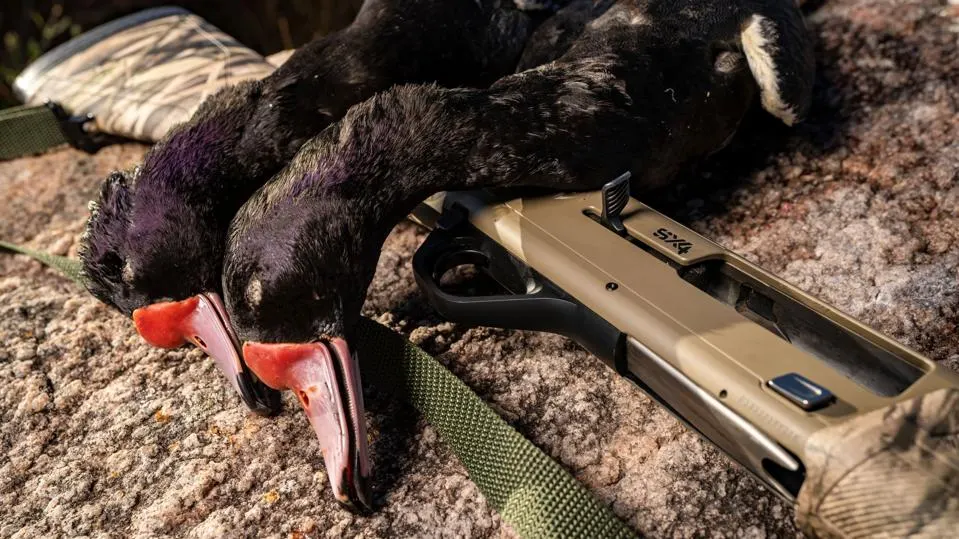
Rosy-billed pochards are are challenging ducks to hunt and are a favorite on the table.
The untold story of America’s 15 million hunters is the outsized influence they have on global conservation efforts. Without U.S. dollars from hunters creating an incentive to sustainably manage wildlife—from Africa to South America to the South Pacific and many points in between—wildlife is often considered an agricultural pest or threat and animals in those scenarios seldom survive.
In Uruguay, for example, animal rights groups have pressed to close duck hunting seasons in recent years. Once farmers no longer receive funds from foreign waterfowl hunters, however, the ducks will suffer the consequences. Prior to foreign hunters visiting Uruguay and providing a financial incentive to keep the birds’ populations healthy, ducks were often poisoned en masse because they were seen as little more than crop raiders.
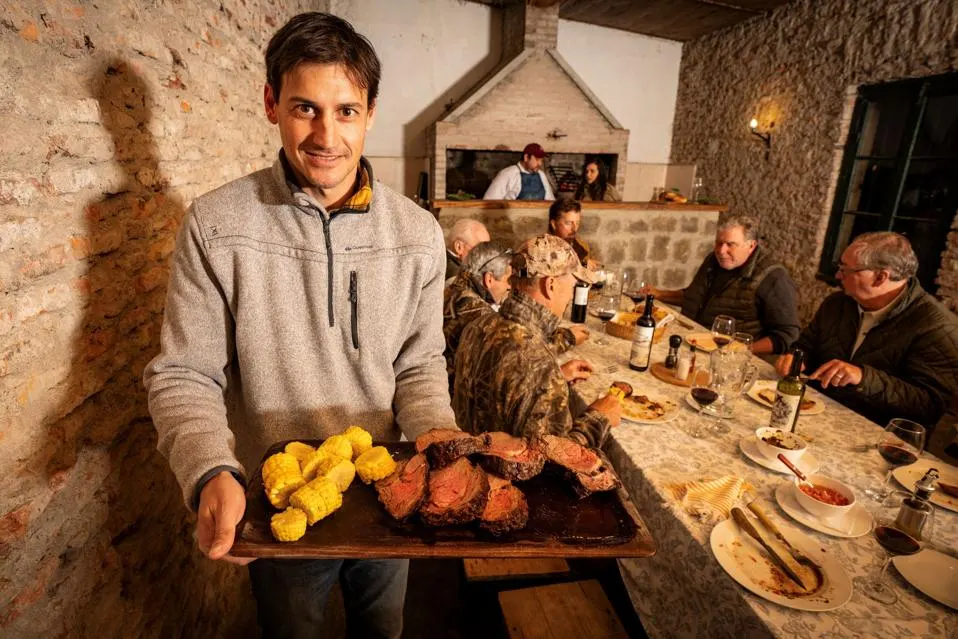
After a day of high-volume wingshooting, hunters refuel with an Asado – Uruguay’s barbecue.
Even though such a practice has been made illegal and the poisons used to kill the ducks have largely been removed from the Uruguayan market, there’s little to stop farmers from getting the preferred poison from neighboring Brazil.
Hunting bans seldom deliver their intended results wherever they’ve been tried, for the reality that holds true in Uruguay and around the world is simple: wildlife that pays, stays. Put another way, examine sustainable wildlife conservation success stories from across the globe and they inevitably come down to simply following the money. Without an economic reason to sustain wildlife populations, they won’t be conserved long-term through benevolence alone.
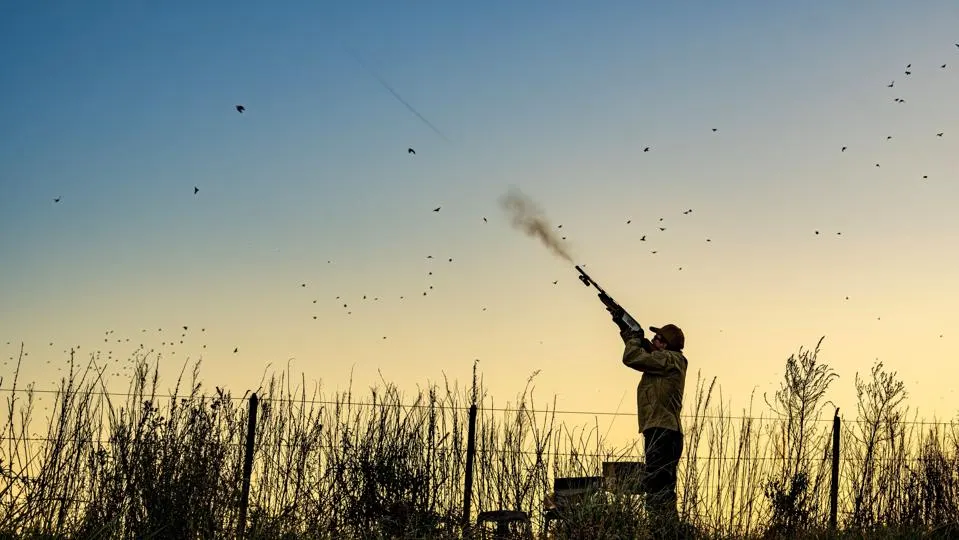
Future threats to Uruguayan waterfowl conservation notwithstanding, for our group of American bird hunters, another clear-cool afternoon proves ideal to visit the edge of a grove of eucalyptus, a favorite roost for nearly unfathomable numbers of doves. They don’t so much flock here as they move in clouds, providing an endless stream of challenging targets for even seasoned shooters.
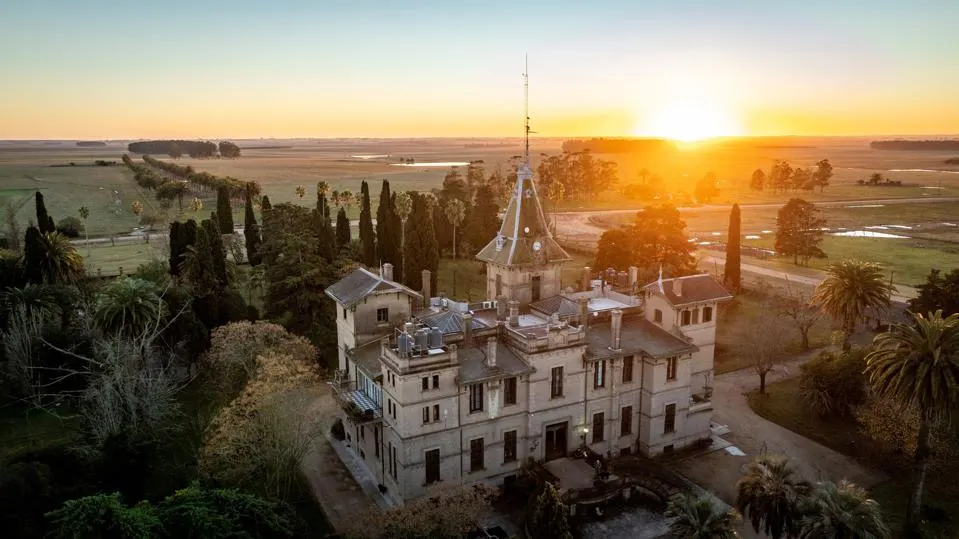
The Chateau of Santa Clara was built in 1903 and crowned with a Paul Garnier clock tower.
For shotgunners looking to knock the rust off a specific shot—perhaps left to rights—this is the ideal venue to get plenty of opportunities to bolster shooting weaknesses. At the same time, shotgunners are endearing themselves to local farmers who are looking for relief from the plague of hungry birds.
Dinners in Uruguay are often festivals of meat, with the country’s famous grass-fed beef serving as the main course. The nation is a carnivore’s delight with the highest beef consumption in the world. Not surprisingly, there are more cattle in the country than people. A plate full of medium-rare tenderloin and roast vegetables drizzled in olive oil accompanied by a Tannat full-bodied red wine, a French grape that is locally grown, is a staple to any day afield here.
The next morning, we depart at 6am to wait in a makeshift blind on the banks of a 50-acre lake holding a generous population of ducks. The birds roost overnight on the water, leaving at first light for nearby grain fields for breakfast. We position a couple dozen decoys in the water in front of our blind to attract returning birds within shooting range.
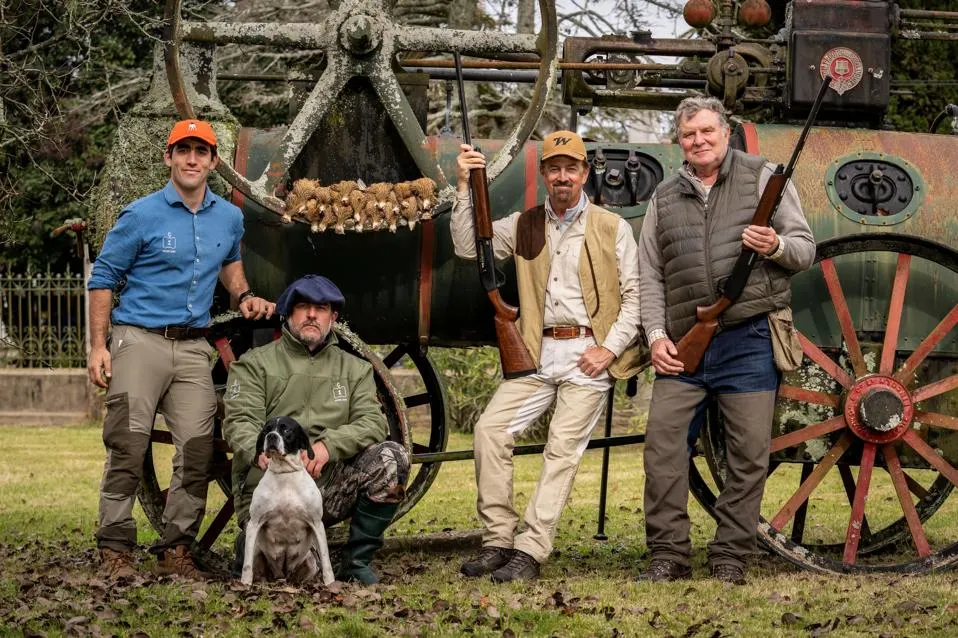
Hunters, guides and dogs take a brief respite after a morning of bird hunting action.
Upon seeing our decoys, rosy-billed pochards—the mallard-sized, black-bodied king of South American ducks—along with yellow-billed pintail, bank for final approach to our plastic imitations that serve as runway lights of sorts for incoming birds. Both species are fast flyers, so keeping a consistent swing and stretching the lead on them proves the key to adding them to our dinner menu. All meats are cooked over an open flame here, and wild duck seared medium rare proved a group favorite.
After our Santa Elena wingshooting baptism, we land at Estancia Santa Clara, one of South America’s crowned jewels of wingshooting. The stunning castle-like structure is the Balmoral (the King of England’s famed Scottish hunting retreat) of South American shooting destinations.
It was a British naval officer, John Jackson, who fell in love with the land in 1825 and purchased some 300,000 acres of it. He named the property Santa Clara after his wife. Since then, it has hosted presidents, princes and aristocrats of all stripes…as well as our vagabond collection of South Carolina bird hunters.
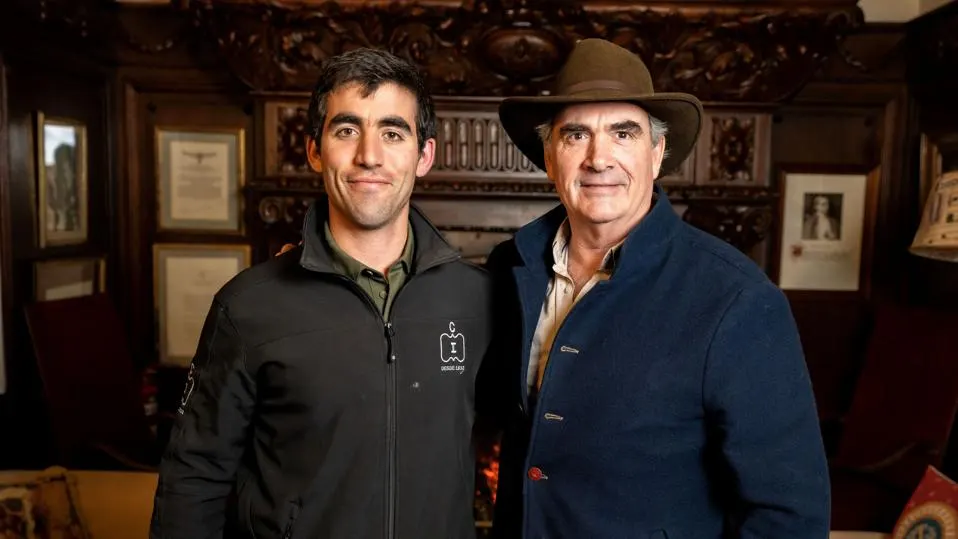
Luis Ignacio Bonasso and father Pablo Bonasso represent the sixth and seventh generations of family members to manage the historic Santa Clara.
The working ranch is now being run by the seventh generation, managing the property’s agriculture, timber and livestock operations along with the hunting. For Luis Bonasso, introducing visiting foreign hunters is a way to travel the globe without ever leaving his beloved Santa Clara.
“I meet so many interesting people who travel here,” he says. “They’re all bound by a love of bird hunting and there aren’t many places that offer better wingshooting than we do.”
It wasn’t long before Orzi and I once again found ourselves walking behind a classic continental pointer, the kind of dog that sometimes lays flat as it indicates the presence of nearby game. Such dogs are direct descendants of European pointers that once upon a time slowly belly-crawled their way toward birds. Before the advent of the shotgun, hunters threw nets ahead of the crouching dogs, hoping to entangle the fowl as they flushed. Such an effort had less to do with sport than it did to simply adding poultry to the pot.
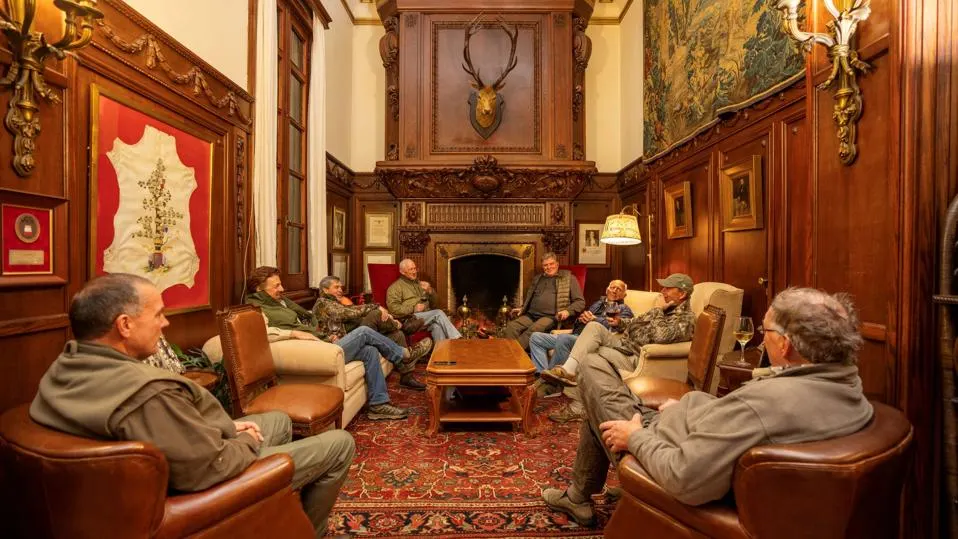
Hunters relax and reflect on a day of stunning action in Santa Clara’s historic library.
In two hours, we walked much of a 15-acre field, unearthing some 30 perdiz in all and taking our daily limit of 10 birds apiece. For upland bird hunters, witnessing the mesmerizing poetry in motion embodied in the work of great dogs is the main attraction of the pursuit. The pointers are the interpreters of scent, telling a hunter, in no uncertain terms, to be ready as birds are nearby.
Ultimately, for Americans who fantasize about enjoying an endless bird hunting season, it would be hard to surpass Uruguay and its riches of game birds and memorable gun dogs. Add that to the country’s unique culture and charming people and Uruguay rises high on the list of ultimate sporting destinations.