
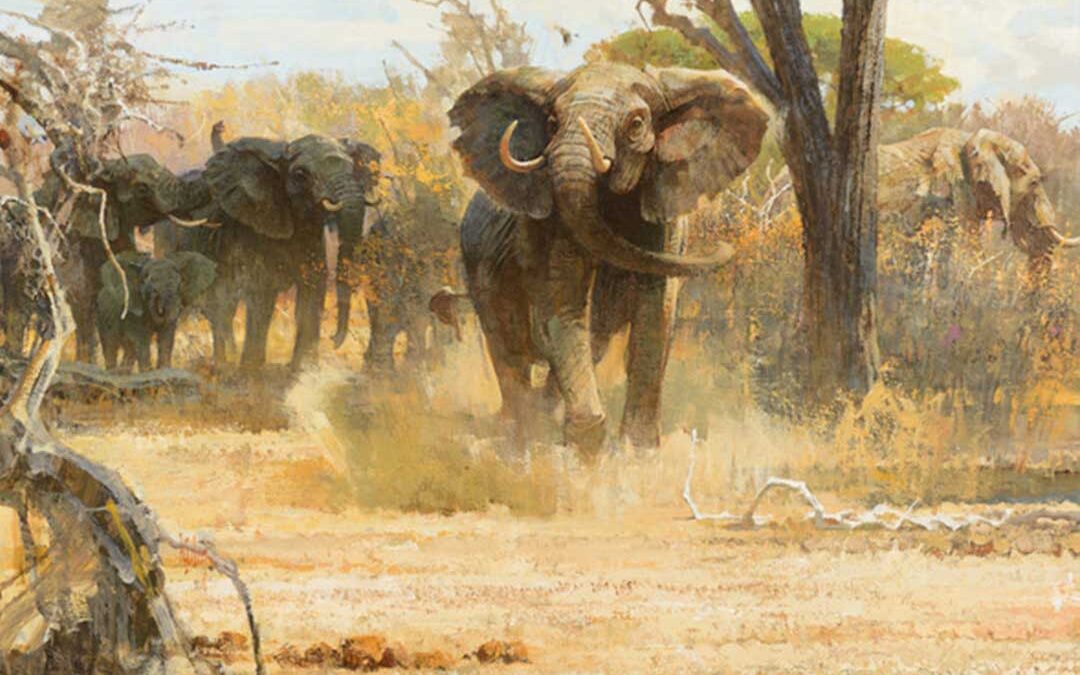
Powerful and tireless, quiet and quick, elephants proved smart enough to avoid hunters. Or kill them.
It was another time. We’d picked him up at dawn, a slight, expressionless, middle-aged man who nodded to every query and directive. Motoring along a track toward our hunting area, we spotted a frisky young elephant bull. He paced us in mopane forest, tossing his head and trumpeting. Then I looked back. Our man was no longer in the Toyota’s bed but hanging outside, off the opposite wheel well, as far as he could get from the elephant. It was an omen.
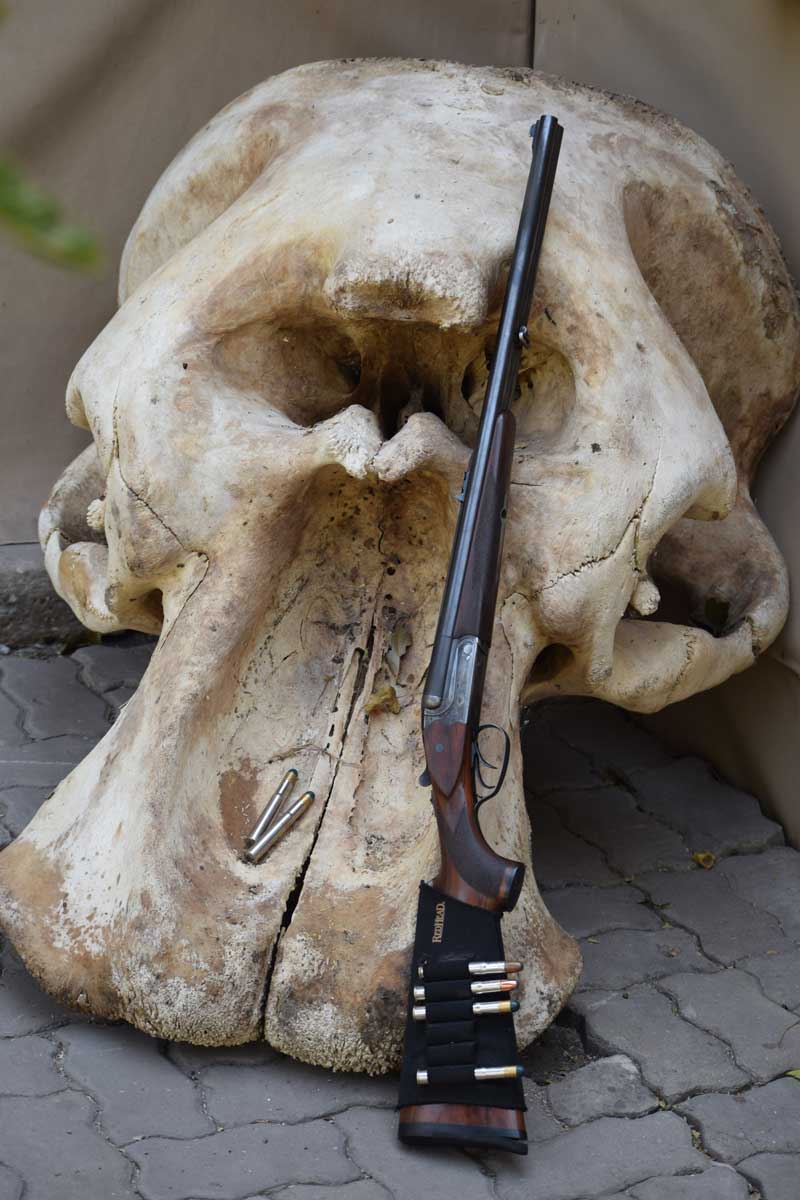
The elephant skull behind this 470 Nitro Express double rifle shows the mass and complex bone structure that could cause hunters to bungle a brain shot. Bell studied and made anatomical drawings of elephants.
That morning, after an hour’s walk and just as trackers cut the prints of a modest herd with a big bull, skies loosed a hard rain. We moved faster, lest sheets of water scrub the trail. Soon we were running to catch the beasts. Then the storm throttled back. A gentle pattering muted our step, confined our scent.
We heard them first: gurgling small talk, the rending of leaves. I checked the Mauser’s chamber. Slower, now, for they were inside 80 yards. We closed the gap.
Then our chaperone sat. He drew his finger across his toes and shook his head. This was as far as we could go. After hours on the spoor, kilometers from any visible boundary, had we reached the end of our tether? Jamy shoved his GPS unit in front of the man’s face, in animated whispers telling him we had not. Eyes to earth, the man sat, still and silent as a stone Buddha.
It was the second arbitrary halt in as many days. Our fellow was afraid of elephants.
After a long, wet hike back, we called on the village chief. “You should have shot the elephant,” he declared expansively.
“But,” we protested, “the man was appointed to ensure we obeyed all the rules!”
“I would have approved,” replied the chief, visions of an elephant feast fading fast. He could not understand why we would think otherwise.
“Go shoot another,” he said, waving us off.
Outside the hut, the slight, middle-aged man sat, eyes downcast. I dug out the last chocolate in my pack. I was still furious; but my loss that day hardly matched his poverty. After a pause, he took the bar, pressing it to his chest before tearing the wrapper. He did not thank me. Perhaps he did not know how, as he did not know why not getting close to a dangerous animal could trigger our wrath.
Fear. We must feel it to comprehend it. One evening long ago my fortunes floated on a light breeze where I’d foolishly let my scent drift to an elephant herd not far off. A phalanx of cows sought me out as I scurried like a mouse crosswind to belly under a bush. Their collective bulk erased the last red ribbon of dusk as, mere feet away, their trunks probed the gunmetal sky. My pulse was a trip-hammer. When at last the beasts melted into the thorn, I lay still, grateful for each new breath.
Alan Lowe wasn’t so fortunate. An experienced PH, he and a client were on a bull’s track when dusk corked the day. Turning back, they met a herd of cows and calves. Lowe sent his trackers and client back on an alternate path. He did not return. His staff found his remains by torchlight, his 416 unfired.
Earlier in the century, PH John “Pondoro” Taylor was easing toward a bull in cover when he lost track of others in the herd. An old cow had edged toward him—or had just stood silently, becoming in her wrinkled, gray, muddied skin, invisible, as elephants are wont to do. Suddenly, Taylor was blasted by a scream directly from above. He launched himself backward and “fired blindly up into the cow’s face.” A springy bush tossed him up as she lunged. He killed her “too close for a brain shot.”
Fear of elephants seems endemic to some African cultures—appropriately so, if for most of their history they’ve had to endure elephant depredations with no means for self-defense. Poisoned arrows and pit traps have been used to kill elephants, but neither protect a man in a chance encounter with the animals or when trying to shoo them from his shamba.
Cigar, a diminutive Hottentot, was a jockey before elephant hunter William Finaughty hired him to hunt elephants in 1869. In that day, hunters found their quarry largely in the open, even shooting from the saddle. As Cigar was an excellent rider and proved “a fair shot,” Finaughty agreed to give him half the proceeds from ivory he brought in. Armed only with an 8-bore muzzleloader, Cigar resolved to turn his natural fear of elephants into reasoned respect. When explorer F.C. Selous met him in 1872, the Hottentot had two native hunters and two porters in his employ. And, with a mounting tsetse fly threat to horses, he was hunting on foot.
Intelligent, powerful and soft-footed, elephants think and move faster than their bulk and normal demeanor suggest. Billy Judd, a broad-shouldered, barrel-chested PH many years the veteran, once had a dream in which a colleague was attacked by a bull that grabbed him, threw him down and stamped on his face. So alarming was this vision that Billy contacted the hunter’s wife to plead that he return from the bush. The next day Billy took his son elephant hunting. The spoor of a bull that had raided a shamba led them to the animal. Young Judd fired both barrels without effect, then tripped while reloading on the run. Billy’s shot turned the elephant toward him. It picked him up, threw him to earth and stamped on his face.
Records of elephant hunting date to the mid-19th century—farther back than those for most game because ivory had value and fueled markets. Settling in South Africa, Boers (farmers) took up firearms to provide meat for their families and staffs, and protection against wildlife and hostile tribes. English-born Henry Hartley’s parents brought him, then a child, around 1820. As a young man, he established a farm in the Transvaal. Ivory prices put him on the trail of elephants. Hunting from horseback, he shot as many as 1,200 in a long career. He died, age 61, when a rhino he’d shot fell on him. Petrus Jacobs, another South African of that day, was eventually compelled by tsetse flies to hunt elephants on foot. He laid low more than 400 before he was badly mauled by a lion at age 73. Short months later, he was back in the saddle.
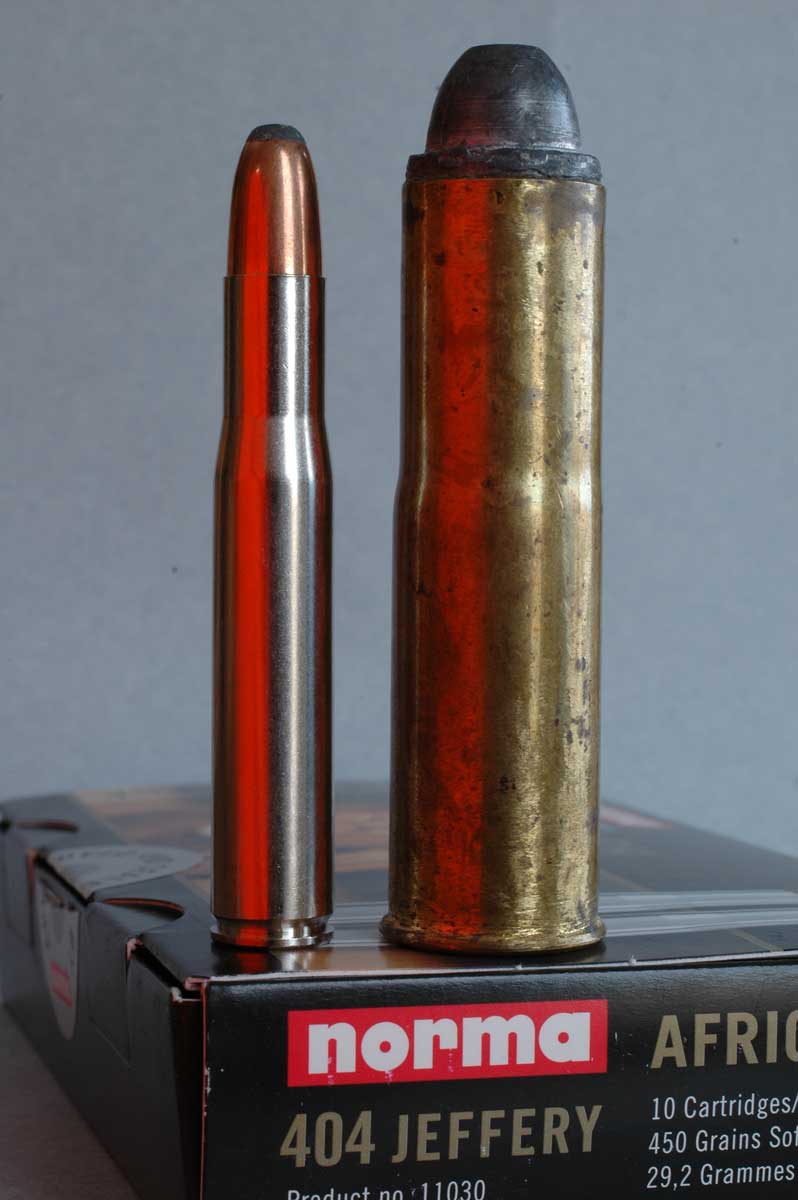
A popular “elephant gun” early on was a 4-bore muzzleloader (550 grains of blackpowder, a 4-ounce ball). Right: a 4-bore cartridge, next to a current 404 Jeffery, from which modern “beltless magnums” evolved.
The toughness and resilience of South Africa’s pioneers was shared farther north by explorers and missionaries such as David Livingstone (1841-1873). Hunter/explorers followed, many of military bent, most from families of means. Frederick Lokes Slous (original spelling), accomplished in finance and chair of the London Stock Exchange, sired Frederick Courtney Selous in 1851. The lad grew up poaching. At age 18, stealing buzzard eggs for his collection, he was collared by a Prussian game warden and fled that country to avoid prison. In 1871 he left England for Africa to become an ivory hunter. In three years he killed 78 elephants with a 4-bore muzzleloader that fired 16 drams (437 grains) of blackpowder to hurl a 4-ounce (1,750-grain) silk-patched lead ball. As its recoil was “upsetting,” he switched to a 10-bore cartridge rifle, then a 461 Farquharson/Gibbs and a 450 Black Powder Express by Henry of Edinburgh. After he’d become something of a firearms authority, Selous was offered a 425 Westley Richards repeater. Declared he: “Had I…such a rifle [when hunting elephants], I could have killed three or four times as many….”
Selous hunted abroad as well, from Turkey to Scotland, eastern Canada to Alaska. He prowled the Wyoming Rockies before joining Theodore Roosevelt’s 1909-1910 safari in British East Africa. His long hunting career reportedly blessed Selous with 106 elephants. It ended January 4, 1917, on the Rufiji River where, as captain in the 25th Royal Fusiliers, he served as a scout. A German sniper’s bullet found him. He was 66 years old. A year to the day later, his 19-year-old son died in an air battle over Belgium.
The evolution of more powerful, more reliable rifles reduced risks in hunting elephants, even as pressure from ivory hunters sent the beasts to thicker cover and remote places that handicapped riflemen. Explorers had relied on heavy muzzleloaders, commonly 4-bores. Such a rifle, commissioned by Samuel Baker from George Gibbs in 1840, had a two-groove, 36-inch barrel. Weighing 21 pounds, it was hardly quick to cheek. But Baker, then age 19, found it still kicked viciously. He would order later rifles, smaller of bore but sending bullets faster, from the gun-making shop tobacconist Harris Holland had started around 1835. His nephew, Henry, apprenticed in 1861, joining Harris as partner six years later. In 1876 “Holland & Holland” replaced “H. Holland” as the company’s name of record. Baker, whose celebrated career gave the shop a boost, enjoyed a full life, succumbing to a heart attack in 1893, age 72.
Through the mid-1800s, blackpowder and barrel steels of that day limited breech pressures and projectile speeds. Bigger balls, then bullets, dealt a stiffer blow to the animal but also hiked rifle weight and recoil. William Finaughty, who hunted in the same era as Selous and tallied about 400 elephants, sold one of his rifles three times after retiring. In 1875 the fourth owner hung three pounds of lead on the barrel to limit its climb during discharge!
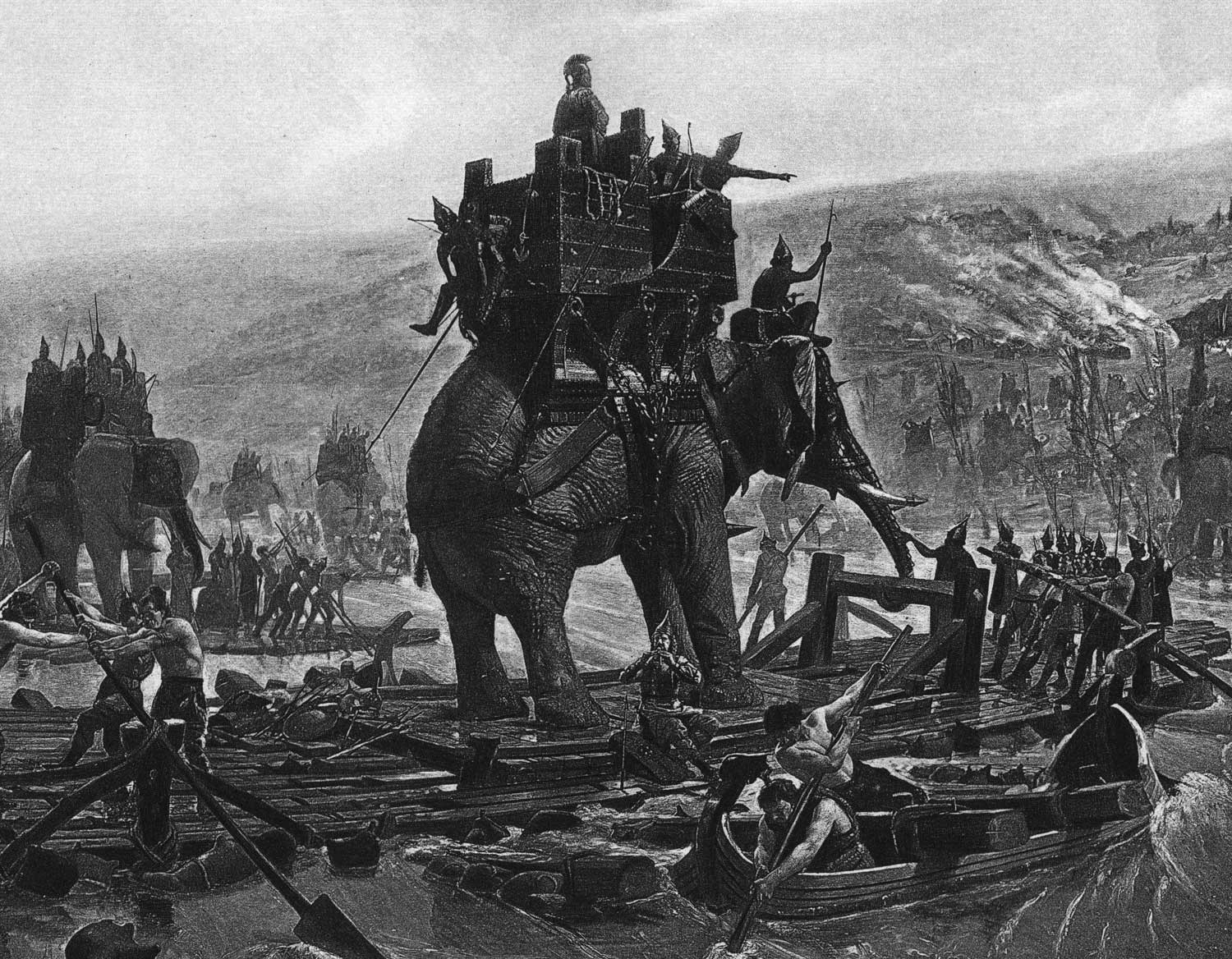
Before Doomed by Ivory
As early as 3,500 B.C. Egyptians trained African elephants to do what was once expected of the smaller “Indian” elephants of south Asia—work later done by troop carriers and tractors. Between the second and third centuries B.C., Carthaginians used elephants in war, Hannibal marching 37 through the Alps to Rome. These beasts were steel-armored, soldiers on their backs taking advantage of their height to rain javelins upon the enemy. In a bid to tap the animal’s great strength and intelligence, Belgians later trained the Congo’s elephants. Beginning in 1899, King Leopold II established “schools” for that purpose in the Ituri Forest, an elephant-rich area in the northeast sector of the Democratic Republic of the Congo.
Later, metallic “Black Powder Express” cartridges fired conical bullets from breech-loading arms. A 450/400 BPE sent 270-grain missiles at 1,650 fps. Then in the 1890s “Nitro Express” cartridges added thump with smokeless Cordite powder. Jeffery’s 450/400 3-inch Nitro Express drove 400-grain bullets at 2,100 fps.
As a profusion of heavy-game cartridges appeared, a generation of young adventurers, many from Scotland and England, sailed to Africa. Those who didn’t tap the ready labor pool to establish plantations and farms, brought that labor afield. Safaris employed great numbers of natives to tote supplies, set camps and find elephants, also to pull tusks, prepare hides and flesh of the slain, and bring ivory to markets.
Late in 1894, after he’d sent his ivory to the coast in July, Arthur Henry Neumann pitched a new camp, El Bogoi, on the Tana River. Early hunts the next season in the Lorogi Mountains disappointed. A long trek to the southeast of Lake Rudolph yielded only harsh terrain and cold wind. But he persevered, and at last killed two big elephant bulls, the four tusks averaging more than 110 pounds! Another hunt blessed him with three bulls, one with 9-foot ivory that scaled 109 and 117 pounds.
But elephant country holds many threats. At river’s edge on New Year’s Day, 1896, Neumann’s servant, Shebane, was snatched by a huge crocodile. That afternoon, his 303 British misfired. An elephant cow swept down upon Neumann and crushed his torso with her feet and fore-skull. Bed-ridden with splintered ribs, the hunter clung to life for months on a milk diet, his staff nursing him back to health.
“Elephants have a variety of ways of killing a hunter,” wrote J.A. Hunter years later. “Sometimes they will trample him [or] pull him over a tusk. Another beast may kill by braining the man with one blow of his trunk. Once an elephant has killed…by one method, he tends always to use [it].”
At the time of his dust-up with the cow elephant, Neumann was age 46—old enough to leave the bush before it tested his longevity. Thirty years earlier, adventurer Ronaleyn Gordon-Cumming had died at age 46. In 1843, after a military stint in India, the tall, raw-boned Scot sailed to South Africa to seek his fortune in ivory. With 4-bore muzzleloaders, but preferring a two-groove 10-bore double by Dickson of Edinburgh, he slew 105 tuskers. In 1850 he wrote Five Years of a Hunter’s Life in the Far Interior of South Africa. Gordon-Cumming succumbed not to elephants but to heart disease.
Neumann, an ivory trader as well as a hunter, would publish his exploits in Elephant Hunting in East Equatorial Africa after a return to his native England in 1897. The Second Boer War occupied him from 1899 to 1902, when he took up a fine Rigby 450 Nitro Express to hunt again near Mount Kenya and the Lorian Swamp, then Lake Rudolph. But elephant numbers had slid; in 1905 he killed only 15 bulls. Returning to London in 1907, having shot an estimated 300 elephants in a short and interrupted career, he peddled an accumulation of ivory for £4,500. Then, age 57, he ended his life with a pistol.
A contemporary of Neumann’s, London-born Frederick Grant “Deaf” Banks, wore many hats in Africa after arriving from New Zealand in 1896. After a stint on a coffee plantation and a prospecting trip to the Congo, he took up a rifle, hunting elephants in the Uganda Protectorate and the Lado Enclave (in central Africa on the west bank of the Upper Nile, later ceded to Sudan). Though almost completely deaf, he is said to have killed 1,000 elephants. He died at age 74 in 1954.
Peter C. “Pete” Pearson, a native Australian, came to Africa in 1900 as a seaman to take part in the Boer War. He stayed to hunt in Kenya, then poach in the Lado Enclave. After WW I, Pete hunted in Tanganyika, then worked as a game ranger for Uganda’s game department, mostly in elephant control. That work contributed to his life-long tally of 2,000 elephants. He used cartridges still popular: the 350 Rigby, 375 H&H and 404 Jeffery—also the 577 Nitro Express. Pete died of cancer at age 53, a month before the U.S. stock market crash of 1929.
In the early 1890s, William Dalrymple Maitland Bell schemed to leave his native Scotland, where he’d lost his parents at age six. With substantial family resources but no academic bent, he hired onto an Australia-bound barque, reached New Zealand by paddle steamer and came home on a refrigerator ship in 1894. He was 14 years old. Three years later, family money landed him in Mombasa. His single-shot 303 British got him a job killing lions on the Uganda rails, soon to gain notoriety for man-eaters at Tsavo River camps.
When a failed partnership scuttled Bell’s first attempt at ivory hunting, he went to Canada to join the rush for Yukon gold. With another Scot, he paddled the Yukon River to Dawson, shoveled ore for $10 a day, then entered another doomed partnership to supply meat to mining camps. Broke, Bell sold his rifle and paid £5 for a horse so he could join Canadian recruits mustering for the Boer War. By 1901 he had been captured, escaped back to Scotland, funded another try at elephants and crossed Lake Victoria by steamer. With a crew 100-strong, he hunted 600 miles off in Uganda’s game-rich kingdom of Bunyoro. The Karamojong people took to him. He traveled north of Lake Rudolph, then by horse, mule, camel and canoe west of Addis Ababa and into the Sudd. A six-month safari yielded 354 tusks from 180 elephants.
Just 17 years after killing his first bull, “Karamojo” Bell was wealthy. By his count, he had shot 1,011 elephants. Annual profit ranged from $9,000 to $21,000. He was never badly injured by his quarry, though he favored small-bore (.256, .275, .303) cartridges. A skilled marksman, he studied and sketched elephant anatomy to learn where to aim from all angles. In tall grass on a ladder, he might topple several bulls from one place, where a more powerful rifle’s report might scatter the beasts, and its recoil spill him from his perch. He reckoned he averaged 1 1/2 cartridges per tusker with his 275 Rigby!
Bell was a tireless walker. He once “traveled hotfoot” 8 1/2 hours at 6 miles per hour on an outsize track, only to find a tusk-less bull. He once surmised he’d walked about 73 miles for each elephant killed.
John “Pondoro” Taylor declared a hunter might walk to elephants every day for many days without earning a shot. Thorns and insects could make every step an effort. And not all trekking produced ivory. “[Once] I hunted for fully six weeks without firing my rifle, though I [found] elephant almost every day, [some] so close I could have touched them. But I couldn’t see a vital spot….”
Big tracks didn’t always mean heavy ivory. A bull might have a broken tusk, small tusks or tusks that look fetching but were diminished by a big hollow (thus less ivory) in their bases. Short, beefy tusks could weigh more than long tusks with steep taper. Taylor once killed a bull whose tusks taped just 4 feet. Straight and thick with only a saucer-like cavity at their bases, they scaled 65 and 72 pounds!
Completing a 33-year hunting career—roughly twice as long as Bell’s—Taylor wrote: “I have killed about 300 elephant on license and [most likely] poached four for every one shot legally.” He was never smashed up by an elephant; nor did he lose a tracker or gunbearer, a fact that gave him particular satisfaction. He believed in pensioning staff when age slowed their step.
“Pondoro” himself lived into retirement, passing at age 65 in 1969.
A generous tenure also blessed John Alexander Hunter, born in 1887 near Shearington, Dumfries-shire, seven years after Bell. Hunter’s father was a prosperous farmer, with 3,300 acres near the Solway Firth, where he shot wildfowl. By age eight “J.A.” was tramping those marshes with his father’s Purdey.
Like Bell, J.A. cared not for school. He was 18 years old when an older woman’s attention freed him from such boredom. His parents and local minister concluded that time with a distant relative in Kenya might save his soul. But the relative was, in fact, a violent ne’er-do-well, and weeks after his 1908 arrival, J.A. had had enough. Then another Scot suggested he apply for work on the Mombasa-Nairobi rails.
Riding the train as a guard, Hunter kept his .275 near at hand. One day the engineer stopped the train to show the lad his first elephants. J.A. grabbed the Mauser, leaped off the platform and shot one. Its ivory fetched more than two months’ wages. Hunter would kill more than 1,400 elephants in a profitable career. “Ivory brought 24 shillings a pound,” he wrote. Tusks scaling 70 pounds were quite common then. Adept hunters could kill with nearly every shot, and “a .450 cartridge cost only one and sixpence.”
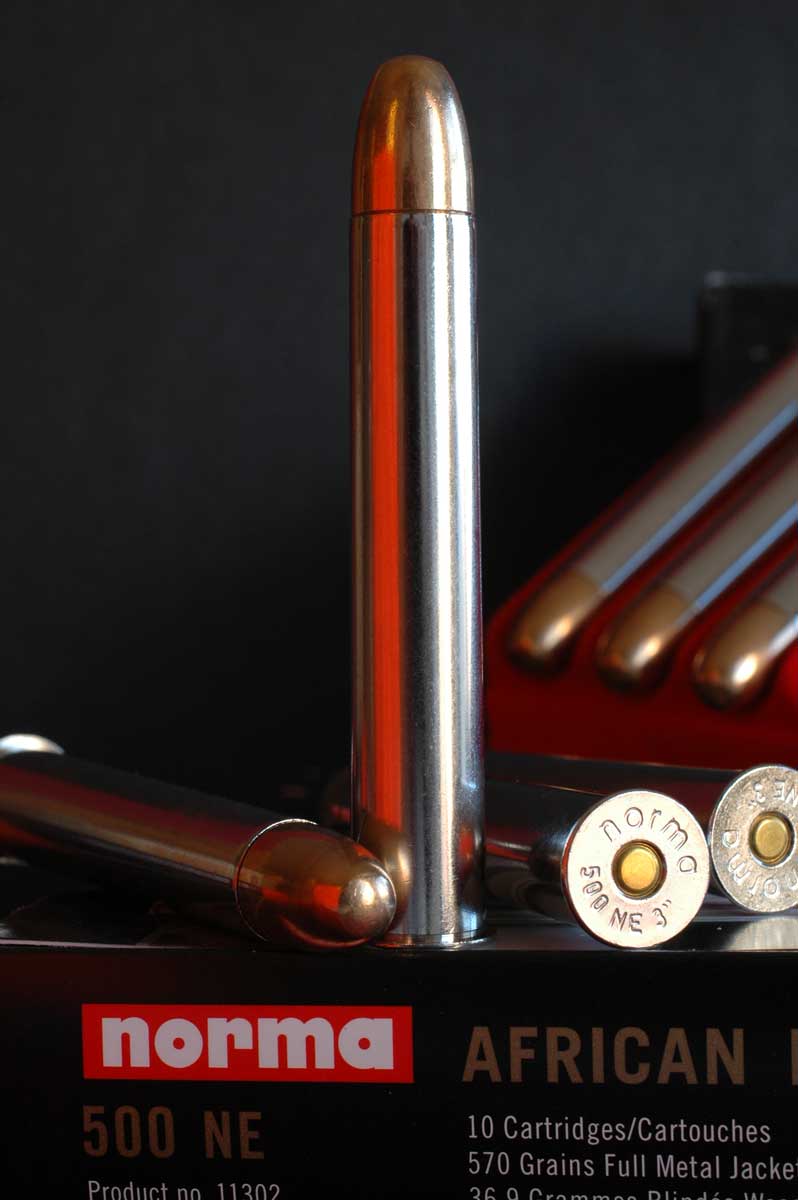
Hunter’s rifle of choice was often a 10 1/4-pound Holland & Holland double in 500 Nitro Express. He found the kick of the 577 and 600 Nitro Express too severe. Still, while hailing Bell’s exploits with small-bore rifles, J.A. noted that Bell had earned his plaudits early, when elephants had been lightly hunted. Many were found in grassland. Not tasked to kill rogues that had learned to outwit or kill people, he could pick his shots.
In thickets, fortunes could pivot in an instant. Few hunters who lost control of that moment got it back. One who did was a Captain Heskett of the King’s African Rifles. When his first bullet failed to kill the elephant in his sights, he stepped clear of cover to catch better aim for a follow-up. The animal spied him and charged. Heskett’s chest shot tore its lungs but, before he could fire again, the beast picked him up and slammed him to earth, then thrust at him repeatedly, driving a tusk through his thigh. Finally, the bull hurled his victim into the bush. Conscious when found, Heskett survived nine days on the trail on a stretcher through equatorial heat. Entebbe surgeons saved his life.
Though he dodged death several times by a step, John A. Hunter entered retirement unscarred. He passed at age 76 in 1963, following “Deaf” Banks and “Karamojo” Bell, who died in 1954, ages 79 and 74, respectively.
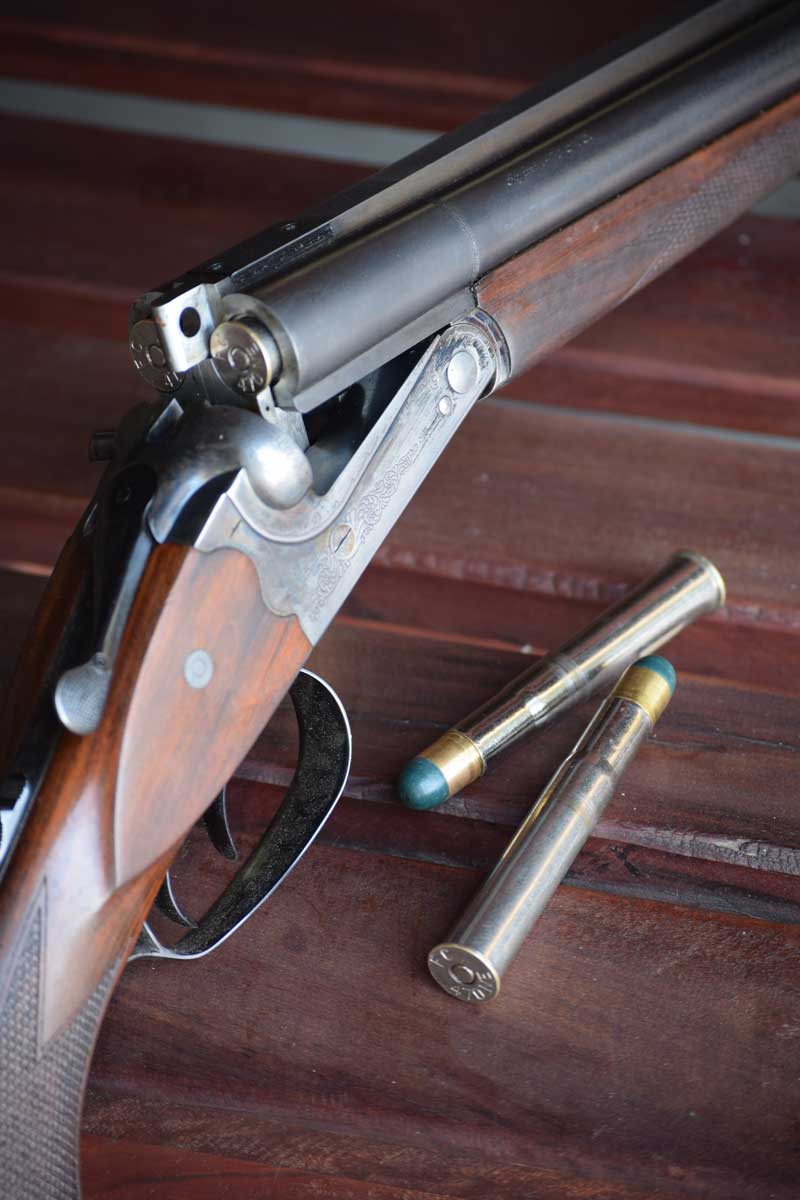
Designed by Joseph Lang, the 470 Nitro Express appeared in 1907 as a replacement for powerful 450s, banned for a time in India and the Sudan. Not proprietary, it was embraced by the British gun trade and is still a hit!
By the 1920s, ivory hunting in Africa was much diminished. In many areas, elephant numbers and habits made it unprofitable. Elsewhere, legal constraints and fees discouraged hunters. Safaris for wealthy sportsmen and women prospered PHs such as Bunny Allen, Harry Manners and Bobby “Iodine” Ionides, all born in the 20th century. After WW II, the safari industry bent to greater costs and more restrictions, while demand for safari services increased.
A New Zealander may have shot more elephants than any adventurer from the British Isles. Roy Dugdale “Samaki” Salmon, born in 1888, came to Uganda in 1911 to grow coffee. He killed 20 elephants a year, permitted on his planter’s license. In 1924 he became one of four white elephant control officers in Uganda’s newly minted Game Department. Six years later, he was appointed the country’s chief warden, a post he held until his retirement in 1949. Salmon used bolt rifles in 416 Rigby and a 470 Nitro Express double to shoot a reported 4,000 elephants.
While the elephant has been called the most dangerous of Africa’s “big five” game animals, it has also edged the bottom of that list. Rankings reflect the experience or imagination of the respondents, also hunting conditions and the moods of elephants in memory.
Most elephant hunters active in the ivory trade or animal control work from 1850 to 1930 died of natural causes or mishaps unrelated to elephants. Many thousands of tuskers fell to hunters who suffered no serious injuries over many years afield.
Of course, hunting records of that era were written largely by the aged and successful, not by the young who perished early or were permanently damaged and whose obituaries have faded.
Even during the peak of the ivory trade, when fortunes were made killing elephants, much of the allure of hunting these beasts derived from the attendant risk. An African elephant is, after all, the world’s biggest terrestrial game, if not the most dangerous.
Fear is a powerful incentive to shrink from that risk. Or to take the spoor.
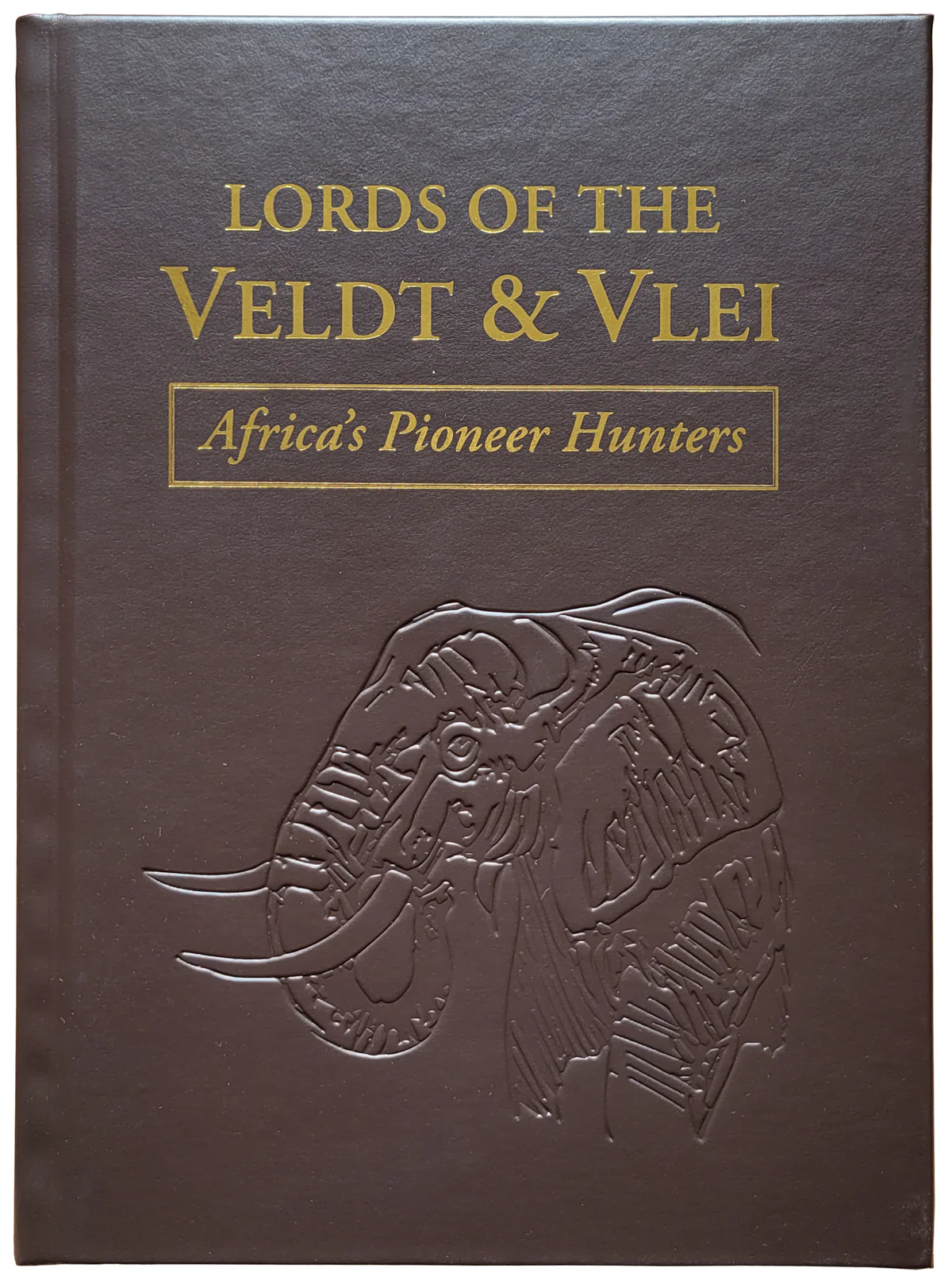 This volume carries the reader through a representative collection of those who pioneered and popularized sport in Africa from 1837-1910. Chronologically, they include: William Cornwallis Harris, William Cotton Oswell, Roualeyn Gordon-Cumming, Sir Samuel White Baker, William Charles Baldwin, Charles John Andersson, John Parker (“Ubique”) Gillmore, Paul Belloni Du Chaillu, William Finaughty, Arthur Henry Neumann, Frederick Courteney Selous, Abel Chapman, Theodore Roosevelt, Nicholas Potocki, Chauncey Hugh Stigand, Sir William Northrup McMillan and Frederick Vaughan Kirby. Buy Now