
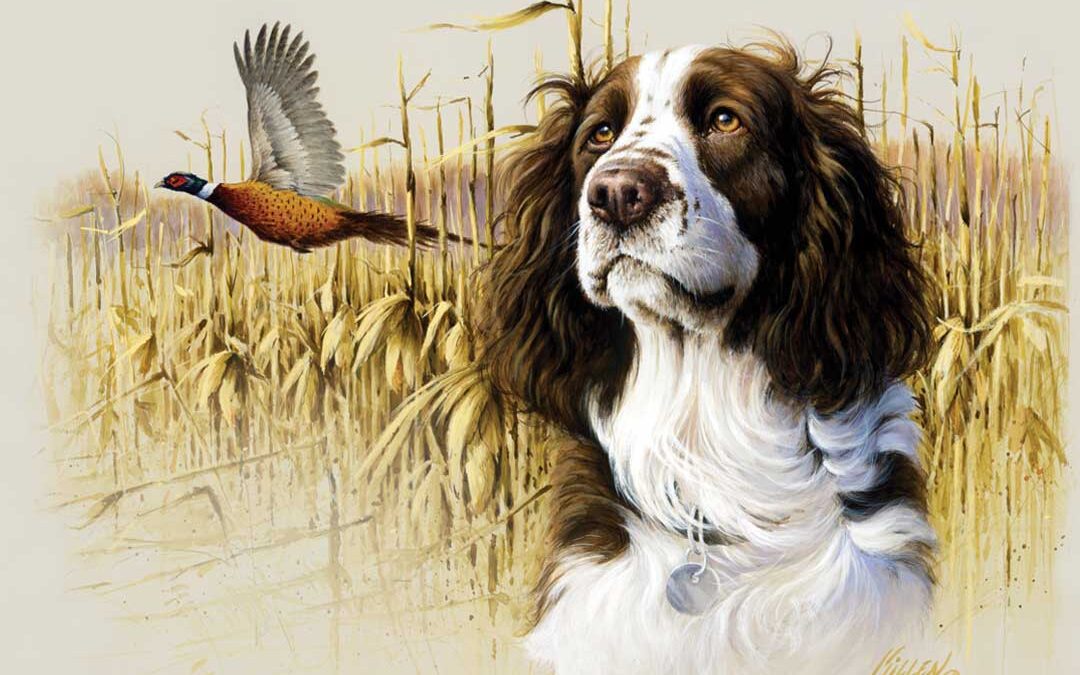
It was to him a very simple thing and the wonder was that the others, the older ones, were so stupid and confused. It was only a matter of going back a few years to when he was ten and her age, and thinking as he had thought then.
The old urges and desires and faiths came back, and along with them the memory of the path, half forgotten now, that followed down the tiny stream through the woods and came at the end of the cave. It was there, he decided firmly, that the lost girl had gone.
He stood a little distance from the group of men, watching the captain, noting his taut face and nervous hands.
He had always thought of the captain and of the captain’s daughter as beings apart – as, somehow, Olympian people – with whom he and his kind had little in common. He had felt that way for years, ever since the time his uncle had left him the 50 dollars and he had gone, nervous and hesitating, to his father and said that he meant to spend it for one of the captain’s fine springer spaniels.
He could remember still his father’s dark, bloodshot eyes looking at him with infinite weariness, and he could still hear his father’s voice saying, “So you’re getting big ideas. Well, you’ll get over them before you’re much older. Them fancy dogs is for people like the captain. Not for any of our kind. Keep that in mind, if you got one. We ain’t like the captain – we only work a piece of his land.”
The money had been spent for clothes for the family and a much-needed new stove, and the little that was left had gone into the meager budget.
So it was a strange thing to see the captain now as a worried and indecisive man, a man like other men, gesturing and shaking his head and saying over and over, “We’ve got to find her before another night comes. You sure you asked at every house along the Toll Road, Tom? I’m not satisfied with the way we combed that hill country, Jim.” He looked at them with bright agonized eyes.
Ben Frazier went down to the road then, tightening the loose knot in the rope that served him for a belt. The captain sure set a mighty store by his daughter, he thought.
He pulled the old straw hat down against the sun and walked faster. Soon he turned off on the little abandoned logging road and, a hundred yards along, left that to fight his way through brush to the forgotten trail. He saw a strip of bark torn from a log, broken branches and a shoe print in the mud next to a small spring. He smiled. He knew where the lost girl was.
He found her at the old cave, as he had expected, and she was too tired and frightened to answer when he told her shortly that they were going home. They walked side by side up to the house.
He was about to leave her when he heard a call and saw the captain coming toward them.
He shifted uncomfortably from one foot to the other while the captain bent and held his daughter close. Then the captain, clinging to the girl’s small limp hand, rose and turned to him, the tightness gone from his face now, the lines fewer and not so deep. He said, “I’ve seen you around – you’re Frazier’s son, aren’t you?”
“Yes, sir.”
The captain ran a hand through his hair. “What do you want, boy? You’ve got something coming.”
He shook his head and turned away. “That’s all right.”
The captain laughed. “Maybe she would have come home by herself today. But saving me an hour or two of worry is worth plenty. Tell me what you’d like, boy.”
He drew a sharp breath. He thought of the kennel back of the house and the fine new litter. The captain was a dog man. He raised the best springers in the state. The captain owned the greatest springer that had ever lived, and this dog had sired the new litter. But dogs like that were rich men’s dogs.
He settled his feet in the roadbed. “I’d like a dog. One of your dogs. Only I know it’s too much to be asking.”
The captain looked at him for a moment, then nodded and said, “Nothing’s been sold out of the new litter. You can have your choice of it. I didn’t plan to sell for two weeks. If you want to wait, you’ll be able to make a better pick. I’m promising you I’ll sell nothing until you’ve had your pick.”
He had to think the words over in his mind before they had any meaning. Then he had to look into the captain’s face again to make sure he wasn’t having the cruelest kind of sport that any man had ever had. And when the words came out of his throat at last, they came in a voice he had never heard before.
“If you mean it – if that’s all right, I’ll pick now.”
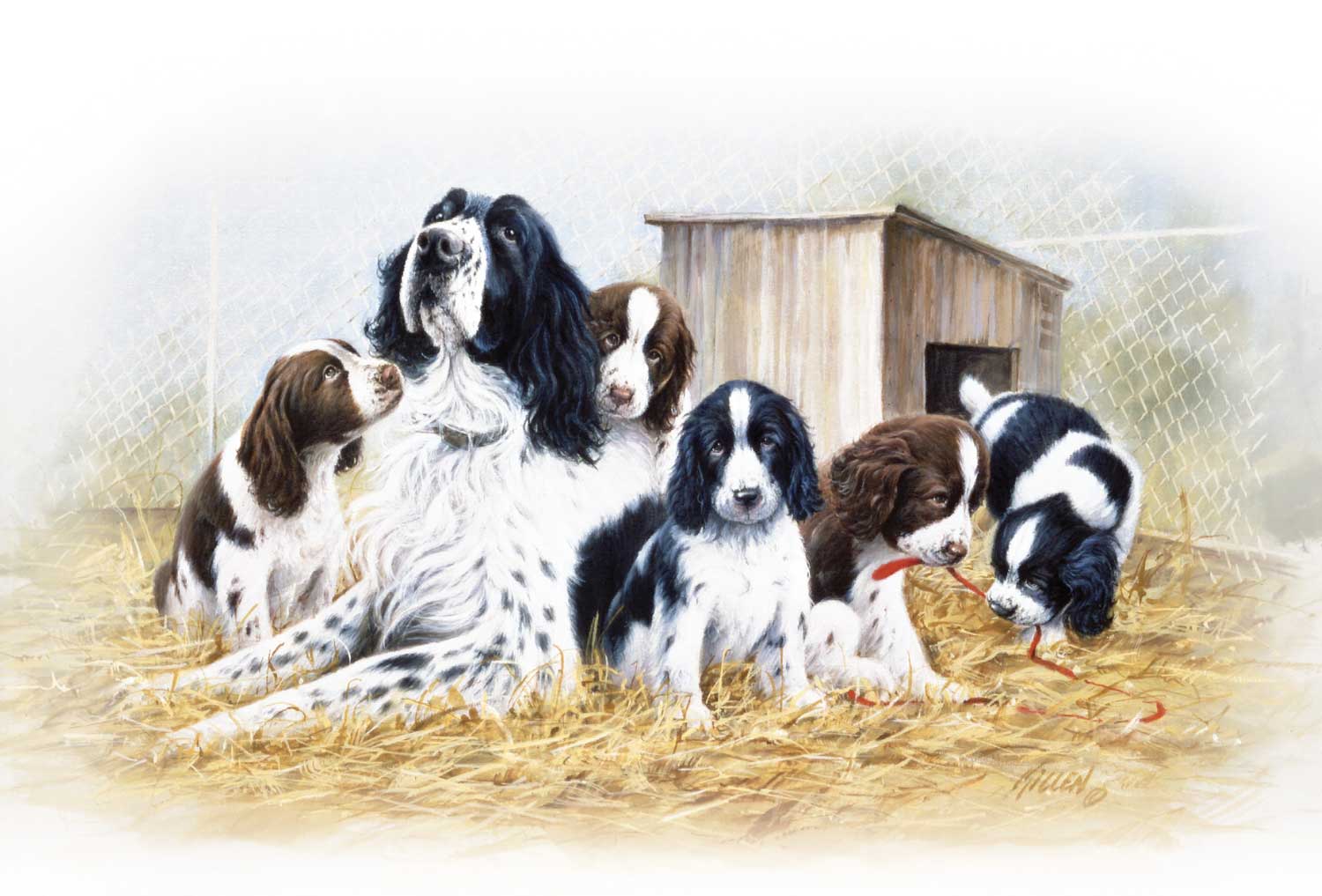
I was a litter of eight; he knelt and ran his hands over them lovingly. He looked at their tremendous feet and their bright, sad faces; he watched the eternal movement of their sterns and thought that surely he was dreaming. After a long time he stood up and saw that the captain, whom he had forgotten, was still leaning against the fence.
The captain smiled at him. “If you want my advice, I’d take that big fellow. I never saw a better chest, and if he turns out gun shy I’ll eat him.”
The captain’s advice was honest; Ben had watched dogs all his knowing life, and this was the likeliest specimen. Most men would take him. Only there was another of the males that he had been watching. A little small, maybe, and he certainly didn’t stand out in a litter as fine as this. He couldn’t have told why he preferred him to the rest. It was something felt, something beyond and alien to words.
“I’d like him,” he said.
The captain looked puzzled. “He seems to me a little on the nervous side. But it’s your choice, not mine; and I’ve made my mistakes.”
“I’ll take him now, if it suits you.”
The captain nodded and he picked the dog up. He heard the captain telling him to come back in the morning and they’d make a deal about food – he wouldn’t have a dog fed wrong, and feeding right was an expensive business for a man who didn’t own a kennel.
Ben said, “Thank you, sir,” and started home. A little wind had come up and he put the dog gently inside his shirt against his skin, and very soon its frightened trembling stopped.
He did not go directly home. He knew with grim certainty what would be said when he arrived there carrying the dog.

He went into a field where the clover was deep and soft as an animal’s pelt and put the dog down. The dog looked up at him, pricking his ears, his muzzle quivering and eager. Even in his great-footed awkwardness was a grace, a fineness of movement that was surer proof of his breeding than the writing on his pedigree. The dog came to him when he called, and he stroked him for a few moments, then stood up, suddenly austere. You could harm the finest dog ever born with an excess of attention.
He went home then, and when he met his father he spoke first. “This is my dog,” he said softly. “The captain’s girl got lost. I found her. He gave me the dog.”
His father looked at the dog with fathomless eyes. “So the captain did. I guess you’re about one of the captain’s buddies. No doubt you’ll be going into the city soon to buy yourself some of those swell clothes like he wears. A blooded dog like that expects a lot of a man, all right. Why, he wouldn’t lower hisself to bark at anyone like me.”
Ben said nothing. The dog lay at his feet on his back, the four immense paws waving. And while he looked at him, he changed from a puppy into a grown dog, all grace and power and sureness and intelligence, the finest sight any man’s eyes had ever seen. It was as if the dog’s whole great career had been graphed out, right down to his final victories in the great national trials that rich men spent thousands trying to win and failed a hundred times for each time they succeeded. He started to turn away.
His father said slowly, “You take that dog back.”
“I’m not taking him back.” He said the words without passion, the way you say a fact beyond denial.
When his father turned suddenly on his heel and went into the house, he knew he had won the first round. He took the dog to the barn, where there was old wire and boards, and started the job of building an enclosure and a doghouse.
It seemed to him that each day really began at evening, when he was done with his work and could have some time with the spaniel. He was prepared for his father giving him more and more jobs to do. He made no complaint. He worked harder than ever in his life and knew no weariness. The most onerous work was easy when you knew that once it was finished you could do what was closest to your heart. He and his father talked little. His mother had nothing to say concerning the dog; it was obvious that she thought of him as only a creature that ate food and barked at nothing and tried to come into the house where he wasn’t wanted.
He thought a great deal about a name for the dog. You couldn’t call one of the captain’s spaniels Bill or Pete or Boy. He had to have a dignified name, with style. It came to him in the middle of one night. The nearest town was Derrydale, and the captain had given the dog. Derrydale Captain. Derry for short.
He worked slowly, patiently, first teaching the dog obedience. He taught Derry to come to him, to walk at heel and to sit at his feet without jumping on him. After each lesson he lay on the ground and let the dog run about as he pleased, watching him all the time.
Often he talked to Derry, telling him in short, definite words what his life was to be. He held him by the scruff of his neck, and tried to make him understand all that was wanted of him, all that he must do. Once his father came up to him at such a time and announced his arrival by a laugh.
“That must be a wonderful dog you got. Talks English just like a human, I see. Or maybe you’re a little cracked in the head.”
He stood up and faced his father, feeling an impotence, a harsh knowledge of his inability to say in words the thoughts that boiled within him. When he turned away without answering, his father laughed again, a long laugh. He wondered, his blood pulsing hotly, that any man could be so unfeeling. Then his father walked away almost jauntily, as if he had achieved a victory. He had no heart for training that evening and put Derry into his kennel. He awoke in the middle of the night feeling deep shame that he had let himself be so disturbed by nothing. His father was only a man who did not see as he did.
Twice each week he went to the big house to get food for Derry. He didn’t feel that this was charity; he and the captain knew such a dog must have certain foods and that was all there was to it. Sometimes one of the hands would get the food for him. Other times the captain would be there and they would talk.
“How’s he coming along? Taught him anything yet?”
“He’s coming along pretty good.“
“Bring him next time you come, I’d like to see him.”
“Yes, sir,” he always said. But he didn’t bring the dog next time. He didn’t intend to. He didn’t want the captain or anyone else to see Derry until he was right.
One night Derry looked poorly. His eyes were watery, the underlids half closed. He felt a surge of fear like a knife between his ribs and he stayed up all night keeping the dog warm, watching, feeding him warm milk. In the morning Derry was definitely improved. It wasn’t distemper, after all – just a slight cold.
His father was waiting for him. “Did you go to bed last night?”
“No.”
“You stayed up with that dog. I suppose he coughed or something. Well, I’m telling you this – I’m not letting any dog interfere with the work around here. I’ve let you keep him so long as you held your end up. This is too much. No man’s fit to work without sleeping. And –”
He said, “You’ll have a better idea when the day’s over what I can do.”
He drove himself to the most productive day’s work of his life. When his eyes were burning and muscles fairly screamed for the lack of sleep, he increased his exertions. His father said nothing.
The next morning Derry was in perfect fettle, jumping at the wire and crying to get out for a run. He allowed himself to pet him a little longer than usual that morning.
Derry took to retrieving quickly, but he had a naturally hard mouth and many hours of work with a feather-covered ball, in which needles were cunningly placed, were needed to break him. When Derry was six months old it was late summer and time for him to know the sight and sound and scent of pheasant.
He thought a great deal about a name for the dog. You couldn’t call one of the captain’s spaniels Bill or Pete or Boy. He had to have a dignified name, with style. It came to him in the middle of one night. The nearest town was Derrydale, and the captain had given the dog. Derrydale Captain. Derry for short.
Ben took him into the remote corn patch one Sunday morning. He fastened a long line to the round collar of saddle leather that he had bought with money long saved for another purpose. Then they started slowly through the corn. Ben was speaking softly to Derry now and then to restrain his bouncing eagerness. A young rooster flushed five feet ahead and rose cackling into the air. Derry broke and Ben called to him, not raising his voice. The dog rushed on, barking now, oblivious to everything but the bird soaring towards the shelter of the woods. Ben held the line firm and Derry tumbled over backward, gave a small cry, more of surprise than pain, and came trembling to his feet.
Ben went on as if nothing had happened. The same thing happened half a dozen times. After that Derry stopped dead in his tracks when his name was spoken, even when three birds were flushed at once, not ten feet from him.
They went home at noon and Ben himself was trembling with excitement. His father was sitting smoking in a rickety chair in the sunshine, and Ben was so eager to talk to someone that he blurted out the news as soon as he reached him.
“You should have seen him with the check line – he got into it in no time. I knew it took weeks to break some of the captain’s good dogs. I tell you this dog’s got something no other dog I ever saw has.”
His father blew a spiral of gray smoke into the clear air. “Wonderful,” he said. “Maybe he can smell out a gold mine. I hate to remind you of it, but we’re poor people and we’re supposed to work at things that make a little money.”
“A good bird dog’s worth money, “he said. “Big money.”
“That may be,” his father said. “I don’t doubt it. Now, if you think your high–toned dog’s worth something… ”
Ben spoke over his shoulder, “There’s not enough money in the world to buy this dog.”
His father made no answer. Ben walked quickly away. He had been burdened suddenly with a dark fear that clung to him stubbornly, try as he might to shake it off.
He felt his heart beating hard and too fast the day he first went into the field with his old hammer gun and a pocketful of shells he had loaded himself with light charges. He let Derry go a good way off, then fired. Derry started, looked about and cowered, belly to the ground. Ben walked toward him, firing twice as he came; the dog broke and ran out of sight into the woods. He called him, but Derry was a long time coming back.
When the dog returned to him, shaking as if with a fever, he stroked him lightly until the fear had passed. Then they returned home.
For five days each evening at feeding time he put the tin plate of food down and waited until Derry came for it. Then he fired into the air. The dog ran into his kennel and Ben took away the plate. On the fifth day the dog’s flanks, to Ben’s agonized eyes, were thin as paper. He wanted to give in, to let Derry eat in peace and afterward to sit by him and let him lick his hands and look at him worshipfully with his great spaniel eyes. But he steeled himself and waited.
He worked until darkness made work impossible, the week before the opening season of the pheasant season. He walked the five miles into town and back on Sunday to buy his license, then stayed up late that night to load shells and clean the old shotgun. The evening before, he told his father he wanted the day off.
“I been working extra,” he explained quietly. “I’ve done a good day’s work ahead and more.”
“And if I said no – ”
“I’d go anyway. I have to go. This is my first chance to see what he can do. Only – I’d rather have your say-so.”
His father shrugged. “Do what you like. If you’re as crazy – dog crazy – as that, there’s nothing I can do to help it.”
He chose a place where no others were apt to go. He was there before dawn broke, waiting with Derry pressed against his knees. He didn’t expect many birds. It was not a real good place. If he could only bring one or two down he’d be satisfied. Then he‘d know where Derry stood.
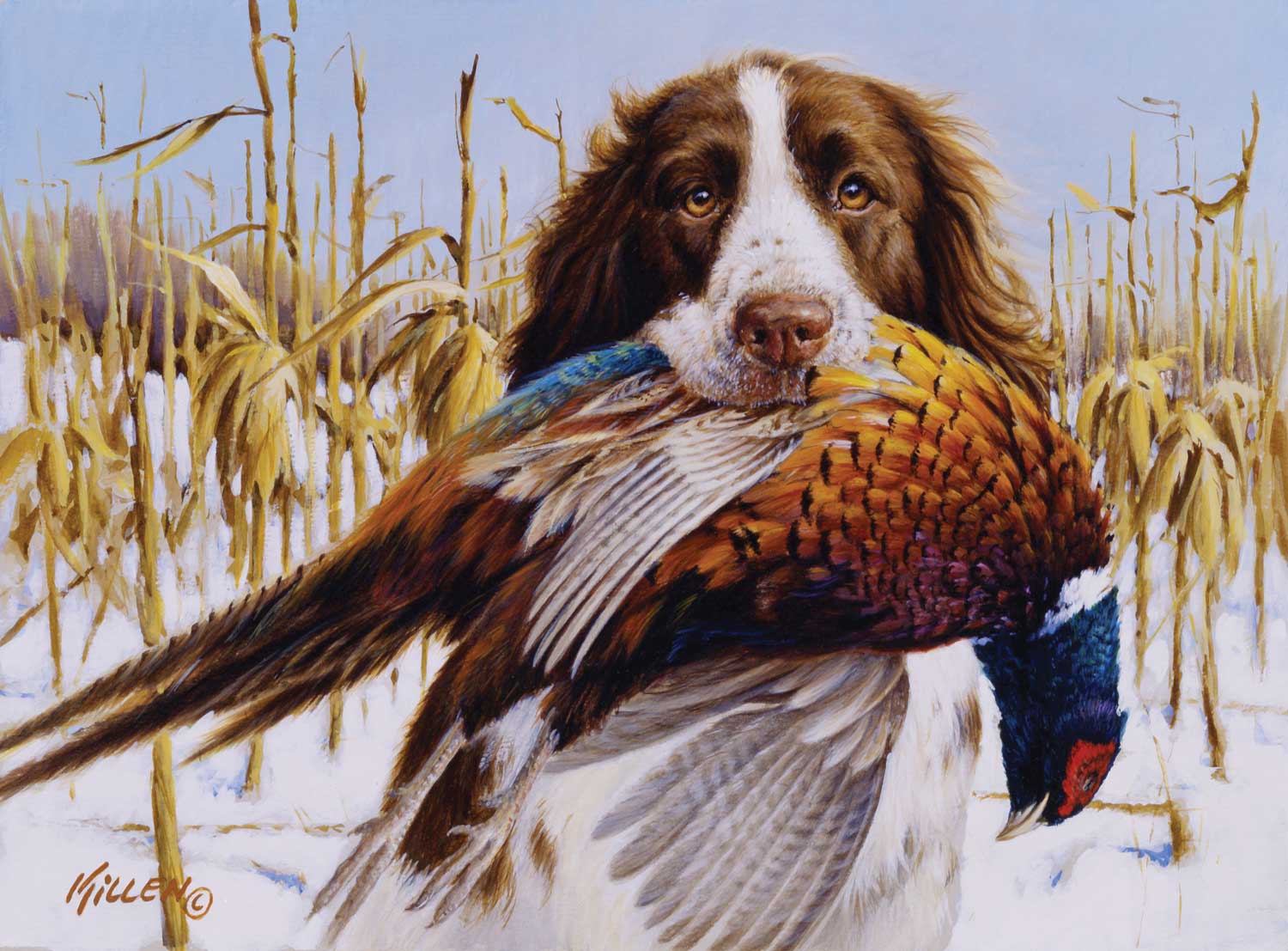
They worked two hours, the dog crossing and quartering the ground before a bird was raised. It was a fine shot, going away, and he made it a clear kill. He saw the cock fall and the dog go forward to it. He stood still, his hands shaking so he could hardly support the gun. Then, through misty eyes, he saw Derry coming to him, the pheasant in his jaws. He straightened and waited; the dog sat down before him and placed the bird lightly in his hand.
He drew a long breath. He’d seen the captain’s dogs work, and only one of them handled a bird in handsomer fashion. That dog was the champion who had sired Derry.
He said aloud, “You know, you, there’s no dog young as you in the world that’s in your class. And someday there won’t be any dog in the world as good as you, no matter how old and smart he is.”
He got his last bird just before it became too dark to see. Derry raised it out of a small corn patch, and Ben swung and brought it down with a side-angle shot. A moment later Derry retrieved. It was then that he felt someone watching him.
He turned, and 50 feet away saw a dark figure. The captain’s voice came floating across to him, soft-syllabled and obviously excited.
“That was good,” he said. “That was fine, I enjoyed seeing that.”
“I didn’t know you were here, sir.”
“Heard shooting, and thought I’d wander down and see who it was. Truth is, I’d an idea it might be you.”
The captain approached and stooped to touch and examine Derry. “And I would have never picked this one,” he said. “I always pride myself for picking ’em young and picking ’em right too. I congratulate you.”
“I guess I was lucky.”
“Maybe. But there wasn’t any luck about the way you trained your dog. You did train him yourself?”
“Yes, sir.”
“Have any help at all?”
“No, sir. My father don’t care about dogs.” He was sorry at once for saying that; to tell a man like the captain that another man didn’t care for dogs was to brand him an outcast.
“I see. What’s his name?”
Ben felt his face redden as he told it. But the captain laughed and clapped him on the back and said that was a mighty fine compliment. He’d never had a finer one, the captain said, and he was grateful and happy for it. Then he said, and there was a serious note to his voice, “I’d like you to stop in at the house a minute. There’s something I want to talk to you about.”
Ben said, “Yes, sir.” As they walked along in silence he felt a sharp, quick sense of foreboding that robbed him of all the pleasure of the day. But he told himself it was ridiculous – the captain was his friend . . .
The captain led him into a small study. “Ben,” he said, “I’m looking for a good young dog. A real field trial dog. A dog that has a chance to win the national. That dog of yours, that Derry, might be what I’m looking for. I’ve a hunch he is.”
Ben looked at the captain, then away. He felt real fear now, cold and hard, and wished desperately that he hadn’t come. He drew a breath that hurt his chest and said, “Yes, sir.”
“Now, I don’t want you to think of how you got your dog at all. Don’t think you owe me any favors. You don’t and that’s a fact. He’s your dog, just as much as if you’d come to my kennel and paid a big price for him. But I’m going to make you a proposition. I’m going to offer you five hundred dollars for that dog. And on top of it, the choice of any other pup I’ve got. You’re perfectly free to take it or leave it.”
Five hundred dollars meant riches such as Ben had never known. It meant lifting the ceiling of fear that pressed his family down. But Derry. He could not let himself think of Derry. It seemed now as if it had been predestined from the beginning. If he had only been wiser he could have seen it coming, sure and certain as the procession of the days. He could, of course, refuse. For a moment he clutched at the thought as if it were a sturdy floating plank and he a boy drowning. But no matter what, you always knew what you had to do. There was something that made you do it out of respect for your own self.
He said, “Yes, sir, captain.”
“It’s a deal,” the captain said. He opened a desk drawer, found a checkbook and wrote a check. He handed it to Ben. “Now we’ll go out to the kennel and you can have your pick again. And boy, I’ll bet you pick right.”
Ben stood up. He said quietly, “Thank you, sir, but I don’t want another dog, I’ll be going now.”
“Then you’re entitled to a hundred more.”
He didn’t answer that. He turned and hurried away. He heard the captain’s voice with a worried note to it, “Well, then I’ll send it down to you.”
Outside he did not look at Derry. He told him roughly to stay where he was and did not look back as the captain led him away.
At home he put the check on the table and told his father what had happened. His father picked up the check and examined it, holding it as delicately as if it were some fragile bit of china. Then he laid it down.
Ben said, “It’s yours. To do with what you want.”
His father shook his head. He looked past the boy, above his head, as if there were something of great interest on the wall opposite. “Thanks for your favors. I don’t want no part of them. I got along and I always will. Maybe you’ll want to be buying a car with it, like your rich friends have.”
Ben stared at his father for a long time. His father’s eyes never lowered. A sudden gust of wind came through the open window and blew the check to the floor. His father picked it up and put it in the drawer of the table.
“It’ll stay there, for all of me and your mother,” he said. “You’ll know where it is when you want it.”
The days went by leadenly. At first it seemed that not having Derry was more than he could bear. Then one day he tore down the enclosure he had made and chopped the kennel into kindling. After that it was not so hard; it was as if with ax and hammer he had destroyed something that never should have been, and so, in a strange sense, set himself free from a harsh bondage.
Half a dozen times he met the captain. Always he escaped as soon as he decently could, not asking about Derry. The captain mentioned the dog once. That was soon after the sale, and the captain asked if he’d like to come up for a hunt. He made some palpably false excuse, and the captain, nodding his head, said gently, “As you like, Ben. I know. But he’s doing what he was made to do and that’s what any being should.” The captain did not speak to him of Derry again.
He worked a day for a neighbor and earned enough cash to subscribe to a magazine devoted to field trials; the check still lay in the table drawer, untouched, and with it the check for an additional hundred which the captain had sent down by a servant. He read the magazine with infinite care, line by line, analyzing the dogs pictured, and finding none that had the grace and power and perfection that was Derry.
The first time he saw Derry’s name, the print seemed to leap from the page. It was in an early article covering a tricounty trial, and it simply said that Derrydale Captain, owned by Capt. Richard and handled by Joe Bleecher, had placed second. Derry, the article went on, “ranged nicely and obviously had an excellent nose, but was not too well controlled.”
He felt anger at the criticism, then wonder that Derry had come in but second. Yet Bleecher was a famous trainer and handler, to whom the captain had sent many of his most promising dogs. It was ridiculous to think that the outcome would have been different had he been the handler that day, but that night he slept badly and dreamed of hunting with Derry, and the dog was the great champion of all the great champions of the world.
Derry’s name appeared frequently after that – a third here, another second there, a first in one or two county trials where the competition was entirely unworthy of him. In the Western, he did not place at all. Once there was a picture, a small, one-column cut taken at a bad angle. He stood for a few minutes looking at it, miserable with the pictorial injustice of it.
He kept the magazines from his father’s sight. He was always first at the mailbox around the period when they were due to arrive. Once his father caught him as he was reading one in the barn. His father’s shadow fell across the page, and he looked up.
His father’s eyes were wide and bright. “So our gentleman is improving his mind,” his father said. “It must be fine to be born to the purple.”
Ben stood up, holding the words back that wanted to gush out. He rolled the magazine and stuffed it in a pocket. “I’m doing my work,” he said.
His father smiled. “When you getting that car? The money’s still in the drawer.”
“It’ll be there forever, far as I’m concerned.”
“And me too. I guess the captain’s ahead a nice piece of change. Well, if you can spare a minute I can use you. If you can lower yourself to help.”
The State Field Trial was coming up and he read in his magazine that the captain had three dogs entered. Derry was one. He was hoeing the kitchen garden a day or two later when the captain‘s car came down the road stopped near him.
They shook hands gravely and the captain stuffed tobacco into his pipe. “Ben, Derry’s not going like I hoped. I don’t know whether you know.”
“I know. I’ve been reading about it.”
“I figured for him maybe a national champion one day. And he couldn’t win even those little trials. It’s hard to blame Bleecher. He’s got a record back of him.”
Ben put the hoe down. “Bleecher ought to know as much as anybody.”
“There’s such a thing as a dog working right for only one man.” The captain said. “It doesn’t happen often, but it does happen.”
He saw what was coming and wanted desperately to dodge it. He never wanted to see Derry again. That was one thing of which he was dead sure. And all he could do was stand cow-like before the captain and wait for him to say what he knew he was going to say.
The captain put his pipe in his jacket pocket. “I want you to handle Derry in the State. I’ll pay you the same as I would Bleecher.”
Ben broke in angrily, “I wouldn’t take pay for a thing like that.”
The captain eyed him curiously. “Well, we can argue that later. It’s a detail. The point is – will you do it?”
He looked away from the captain, seeking hastily for excuses. There was but one he could hit on that was at all valid. “We’re busy now. I got to help. You know how it is in this season.”
“I know,” the captain said. “I can send a man down to take your place.”
“And my father – well, he wouldn’t like it. He doesn’t think much of things like dog trials. For me, that is. And I can guess I’d better – ”
“I can fix that with your father.”
There was a way the captain said that, as if he thought his father nothing more than the servants that waited on table, or milk cows in the fine pastures. Ben stiffened and looked away stonily, his whole being an intense discomfort.
The captain watched him for a moment, then said, a different tone to his voice, “I’d think he’d be mighty proud of you handling a dog – maybe a winning dog – in that trail. After all, it’s second only to the national. Yes, I’ve a feeling you’ll be out there with Derry.”
He could find nothing to say. The captain left him then, striding away to his car, and Ben watched him drive off. When he looked to the barn, he thought suddenly, his heart beating painfully hard, that he could see the wire enclosure and the doghouse within. He had to run his hand across his eyes to banish the strange illusion.
The captain came for him early and they drove off into the cold, clear morning. His father had said good-bye to him calmly, without comment, as if he were going off on some ordinary errand.
The captain drove fast, humming a tune, keeping his short brier pipe going like a furnace. Ben sat huddled in his ancient overcoat, his body a bundle of active nerves.
The trial was held at one of the great farms, 20 miles away, and long before they reached it the traffic grew thick. There were little cars and big cars, old cars and new, and the men who drove them were the big, smiling kind of men whose lives were given largely to their interest in sporting dogs.
They arrived and the captain got out, stretched, and pointed to a dog trailer hitched to a big coupé parked under a clump of trees. “That’s Bleecher’s rig,” he said without emphasis. ”Derry’s there.”
Ben walked to the trailer slowly, wondering if the dog would recognize him, hoping in one breath that he wouldn’t and in the next knowing that it would be the cruelest blow he had ever suffered. Then Bleecher’s boy, at the captain’s nod, was opening the trailer back and Ben was saying, “Hello there, Derry,” and the dog was hurling himself upon him. The dog barked twice, a high-pitched, staccato sound, and his eyes were blazing with eagerness.
Ben said, “Charge, Derry,” and the dog hesitated, then dropped. He could resist no longer. He knelt and ran his hands lovingly down the smooth flanks, his head close to the dog’s ears so he could talk to him without being overheard.
Afterward he took him away into an empty field and gave him orders. He had him cross and quarter the ground and threw a rubber ball for him to retrieve. He was still busy with this when the captain appeared.
“You’re going out in twenty minutes,” the captain said. “How’s he doing?”
“He’s fine.” Ben said. “He can win this.”
“He’s got tough competition. It’s the best lot the state ever saw, to my mind. There’s a bitch here – shipped west by plane with her handler. She’s been taking everything.”
“He can win,” Ben said again. The feel of the captain’s hand on his shoulder was warm and pleasantly intimate, and he was glad the captain said nothing more.
Afterward, he tried to remember the day in full detail, and he failed. He remembered the beginning of it, when his own clothes seemed horribly shabby beside the fine boots and breeches and jackets of the big handlers. Then he put this firmly out of his mind and concentrated on Derry. He never looked at another dog, and he never allowed himself to think that another dog might be going better. When he came to the trailer in the early afternoon the captain spoke to him for the first time since the start.
“Well done,” the captain said.
He really saw the Eastern bitch for the first time when it was announced that she and Derry were to go out together – the judges had not been able to decide between them for first honors. She was a liver-and-white dog, delicately but beautifully made, with the fine eyes and full muzzle of a great line. He saw her handler looking at him, smiling curiously; he drew his shoulders back and made a little speech of resolution to himself. Then the guns were ready and the judges were down the field in a little knot.
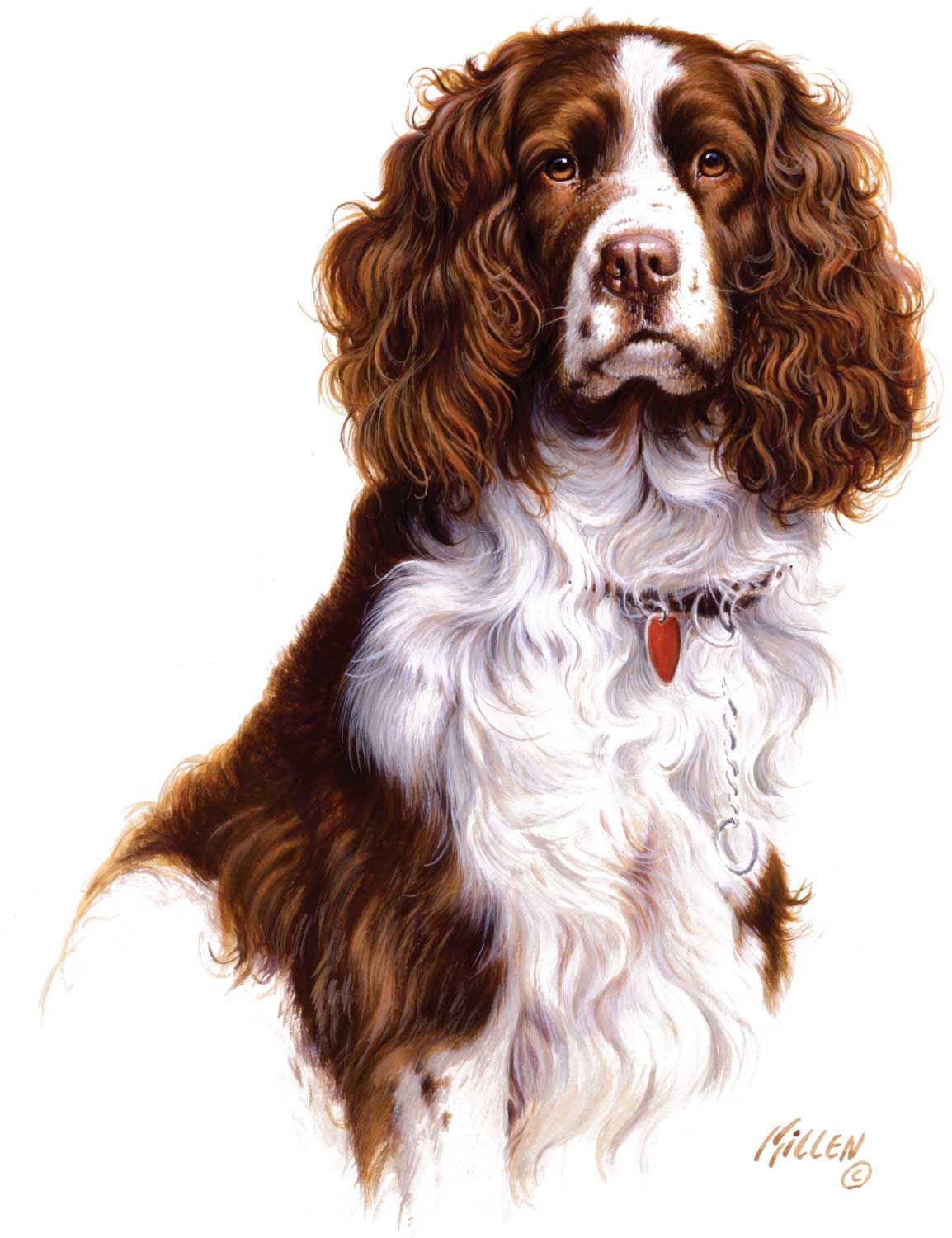
They were to have three birds each, and before Derry found his first a shot to the left meant the bitch had scored. Then Derry found two in quick order and they were brought down and perfectly retrieved. The bitch found her second a moment later. Both found their third birds almost together – the shots came hardly a second apart.
It was over. As Ben walked back, Derry at heel, the sweat was dripping down his back and chest, though the day was not warm. The captain had his arm and was saying, “I don’t care which wins, I’ll never forget this. You even had Bleecher amazed. By the way, your father’s over there. He arrived a couple of hours ago.”
Ben turned quickly, and saw his father standing alone, dressed in his ancient Sunday best, the dust thick on his heavy, carefully polished shoes. There was about him an immense pride, as if it were his protection against a world full of humiliating and inimical things. He stood very straight and he looked like a man who was alone because it was the way he wished to be, not because he had no one to whom to turn for companionship.
Ben walked quickly toward him, thinking of how his father must have come because he could not bring himself to ask for a ride with Ben and the captain. The five-mile walk to town, the search for a lift to reach the farm. . . Ben felt a strange, soft emotion that was entirely new to him. He said, “Hello.”
His father said, “Hello. I guess you did all right out there.”
Now he could almost feel the pride – as if it were a stone wall between them. He said, “Listen – I want to tell you – I want to tell you I’m mighty glad you came. That makes it a good day . . . sort of caps it off, as they say.”
It seemed to Ben that a little of the ramrod stiffness went out of his father’s posture. “You mean that, Ben? You mean that, like you said it?”
“Of course I mean it.”
His father smiled then, a wide, free smile that was reflected in his eyes. “I’m glad I came too. I guess there’s a lot more to these dog things than I knew.”
The loud-speaker rumbled then and a metallic voice roared out, “The judges wish it announced that this was one of the closest and most brilliant contests in their experience. The winners are: first, Derrydale Captain, owned by Captain Richard Harmon and handled today by Ben Frazier. Second – ”
He heard no more, for there was a pounding as of surf in his ears and his father and the captain were slapping him on the back and shouting. His mind was a spinning wheel of many colors that he thought would never stop.
It seemed a long time later that the captain was saying, “I‘ve something to tell you. I’ll make it short. It takes you to handle Derry. He’s your dog. I’m giving him back to you, no strings attached. He won’t work right for Bleecher or me or anyone else. I’m doing this because I want to, Ben.”
The world was a calm and silent place now and he looked up at the captain, knowing at once what his answer had to be – as if it had been all prepared by some portion of his mind that had the gift of anticipation. “I can’t do that, sir.”
The captain didn’t answer, but waited.
“Because of Derry. He . . . he’s got to do what he’s supposed to do. Win the national. He can do it. It wouldn’t be right not to give him the chance to do that.”
“You mean,” the captain said slowly, “there’s a sort of absolute justice involved?”
“I guess that’s it. I can help Mr. Bleecher so Derry will work for him. Derry’ll do what I want. And I want him to be champion.
“I see.” The captain looked away and when he looked back his eyes were soft and moist as a spaniel’s. “Only – the way you feel about Derry – I thought – ”
“It’s something I’ve got to work up to. To earn, I guess you’d say. And I will. I don’t care how long it takes, I’m going to work and save for it.”
The captain looked at him for a long time, then ran a big hand across his face.
“Well. Well. Anyway – you go to your father. We’re having a victory dinner tonight at the house. And I’m going to see to it your mother comes up too.”
He found his father and they went along to the car. His father walked slowly, his head down. Ben took hold of his arm.
“I had an idea,” he said. “About you and me and what to do with the money the captain paid for Derry. Maybe we could use it to start a little place of our own. We could work it on the side, to begin with. I could help with all the work and then maybe get a pup cheap from the captain and start raising dogs and – well, I thought something like that might be all right.”
His father’s shoulders bent forward a little and he did not lift his head. ”That was no thought of mine,” he said slowly. Then the words came out with a sudden burst, as if a dam had broken. “You could use that money for schooling. You’d ought to have more than just eighth grade. You could go to high school in town – the money would buy clothes and books and I could make out here without you maybe, if I worked Sundays and a little extra evenings. I never wanted – I never wanted you should grow up ignorant like me.”
Ben stopped short and faced his father with blazing eyes.
“What a thing to say!”
For the first time in his life he felt grown up, felt that he and his father were men together. “No man’s ignorant that can farm the way you can. No man’s ignorant that can train dogs right. But any man that don’t know what he can do and has to go to high school to try and find out – that’s awful ignorant!”
He stopped talking, suddenly conscious of his father’s eyes. They were looking straight into his own with a warm, awakening understanding. “All right,” his father said.
They walked on toward the car, keeping step, heads up, feet coming firmly and rhythmically down on the ground.
Note: “Choice of the Litter,” which originally appeared in the July 1941 issue of the Saturday Evening Post, is copyright © SEPS licensed by Curtis Licensing, Indianapolis, Indiana. All Rights Reserved.
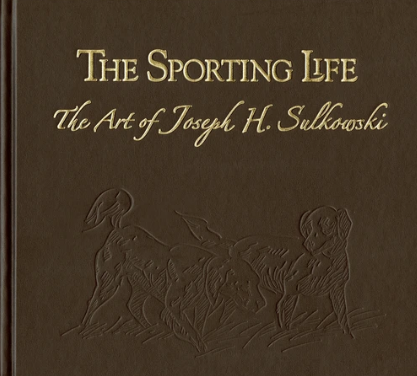 The Sporting Life is a celebration of gundogs and horses, hunting and fishing as expressed through the rich and exuberant paintings of Joseph Sulkowski.
Acclaimed as one of America’s premier dog and sporting artists, Sulkowski shares his personal conversation with the outdoor life in a style of Poetic Realism. Influenced and guided by the hands of the Old Masters, he creates fluid brushstrokes that imbue his canvases with a compelling blend of light, atmosphere, and spatial effects that bring his passion for the sporting life into vivid focus for the viewer.
Whether it’s still-lifes, dog paintings or scenes of hunters and anglers, Joseph Sulkowski derives his inspiration from personal contact with the natural world. He carries out his visions through a lifelong discipline to his craft in which hand-ground paints, carefully prepared oils and varnishes, and handcrafted linen canvases and gessoed panels play a vital role in the quality of each work of art.
All this and more about the immensely gifted artist is detailed by author Brooke Chilvers, one of the foremost experiets on wildlife and sporting art. Altogether, the large-format, 240 pages book features more than 180 paintings and dozens of sketches.