
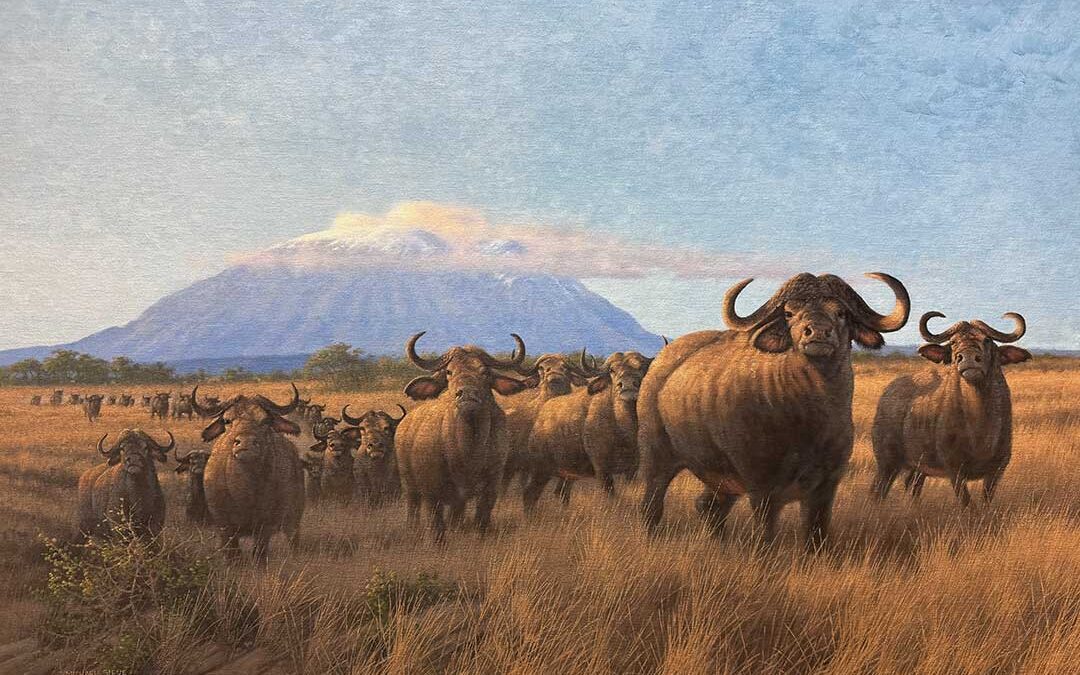
I got my first good look at the mountain just before dawn on the second day of the trip. The morning was clear, and as the sky began to lighten, the mountain appeared and quickly dominated the skyline of the flat Masai steppes in northern Tanzania. I knew it was several days and many miles away, but it seemed as if I could just reach out and touch it.
It was my birthday. September 2, 2024 – the day I started to climb Mount Kilimanjaro.
Kilimanjaro is an extinct volcano, and at a little less than 20,000 feet, it is the tallest mountain on the African continent. It’s not a technical climb – no ropes or harnesses are needed – but it is long and sometimes very steep. There are a few times when hand-over-hand cliffs need to be climbed or crossed, but usually it’s just a long, steep walk.
We were warned that cold temperatures would be an issue, but coming from Minnesota, that was not going to bother me. The altitude, however, was challenging, especially in the last thousand or so vertical feet to the summit. It was during that difficult stretch that I experienced altitude sickness.
Five of us climbed the mountain: Christine from Canada, Peter and Nicklas from Germany, Mathilde from Tahiti and myself. The two young Germans did fine, but for the other three of us, it was difficult and challenging, especially near the summit.
We all made it to the top, but could we have been successful on our own? Not a chance! We had a total of 26 young local men supporting our success. Our guides, our porters, our cooks and our camp staff – each one did his part on our behalf. They knew the route, carried our gear, put up the tents, cooked our meals and more. They got us to the top and back down. And most importantly, they did it safely!
Our challenge took us a total of eight days from start to finish. On the last day, back at the trailhead, we boarded a old school bus to take us back to Arusha, where our journey had begun. The bus was packed with the mountain of gear and supplies that we needed, all of it piled down the middle aisle. We were all hot and tired, and way too crowded to be comfortable.
The first hour or so was very quiet. But about halfway back, we had to stop at a small store for something. I can’t remember what. There, I got the idea to go in and buy everyone a cold Coke. I bought every pop they had in the cooler, about 35 in all, and stayed back to pay for them. At about 75 cents apiece, they were in the old-style glass bottles we grew up with and threw away a quarter-century ago. Perhaps even longer. When I got back to the bus, everyone had their Cokes, and the cheers of thanks and appreciation filled the air.
Back on the road, the songs soon began. Twenty-six young African guys, a couple of bus drivers and a few passengers all singing Bob Marley at the top of their lungs. I swear they knew every song he ever recorded, but the one I remember the most was Buffalo Soldiers. I’ve always liked that song, but those guys really made it special.
For the next couple of hours, we were treated to the best concert of my life. Certainly, it was the most inspiring and meaningful one that I can remember. Wide-open windows carried the music far out into the villages and fields as we passed by. People walking and working stopped to wave and briefly join in for a few bars if they could. It was the high point of the trip for me.
Back in Arusha the next day, I think I suffered a heart attack. I didn’t feel well again for the rest of the trip. When I got back home almost a month later, I spent a total of three weeks on three separate occasions in the cardiac unit at Mayo Clinic in Rochester, Minnesota. While there, I had time to reflect on my decision to climb that mountain. It was a new kind of adventure for me, and I certainly enjoyed the friends I was with, but at 73 years old, it was probably a pretty stupid thing to do.
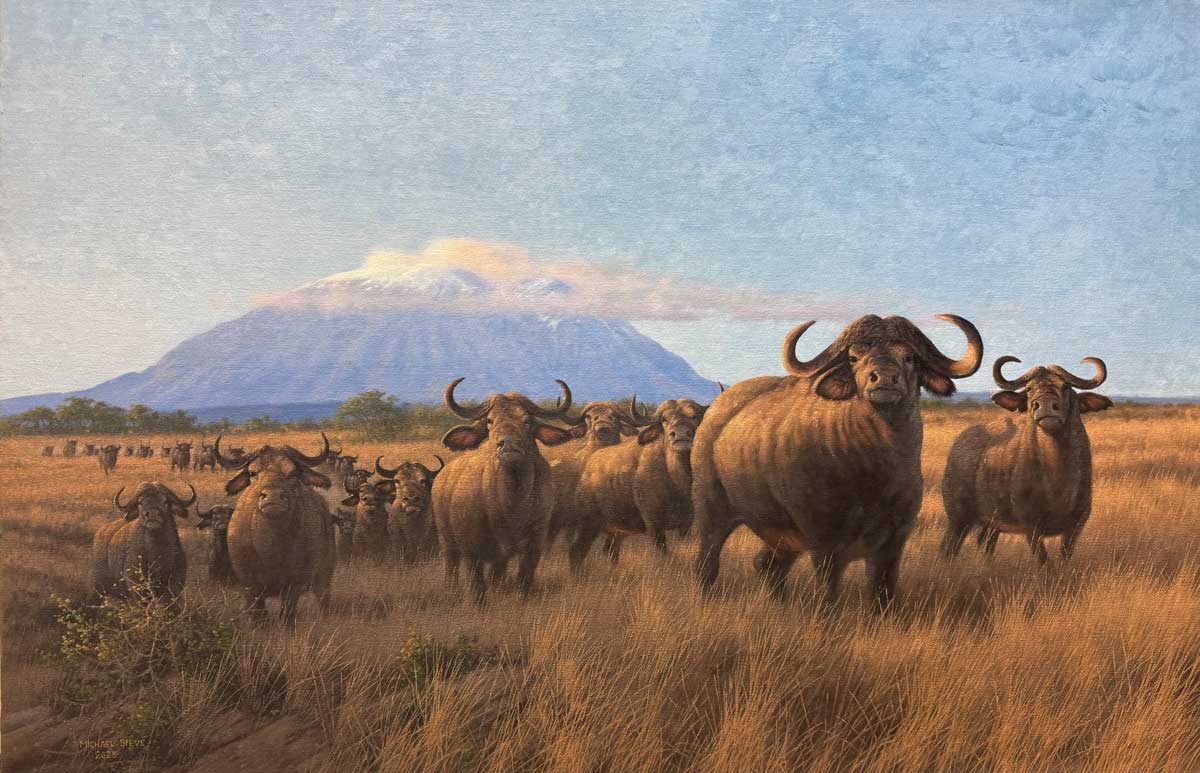
As I lay in the hospital, searching for something good to come out of the experience and the situation that I now found myself in, I decided to do a painting with 26 buffalo and Kilimanjaro in the background. I would write a story to memorialize the adventure. Calling it “Buffalo Soldiers,” I wanted to honor the mountain and the guys who got us to the top and back. They enabled us to be successful. Most of them carried our gear on top of their heads in big, oversized bundles. Some of them just grabbed their bundle with a big bear hug, and away they went. Up steep slopes and along narrow passes, day after day. They negotiated steep ledges with cliffs above and long drops below.
At one point, we went around a rock sticking out so far over the trail and so close to your face that you would brush it with your nose if you didn’t lean back. It’s called the “kissing rock.” It was suggested that you kiss it for good luck before you continue on, just don’t look down when you do!
Those guys did all that they did and much more with a smile on their faces, with friendship in their hearts, and with a positive attitude – for about $10 a day. That is a lot of money where they come from.
I don’t know if they sing Bob Marley and Buffalo Soldiers for all the Kilimanjaro climbing groups, but I’d like to think that it was special for us.
Since my African adventure, I’ve been asked many times if I would climb that mountain again. My answer is always the same: No! However, if I knew for certain that I would be treated to such a great concert on the way back from the climb by the a-cappella group that I now call “The Buffalo Soldiers,” then the answer would have to be: Hell, Yes!