
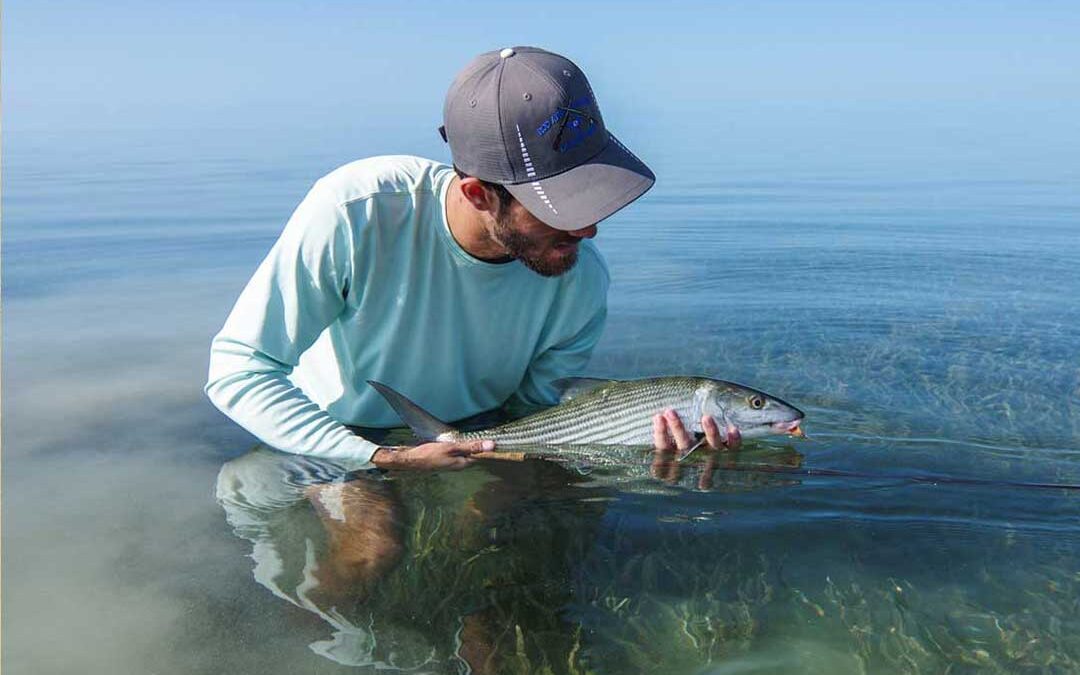
At first light, Core Hart climbed the outside spiral stair onto his flat roof. He sat down at the rooftop picnic table and, using a spotting scope, scanned the turtle grass flat that was his front yard. A half mile out, at the edge of the flat, he marked a pod of three large bonefish, tails flashing silver as they fed on small crabs and shrimp.
He scanned down the flat looking for others, knowing they would move to deeper, cooler water the instant the full sun was on the water. He found no other bonefish or permit but instead marked a bloated porpoise carcass pushed up against the flat with sharks feeding on it in a semi-circle frenzy.
Core wondered how long it would be before the sharks devoured the carcass, then scanned back to verify the bonefish were still tailing, but the distant thud-thud-thud of a helicopter coming in to land at the cay’s small airstrip spooked the bones.
The last time Core heard a helicopter land at there was just before 9/11 when his fraternity roommate came to fish. His fraternity roommate was a CIA legacy whose father had been director of counterintelligence.
His nickname at their fraternity was “The Ghostling,” or just “Ghost.” All the brothers could see that he was so secretive in nature that he would follow in his father’s footsteps. Core thought of it as an appropriate name because his roommate had a feminine face more like his mom that could be expressionless and severe like his father if the situation demanded.
Core knew to always refer to him by his nickname after he’d been recruited by the agency just out of college. “G” kept in touch frequently at the start, from D.C. and then from a station he had in California. Core didn’t hear much from G while he was learning Arabic through immersion at some small country in Africa, then only on holidays while he was station head in Afghanistan, and then not at all for the nine years since 9/11.
Core hoped Ghost had come back to fish and drink in celebration.
Warbirds circled overhead, stirred up from their roosts by the helicopter. A bull shark of maybe 400 pounds swam out with the tide on a wavering path toward the carcass.
An orange half sun nibbled up then flared yellow white. It rose above the horizon and brought a light breeze that reminded Core of his wife’s smile and took away the thought of the dead porpoise.
Core thought back to his college days in the Midwest and of a group of his frat brothers piling into Ghost’s light blue Chevy Malibu convertible with three cases of 3.2-percent beer and driving off into farm country listening to Bruce Springsteen, Dire Straits and Tom Waits, flipping a coin at every cornfield corner as to go straight or left or right but never back until they ran out of beer.
What fish would G want me to put him on this time? Core wondered as he climbed down the outside spiral stair and went through the side door into the open house.
Core recalled the times taking G fishing from a boat for night blues off Montauk, mooching for king salmon out of Monterrey and high-speed trolling for wahoo out of Key West. Core thought it was funny when the captain would cheer G to puke with the wind but into the chum slick.
Core poured a cup of coffee and sat at the dining table when the sliding doors on the front porch slid open.
Ghost’s stooped shoulders and furrowed brow made Core see him smaller than the 6-foot, 4-inch man with the awkward saunter and the oversized hands he’d known at school who would appear out of thin air in the most unlikely places and at the most awkward moments, always with a sardonic grin.
“May I come in?” asked G.
Missing were his forward searching eyes with the creased corners that turned up at the thought of mischief. Instead, they were inwardly focused and dark, far away and somber.
Brand new fly-fisherman’s clothing hung like loose drapes on his slender frame. Zinc oxide streaked his hands, face and neck so that he truly looked ghostlike staring out at Core from behind a mind that knew too many secrets and not enough about throwing a fly line.
Core could see the outline of a holster on his arm under his shirt.
“Put me on a bonefish, Core. I’ve been told it’s a religious experience,” said G.
“You intend to shoot one?” asked Core.
“Not today,” said G.
G unsheathed the pistol; the small gun that got lost in his big hand.
“Walther P-22, made out of polymer composite. I started out a field agent and it rarely leaves my side,” said G.
“I get it,” said Core with a grin.
Ghost looked away and it made Core uncomfortable.
“Have you ever thrown a 9-weight fly rod, G?” he asked.
“Never have,” said G.
“Follow me.” Core said.
It would be hot and getting hotter on the roof and Core wanted to see if there was any hope in taking Ghost fly-fishing for bonefish. Core guided his friend out the side door and back to the roof.
“I always wonder if you guys can see me from your satellites when I’m on my roof in the morning,” said Core.
“You’re not on our watch list,” said G.
Ghost pulled his floppy hat down over his brow as they climbed up to the roof porch.
“I don’t suppose you could ask your satellite people to re-task for a day to find us a school or two of bonefish?” Core asked.
“You’re supposed to know where they’re going to be, Core.”
“They’re out near the edge in deeper water, waiting for evening and the water to cool down.”
“That’s where I’d be,” said G.
“We should use the skiff on a calm day like today,” said Core.
“I’m guaranteed to puke if we get on a boat,” said G.
“You always were a puker and a slacker,” said Core.
“Find me some luck, Core. I could sorely use some. Just don’t make me fish from a boat.” Ghost wasn’t smiling.
“What have you been up to since 9/11?” Core asked since he hadn’t seen him since.
“We will find him,” said G.
“You sure he’s not already dead?”
“You’ll be the first to know,” said G.
They stepped onto the hot roof.
“Let’s see what you know of the art of fly casting,” said Core.
Core kept the tools he’d used to teach his sons and his wife how to throw a saltwater fly rod and where sometimes he practiced himself under the awning on the roof.
The tools were nothing more than an old coffee can that Core left open so it could collect rainwater and a long-handled squirrel-hair paint brush.
He put the coffee can on the picnic table, soaked the brush in the rainwater and moved his arm and wrist together slowly back so the water held in the long, tapered squirrel hair bristles, then he moved his shoulders and hinged arm in slow motion forward then back steadily and forward faster the second time, and faster still once more until the end of the third stroke where he broke his wrist following through from 12 to 9 o’clock and there became the cast.
“You try to keep the water loaded in the brush until you’re pointing ahead of the fish and then snap down. Imagine that cloud that looks like the bust of Wonder Woman is your target,” he said.
He pointed to a cloud that looked to Core like the bust of Wonder Woman, arms out, holding a big shield in one arm and a whip handle in the other with a funnel cloud forming off the whip handle, pushing slowly across the still ocean.
“You see Wonder Woman’s breasts in every cloud, Core,” said G.
“Soak the brush in the water and see how far and how accurately you can toss the water. That’s all the time you have, to hold the water on the brush and send it forward leading your target. It’s almost like a golf swing with a barely conscious pause at the end of your back swing.”
Core made another practice cast and Ghost took up the brush and held it, feeling the weight of the water then swiped his arm forward with the droplets spraying out in a broad pattern to the side like wiper fluid on a windshield.
“In golf the loading and power comes from the legs, in fly-fishing, each rod has a load point. Your pause comes when you find the load point. You give the line time to straighten behind you and then you shoot forward smooth and easy and snap your wrist from 12 to the 9 o’clock position to deliver your fly.”
Ghost tried again and this time the water-load sprayed straight at the cloud on the horizon.
Core took up the practice rod and stripped some line and gave it a few flicks so that the line stayed parallel to his ear. Having shown him, he reloaded and handed the rod to G.
“Don’t they teach you to get it right the first time at Langley?”
Ghost waved the rod back and forth, not feeling the line bow behind him, not waiting for the line to load into the bow.
“Keep your right elbow tied to your side and wait until you feel the line unfold behind you, then throw forward and then flick your wrist like the paintbrush, like you’re trying to splash your line to a point above the horizon.”
G tried again, this time landing at the edge of the roof.
“That should work,” said Core.
G nodded, but his face remained flat and expressionless.
“Time to cool off before we catch the end of the outgoing tide,” said Core.
“Can you eat bonefish?” asked G.
“They’re called bonefish for a reason,” said Core.
“There’s this myth about them,” said Ghost.
“You’ll understand once you’ve caught one on the fly,” said Core.
“I feel the need to catch something beautiful, Core, and hold it, and then to let it go. I don’t get a chance like this very often,” said G.
Core stood quietly in front of his friend, realizing G had shared something special.
“You’ve come to the right place,” said Core.
Ghost nodded his long gaunt face in understanding.
They stepped in the house and Core poured spring water in coffee mugs and they sat in the quiet cool of the living room and drank.
Ghost tilted back in Core’s favorite recliner and shut his eyes.
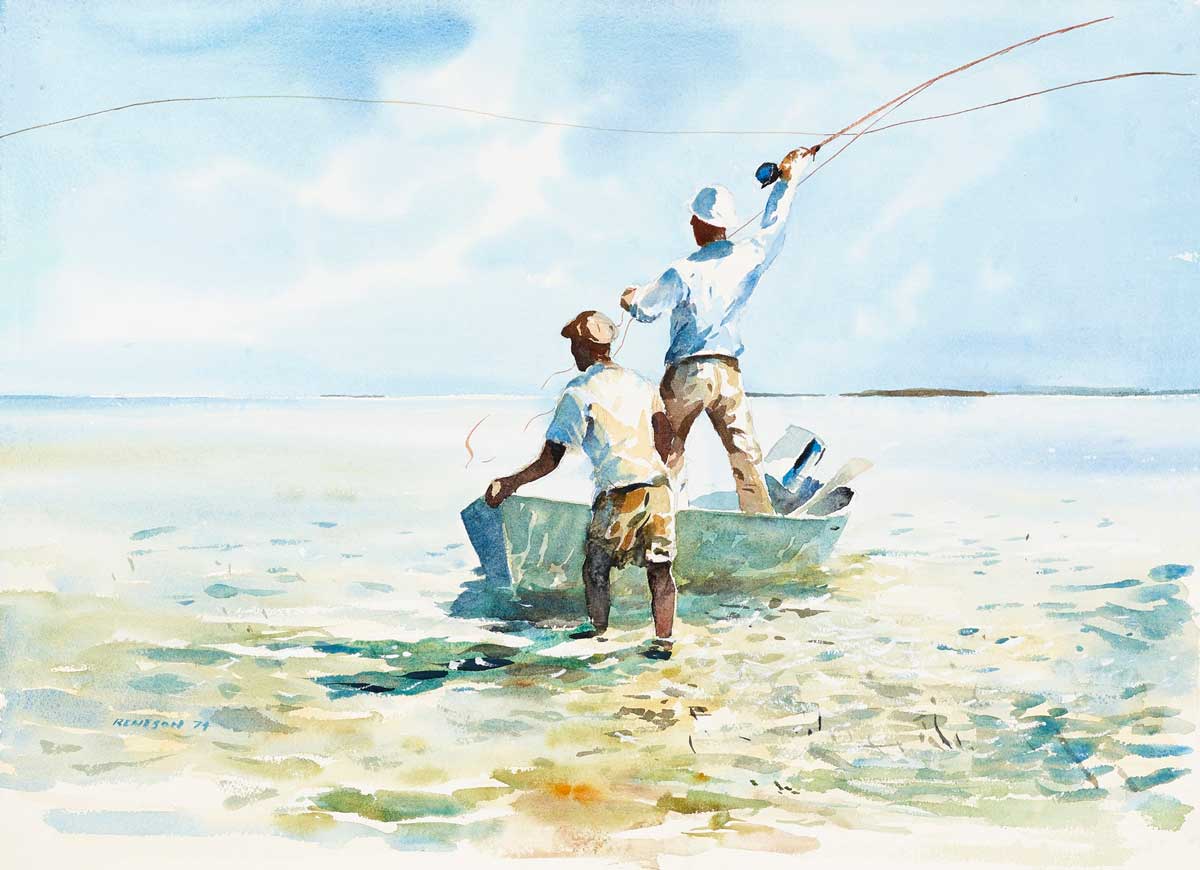
Core set up the gear they would need, two 9-weight rods with leaders and flies, canisters of water mixed with bourbon and a couple ham and Swiss on sourdough sandwiches. He packed it all in his sling shoulder pack.
He went outside to the porch closet and grabbed his walking stick that he’d converted into a bang stick because big sharks were always coming after the bonefish and permit and tarpon he fought on the flat.
He put a box of five 12-gauge slugs into the outside pocket of the sling pack. He hadn’t liked the big bull shark he’d seen swimming to the carcass that morning.
Core finished an email to his wife and lay down on the big pillowed couch and read a book until he fell asleep.
He woke sometime later with Ghost standing above him.
“I don’t think I’ve slept that well since Hell-Week ended,” said G.
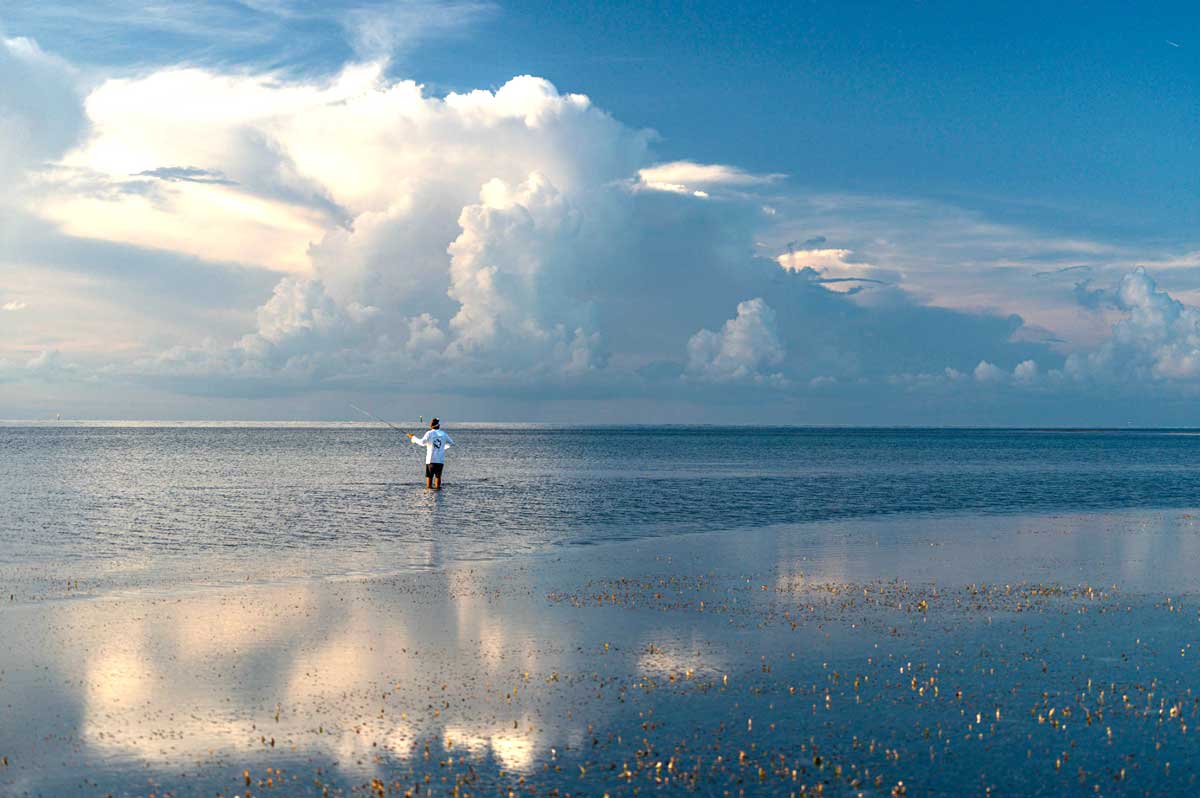
Core led Ghost through sliding glass doors onto the back porch down the long ramp and they stepped down onto the flat. The 92-degree water felt cooler than the 89-degree air.
Distant thunder rumbled offshore and the tower clouds from earlier in the morning had flattened into a line of short, squat puffballs with shafts of sunlight cutting through gaps in the clouds.
“If I happen to hook up with a bone what is the protocol?” G asked.
“Strip-strike hard like you’re setting the hook through coral. Don’t fret about the mayhem after that. Let him run away until you’re tight to the reel. Then stay taut to the fish and know that sideways pressure is greater than straight up pressure but that you’ll need to apply both during the fight.”
“I’m not seeing it,” said G.
It’s easier to learn by doing,” Core said.
Core led G out toward the edge of the wall through knee-deep water for 30 yards until the ground came up onto a bed of eel grass combed flat toward the deep water.
Three football fields out the drop off began, and they had a hard slog getting there. Once on the edge of the drop off, they felt frail and alone against the deep-water cliff where the big sharks roamed.
G stared out across the flat toward the deep water over which the storm clouds were building.
At times along the undulating path to the flat’s edge, they waded arm in arm like brothers across the knee-deep grass up onto the shallow coral rubble ledge, fly rods balanced on shoulders.
When Core reached the high ground on top of the rubble bar, he unslung his shoulder pack and took out the water bottles that he had cut with G’s favorite bourbon, and they drank and smiled.
Core pointed out one silver tail of a feeding bonefish that wavered up through the heat like the illusion of an oasis on the desert.
“Step heel to toe and stay low so as not to spook him,” said Core.
“I feel like I’m stalking my own Karma,” said G.
They moved like a stealth team across the shallow flat and pushed through shin-deep water over corals and sand and grass for 200 yards and, just as they arrived, the big bone ducked beneath the surface. His wake pushed away moving in on the flat, so Core felt the bone fish hadn’t spooked. He looked behind and ahead for others and saw nothing.
Each tide rolls and unrolls depending on the moon and wind. Slack-tide is a transition on each tidal revolution where the waters on the flat come to a virtual standstill, when fish scatter into deeper cooler water and they feed without spending too much energy or not at all.
During slack tides, Core often felt an ambivalence of spirit as there seemed no point in the hunt anymore whether for food or sport and this slack was no different until the frontline of clouds that had stalled offshore began coming together and rising up into towers taller than any man-made skyscraper, standing there in a line like the living dead about to come back to life.
A strong breeze sharply hit them with a tang of lightning.
“Smell that?” G questioned.
“Never been a fan of lightning when I’m on the water. Should we call it a day?” said Core.
“Let it rain,” said G.
“On the other hand, a change in barometer gives us a better chance at catching a bonefish in this heat,” Core added.
G took the lead and waved Core to follow as he strode out through the thigh-deep water toward the edge where that morning Core had seen the bloated carcass and the large bull shark wandering in for a feed.
“I can see now,” said G and nodded the way to the edge of the flat and to the building bank of clouds.
They walked over marled hard bottom with golf ball-sized star and staghorn coral rubble that gave way to small lawns of sea grass and sand pockets and then Ghost stopped like a hunting dog locked on point.
The wind freshened and heavy rain-laden clouds pushed at them from off the ocean.
“Look there,” said G, as the tail of a good-sized bonefish came up a sand wedge, then submerged into a pocket.
“They’re coming up on the flat to feed as it cools,” said Core.
Big drops of rain fell out of a cloudless sky followed by a cool updraft wind that hit them in the back of their heads. Thunderheads began to tower up several miles down the edge.
“Let’s wade up the outside of the flat and stay ready,” said Core.
They waded into a field of short-spine sea urchins that made a dry-snow crunch under their wading shoes. Each urchin they crushed became an eruption of sea urchin guts and roe that puffed out on the incoming tide in a greenish-orange cloud.
“Stop here for a minute,” said Core.
“What do you see?” G asked.
“Bonefish candy,” said Core pointing at the small clouds of urchin roe and guts.
Core crunched urchins with his thick-soled wading shoes and broke them up further with his walking stick.
“I don’t see anything moving,” said G.
“Give it a minute,” said Core.
Core looked up and down the flat surface and noticed a series of wake-Vs forming behind one large V that at first he thought might be another shark, but then realized it was a big bonefish.
As it moved toward them, others emerged on either side and then the one had become a dozen and the dozen became 20 all feeding fast, pushing hard like a migration of geese into the chum. They came straight at Ghost.
“Big bones at 2 o’clock, G,” said Core.
“I’m on them,” said G.
Ghost moved with a smoothness Core didn’t think he had, and he watched in admiration as G cast back and held and then full extension straight toward the lead fish and then back, stripping line as he held, then forward this time laying it down four feet in front of the lead bonefish. The pinkish colored shrimp fly hit the surface, and the bonefish darted forward taking the fly.
“He mugged it, G. Set hard,” said Core.
G strip-set and the big bone turned away from the set. The migration V of a dozen or so big bonefish turned, too, as if they’d each felt the sting of the hook, swimming away from the pressure with the entire pod following in V formation. The lead fish made a reel-stripping run over the drop-off with G holding the rod tip high with both hands and the line well into the backing on the reel.
Core knew he’d put enough drag on the reel and that he might be spooled when G’s first bonefish ran over the edge, but the hooked fish came back up onto the flat with the pod still in tow and headed to shore as if this time to beach themselves on the rubble bar.
Core saw then what he most feared while wading any flat—the dark, swift shape of a large shark swimming in fast, sprinting in on the lead fish as the pod arched around in front. The shark zeroed in on the hooked bonefish as it took off up into the skinny water at the edge of the bar just far enough away to avoid grounding themselves on the rubble bar and where the 200 pound shark couldn’t follow.
The line pulled tight against the big bone’s lip and then he turned and swam straight at them along with the rest of the pod.
Core saw why the pod had turned straight toward them. A second shark had come in from the north, this one a tiger of 300 pounds or more, both of them big enough to take your leg off.
G focused only on his bonefish and the closest shark. He dropped his right hand away and let the big bone run straight at him as he reached into his shirt and brought out his Walther and leveled it on the big bull shark’s broad head.
“Stay away from my bonefish,” said G under his breath.
G’s fly-line curled back in a loop behind the speeding bonefish as it swam into the gap between the two men, then past them and down over the edge while the rest of the pod ran through and around and scattered into the deep.
Core knew bull sharks as relentless feeding machines that would try to eat whatever got between them and a meal and G stood directly in the way of his next meal.
The big bull swam straight at G. His Walther went “pop, pop, pop, pop, pop,” as G emptied half a magazine toward the bull shark’s broad head.
The tiger shark darted off at the report of G’s handgun and Core was glad he did not need to fend it off with his bang stick.
The big bone came back on the flat and away from the dying shark. The bull shark swam in circles, belly-up on its side, blood seeping from the tidy bullet grouping in its broad head. The shark continued to swim twitching and writhing. It churned up a growing cloud of mud and blood.
G holstered the Walther and took up the rod and began reeling. He had to walk to where the fly line had snagged on the rough bottom.
As G came tight on the line, he lowered the rod tip to unwind the backing from the gravel and Core saw the big bone come back over the edge of the wall onto the flat. Core hadn’t seen it.
“Get the line off the bottom, man. You’re still on,” said Core.
G stared blankly down at the line where it went into the coral. Core stepped in and knelt and unwound the line and raised the line above his head just as the bonefish ripped off on a 50 yard run, this time to the south along the edge.
“Let him run,” instructed Core.
The reel handle spun round and round and Core could hear it rapping G’s knuckles.
The bonefish stopped.
“Now back to the reel,” said Core.
Core showed G how to pump and reel, pump and reel, and soon the big bonefish was taking shorter and shorter sprints.
G brought the bonefish to hand and held it, gills flapping hard like gasping lungs. Core came to his side and pushed the hook easily off the crease in the jaw and stepped back to take a picture.
“No pictures,” said G.
G opened his hand and let the bonefish swim slowly away.
“We’d better make tracks for the barn as that dead bull shark will bring in others,” said Core.
They walked fast back up onto the rubble bar and took time to have another slug of spring water and bourbon and each ate half a sandwich while looking behind them where the second shark, the tiger of 9 feet or better, had returned and hovered near the still-twitching bull shark.
Lightning streaked through the sky ahead of the stalled storm, getting their attention and bringing them back to themselves as they surge-walked, arms around shoulders like the brothers they were, the half mile back to the ramp up to Core’s fishing cottage.
A car was waiting at the house for G. He didn’t bother to shower or change, just grabbed his bag and shook Core’s hand.
“Back to the search for OBL?” asked Core.
“Others too,” said G.
“Feed them all to the sharks,” said Core.
G nodded and got in the back seat of the car and was driven away.
Core went back to his roof and looked out at the flat where they’d just been. Grey clouds had rolled out like a calming blanket over the cay, and the ocean as far as he could see was grey with small silver white caps and then he saw the helicopter fly out to the west across the face of the setting sun.
Core felt lonely for his wife and sons and wondered if The Ghostling had ever found someone to share his life with. She would need to work with the agency as well, thought Core.
Nine months later, in early May of 2011 Core received an email from G that had a satellite picture of him and Core, standing on the shallow flat at the edge of the drop-off at the cay. Their heads were bowed as if in prayer. The dead bull shark floated on the surface nearby.
The subject line read, “We got him.”
The email vanished when Core tried to print the pictures.