
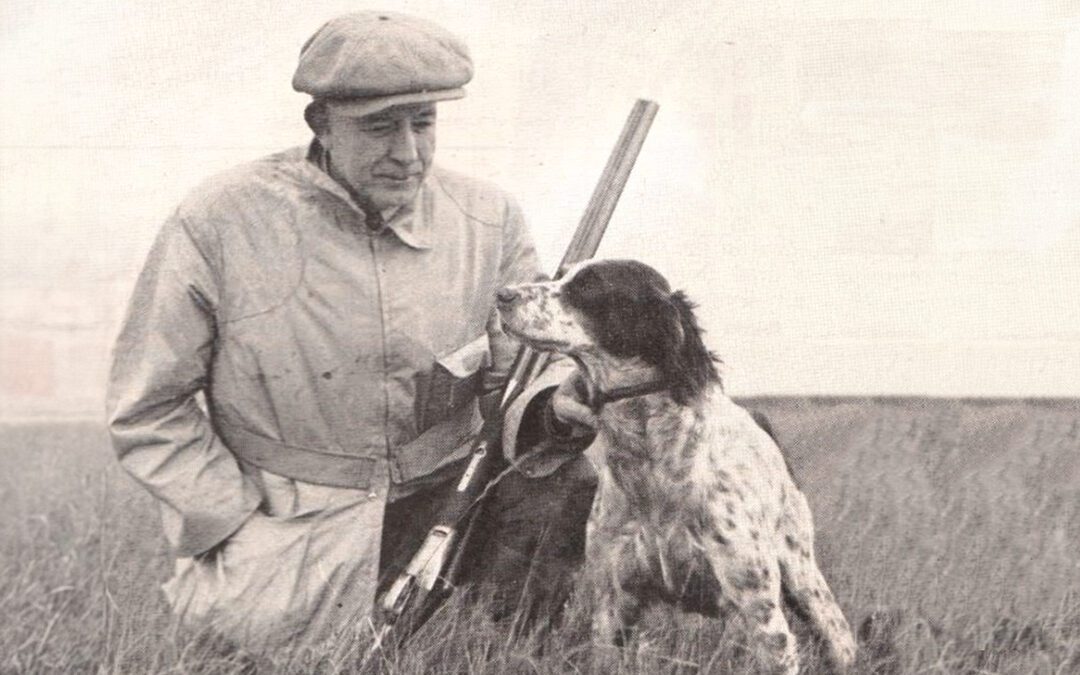
It was born of genius, destined for fame, and fated for mystery. Together, to make it the single-most fascinating and enduring legend in the multi-colored history of the American sporting scene. Its name was “Bo Whoop.”
A custom-built, ten-pound, twelve gauge, waterfowling gun, barreled, over-bored and honed by “King of Barrel-Makers” Burt Becker in an arguable year within the Roaring Twenties . . . it was soon to become the most famous in the greatest family of long range, wildfowling guns the world has ever known: the HE Super-Foxes. Regulated for the first of John Merrill Olin’s (Western Cartridge Company’s) new, magnum, 3-inch Super-X shot shells – in the hands of the few men skilled and able enough to handle it – it was capable of consistently and cleanly felling single mallards at seventy yards.
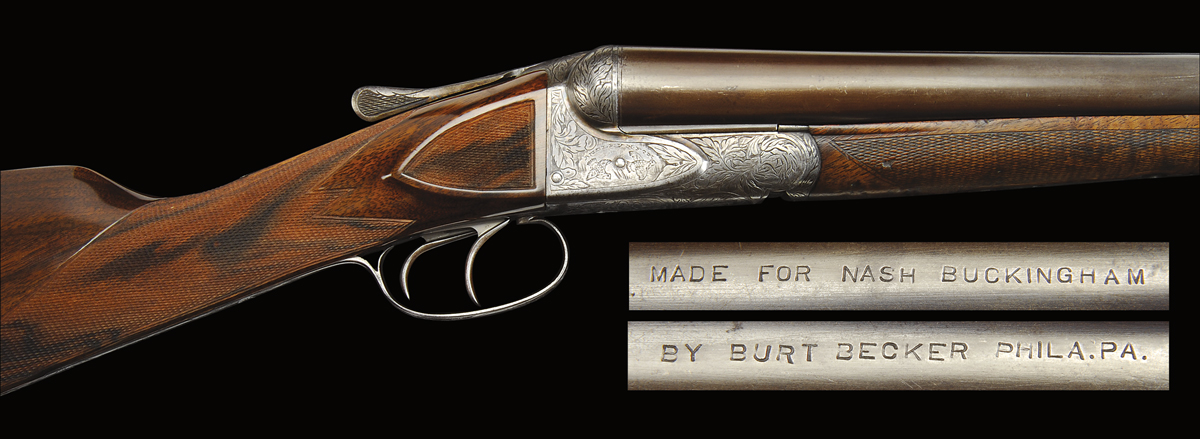
Super Fox #31088, auctioned as “Bo Whoop” by James Julia, Inc. in March, 2010, sold for $201,250, the third most expensive shotgun in market history.
Of it, Col. Harold P. Sheldon, author of the The Tranquility Stories and an estimable technical writer of the day, would declare: “Of late there have been persistent rumors of shotguns capable of putting 90 per cent of the shot charge into a 30-inch circle at 40 yards. I know that such barrels exist for I have tested three that could be called 90 per cent barrels with the one size shot that seemed to fit them best. Two of those barrels were bored and regulated by Becker . . .
Bo Whoop had one of these barrels and its mate was nearly as good. The favorite load was 1 3/8 ounces of copper-coated 4s.”
When the big gun was completed, it was shipped to Memphis, Tennessee, to the one man in America most prominently born to shoot it: Nash Buckingham.
Perhaps that is best explained in its age, by Nash’s long-time friend, Col. Sheldon again, in “The Saga of Bo Whoop” . . .
Sheldon’s 1953 introduction to Nash’s book, Hallowed Years: “The great lonely river bottom lands of Arkansas, Mississippi, and Tennessee were with easy reach of the sporting gentry of Memphis where Nash was born [1880] . . . It was a vast almost uninhabited area of swamp, forest and slough with many shallow lakes and slow streams of brown water winding through impenetrable thickets of willow and cane. A few hours journey to the west brought one to the great plantations of the Grand Prairie country and the wide brakes and marshes of the White River.
“During the months of frost the region was the haunt of millions upon millions of waterfowl. They filled the sky and crowded the open waters of lakes and ponds to form a living, restless clamorous carpet.
“In some few remote and limited regions in North America, ducks, geese and shore birds are still found in apparent abundance but in sober truth it is no more than a pale shadow of the true abundance known to the older generations of sportsmen who learned to shoot game by shooting at game.
“Any boy given similar opportunities could hardly fail to become a fine marksman. If he had the splendid physique, the perfect coordination, eye sight and intelligence which Nash had . . . he became a really superlative game shot demonstrating a degree of skill we seldom see . . . It is almost a certainty that Nash Buckingham’s skill will never again be equaled . . .”
Horace Lytle, another renowned outdoor correspondent and sportsman of the period, in reply to The Shooting Sports Journal in 1929, wrote: “Answering your telegram just received, I regard Nash Buckingham as the best all-around marksman in America. I think that Mark Arie would possibly beat Nash on clay birds but no man can beat Nash Buckingham in the field, whether it be on wildfowl or upland game.”
For all of that, handling a ten-pound shotgun with 32-inch barrels and heavy loads on ducks and geese, with nimble reflexes and perfect coordination, was not a feat for the slight or faint-hearted. It was more than just the shooting of thousands of loads at game, and the skill thereby, that made Nash Buckingham the perfect match for the big gun. He was also physically able to stand up to its mien.
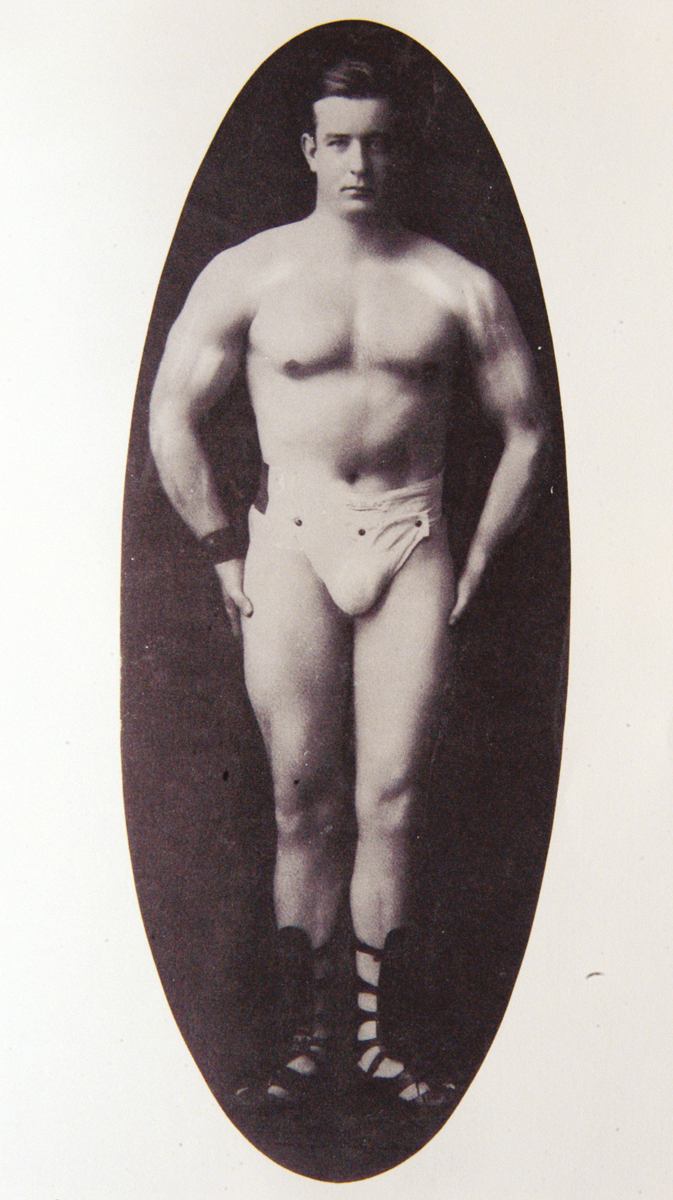
Nash at age 22, then a young bull of a man and a member of the noted “Milo Trio” vaudeville, weight-lifting act.
Nash was by genetics endowed with superb athletic abilities, and throughout his long life, made the best of them. Raw athleticism must be honed and shaped, and as a young man – as with everything else he did – Buckingham worked with extraordinary zeal at developing his physical prowess. At the University of Tennessee, he excelled in four sports, winning letters in football, baseball, track, and boxing – the All-American Captain of the Vol’s 1902 football team, and the Southern AAU of America Heavyweight Boxing Champion in 1910.
He was also a serious power-lifter and bodybuilder long before the sport gained vogue. At age 22, he was a member of “The Milo Trio” vaudeville, weight-lifting act. An old Knoxville studio photo from 1902 depicts him in jock strap and sandals, a young bull of a man. On the back, he had proudly described his particulars: “chest, normal 45”, expanded 49”; waist 34 ½”; bicep 16 ½”; thigh 25 ½”. At 5’ 10 ½, 190 pounds, and at those proportions, his “lats” and “delts” were strikingly massive. Pretty impressive in any era, outstanding for his day. Like his guns, magnum.
When Bo Whoop arrived on his doorstep, Nash Buckingham, in his 40s, would have been only a little more than halfway through his life, and at the pinnacle of his physical maturity. Exceptionally well-equipped to handle a gun that not one man of a thousand – if that – could shoot with such remarkable ability. Together, over the next two decades, they would become equally bigger-then-life, inseparable in fact and lore – Buckingham as the premier outdoor raconteur and wingshot of the 20th century, Bo Whoop as the most renowne spontaneously . . . presented d fowling piece in all of sporting literature.
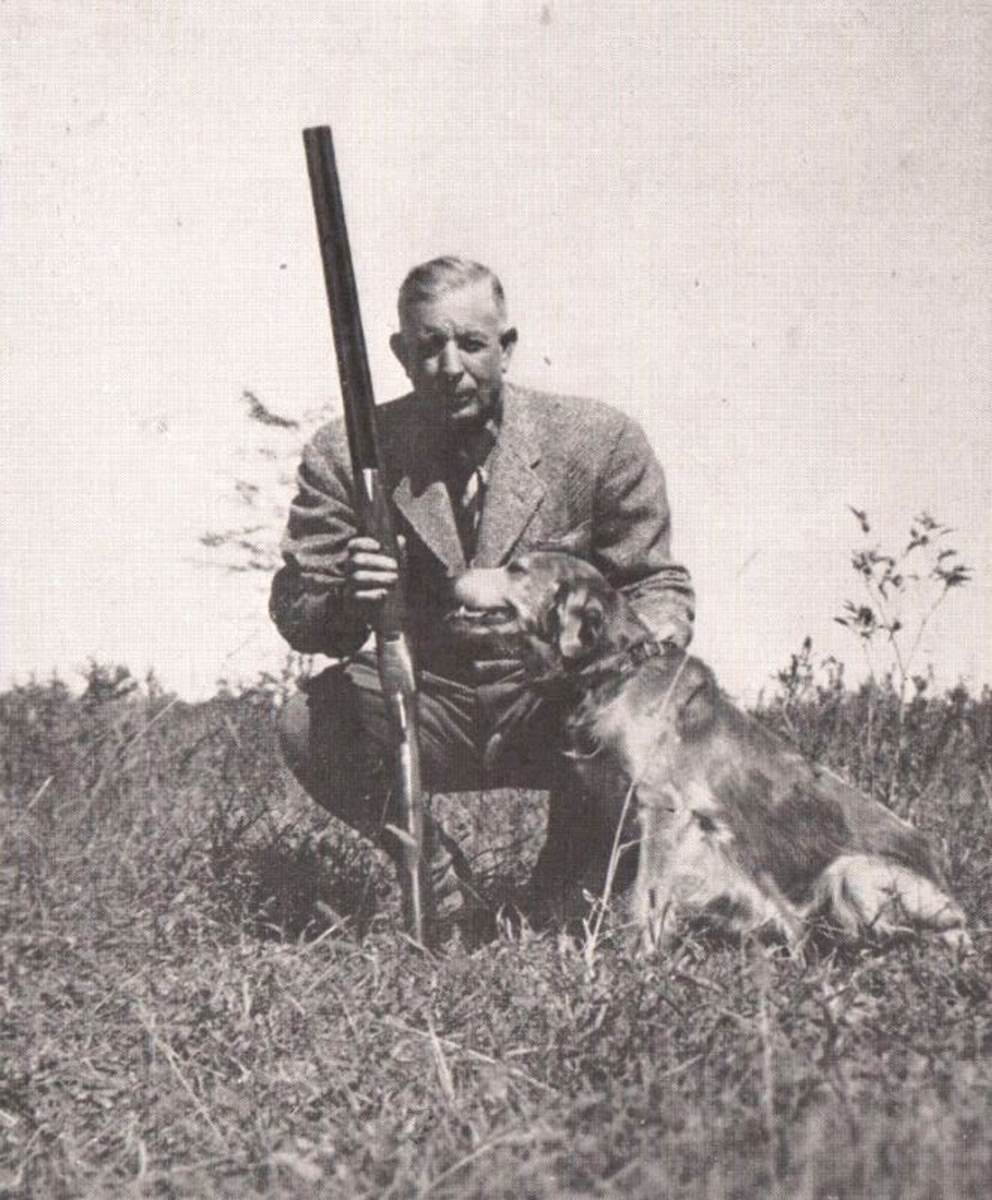
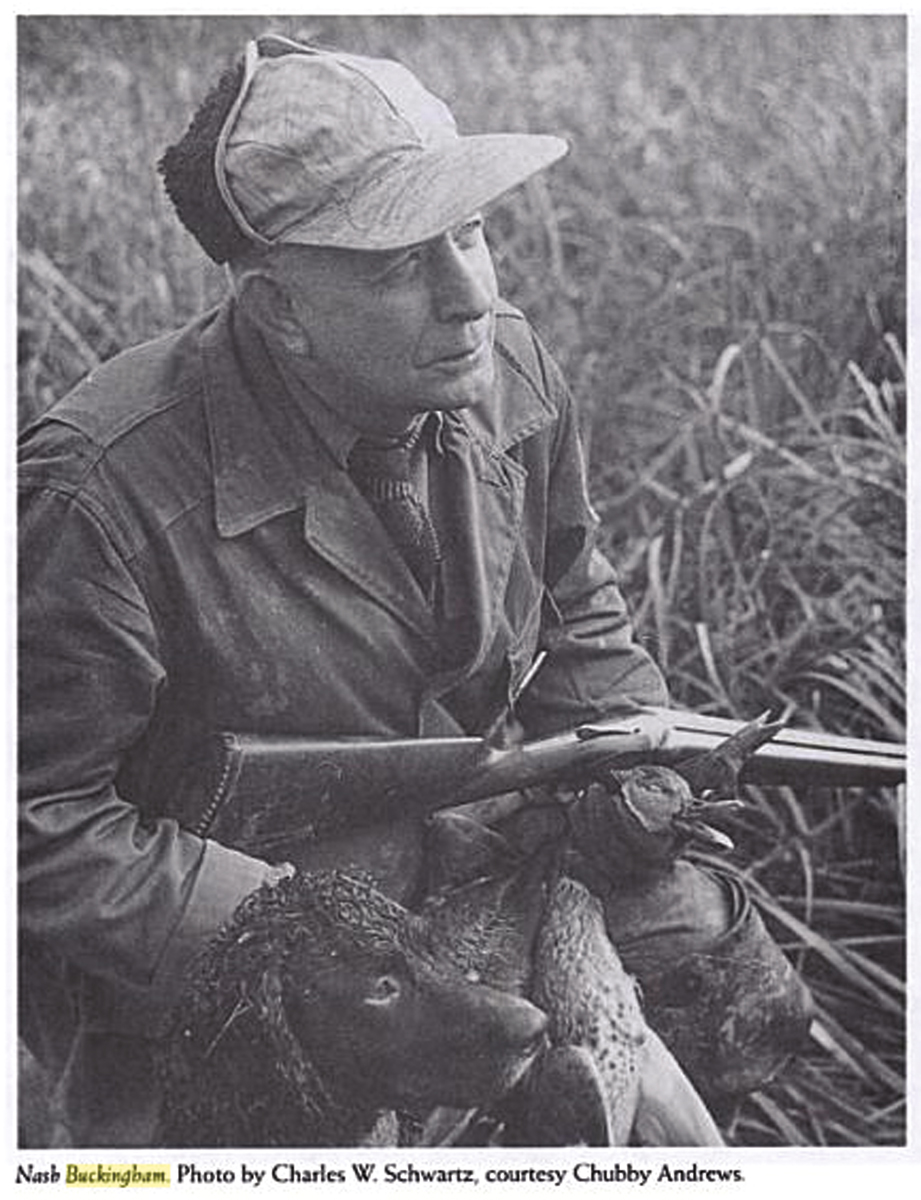
The jacket photo from Buckingham’s book Hallowed Years depicts Nash, Bo Whoop and an unnamed golden retriever. Note the unique ivory inlay at forend tip, which was missing in another photo taken not long before the gun was lost.
The almost incredible gunning feats of the two soon became celebratory. The numerous accounts by Nash’s friends from the period are invariably replete with awe. Always, at their epicenter, was the big Becker magnum.
One such recollection, by Clifford Green, illustrates well the universal aura: “When Nash suggested I take a shot, the ducks appeared so high I thought he was kidding, and did not pick up my gun. When he realized I did not intend to shoot, he let fly with his magnum. He ejected the shells and reloaded before the first duck hit the water. They were both very dead ducks.
“He constantly killed ducks that other hunters considered out of range . . . did not cripple them down, but killed them.
“I saw Nash kill ten high ducks, with ten shots, the closest hitting the water at least forty yards from where we were standing.”
Big Jim, paddler for the old Lakeside Club in Arkansas, where Nash shot for several years, recollected even more colorfully: “Mistuh Buck he gone an’ got himself one o’ dem Andy aircraf’ guns lak us boys had in de war. He don’ require to know nothin’ ‘bout a duck ‘cept dat it’s in Arkansaw. Um hum! Jes’ so dey’s dis side ob Mississippi Ribber, he sho’ is able to carry ‘em down!”
Finally, it was in a related account, that Col. Sheldon, once more, would bestow upon the big gun its lasting name: “. . . some 150 yards from my stand . . . A pair of mallards travelling high and in a hurry went over Nash. Both collapsed and after a moment of complete silence the double-boom of the big gun came rolling roundly over the marshes. It sounded exactly like the two deep solo notes from the bass horn in a symphony orchestra and I mentioned it to Nash when we got back to the lodge. “Bo Whoop – Bo Whoop.”
And Bo Whoop she has been.
In his annotated editorial comments supporting The Best of Nash Buckingham, George Bird Evans astutely observes that “the soul of a gun is of dual essence – its maker and the man who shoots it. In shooting circles, the names Burt Becker and Nash Buckingham may well be spoken together. Not one without the other.”
To that association, most certainly must be attended the gun itself, for in a time a gun in the carry of a passionate sportsman gains a life and persona of its own. Never more dramatically than in the life and times of Bo Whoop.
From its incarnate christening by Col. Sheldon, to its enormous capability in the hands of the one man in America who best could shoot it, to its widespread fame as the most celebrated of the Super Foxes . . . to its revered and reverberating symbolism of the last great, golden age of American waterfowling . . . the big gun gained a charisma that rendered it virtually animate.
For 20-plus years, the bass, double-thump of Bo Whoop resounded unmistakably across the sloughs and willow brakes of the Old South. While Nash’s rich tales of the encounters delighted a broad and lionizing audience. Until on December 1, 1948 arose the silence that bespeaks the greatest tragedy that can befall the unity of a man and a gun. In the aftermath of a shooting trip at the old Section 16 Club in Arkansas, Bo Whoop fell off the fender of Clifford Green’s car, somewhere along the east-west stretch of US Highway 79, between Roe and Clarendon – never to be recovered.
The day after, Nash wrote in great despair to his long-time friend John Bailey of Quail Hills Plantation: “Well, I lost the big gun yesterday – terrible blow. Cliff Green and I came out of the roadway from the club to the highway where the car was parked, due to mud in the lane. Just as we reached the car, a warden’s car drove up, two of them got out, and began checking us. I handed the gun, cased as usual, to one of the wardens. Then he checked my license and the back of the car to count ducks. Meanwhile, instead of giving me back my gun, the SOB laid it on our car’s right front fender. Some other members came out of the lane, there was a lot of talk, Cliff and I drove to Clarendon before I missed the gun. We drove back – searched – no soap.
“My name [is] on the case, and also on the left barrel of gun. In Clarendon, the town about turned out. If an honest person found it, I’ll get it back. If NOT, I hope he gets shot by the missing safety.” (Nash did not believe in safeties. He thought the best safety was never to load a gun until ready to fire.)
Neither was to be. For all of Buckingham’s notoriety in the area, and despite road blocks by the wardens and highway patrol, calls alerting enforcement officers and sporting goods stores in nearby towns, news and radio ads … months drew by, and the big gun was never found.
In his affecting and nostalgic memoir, Far Away and Long Ago, W.H. Hudson tells of a favorite gun he once had, which had for years and in happier times been a constant companion: “It served me well,” he wrote. “I became as much attached to it as any living thing, and it was like a living being to me, and I had great faith in its intelligence.”
To Buckingham, the loss of Bo Whoop was like losing a piece of himself, a portion of life itself. In stature, he related its loss to the death of his beloved Springer spaniel. “I feel like I did when Chubby died. I’ll never get another friend like that gun.”
Only another sportsman of honest sentiment, who has shot for years over a favorite dog with a favorite gun, to suffer then the loss of both, can understand how shattering the experience would be.
Rumors, and rumors-of-rumors persisted, but for the next 61 years, the whereabouts of Bo Whoop, the most famous and increasingly legendary shotgun in sporting history, remained an utter and confounding anonymity.
Nash on a morning gunning mallards and geese at Tom and Doris Bash’s “Lost Quarter” pits near Swan Lake Refuge, Missouri. His companion is “Duke,” from his story of the same name, the Bash’s “crisscross water spaniel.”
Theophilus Nash Buckingham, meanwhile, continued a long, full life, dying at 90 in March of 1971 – the most eminent and venerated outdoor writer in America – never to be reunited with the big gun in his lifetime. An event attended by terrible irony, as it turns out, for a fairer Fate could have rendered it differently. Sadly it did not. Why, is a deeper part of an ever-swirling mystery.
Instead, life and time churned on, 38 years beyond the day Buckingham was buried, to a moment in 2009 when suddenly the sporting world was abuzz with the news that a gun closely resembling the original and legendary provenance of Bo Whoop had reappeared spontaneously . . . presented for sale to the famed, auction house of James D. Julia, Inc. in Fairfield, Maine.
Is this gun, indeed, the very Bo Whoop that Nash Buckingham shot and so vibrantly idolized in life, literature and correspondence?
Because of the totality of the big gun’s absence, the ardent awareness of its loss and identity among an entire nation of knowledgeable sportsmen quick to recognize the slightest clue, the depth and extenuation of the mystery of how it could survive and remain undetected all those years, the coincidence, or otherwise, that it appeared and was consigned hard on the heels of quarter-million-dollar-plus, individual and consecutive world auction records for American shotguns by the same auction house – plus the presence, opportunity and technical potential for successful firearms forgery in our day – there is natural and justifiable reason for skepticism.
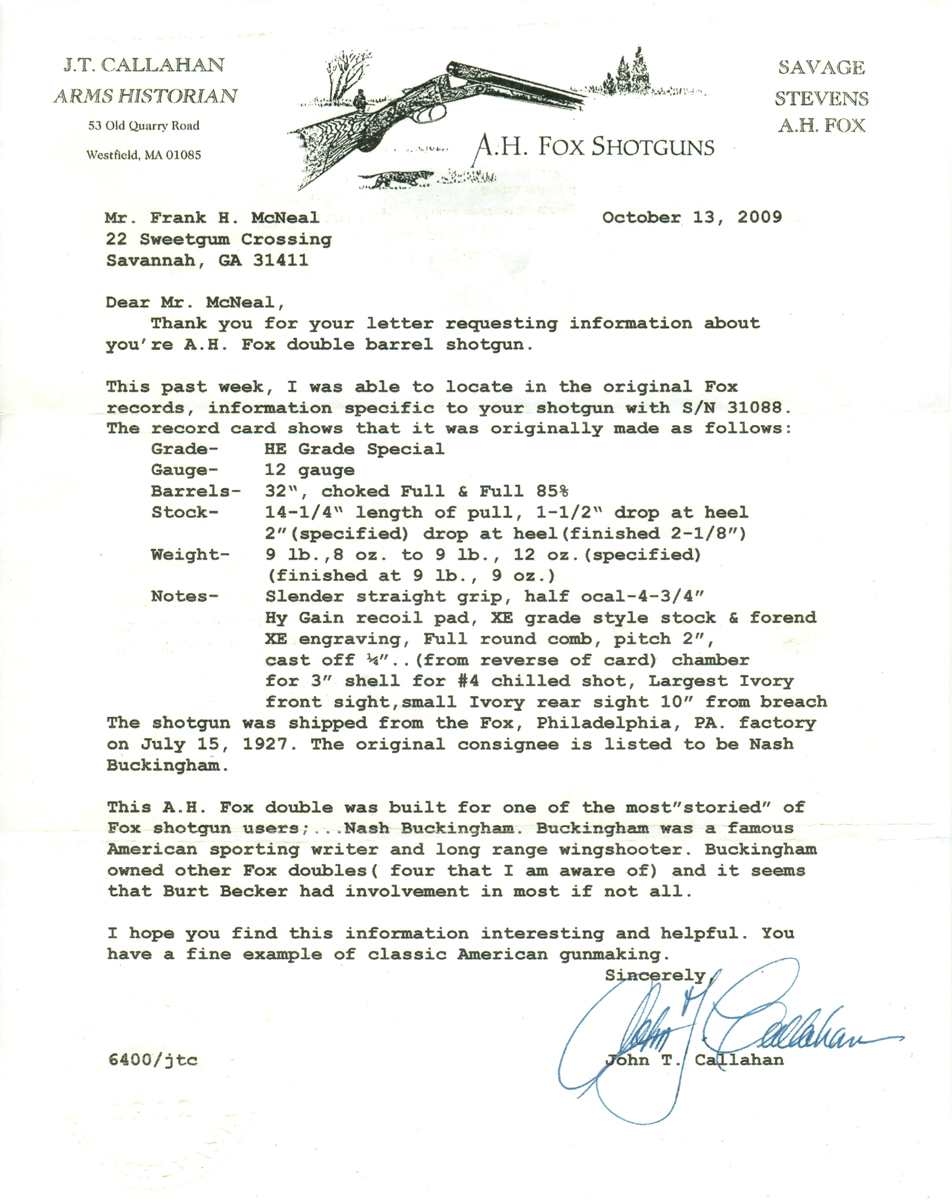
This letter from Savage Arm’s historian John T. Callahan to Frank McNeal (representing the consignor’s family), verifies the original Fox work card for the Julia gun, Super Fox #31088. Original consignee listed as Nash Buckingham.
The most substantial argument for its validity resides in a letter dated October 13, 2009, from John T. Callahan, Arms Historian for Savage Arms, in response to inquiry by one Frank H. McNeal of Savannah, Georgia. The key portions of that letter are as follows:
“Dear Mr. McNeal,
“Thank you for your letter requesting information about you’re [sic] A.H. Fox double barrel shotgun.
“This past week, I was able to locate in the original Fox records, information specific to your shotgun with S/N 31088. The record card shows that it was originally made as follows:
“HE Special, 12 gauge, 32”, choked Full & Full 85%, slender straight grip, XE grade style stock & foreend, XE engraving, chamber for 3” shell for #4 chilled shot.
“The shotgun was shipped from the Fox, Philadelphia, PA. factory on July, 15, 1927. The original consignee is listed to be Nash Buckingham.”
According to the consignor’s notarized affidavit, the gun was purchased by his grandfather in the late 1950s or early 1960s, for $50.
Relying on these testimonials and the related, comprehensive research it would normally undertake to establish the legitimacy of a famous firearm, it is certain that Julia next addressed the question of the consignor’s legal right to sell. In an article in the Summer 2010 Volume of The Double Gun & Single Shot Journal, authors J.E. Fender and David Trevallion present an argument which likely underlies a portion of the rationale for the eventual substantiation: “Accepting the notarized affidavit of the consignor at face value, the consignor’s grandfather is what Anglo-American common law deems a bona fide purchaser in that the grandfather in good faith paid valuable consideration for property without notice of prior claims. As a successor to the original bona fide purchaser the consignor can pass clear title to another.”
Further . . . in another letter to John Bailey . . . Julia discovered, Nash indicated that he had insurance on the big gun. From that, it was assumed, though not substantiated, that Buckingham received a cash settlement for Bo Whoop’s loss – thereby negating further claim by his heirs.
Upon these corner stones, Bo Whoop became the marquee offering at Julia’s spring auction of distinguished firearms, in March 2010. It was purchased by Mr. Harold (Hal) B. Howard – the son of Buckingham’s closest friend and hunting companion – for donation to the Ducks Unlimited Museum in Memphis. The hammer price plus buyer’s premium came to $201,250, rendering it the third most expensive American shotgun in market history.
Thus it can be argued that the recovery of Bo Whoop – though not the mystery – has been resolved. However – even assuming that #31088 is actual and not a clever facsimile – there still persist within the undying mystique specific and disturbing variances which impel serious and long-time followers of Buckingham and the big Fox to say again, “Is this gun, indeed, the shotgun Sheldon, Buckingham and Becker made legendary?”
That the Fox work order attested by Mr. Callahan, for a Super Fox #31088 – designating Nash Buckingham as the original consignee – exists and descriptively approximates the gun presented by the consignor, can be reasonably accepted. Nash, and Capt. “Ad” Roll, Fox’s sales manager, were good friends. But did Nash “order” the gun as implied? It may be as likely that Fox, recognizing the value to be gained from Buckingham’s already established celebrity with the big guns, commissioned the gun for presentation – as it did even more openly and famously with Theodore Roosevelt.
The timing of the work order is interesting: 1927. This was six years after John Olin first sent Nash his own 3-inch Becker magnum and the first of his Super-X shells to try, and just as the Buckingham/Becker magnum fame was beginning to soar. Why would a man of Buckingham’s shooting passion, fame and influence within the shooting world of the day wait six years to “order” a Becker magnum of his own?
In answer, there is substantial indication that he did not. In “Mr. Buck” The Autobiography of Nash Buckingham, the editors – using original materials furnished by Buckingham’s granddaughter, Irma Buckingham O’Fallon – state, that after shooting Olin’s gun and magnum Super-X shells, “Nash liked the combination so much, he had one built for himself by the famous barrel-borer and gun-maker Burt Becker in 1921 or early 1922.” Which seems far more logical.
Further corroborating this is Nash’s own assertion in “Firsts and Lasts for Everything”: “After writing my report on the [Olin] test shells and the overbored Fox, I lost no time in acquiring a 10-pound Fox magnum of my own.”
Interesting, also, that the work order for #31088 includes absolutely no mention of Burt Becker. And that the choke specifications indicated Full & Full 85 percent. What of Col. Sheldon’s affirmation of Bo Whoop’s 90-percent bores? And if Nash “ordered” the gun through Fox, would not the request for Becker have been the most explicit item on the card?
Nor does the #31088 work order make any mention of the very unique, ivory forend tip that adorned the original Bo Whoop, clearly visible in the jacket cover photo of Nash and the big gun in Hallowed Years. Not evident in this photo, however, or in two of the last photos of Nash and the big gun before it was lost, is the Hy Gun recoil pad detailed on the 31088 order card. Rather, in the latter two, the big gun was fitted with a lace-on, leather pad.
When consigned to Julia, #31088 had been restocked . . . in similarity to the broken buttstock, also present . . . apparently damaged when the gun fell off the fender well of Clifford Green’s car, or later, at the hands of someone unknown. Fender and Trevallion speculate that this broken stock is not, in fact, the original for 31088, but a replacement that Buckingham had effected himself before the big gun was lost.
If so, the aspect is intriguing, because Nash chose to fit the replacement stock with a traditional checkered wood buttplate rather than a recoil pad. In keeping with his tastes, and that of the real and original Bo Whoop? – which would have made rational the lace-on pad? An equitable question.
The forearm accompanying #31088, however, was judged to be original, and was not replaced when the gun was restocked. Also, and of greater relevance, the ivory forend tip is reported to have been intact at the time of restocking . . . while a photo of Buckingham and Bo Whoop not long before the gun was lost clearly shows it to be missing, in probability through hard usage. A fascinating dissention.
Even more opposing and troubling are Nash’s own attestations. In his aforementioned letter to John Bailey, dated the day after Bo Whoop was lost, Nash wrote that his name was on the left barrel of the gun. Yet on 31088, the gun consigned to Julia, his name appears on the right barrel.
Equally conflicting is the serial number discrepancy. In other correspondence to Edgar Caldwell, dated October 10, 1959 – eleven years after the gun’s loss – Buckingham writes that “Capt. Roll . . . had a HE made for me with special Becker boring, 1927, (#)31108.” Was Nash thinking, instead, of the actual Bo Whoop?
Would a man of Buckingham’s cognizance, detail and intelligence – so vibrantly and clearly demonstrated in his writings – misrepresent in two such critical instances, specifics of a gun he had so loved and shot for 20-some years? Would you?
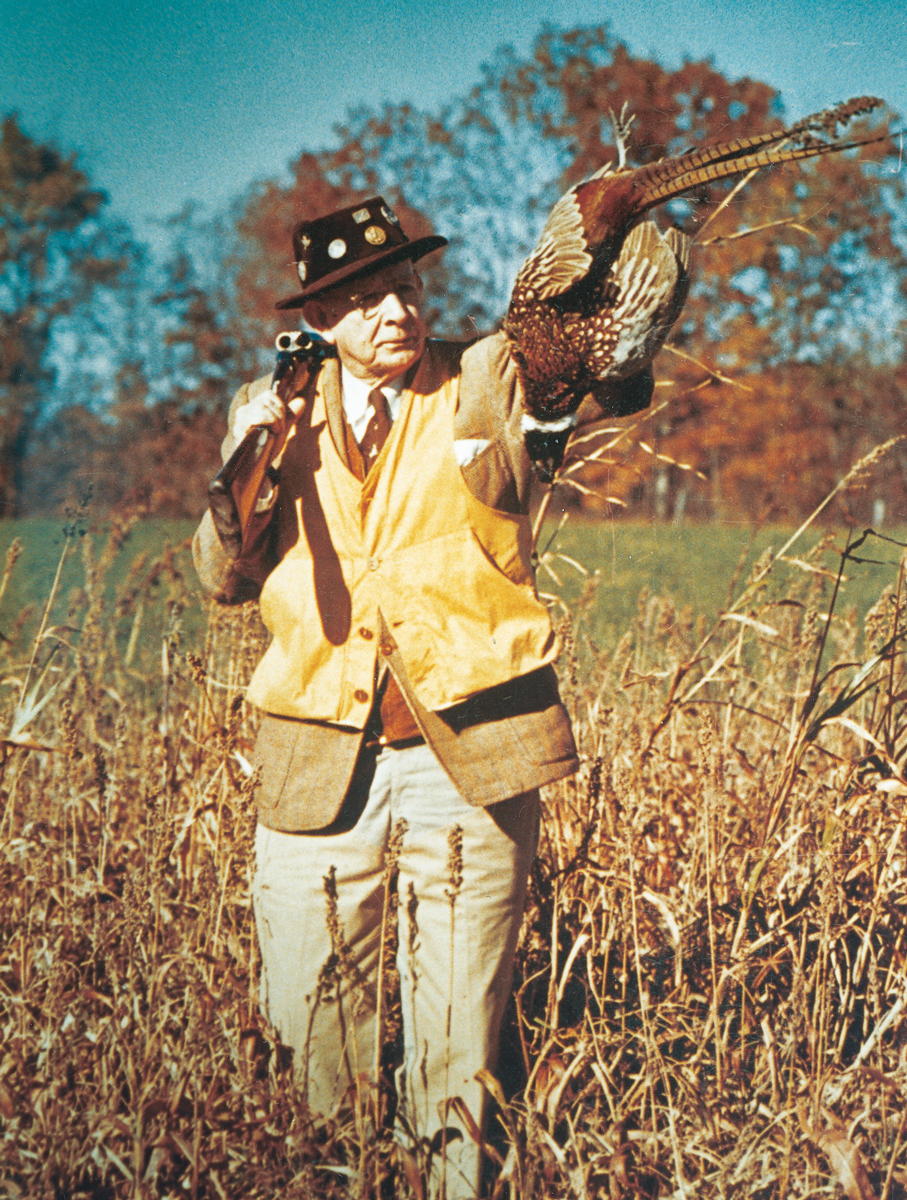
Nash Buckingham in his 80s, from a pheasant shoot at Nilo Farms, Olin Winchester’s historic shooting preserve near Brighton, Illinois. Likely February, 1963, when Nash was presented the 1962 Winchester “Outdoorsman of the Year” Award.
Then, also, arises another Buckingham observation during his history with Bo Whoop, which casts further, argumentative dispersion. In an article, “Long Range Duck Shooting,” he states: “In 1926 [not 1927] my first magnum twelve-bore was replaced by one built and bored for big shot by the famous Philadelphia gunsmith Burt Becker.” There is no mention of Capt. Ad Roll.
Berry Brooks, another old-time Buckingham gunning companion, in response to George Bird Evans’ query, wrote in 1972: “Nash told me that Becker handmade the entire gun and bored the barrels.”
Other aspersions exist in the postscripts surrounding the big Becker gun. In The Best of Nash Buckingham, George Bird Evans references a period photo of Nash, Chubby and the Becker magnum: “Instead of the typical streamlined Fox breech lever faired into the top of the action, this one had a distinctly un-Fox look about it like the lever on a water faucet . . . and there is the characteristic worn area on the barrel blueing near the action, bespeaking a gun well used.”
Contrarily, in close-up photos of Fox #31088 – consigned to Julia’s – the top lever appears sleek and Fox-typical. In these same photos, the barrels appear to exhibit a vintage patina, but not the wear pattern of hard shooting usage near the breech that would be extremely difficult to authentically fabricate.
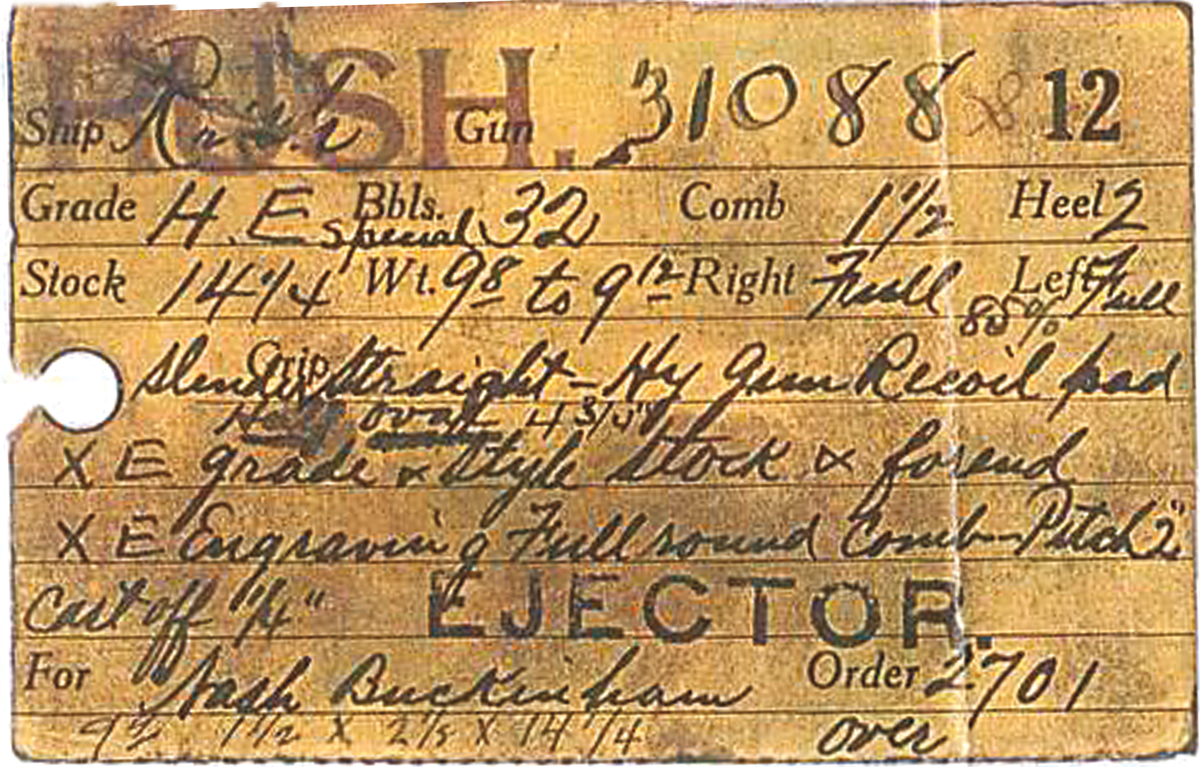
Original Fox work tag for Super Fox #31088, marked RUSH. The gun was shipped in July, 1927.
Also, in The Best of Nash Buckingham, Evans documents another undated, yellowed photograph showing a “Heavy Parker 12, Super Fox 12, Over and Under .410 Merkel.” This gun had the conventional breech lever and a splinter forend. Evans notes that this was not Nash’s first Becker magnum. But was it 31088?
Additionally, in 1950, when Brooks and George Warner tracked down Becker and convinced him to make a replacement for Bo Whoop, to be gifted to Nash – by Becker’s assertion, “the last gun he would ever make” – Brooks, again to Evans, noted key differences between the first big Becker and the second: “the Becker #2 was, through a misunderstanding of Becker’s, made with a pistol grip – contrary to Nash’s taste in stocks. Unlike Becker #1 (Bo Whoop), this Becker was richly ornamented on the action and the barrels had deeply carved engraving for about 2 ¾” forward from the breech.” Brooks, it is important to note, was shooting with Nash at Section 16 the day Bo Whoop was lost.
Lastly, Michael McIntosh, in his book A.H. Fox, states that the vast majority of the early Super Foxes were made up on plain Fox actions with line engraving almost identical to the first generation Fox A Grade, only one of his knowledge ever engraved with barrel wedges. Super Fox #31088, auctioned by James Julia, has full XE type engraving on the action, no adornment at the barrel breeches.
It has been said that Nash was forgetful. Were Brooks and Evans forgetful too?
Bringing these several and important variances to bear does not – nor is intended to – discredit the existence of Super Fox 31088, nor the authenticity of the work order which is deemed to have created it, or that a Super Fox was likely shipped to Nash, or that very probably he shot it.
However, taken together, these inconsistencies constitute a sufficient provenance of discord to suggest very strongly that Nash had access to other Becker Foxes and very likely had two others of his own built by Becker before 1927, and that the matching of Fox #31088 to the factory work order does not of itself and with all certainty declare it to be the gun that fell off the fender of Clifford Green’s car that momentous day in December of 1948. Rather, it can be as diligently speculated that it could have been one of the former two . . . in actuality, Bo Whoop.
Accordingly, it might be reasonably hypothesized, that on the actual Bo Whoop Buckingham’s name did appear, in fact, on the left barrel, and that the serial number it bore was #31108.
(Here, it must be pointed out that another surviving Fox order shows #31108 to have been an A Grade, 12 gauge, with 30-inch barrels, shipped to a Philadelphia hardware store in 1926) – the same year, coincidentally, that Nash said Becker built and bored his second big magnum.
McIntosh, again in A.H. Fox, points out that there were a few occasions when the same serial number was stamped on two guns, and maybe as importantly that he was never able to validate Burt Becker on any of the Fox employee scrolls. Bringing to supposition that the work Becker did for Fox was by contract.
We do know, however, that during the twenties, Becker – who died around 1960 –maintained an independent gunshop in Philadelphia. If, again, as Nash attested, Becker built a second “Big ‘Un” (as Buckingham dubbed the big magnums) for him in 1926, is it not also conceivable – given the timing, and whatever his obvious ties to the Fox Company – that he could have been instrumental in stamping #31108 on the particulars of Bo Whoop?
Be it known that none of this is meant or declared adequate to bring to disrepute the work done by the House of James Julia in authenticating to its reasonable satisfaction the auction of Super Fox #31088 as Bo Whoop. It is, however, factual to note that there cannot be ignored and will likely remain forever a contrary body of testament – presenting grounds for opposing speculation – that to some loyal and ardent fans of Nash Buckingham and the big Becker, cloud the absolute conviction of its recovery.
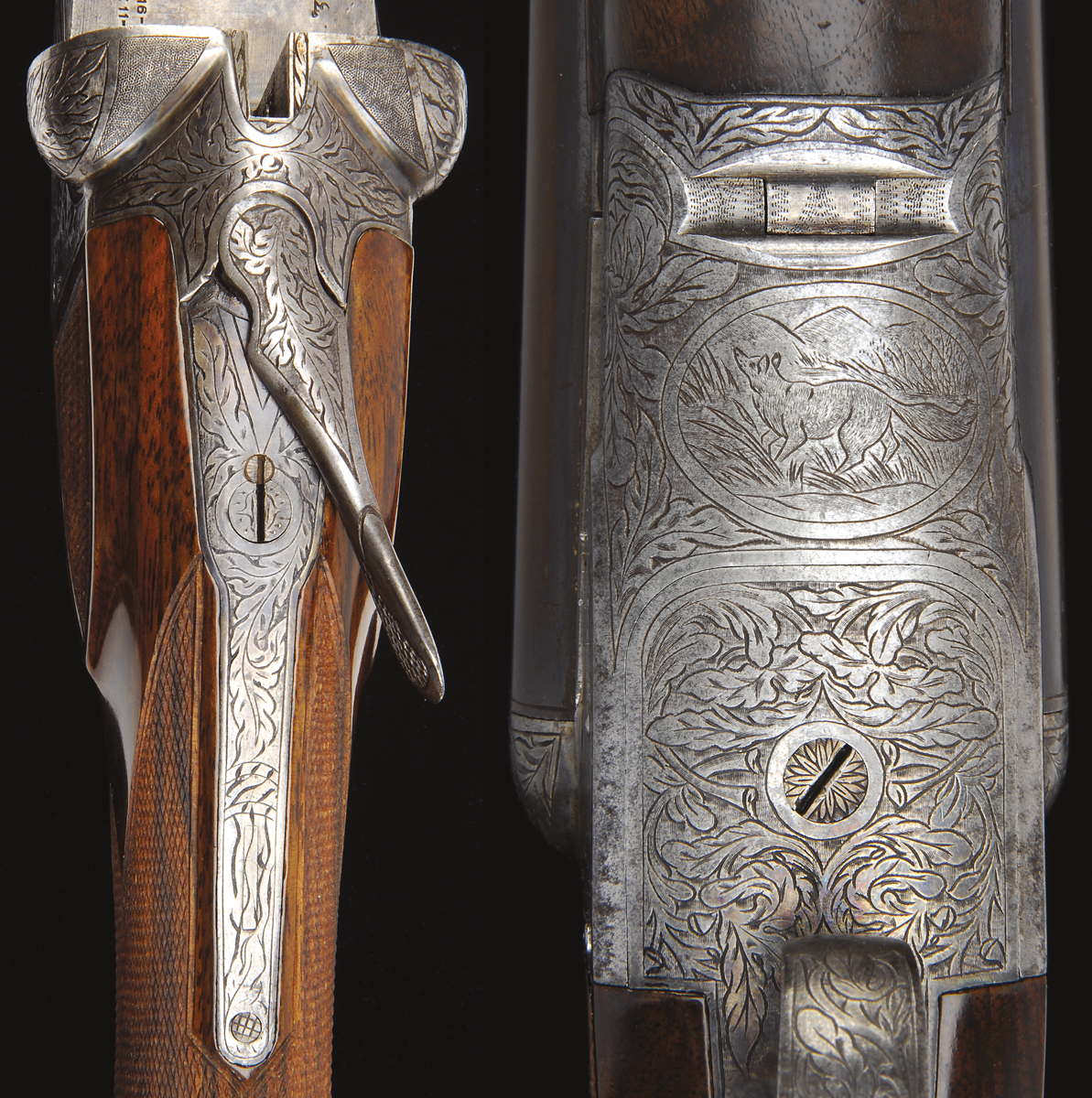
Super Fox #31088 receiver, top view, absent the customary Fox safety. Buckingham believed a “Safe” gun was not loaded until ready to fire. The bottom of Fox #31088 receiver showing profuse, full coverage “XE” type, leafy engraving, with signature “XE” fox in oval beneath the hinge. Nash’s close friend, Berry Brooks, who was shooting with him at Section 16 the day Bo Whoop was lost, reported the big gun to have been absent of such extensive ornamentation.
In final – and beyond the legal, factual and speculative aspects of conveyance and identity – there remain within the chasm of dissolution surrounding the 61-year disappearance of Bo Whoop, perhaps the most troubling perplexities of all: the moral issues, which are huge.
In that period, it is almost certain if the gun truly survives, that it has passed through a number of different hands to get from Arkansas to Savannah, or wherever. Each person involved must surely have recognized its intrinsic value, and more, the uniqueness of a double personal inscription. Which seemingly, in a man of even the most modest curiosity, would have piqued considerable fascination.
How and why is it, apparently, that no one in the chain has undertaken in that time a sufficient effort to ascertain the identity and character of one Nash Buckingham? It would have seemed an easy task. Even with the absence of an internet.
At the time of the gun’s loss, Buckingham was a fixture to both black and white in the Roe/Clarendon area. His family was prominent in Memphis, he already had regional notoriety and fame as a sportsman of exceptional bearing, and had burgeoning national recognition and following as an sporting scribe of considerable appeal. In the early ’60s, when #31088 was reportedly acquired by the consignor’s grandfather, Nash Buckingham was still writing, the most famous outdoor writer in America. His books were in resurgence, and during the era he was a subject of national media attention for his induction in The Field Trial Hall of Fame and as Winchester’s Outdoorsman of the Year.
Even a casual inquiry to Field & Stream for instance, The American Field, a prominent sporting goods or hardware store, or even a dedicated local sportsman, bookstore or library, would have undoubtedly returned a quick and revealing response.
It will be recognized that Bo Whoop was not stolen, but “found.” However, if, and at the moment any person in the chain of loss became aware of Buckingham’s identity, and thereby, the accruing worth of the gun – and it is hard to accept that it has eventuated otherwise – and failed to return it to its rightful owner, in this author’s mind, it became an affair of deeply darker proportions. And should have been absent of gain.
Super Fox #31088 was restocked in 2005 by Jim Kelly of Darlington Gun Works in S.C, presented out of the blue by the father of the consignor for the work. It was at that time that Kelly, realizing what very possibly he had, told the consignor’s father of Nash Buckingham and the historical significance of the Becker gun. Purportedly, the man showed little interest in the historical aspects, just the restocking. Kelly completed the work, replicating from letter and lore as best he could the furniture particulars of Bo Whoop.
Afterwards, the gun apparently went back to “closet,” as reportedly it had previously been kept by the consignor’s family for almost 50 years. It is greatly intriguing as to why, in three generations of a family that had no evident interest in hunting or collection, the father of the consignor suddenly chose in 2005 to have the gun restocked. And perhaps the more, for a gun so universally sought, how it continued undisclosed to the general public eye until late in 2009.
Riddles among riddles.
Equally absorbing is the coincidence, that on the Fox Collector’s website forum in 2010, it was reliably reported that in early 2005, Dr. William “Chubby” Andrews – whom Nash viewed as “the son that I never had” – received a telephone call from someone claiming to have bought Bo Whoop for $1000 at an Illinois pawn shop. Aware that Andrews had bought Buckingham’s Becker #2, the person unnamed then inquired of how much the original would be worth? Andrews called back afterward, with possible thoughts of buying the gun himself, but was informed that it had been sold to a coal mine magnate who wished to continue anonymous.
Nash Buckingham lived, alert and aware, until near his death in 1971. It is tragic, and possibly worse, that in the eleven years beyond 1960 that he survived, Super Fox #31088 could not be returned to its rightful owner … or even afterward, to his heirs. Not only would it have been a proper and glorious reunion, but the gun could have been validated, or not – once and for all – by the only man who could incontrovertibly do it.
Instead, the esoteric saga of the Becker, Super Fox known as Bo Whoop, lives vividly on.
Wherever lies the incontestable truth, too many years are past, too many people are gone. The aura of Bo Whoop will almost surely remain undiminished and incompletely resolved. In fact, legend and mystique . . . the greatest, most enduring enigma in the chronicles of American sporting arms.
Note: This article originally appeared in the 2012 Autumn issue of Sporting Classics magazine.