
I sat in the pre-dawn darkness in the soft glow of the instrument panel of Roy’s 1947 Plymouth coupe, heading out on my very first buck hunt. A 12-year-old boy yearning to be a buck hunter never forgets moments like that. As the old Plymouth began its first climb up into California’s Coast Range Mountains, my stomach churned with doubts about whether I was really up to the challenge. The adult men sitting on both sides of me were old hands at the game of hunting antlers.
Neither man was my dad. My folks were already divorced.
I guess family friends decided it was time for me to make a real hunt, so Roy and Jerry stepped up to fill in. I couldn’t join the conversation when they talked of how smart curly antlered blacktail were and how they’d both been outfoxed on memorable hunts over the years and, as their conversation continued,
I almost wished I’d stayed home. How could I ever get close enough to get a shot at deer that smart?
The old Plymouth wheezed its way slowly higher up the mountains, struggling at the steepening grade. Roy shifted down into second gear while mentioning the heat gauge was beginning to inch higher. Headlights showed we’d left the flat land of wild oats and oaks that were now replaced by the first scattered pines.
“I wanted to hunt where I did last year but, if the engine gets too hot, we might have to start a little lower,” Roy cautioned as the engine labored around one climbing turn after another.
Five minutes later, he pulled the steaming hot Plymouth to a stop.
“Well, this is it,” said Roy. “We’ll have to try our luck here. The engine is as hot as a two-dollar pistol. I don’t want to blow the radiator or crack the block.”
The black of night was just beginning to fade to dawn when we got out and Roy snapped on a flashlight. We slipped into jackets and hats. Roy had promised to borrow a rifle for me. I had a single-shot Remington 22-caliber rifle I hunted jackrabbits and ground squirrels with, but it was inadequate and illegal for buck hunting. I wondered what he’d gotten for me. He called me over to the trunk and opened it up. “Here’s your buck gun, Art.” He reached in, unwrapped the blanket covering the rifle, and handed it to me.
The old cannon was a silver-worn, heavy, steel, 38-40 Winchester lever gun. Obviously, the big gun had seen many years of use. I wondered if it would set me back on the seat of my pants if I actually had an opportunity to shoot it.
“Here’s a box of 180 grain bullets,” Roy said, digging them out of the trunk. “You put these iron sights right behind the shoulder of a buck, and you’ll have venison on the ground for sure!”
Roy got out his 30-30 lever gun, Jerry pulled up his fancy 30-06 bolt rifle, then Roy laid out his plans for our hunt. “Art, me and Jerry are going to climb a little higher and make a big circle back here to the car. Probably going to take us an hour or so. We might run a buck down to you, or you could jump one up on your own. Just be ready and keep your eyes open. You can make a smaller circle right here so you don’t get too far away from the car. You ready for this?”
“Sure, I’m ready,” I answered trying to sound convincing, but the thought of hunting alone did scare and trouble me. I wasn’t really ready for that on my very first hunt.
I made my smaller circle, stopping often and looking around through brush and timber, with the spooky feeling that eyes were on me every step of the way. When I got back to the Plymouth, I was relieved I’d made it back alive. I wish I could have said I caught a big buck flat footed and put a 180-grain slug right behind the shoulder, but I did not. Roy and Jerry didn’t get a shot either, and that helped ease the embarrassment of coming up empty.
I’d hate to have to admit how long ago that first hunt took place but, between then and now, I’ve lost count of the number of times I’ve hunted the little deer in the thick cover they love so much. Surely, the number of times would have to go into the hundreds.
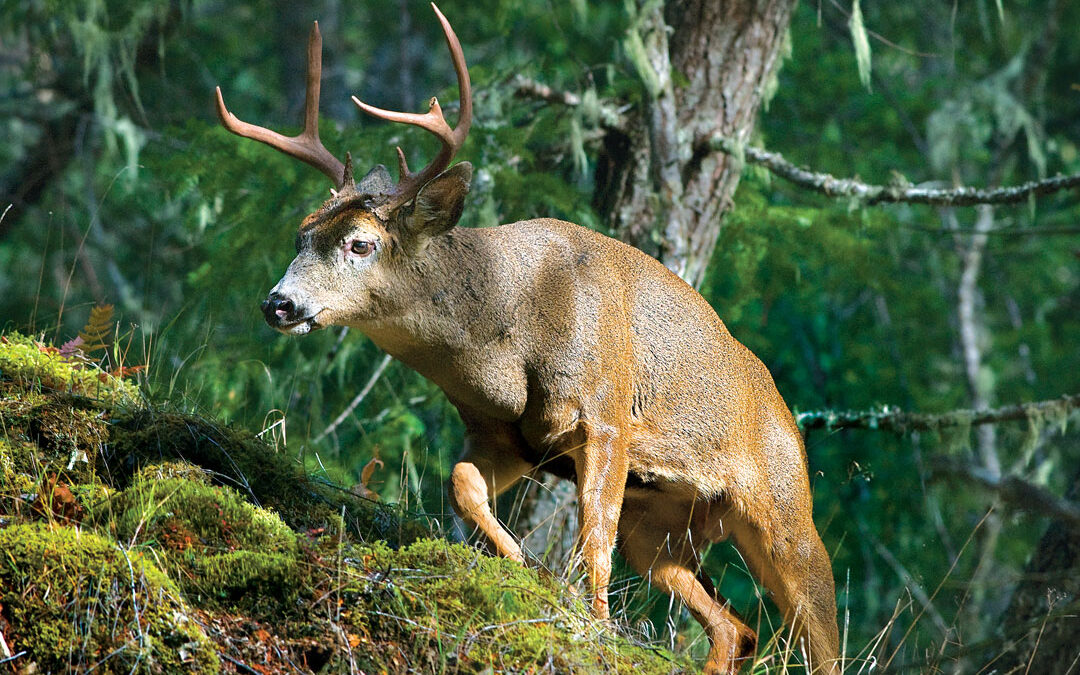
Every buck hunter grows up hunting deer in his or her particular part of the country, and their bucks are always the smartest and toughest to wrap a tag on. Eastern and central state riflemen tout their whitetails as wisest of all. From the Dakotas to the Sierra Nevadas, mule deer are king. For us farther west, it’s the blacktail, that kissing cousin to mule deer, that rules the roost. But all resemblance ends right there, for blacktails are deer of intense cover—the thicker the better—the exact opposite of the big mule deer. And like big-game animals any place on the globe that must be hunted in thick cover, it’s an entirely different game whether it’s Cape buffalo or West Coast blacktails.
By my teenage years, I’d graduated up to my own car, a nifty 1931 Chevy coupe with spoke wheels. Now I could expand my blacktail hunting world tenfold into new areas. My “deer gun” at that time became a slender, quick shooting, Savage Model 99 chambered in 250 Savage stoked with fast-stepping 100-grain bullets. I toted the Savage through twisted digger pines and manzanita jungles that grew as high as a house. The tactic was always the same—hunting only as far ahead as you could see. If I got a shot at all, it was just a blurred flash of buckskin, gone for good if you missed.
Teenagers, especially boys, are competitive. Every one of us kept track of what others their age were doing, especially when it came to buck hunting. None of us wanted to suffer coming to the end of deer season without filling our tags. If you found yourself among the unlucky ones still holding tags and were questioned about it in front of friends, the only answer you could come up with to save face was to answer the question with a question of your own. One I especially liked was, “You got your limit of doves yet?”
Blacktail bucks are so smart and sure of themselves that, when I invaded their domain of cover, instead of breaking out and running for it, they’d stay right there tiptoeing around me so close I could hear them moving. They had nerves of steel and the cojones to back it up. No whitetail or mule deer ever showed me that kind of nerve.
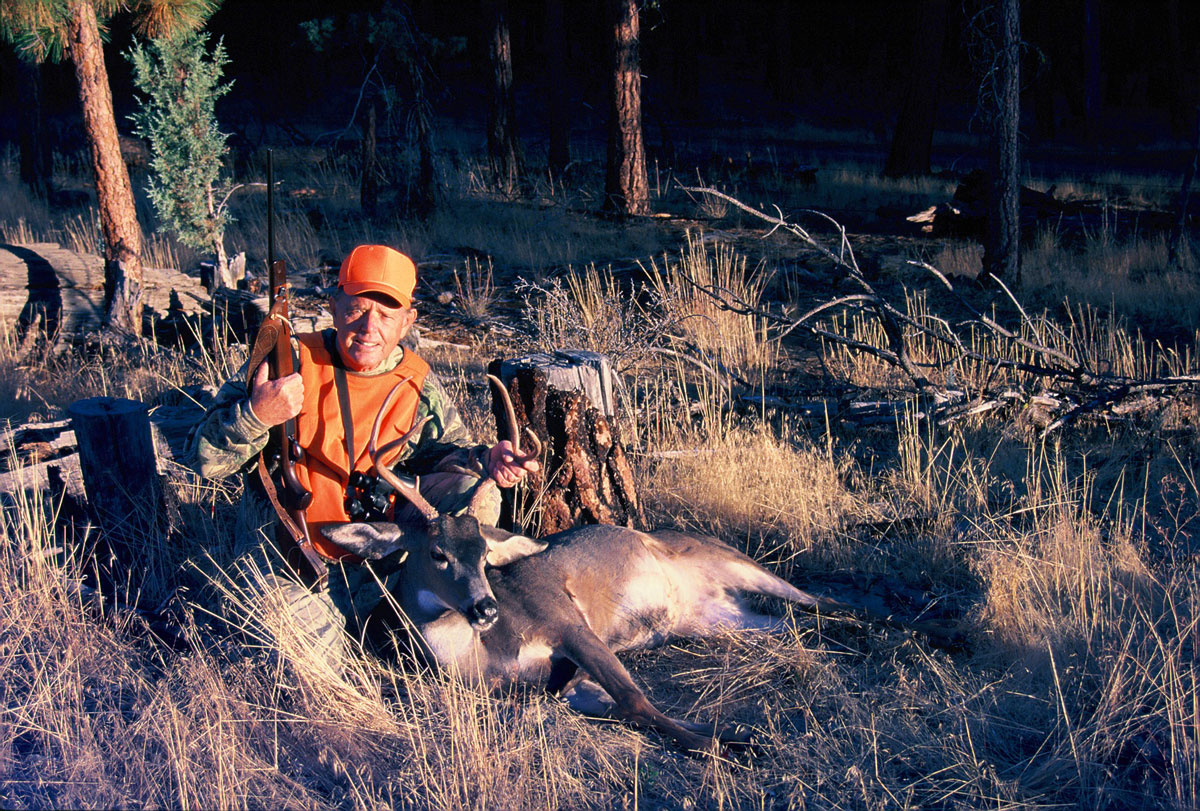
The author with a nice coastal blacktail he took using a trail ambush as the deer finished feeding and headed back into cover for the day.
I’ll never forget the largest blacktail buck I ever tangled wits with. This great deer lived in a steep canyon thick with pines, manzanitas and willow brush. If hunters came at him from below, he’d simply climb higher while staying in cover and then top out into another canyon without ever being seen. If you came down on him from the top, he’d slip down steep gullies out of sight and circle back up above the hunters moving down on him. I got one quick look at him one weekend while hunting above Cach Creek. He had antlers the likes of which I’d never seen on any other blacktail. They were palmated like moose—flat paddles with points growing out of them— and I made a vow to take him.
The following weekend, instead of going at him by hunting parallel into his hideout, I decided to come in over the top rim of his canyon and work straight down where I had a fairly good view, even into thick cover. If he made a break for it, I thought I had a better chance to see him go.
At the first grey of dawn, I parked the ’31 Chevy and began a stiff climb heading for his canyon. After a quick hike, I approached the rim and suddenly heard a wild fusillade of shots coming from the canyon. I couldn’t believe anyone was in that country, at that time, or knew of the buck’s home. Starting for the drop-off at a run, I was stunned to see the buck making a leap as he came over the top. Just as quickly, I threw the Savage to my shoulder and took a snap shot that missed. The deer landed swapping ends and ran back over the rim down the canyon. From below, more wild shooting started again. When I reached the edge, I saw below three tiny figures of hunters working back and forth through the thick brush. There was a short silence, and then the sound of a single shot. I knew “my” buck had just met his end, but not by me.
An hour later, I drove down the canyon to see two pickup trucks parked in a draw. Getting out, I walked the short distance to the three men standing together. That great buck with his unusual antlers was hanging from a tree limb with a rope around his neck. I couldn’t help but think what a sad ending for such a magnificent animal. Even worse was the realization that I was the one who sent him back down the canyon to his death.
“We got a bullet in him when he ran back down after you shot,” one of the men said. “We found him hiding flat on his belly on the ground in tall brush. I put in the finishing shot. I’ve never seen a blacktail with antlers like this. Have you?”
“No,” I answered, “and I don’t expect I ever will.” I turned away sad and mad at myself for the way things turned out, feeling uncomfortable with how it all ended. That great buck deserved more respect than hanging from a tree with a rope around his neck. In the years since that fateful day, I’ve never seen or taken any blacktail buck that comes close to that fantastic deer with the palmated antlers. I still believe I never will.
As seasons came and went, a sudden awakening began to overtake me, and I’ve since learned that many other lifelong hunters experience this transformation, too. Plainly put, a deep and heartfelt respect for the deer and their survival began to grow in my thinking. I’ve lived with blacktails from the time I was in the first grade all the way to retirement. It’s been an epic journey. The “little mule deer,” as some have called him, holds on to high population numbers over decades throughout his vast range, while some other big game have lost significant ground. Why? I think it’s their cover-loving lifestyle.
When you hunt blacktails, you must go into their domain of thick manzanita jungles, twisted pines and high-walled buck brush. You’ll hear deer moving around you that you’ll never see because of their life and death game of hide and seek. Every hunt becomes a memorable experience, win or lose. Add to that the fact that blacktail season, for many hunters, opens in the hottest months of summer—the exact opposite of most other big game seasons—and you’ll have your hands full. These great big game animals have made the phrase “buck hunting” a reality for many hunters, year after year, from the Mexican border all the way north to Alaska. Even today, all these hunting years of mine later, I cannot imagine an opening day of deer season without them. I have to tip my hat to them. Salute!