
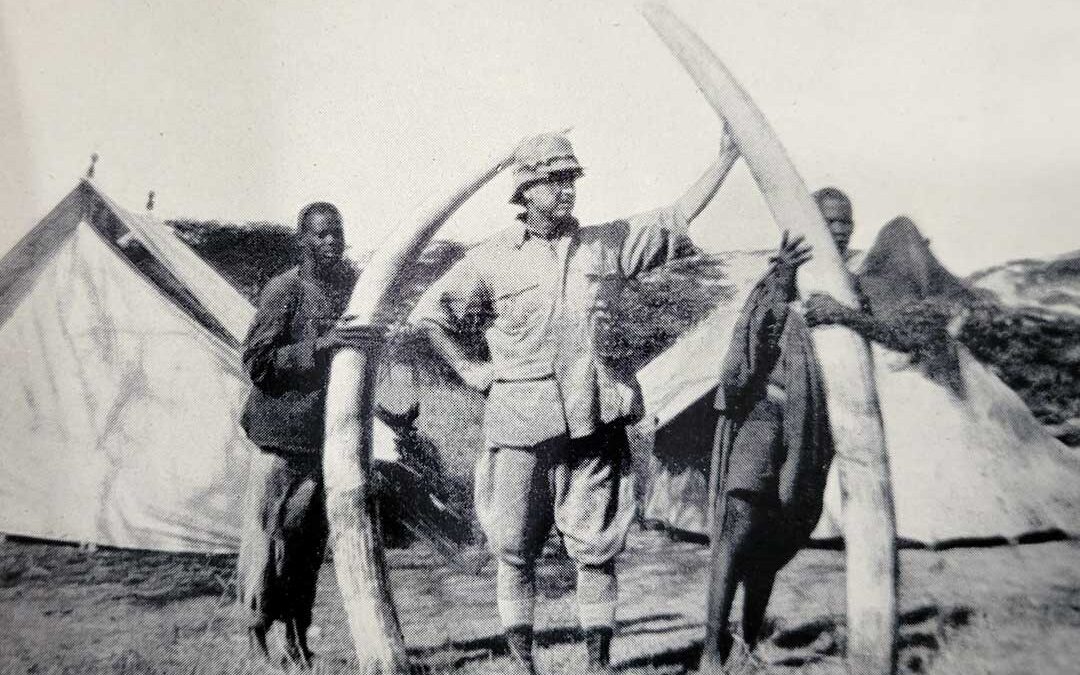
(The following selection is from Marcus Daly’s classic book, Big Game Hunting and Adventure 1897-1936 published in 1937 by Macmillan and Co. Ltd. In London.)
Leaving the steamer and friends I had made, I fitted out my safari again and plunged into that great country between the Congo and Ubangi rivers, which I consider the greatest elephant country in this part of Africa, very wild with many semi-civilized tribes of the worst kind. Many of them are murderers and cannibals and robbers; all the worst type of African natives seemed to have settled in this great country, in large villages here and there, under some blackmailing headman. They, however, got little from me.
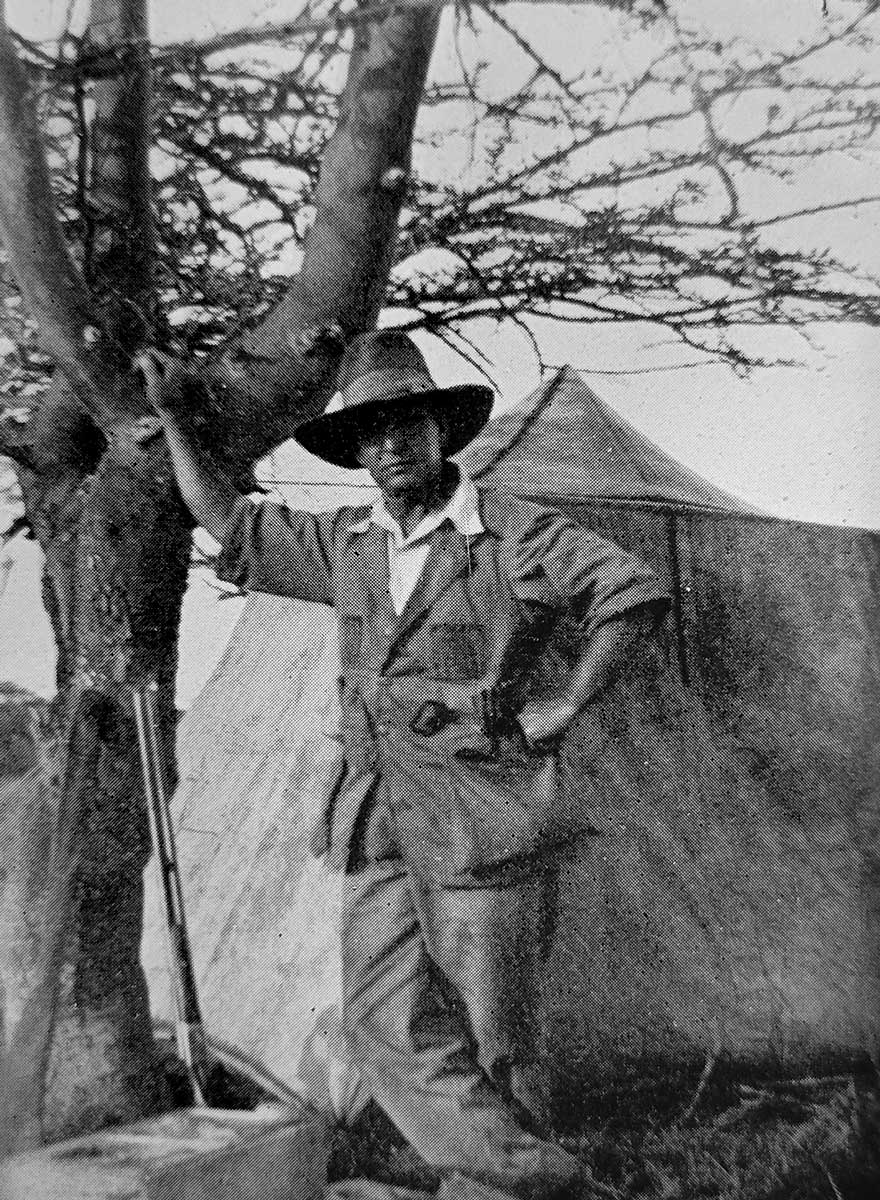
The author on Safari, Northern Territory.
Here again, the main object in investigating this hunting-field was principally on account of my American friends, not anticipating that they would fail me. However, if they had lost their money, what else could they do?
Keeping my direction so as to come out on the Ubangi River somewhere above Bangi, we continued, day after day, sometimes striking it lucky with plenty of wild fruit and honey and sometimes otherwise.
One day about a dozen armed and dressed natives stood across my line of march and said they had orders from their chief some ten miles away to take us to him. I told them to get to blazes out of here; did they think I was a Shenzi native like themselves? “Go!” I ordered. They, with looks of astonishment on their faces, moved aside and we passed and saw no more of them.
After several days more marching, we arrived on the bank of the Ubangi River some 50 miles above Bangi town, just where I had hoped to go, as I did not have a native with me who knew the country. There, I fitted myself and boys with two good dug-outs for our up-river journey. After a few days’ rest near a pretty village of very friendly natives, our river safari started.
We journeyed to the east, finally selecting a field near the headwaters of the great Ubangi River, known as the Boma in the upper reaches, I built a camp in the forest and we started hunting always on the French side, where I bagged many a fine bull and had little trouble of disposing of the ivory at a fair price.
Later in this region, a mishap befell me that came within writing finis to my adventurous career, and it happened as follows.
My tracker reported a large bull with very big ivory, which he had seen not far from the French frontier. Though it was then afternoon, I called my boys and followed the tracker. The bull had moved well inland, roaring, smashing and breaking bushes. It evidently had no fear of hunters and had perhaps met them before.
We followed on, into the long matteti reeds —a terror, as one can only move where an elephant has passed on account of the thick growth of the reeds. Even after an elephant has passed, many of the reeds shoot up again at all angles, and one is obliged to pass very carefully and noiselessly over and under these reeds, a difficult and trying task with a wakeful and dangerous bull near.
Then, to increase the danger, you may cut the figure-eight many times, so that the bulls you are following are perhaps just beside one another, divided by only a yard or two of reeds. The game is full of unexpected dangers and sudden attacks; indeed, hundreds and thousands of hunters of all colors, shades and nationalities have been killed in both French and Belgian Congo.
We continued on and the big bull now roared on my left. All my boys fell back, and I was now, as so often before, quite alone, so I moved quietly and quickly as possible forward, hoping to keep in line with the bull, rather than have him on one side or the other. I thought of the possibilities of another bull; but it was too late now, and so on I went.
A large, treble-decked blackthorn tree appeared in sight, and I knew the bull would make for that if he didn’t know of my presence, so I followed on the winding and twisting trail. Hearing a slight crack behind me, I looked and saw my stout-hearted tracker just back of me, who, pointing to the tree, whispered, “Hurry, hurry before they get scent of us here.”
The great tree shook, indicating the bull’s body was against it. I slipped in and at the tree saw two large bulls, one facing me and the other standing at right angles, head to the tree, both brain-shots, and I quickly got into action with my .416 Magnum rifle. The first bull had not hit the ground before the second one was on its way down. But then, unknown to me, I was standing right under the tusks of a third bull, which, with a roar, had me in the twinkling of an eye.
As the huge bull lifted me in his trunk to pull me onto his tusks, I loosed off a shot straight for his chest, and then away I went, up clean through the treetop. At that point, I was quite unconscious.
The trackers had seen the two bulls come down and the third throw me and also noticed that the third one had taken the shot. They also watched my body up in the tree, slowly breaking through the heavy, thorn-covered, treble roof, then paused to watch the finish as the last bull came roaring round the two dead elephants and dropped to the ground next to the tree.
When the bull fell dead beside the others, at the same moment I landed full force onto its stomach and tumbled over unconscious to settle with my head resting against its chest, just behind the front legs.
It was now late, my camp five miles away across in the Belgian Congo. My tracker, as related later, wanted to pull me away but he was alone, and the elephant kept moving its eyes, so dared not approach. By keeping away, he explained, the elephant would more likely die quietly, whereas to try and get me away might arouse him to a last effort, and if I were not already dead, it would surely kill me. So he watched on.
The elephant made a few convulsive movements, the eyes still blinking. It was getting dark, lions were about and my tracker could only return by the way he had come; he was unarmed and alone, and still had to cross the big crocodile-infested river at the end.
So he went, as he related, ran as hard as he could, and left me there for the night alone and unconscious, lying against the elephant. Next morning early, he returned with a party of my boys, and found me in exactly the same place and position, still unconscious, with both my eyes and side of my head plastered with congealed blood, while my mouth and chest were also blood-covered.
The elephant had not moved, but lions, and plenty of them, had fed on all three carcasses that night without in any way disturbing me. At the sight of me and the elephant, my bush boys wanted to run away, but my stout-hearted tracker prevented them, and using the tin of water he had brought with him, bathed my head. This revived me and though still unable to move, I soon took in my strange position.
In a faltering, weak whisper, I asked him to make a stretcher of weeds and get me back to camp. After many stops and hours, for progress was necessarily slow, we reached the river and crossed, and a few hundred yards farther in the bush, reached, my camp.
My lungs had been hurt and every part of my body, and my skull fractured, but no other bones were broken. I imagine that lying quiet all that night, scarcely breathing, helped my injured lungs. I did no more hunting for several months, and it was three months before I could walk, all this time in my little bush camp without a caller.
Disposing of my ivory at a fair price, I broke up camp, paid off all of my old Congo boys and employed a few others to take me to the next tribal settlement towards the Sudan, as I had much to do there on the French Frontier. There, I did not venture into the bush till I felt fit, and then, selecting my time and place, put down 19 elephant bulls on one hunt. All of these animals were in one herd that within perhaps three or five minutes, broke into an incredible stampede where the whole world vanished in a great red cloud of thick suffocating dust.
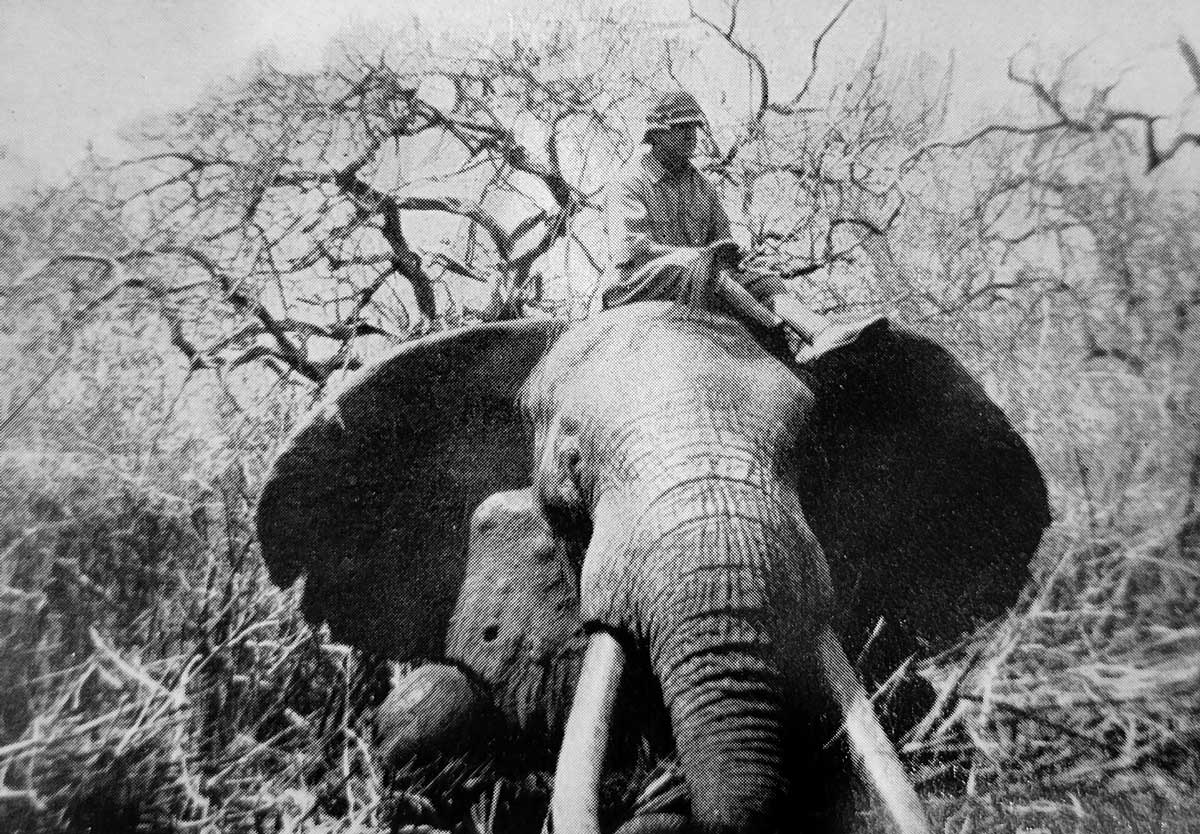
A great bull shot in the lower Wakamba country.
 This volume carries the reader through a representative collection of those who pioneered and popularized sport in Africa from 1837-1910. Chronologically, they include: William Cornwallis Harris, William Cotton Oswell, Roualeyn Gordon-Cumming, Sir Samuel White Baker, William Charles Baldwin, Charles John Andersson, John Parker (“Ubique”) Gillmore, Paul Belloni Du Chaillu, William Finaughty, Arthur Henry Neumann, Frederick Courteney Selous, Abel Chapman, Theodore Roosevelt, Nicholas Potocki, Chauncey Hugh Stigand, Sir William Northrup McMillan and Frederick Vaughan Kirby. Buy Now